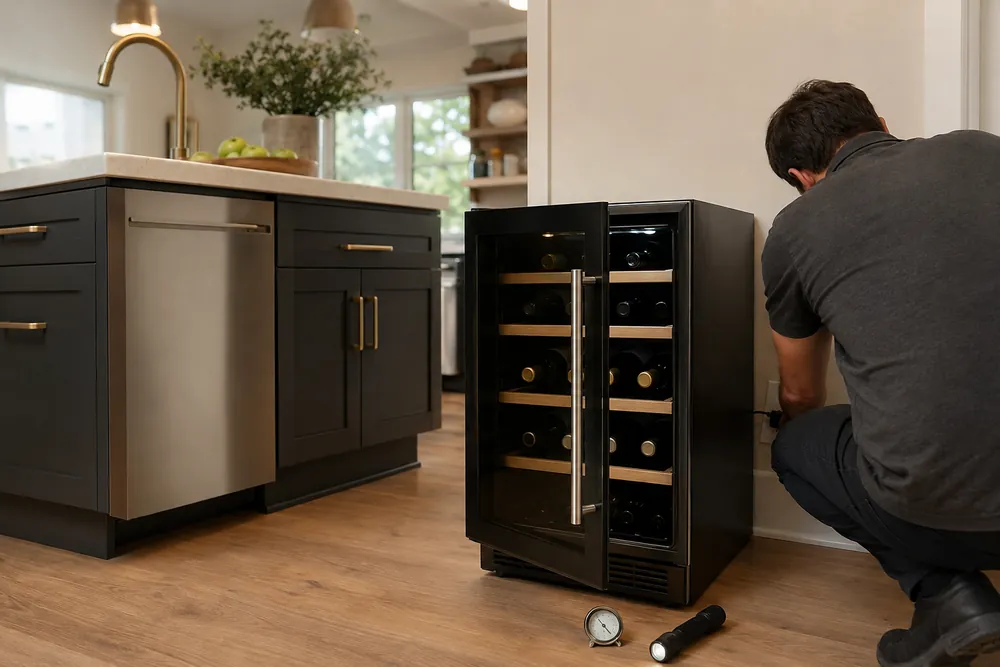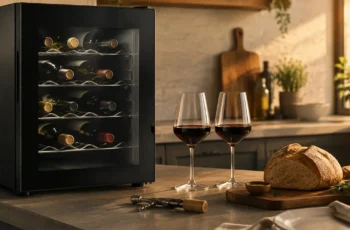
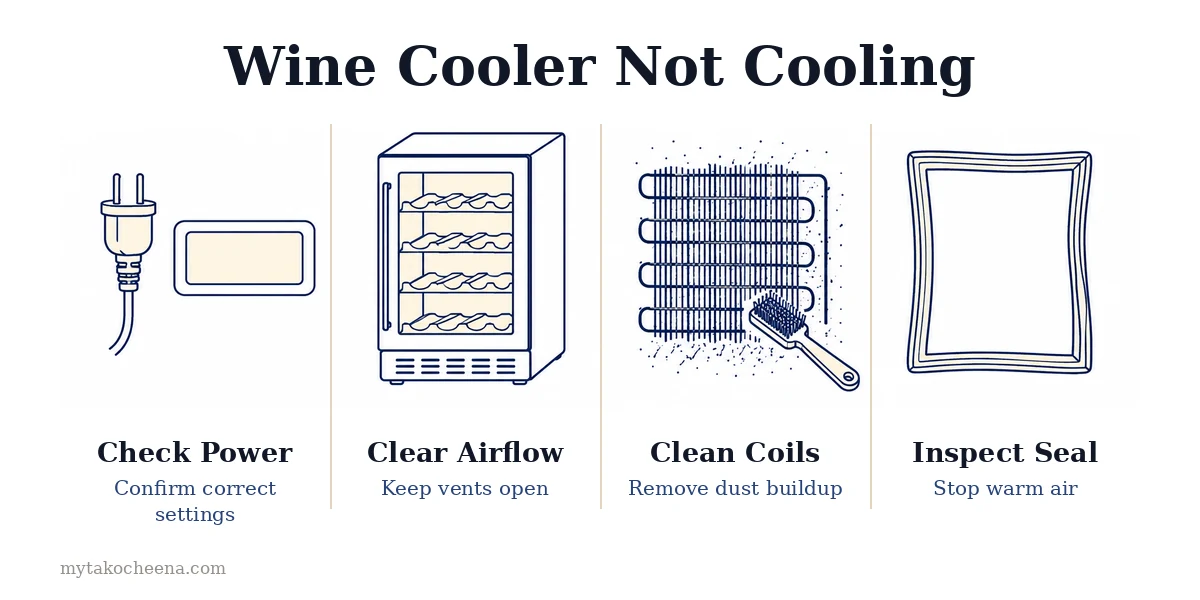
TL;DR: A wine cooler that will not cool is usually suffering from poor airflow, dirty condenser coils, a bad door seal, incorrect thermostat settings, or a failing fan or cooling system.
Start with power, temperature settings, ventilation clearance, coil cleaning, and door gasket checks. If the compressor runs constantly or never starts, professional diagnosis is usually the next step.
Start With the Simple Cooling Checks
Cooling problems often come from setup issues before sealed-system failure. Start with checks that match published wine cooler specifications and owner reports, because they cost nothing and can prevent an unnecessary service call.
Confirm the set temperature against the cooler’s intended storage range. Wine coolers are not food refrigerators, so a cabinet that feels mildly cool may still be operating within its category.
| Category | Typical published range | What to check |
| Single-zone wine cooler | About 40°F-65°F | Setpoint, display reading, and bottle temperature trend |
| Dual-zone wine cooler | About 40°F-68°F across zones | Zone settings, divider airflow, and door sealing |
| Beverage-style cooler | About 34°F-50°F | Whether the unit is actually rated for wine storage |
Next, look at airflow around the cabinet. Built-in and freestanding units have different vent paths, and blocked vents can make the compressor run without reaching the setpoint.
| Installation type | Common clearance range | Risk when ignored |
| Freestanding rear-vented cooler | About 2-6 inches at the back and sides | Heat buildup behind the cabinet |
| Built-in front-vented cooler | About 0-1 inch at the sides, with front grille open | Blocked exhaust through the toe-kick area |
Check the door gasket visually. A loose, dirty, or folded gasket lets warm air enter, causing long run times, frost near the evaporator, or temperatures that drift upward.
- Clean the gasket: Wipe debris from the seal and cabinet frame.
- Check the door swing: Make sure racks or bottles are not holding the door open.
- Level the cabinet: A tilted cooler may not let the door close evenly.
Finally, reduce the heat load. Warm bottles, direct sun, nearby ovens, and repeated door openings can delay cooling even when the appliance works normally.
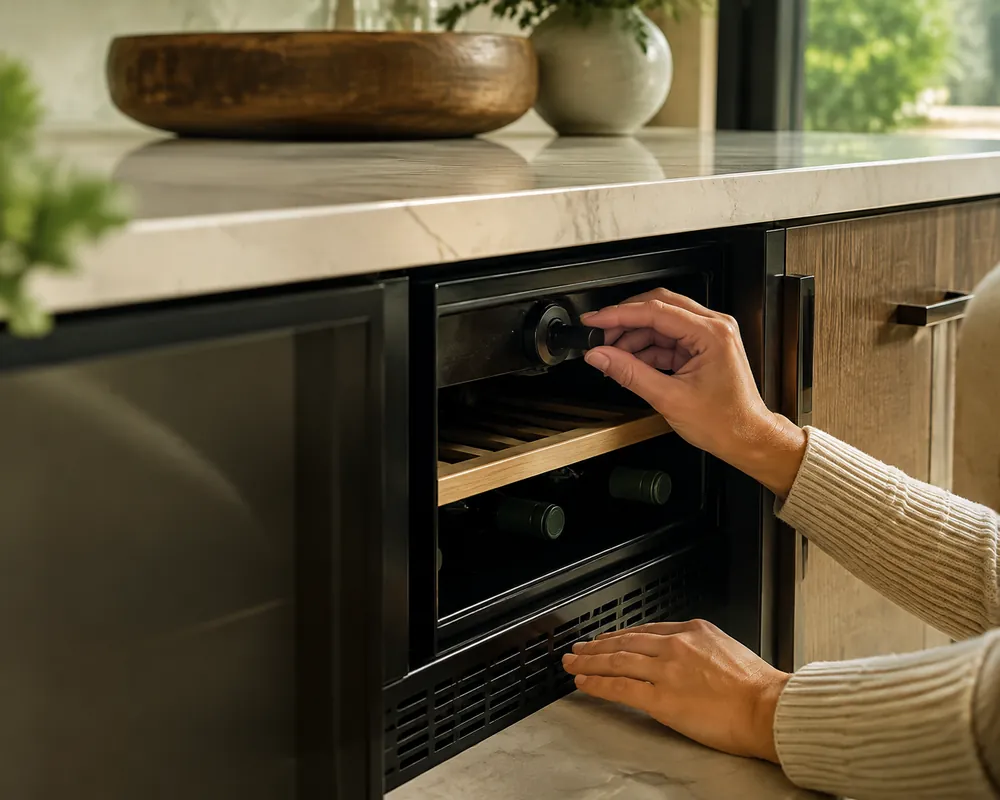
Confirm the Thermostat and Control Settings
Thermostat settings are the first place to check because a wine cooler can run normally while holding the wrong target.
Compare the display setting with the published range for your cooler type before suspecting a sealed-system failure.
Single-zone coolers serve one storage target, while dual-zone units split red and white storage. A setting outside the specified range may cause poor compressor cycling or a warmer cabinet.
| Cooler category | Published setting range to compare |
| Single-zone wine cooler | About 40°F-65°F |
| Dual-zone white wine compartment | About 40°F-55°F |
| Dual-zone red wine compartment | About 50°F-65°F |
Check whether the controls are locked, set to display mode, or changed from Fahrenheit to Celsius. Many “not cooling” complaints trace to a control lock, demo mode, or accidental reset after cleaning.
- Set the target lower: Move the setting several degrees colder within the published range, then allow time for the cabinet to respond.
- Confirm the zone: On dual-zone models, adjust the correct compartment rather than the opposite display.
- Look for mode indicators: Disable vacation, Sabbath, showroom, eco, or child-lock settings if your manual lists them.
Built-in and freestanding coolers also need airflow around the thermostat and condenser. Compare your installation with the manual’s clearance guidance, especially after moving the unit under a counter.
| Installation type | Common published clearance range |
| Freestanding wine cooler | About 2-6 inches at the sides or rear |
| Built-in wine cooler | About 0-1 inch at the sides, with front ventilation |
After changes, close the door and avoid repeated opening while the cooler stabilizes. Use an independent appliance thermometer to compare cabinet temperature with the control display.
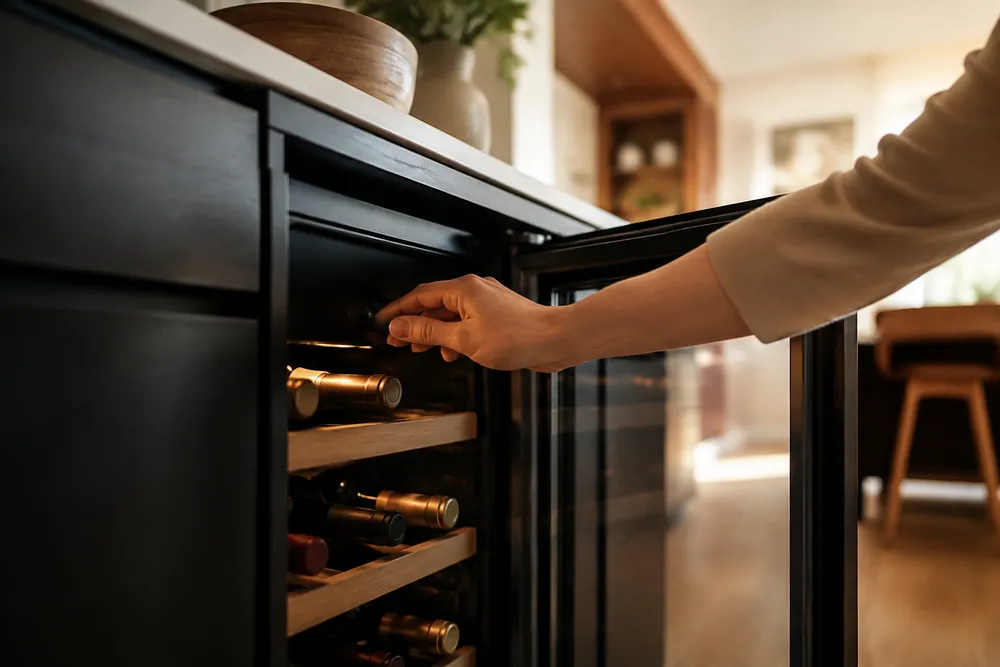
Inspect Door Seals, Hinges, and Interior Air Leaks
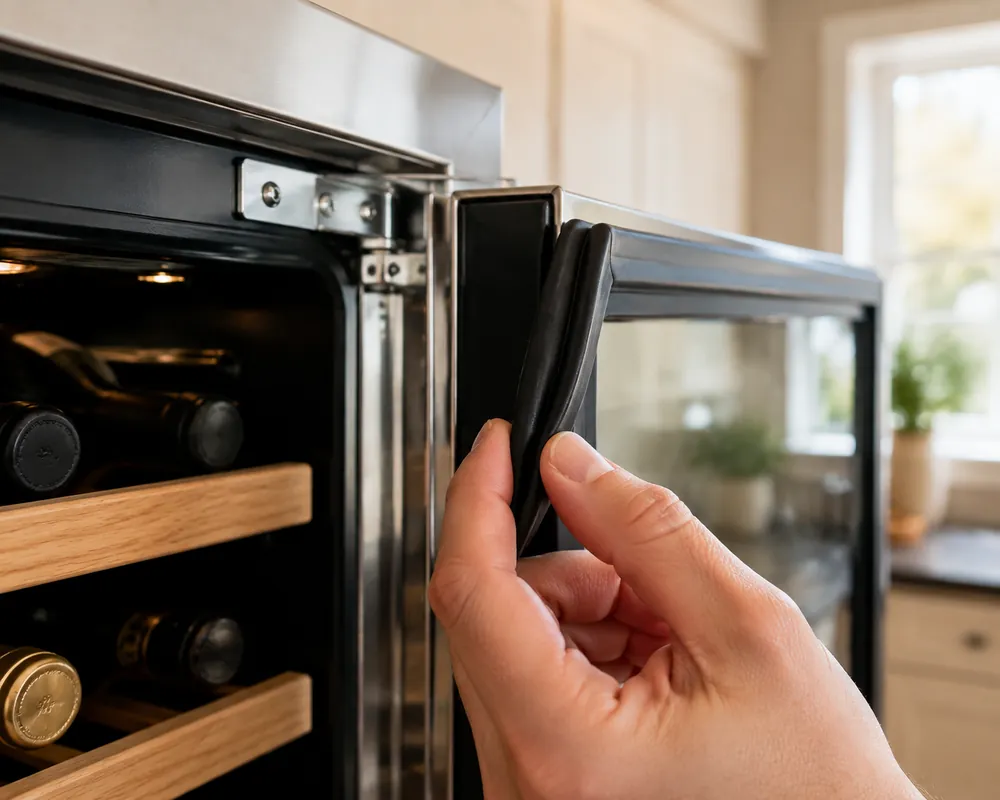
Door gasket leaks can make a wine cooler run constantly while the cabinet stays too warm. Compare the cooler’s published temperature range with the symptoms before replacing electrical parts.
Check the gasket with the door closed. Look for gaps, flattened corners, torn vinyl, sticky residue, or a magnetic strip that no longer pulls evenly against the cabinet frame.
| Category item | Common published range | What it means for air leaks |
| Single-zone storage temperature | About 40°F to 65°F | A leaking door may prevent the cabinet from reaching the lower end. |
| Dual-zone storage temperature | About 40°F to 68°F across zones | Warm air intrusion can make both zones drift upward. |
| Built-in side or rear clearance | About 0.25 inches to 2 inches | Poor installation can twist the cabinet and weaken the seal. |
Inspect the hinges next. A sagging door may look closed, but the gasket can miss the cabinet at the top or bottom corner.
- Level the cabinet: Uneven feet can rack the frame and open a small air path.
- Clean the gasket: Use mild soap and water, then dry the sealing face.
- Check shelf position: Bottles or racks can push the door slightly open.
- Look for liner cracks: Interior gaps can admit warm, humid air.
After cleaning and leveling, let the cooler stabilize before judging performance. If the seal still gaps or the door will not align, replace the gasket or hinge parts before moving to sealed-system diagnosis.
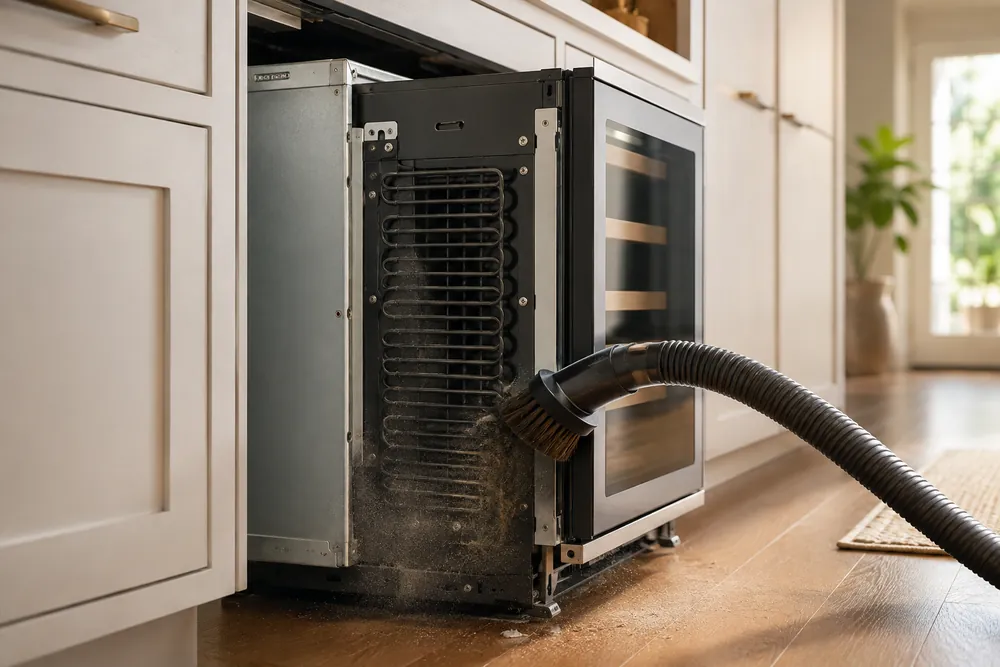
Clean the Condenser Area and Improve Ventilation
Dust on the condenser area makes a wine cooler work harder and cool less effectively.
Compare the appliance’s published installation specs with the space around it before assuming the thermostat, compressor, or control board has failed.
Unplug the cooler first, then pull it out far enough to inspect the rear or lower front grille. Use a vacuum brush and a dry cloth to remove lint, pet hair, and debris from the grille, condenser coil area, and nearby floor.
| Specification type | Typical published range | Why it matters |
| Wine storage temperature | About 40°F-65°F | A dirty condenser can keep the cabinet from reaching the selected range. |
| Typical ventilation clearance | About 1-5 inches | Too little space traps heat around the condenser. |
| Common capacity bands | About 12-50 bottles | Larger cabinets often need more consistent airflow around the appliance. |
Check whether your unit is freestanding or built-in. Freestanding coolers usually need open space at the back and sides, while built-in models are designed to vent through the front grille.
- Do not block the toe kick or front grille on a built-in wine cooler.
- Do not push a freestanding unit tight into cabinetry unless the manual allows it.
- Keep the cooler away from ovens, dishwashers, and sunny windows because nearby heat raises the cooling load.
After cleaning, plug the cooler back in and let it run undisturbed. Cooling recovery can take time, especially after the door has been open or the cabinet was moved.
Compare the displayed temperature with the set range after the unit stabilizes. If airflow is clear and the cooler still cannot maintain its rated range, move on to door seals, fans, thermistors, or sealed-system service.
Check Fans, Airflow, and Blocked Vents
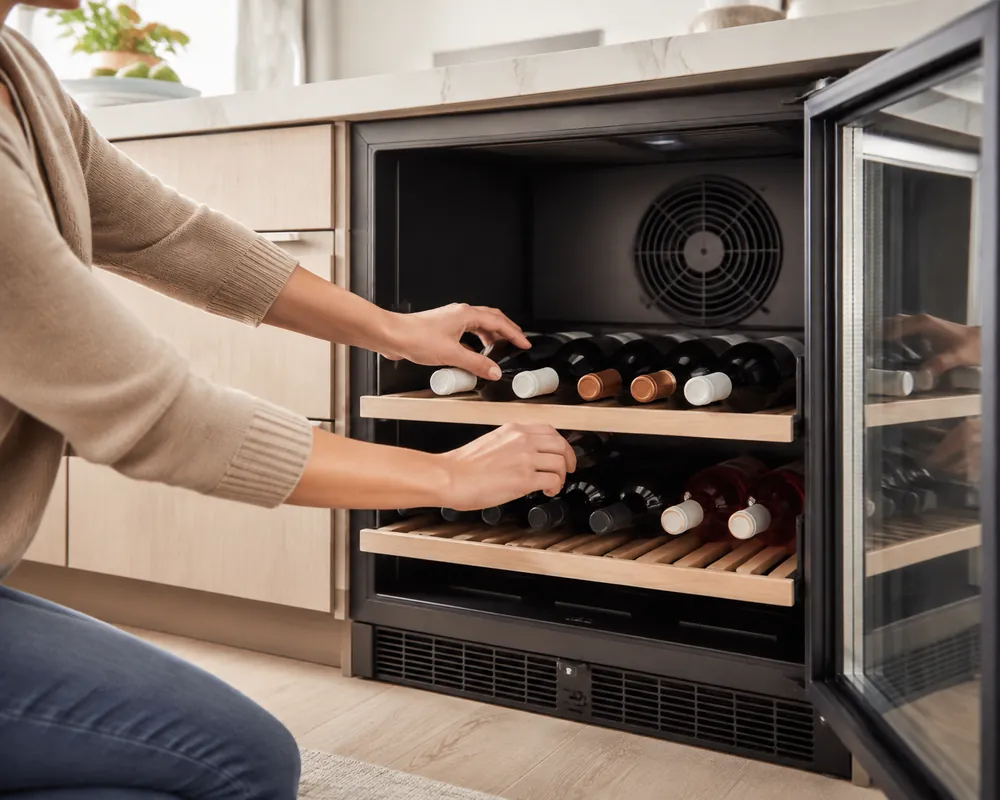
Fans and vents control how heat leaves the cabinet and chilled air moves around the bottles. A wine cooler that runs but will not cool may have working cooling parts fighting poor airflow.
Start with exterior vents. Dust, pet hair, packaging, or a tight cabinet cutout can trap warm air around the condenser side, making the unit cycle longer without reaching the set temperature.
| Specification category | Typical published range | Why it matters |
| Recommended rear or side clearance | 2-6 inches | Allows warm air to escape instead of recirculating |
| Single-zone storage temperature range | 40-65°F | Shows whether the cooler is designed for wine storage, not freezing |
| Common home wine cooler capacity bands | 6-50 bottles | Larger cabinets usually need stronger airflow paths |
Compare your manual’s clearance requirement with the actual space around the appliance. Freestanding units need breathing room, while built-in units usually vent forward through the grille.
- Clean the intake and exhaust vents: Use a vacuum brush, not water, and keep dust away from electrical openings.
- Check the front grille: Toe-kick grilles can clog quickly in kitchens with pets or heavy floor traffic.
- Move bottles away from the back wall: Crowded shelves can block cold-air circulation inside the cabinet.
Listen for the internal evaporator fan after pressing the door switch. Some coolers pause the fan with the door open, so hold the switch in to confirm operation.
A clicking, scraping, or silent fan can signal a failed motor, ice buildup, or a blade touching a wire or liner. Disconnect power before removing panels or reaching near moving parts.
Airflow problems also cause uneven temperatures. Warm upper shelves, cold lower shelves, or condensation near one vent usually mean air is not circulating evenly.
After cleaning and clearing vents, let the cooler stabilize before judging the result. Bottles add thermal mass, so wine coolers change temperature slowly, especially when full.
Know When Frost, Noise, or Heat Points to a Larger Fault
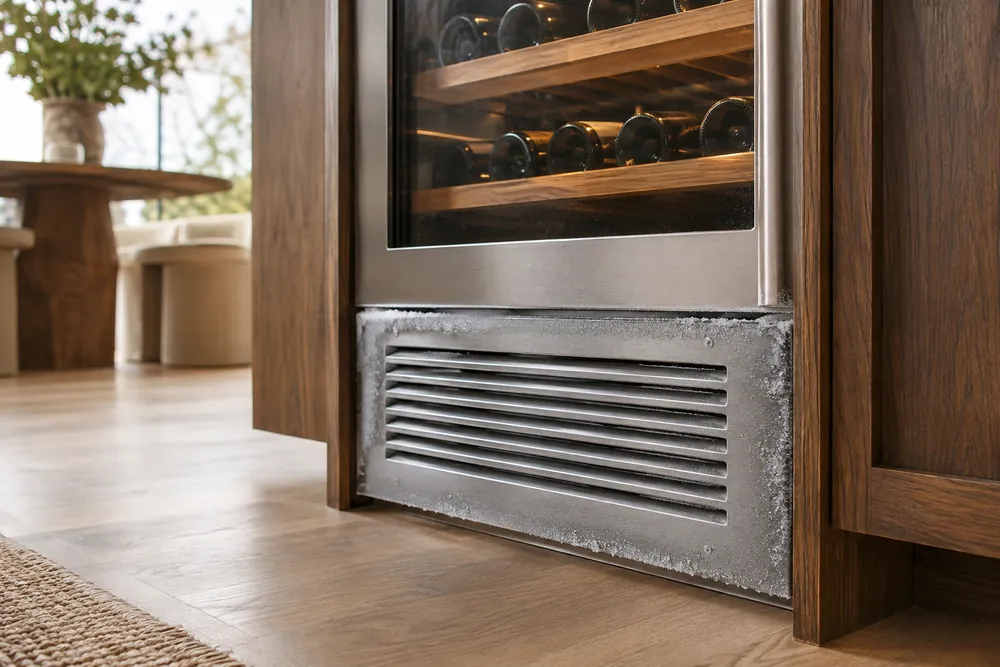
Frost, grinding noise, and cabinet heat can mean the cooler is fighting conditions beyond a dirty condenser or bad door seal. Compare the symptom with published specs before replacing parts.
Wine coolers are usually built for steady storage, not fast chilling.
Many list red, white, or dual-zone settings across broad ranges, so a cabinet stuck outside those bands points to controls, airflow, refrigerant, or compressor trouble.
| Spec area | Common published range | Why it matters |
| Wine storage temperature | About 40°F-65°F | Temperatures outside this range suggest more than normal cycling. |
| Built-in cabinet opening width | About 15-24 inches | A tight or wrong opening can trap heat around the condenser. |
| Typical ventilation clearance | About 2-5 inches for freestanding units | Poor clearance can cause hot sides, long run times, and shutdowns. |
Heavy frost on the rear wall often means moist air is entering or the evaporator is not defrosting correctly. Check the gasket, hinge alignment, and whether bottles block interior vents.
Sharp clicking, buzzing, or rattling that repeats during startup can point to a relay, fan, or compressor issue. A quiet hum is normal, but repeated failed starts usually need diagnosis.
- Frost plus warm wine: suspect airflow loss, sensor error, or sealed-system problems.
- Hot exterior panels: verify clearance and dust buildup before assuming compressor failure.
- Noise plus no cooling: unplug briefly, restart once, then stop cycling it repeatedly.
Use the manual’s required clearances and temperature range as the baseline. If the unit cannot return to spec after cleaning, leveling, and seal checks, schedule service or compare replacement options.
Decide Whether Repair or Replacement Makes More Sense
Repair value depends on the cooler’s age, cabinet fit, fault type, and replacement options. Compare specifications first, then weigh the repair quote against what a new unit would solve.
A thermostat, fan, door gasket, or start relay issue can make repair sensible. A sealed-system problem, repeated compressor failure, or refrigerant leak often points to replacement.
| Category | Common published range | Why it matters |
| Wine storage temperature | About 40°F-65°F | Replacement should match the zone range you actually use. |
| Built-in cabinet opening width | About 15-24 inches | A same-size replacement avoids cabinet changes. |
| Freestanding rear or side clearance | About 2-5 inches | Poor airflow can make a good cooler seem faulty. |
| Compact to full-size capacity bands | About 6-50 bottles | Upsizing may solve space needs better than repairing an undersized unit. |
Use the failed part as the first filter. Controls, fans, sensors, and gaskets are usually more practical to service than compressor or refrigeration-circuit problems.
- Repair makes more sense when the cabinet fits perfectly, the cooler is cosmetically clean, and the diagnosis points to an accessible electrical or airflow part.
- Replacement makes more sense when the repair involves sealed-system work, parts are hard to source, or the cooler no longer matches your bottle count.
- Recheck installation before spending money. Blocked vents, tight clearances, hot rooms, and damaged door seals can mimic cooling failure.
Compare noise expectations, hinge direction, shelving layout, and single-zone versus dual-zone storage. Those changes may matter more than fixing an older cooler that never suited your use.
Get a written repair estimate, then compare it with the installed cost of a correctly sized replacement. Choose the option that restores stable storage temperature with the least cabinet work and lowest failure risk.
What Owners Report After Six Months
Six-month owner reports on wine coolers focus on cooling consistency, noise, and early control-board issues. Manufacturer documentation frames these complaints around ambient conditions, clearance needs, and temperature ranges.
Owner comments often repeat one complaint: the cabinet powers on, the light works, but the interior will not return to the set temperature.
Reports mention warm kitchens, blocked vents, or tight built-in spaces before sealed-system failure is suspected.
| Category item | Typical published range | Why it matters |
| Wine storage setting range | 40°F-65°F | Higher set points may look like weak cooling but can be normal operation. |
| Built-in cabinet opening width | 15-24 inches | A tight opening can trap heat around the condenser. |
| Rear or side clearance | 1-3 inches | Insufficient airflow is a frequent owner-reported cause of poor recovery. |
The basic cabinet, shelving, door glass, and interior lighting tend to hold up. Owners describe these parts as serviceable after regular use, especially when the cooler is level and the door gasket stays clean.
Early failures are more often electronic than structural. Owner reports cite drifting temperature displays, unresponsive touch panels, noisy fans, clicking relays, or compressors that cycle briefly without steady cooling.
- Recurring complaint: the cooler runs but does not pull down to the selected temperature.
- Parts that usually last: shelves, door hardware, glass, and cabinet finish.
- Early weak points: fans, sensors, control boards, relays, and door gaskets.
Manufacturer documentation recommends checking installation, ventilation, ambient room temperature, and door sealing before replacing parts.
Owner reports support that order because many “won’t cool” cases improve after airflow and gasket problems are corrected.
Questions Worth Answering First
Wine cooler cooling problems usually trace back to setup, airflow, controls, or sealed-system faults. Compare specs first, then match symptoms.
What temperature should a wine cooler be set to?
Use the storage target, not a household refrigerator target. Many wine coolers run warmer than food-safe refrigerators.
| Use case | Typical published range |
| Single-zone wine storage | About 40°F to 65°F |
| Red wine serving | About 55°F to 65°F |
| White wine serving | About 40°F to 55°F |
Why is my wine cooler running but not getting cold?
Start with airflow and placement. Check blocked vents, dirty coils, loose gaskets, bottles touching the fan, then thermostat, relay, compressor, or refrigerant faults.
How much clearance does a wine cooler need?
Freestanding units usually need more breathing room than built-in units because heat rejection depends on vent design.
| Installation type | Common clearance range |
| Freestanding | About 2 to 6 inches around vents |
| Built-in undercounter | About 0.25 to 1 inch at sides or top |
| Rear clearance | About 1 to 3 inches where specified |
Can a wine cooler stop cooling because the room is too hot?
Yes. If the room exceeds the rated ambient range, the cooler may run constantly and still miss the set temperature.
Is a wine cooler supposed to cool like a refrigerator?
No. A wine cooler is built for stable beverage storage, not rapid food chilling, and usually runs warmer.
Why does my wine cooler cool the bottom but not the top?
Uneven cooling often means poor internal airflow, overpacked shelves, bottles against the back wall, or a failed circulation fan.
For dual-zone models, compare the symptom with the zone layout because compartments may have different ranges.
Should I unplug a wine cooler that is not cooling?
Unplug it if you smell burning, hear repeated clicking, or see overheating around the plug or controls.
For a reset, leave it unplugged, then restart it. If the compressor keeps clicking, stop cycling power and arrange service.
Is it worth repairing a wine cooler that will not cool?
It depends on age, size, installation type, and the failed part. Gaskets, fans, thermostats, and relays are usually practical; sealed-system leaks often are not.
For built-ins, compare repair cost with replacement models that fit the same opening and capacity.