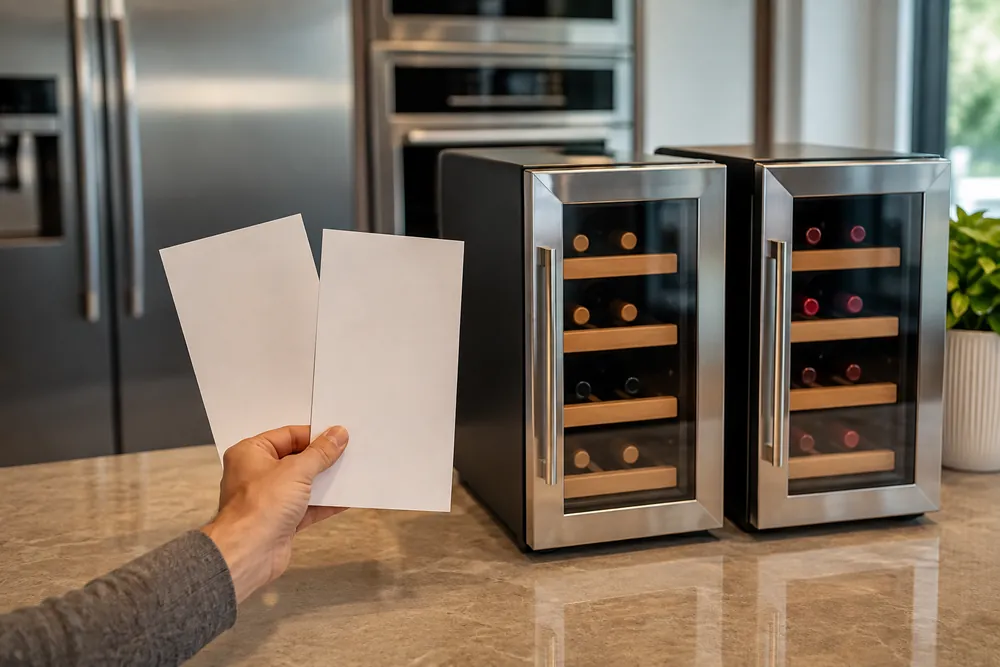
Quick Answer: Thermoelectric wine coolers use an electronic cooling module, while compressor wine coolers use refrigerant and a compressor.
Thermoelectric models are typically quieter, simpler, and suited to smaller collections in stable indoor rooms.
Compressor models generally cool more strongly, recover faster, handle warmer spaces better, and offer more capacity, but they may produce more operating noise and vibration.
Thermoelectric vs Compressor Wine Coolers: The Core Difference
Cooling method determines how a wine cooler manages heat, noise, vibration, placement, and temperature recovery.
Thermoelectric units transfer heat through an electronic module, while compressor units circulate refrigerant through a system similar to a compact refrigerator. That distinction matters more than exterior finish or shelf style.
How thermoelectric cooling works
Thermoelectric wine coolers use a solid-state heat pump, commonly called a Peltier module, to move heat from inside the cabinet to the surrounding room.
Because the system has no compressor and fewer moving parts, it can operate with less mechanical noise and minimal vibration.
This design suits smaller collections kept in stable indoor conditions. Its limitation is cooling headroom: performance depends heavily on the surrounding temperature, airflow, and clearance around the heat-dissipation area.
A warm room, direct sunlight, or crowded placement can reduce the cabinet’s ability to reach its target.
How compressor cooling works
Compressor wine coolers use refrigerant, a compressor, an evaporator, and a condenser.
The system generally removes heat more forcefully, recovers temperature faster after repeated door openings, and maintains cooling more effectively when the room temperature rises.
The trade-off is audible cycling and greater mechanical complexity.
Vibration control varies by design, so buyers should review product specifications for compressor placement, shelf construction, and stated noise or vibration features rather than assuming every compressor cabinet performs identically.
| Specification | Thermoelectric wine cooler | Compressor wine cooler |
| Common storage range | About 46°F–66°F | About 40°F–65°F |
| Common capacity band | About 6–32 bottles | About 12–150+ bottles |
| Typical clearance requirement | About 2–5 inches | About 0.25–5 inches, depending on design |
What the difference means for buyers
- Choose thermoelectric cooling for a quiet office, countertop, bedroom, or small collection in a temperature-stable room.
- Choose compressor cooling for larger storage, frequent door openings, warmer rooms, or stronger temperature recovery.
- Check installation requirements before buying. Thermoelectric units often need visible rear or side airflow, while compressor models may offer front-vented designs for built-in installation.
- Review zone configuration if storing red and white wine together. Dual-zone compressor cabinets are more common, while thermoelectric options often focus on simpler single-zone storage.
A listed target temperature does not prove that both cooling types perform equally in the same room.
Compare the operating range, ambient-temperature limits, ventilation guidance, capacity, and noise information before treating two wine coolers as interchangeable.
Cooling Performance, Noise, and Energy Use
Cooling performance determines whether a wine cooler can hold its target temperature through warm afternoons, frequent door openings, and a full cabinet.
Thermoelectric units are usually quieter and simpler, while compressor units provide stronger cooling and more recovery capacity.
Thermoelectric cooling transfers heat through an electronic module rather than a refrigerant compressor.
With fewer moving parts, this design commonly produces less vibration and a softer operating sound, which suits bedrooms, offices, dining rooms, and other quiet spaces.
Its limitation is cooling headroom. A thermoelectric cabinet generally works best in a stable indoor room, because its lowest internal temperature depends partly on the difference between cabinet temperature and surrounding air.
| Specification | Thermoelectric | Compressor |
| Common storage range | About 46°F–66°F | About 40°F–65°F |
| Typical capacity band | About 6–32 bottles | About 12–150+ bottles |
| Typical clearance | About 2–5 inches | About 0.25–5 inches |
Compressor coolers use a sealed refrigerant circuit with a compressor and condenser, much like a compact refrigerator.
They generally cool more forcefully, recover faster after the door opens, and maintain performance more reliably in warmer rooms or larger cabinets.
That strength creates trade-offs. The compressor may produce a noticeable hum or clicking cycle, and the cabinet can transmit more vibration unless the design isolates the cooling system effectively.
Product specifications and owner reports can reveal whether those sounds are likely to matter in the intended room.
Energy use depends on cabinet insulation, ambient temperature, thermostat settings, door openings, and how efficiently the cooling system cycles.
Thermoelectric models may use less power in small, lightly loaded cabinets, but a compressor model can be more practical when stronger cooling prevents prolonged operation in a warm space.
Match the cooling system to the installation
- Choose thermoelectric cooling for a small collection in a consistently cool indoor room where low noise and low vibration matter most.
- Choose compressor cooling for larger storage, dual-zone layouts, warmer rooms, or frequent access throughout the day.
- Check ventilation requirements before buying, especially for built-in placement, because required airflow differs by cabinet design.
For a buyer in the kitchen, the first question is not which cooling method looks better on paper.
It is whether the planned location gives the appliance enough breathing room, a stable room temperature, and a nearby outlet without relying on an extension cord.
Measure the available width, height, and depth, then measure the route to that space. Doorways, cabinet lips, handles, baseboards, and countertop overhangs can reduce the usable opening.
A cooler that fits the final niche may still be difficult to carry into it.
Depth deserves particular attention. The published cabinet depth may not include the door, hinge, handle, plug, or space needed behind the unit.
Mark the full footprint with painter’s tape, including the door swing, before moving other appliances or shelving.
Check the installation guidance for ventilation space on every required side.
A tight fit can restrict heat release, making the cooler work harder and potentially reducing its ability to maintain the selected setting, especially in a warm kitchen.
A thermoelectric cooler can make sense when the cabinet will sit away from ovens, sunny windows, dishwashers, and heating vents.
That quieter operation is useful in open-plan rooms, but it does not remove the need to control surrounding heat.
A compressor cooler may be the safer practical choice when the location is warm, the cabinet will be opened often, or the collection includes bottles that need more consistent recovery.
Leave room for airflow rather than treating the cooler like a sealed cabinet insert.
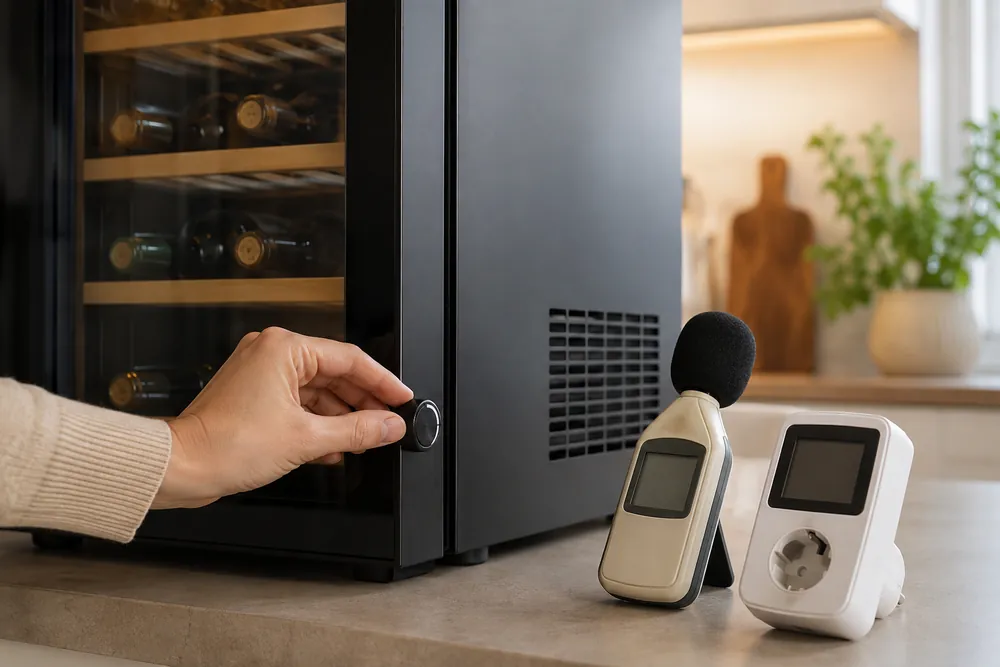
Noise is also a placement decision. A sound that disappears beneath kitchen activity may be noticeable beside a dining table, workspace, or sleeping area.
Listen for both the regular operating sound and the brief changes that occur as cooling cycles begin.
Energy use depends on more than the cooling technology. Room temperature, door-opening habits, thermostat setting, bottle loading, ventilation, and how long the cabinet runs all affect consumption.
Keeping the unit shaded and properly ventilated supports more efficient operation.
Before choosing a My Tako Cheena cooler, compare the measured space with the installation requirements, not only the advertised exterior dimensions.
Confirm that the door opens far enough to remove bottles and that nearby cabinets will not block controls or airflow.
The practical decision is therefore a location match.
Choose thermoelectric cooling for a quiet, moderate indoor setting with modest demands, or choose compressor cooling when heat, access frequency, cabinet size, or temperature recovery makes additional cooling strength more valuable.
Which Type Fits Your Kitchen, Bar, or Apartment
Room conditions, cabinet location, collection size, and noise tolerance should guide the choice between thermoelectric and compressor wine coolers.
Neither system is automatically better; each fits a different combination of space, serving habits, and temperature-control expectations.
Thermoelectric cooling suits quiet indoor spaces with relatively stable temperatures.
Compressor cooling offers greater reserve for warm rooms, frequent door openings, larger collections, and installations where the cabinet must maintain a steady temperature despite changing conditions.
Choose Thermoelectric for Quiet, Small-Collection Storage
Thermoelectric wine coolers use an electronic cooling module rather than a conventional compressor and refrigerant loop.
With fewer moving parts, they generally produce less mechanical noise and vibration, making them suitable for apartments, offices, dining rooms, and living areas.
This design works best when the surrounding room stays moderate.
A thermoelectric cabinet can struggle in a hot kitchen, near direct sunlight, beside an oven, or inside an unconditioned garage because its cooling performance depends more closely on ambient temperature.
Compact thermoelectric units are practical for casual drinkers who want ready-to-serve bottles without dedicating much floor or counter space.
They also make sense when quiet operation matters more than rapid recovery after repeated door openings.
Choose Compressor Cooling for Capacity and Stronger Recovery
Compressor wine coolers operate more like compact refrigerators. Refrigerant, a compressor, and a condenser work together to remove heat, giving these units stronger cooling performance and more flexibility in warmer rooms.
That extra cooling headroom matters for larger collections, frequent entertaining, and mixed wine storage.
Compressor models are also more common in dual-zone designs, where separate temperature settings help accommodate red and white wines.
Compressor operation can create an audible cycle as the system starts and stops.
The sound level varies by design, insulation, ventilation, and installation, so published noise information and owner reports deserve attention before placing one beside seating or a bed.
| Specification | Thermoelectric | Compressor |
| Typical storage temperature range | About 46°F–66°F | About 40°F–65°F |
| Common capacity band | About 6–32 bottles | About 12–150+ bottles |
| Typical clearance requirement | About 2–5 inches | About 0.25–5 inches, depending on design |
Match the Cooler to Its Installation
Apartment buyers should prioritize footprint, ventilation, and noise before appearance.
A quiet thermoelectric unit may be more comfortable in a studio, while a compressor model is safer where sunlight, cooking heat, or seasonal temperature swings could overwhelm a smaller cooling system.
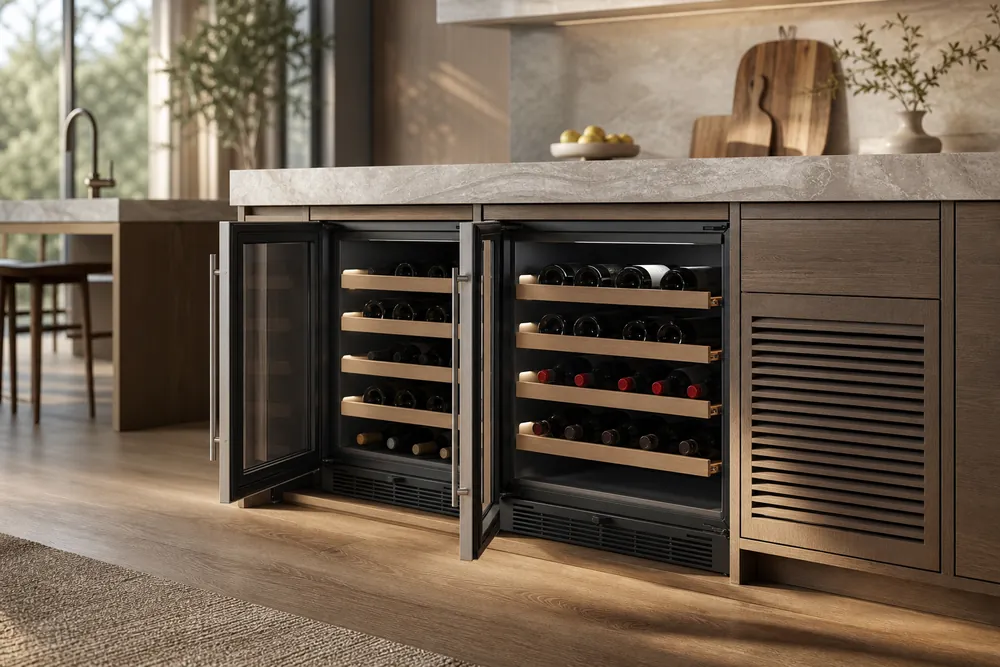
Bar and kitchen installations require closer attention to ventilation. Freestanding units need the clearance specified by the manufacturer, while true built-in models may use front ventilation.
A freestanding cooler should not be enclosed simply because its dimensions fit the opening.
For a modest collection in a stable room, thermoelectric cooling provides a simple, quiet solution.
For long-term storage, larger capacity, dual-zone organization, or demanding room conditions, compressor cooling usually offers the more dependable margin.
Installation, Ventilation, and Placement Limits
Installation space can determine whether a wine cooler performs as advertised.
Thermoelectric and compressor systems both need room to release heat, but they differ in how strongly placement, airflow, and surrounding temperature affect cooling.
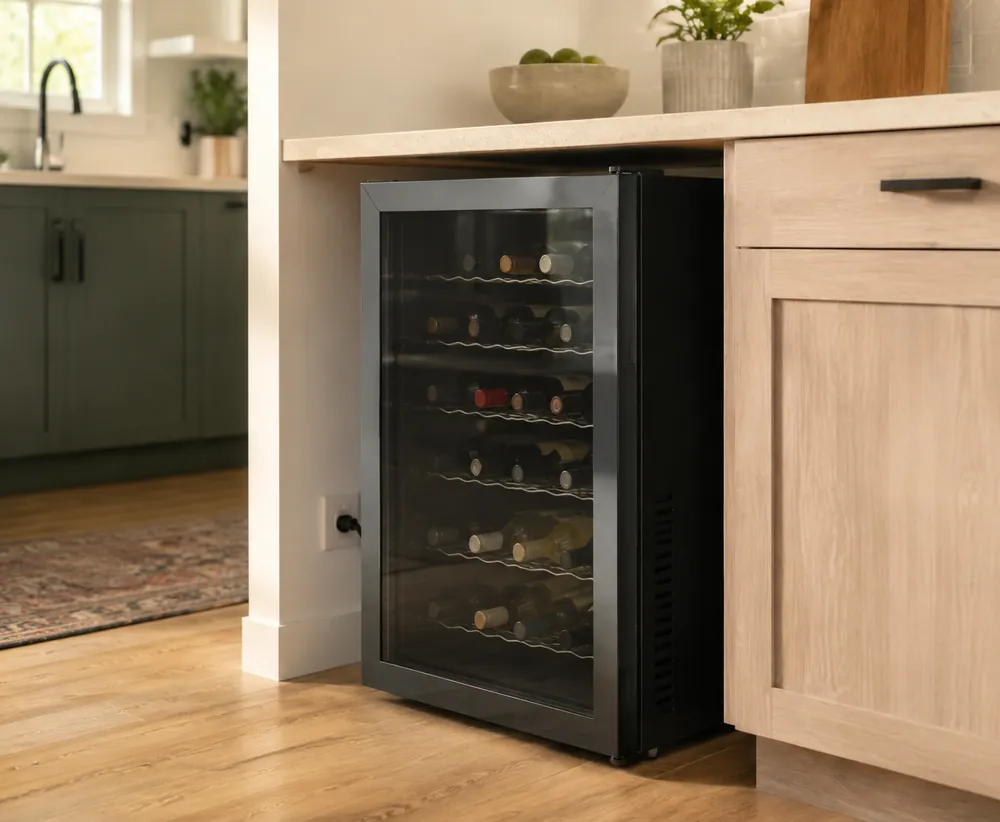
Thermoelectric units are commonly designed for freestanding use on a stable countertop, shelf, or open floor area.
Their heat sink and fan need unobstructed airflow, so placing the rear against a wall, inside a closed cabinet, or beside another heat-producing appliance can reduce cooling performance.
Clearance and ventilation requirements
Check the installation diagram rather than assuming every compact cooler has the same spacing requirement.
Category-level specifications commonly fall within the ranges below, but the product manual remains the authority for a particular unit.
| Consideration | Thermoelectric | Compressor |
| Common rear or side clearance | About 2–5 inches | About 0.25–5 inches, depending on design |
| Typical storage temperature range | About 46°F–66°F | About 40°F–65°F |
| Best installation style | Freestanding with open airflow | Freestanding or built-in, if specified |
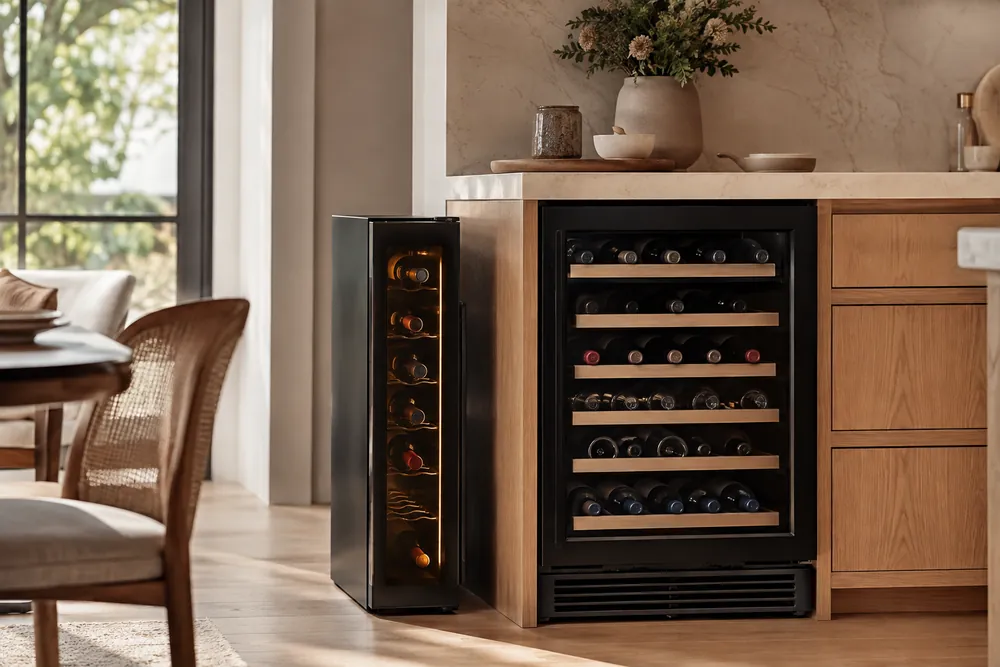
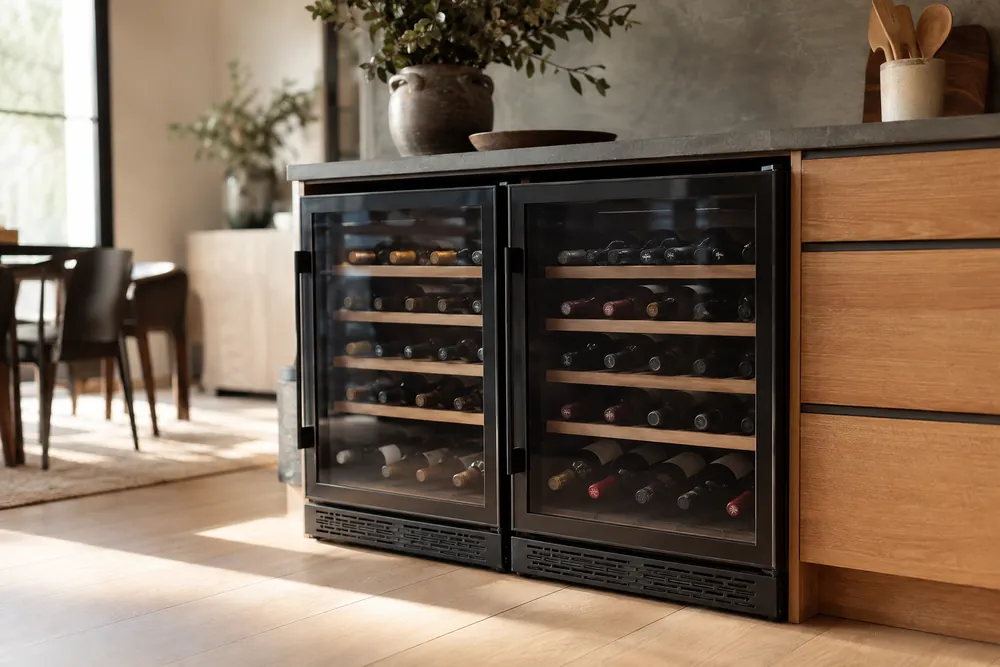
Front ventilation is the key distinction for kitchen installation. A compressor cooler labeled for built-in use may exhaust through the front grille, allowing it to sit beneath a counter with the specified opening dimensions.
A freestanding compressor model usually needs more surrounding space and should not be enclosed unless the manufacturer explicitly permits it.
Thermoelectric coolers are less often suitable for true under-counter installation. Even though they may fit physically, a restricted cabinet can trap the heat removed from the wine compartment.
That raises the surrounding temperature and can make the cooler run continuously without reaching its listed range.
Room temperature and placement
Ambient conditions matter more for thermoelectric cooling because these units can lower the interior only so far below the room.
A sunny window, warm pantry, unconditioned garage, or location beside an oven can therefore create a larger performance loss than the cabinet dimensions suggest.
Compressor models tolerate warmer rooms more effectively, but they still require ventilation and should remain level.
Their compressor and refrigerant lines may also produce vibration or cycling noise, making a solid floor and separation from vibrating cabinetry useful.
- Keep either type away from direct sunlight and heat sources.
- Leave the specified clearance around vents and condenser areas.
- Use built-in models only in approved openings.
- Place the cooler where the door can open fully without blocking airflow.
For a countertop or open shelf, thermoelectric cooling can be practical and quiet. For an enclosed kitchen opening, warmer room, or larger cabinet, a front-vented compressor model usually offers more installation flexibility.
What Owners Report After Six Months
Owner reports after six months tend to separate thermoelectric and compressor wine coolers more clearly than product listings do.
The recurring complaint is not usually initial cooling, but maintaining the selected temperature when the room is warm, the door opens often, or the cabinet is placed too close to a wall.
Thermoelectric owners commonly praise quiet operation, low vibration, and simple installation.
Manufacturer documentation supports those advantages because these units use an electronic cooling module rather than a compressor, but it also warns that performance depends heavily on ambient temperature and unobstructed ventilation.
The complaint that comes up most
Thermoelectric owners most often report that the cabinet cannot reach or hold its target setting in a warm room.
Reports also mention gradual temperature drift when the cooler sits beneath sunlight, beside an oven, inside a crowded cabinet, or against a wall that blocks the rear airflow.
Compressor owners report a different annoyance: audible cycling, vibration, or a short burst of mechanical noise during startup.
Manufacturer specifications often describe these units as low-noise, but low-noise does not mean silent, especially in a quiet office, bedroom, or open-plan kitchen.
| Observation | Thermoelectric cooler | Compressor cooler |
| Typical temperature range | About 46°F–66°F | About 40°F–65°F |
| Common capacity band | About 6–32 bottles | About 12–150+ bottles |
| Frequent complaint | Weak performance in warm rooms | Audible cycling or vibration |
What tends to hold up
After months of ownership, thermoelectric cabinets generally retain their appeal when used for a small collection in a stable indoor room.
Owners often value the absence of compressor startup noise, while manufacturer documentation identifies fewer moving mechanical parts as a reason for the simpler design.
Compressor models tend to hold temperature more consistently through door openings and seasonal room changes.
Owners of larger collections also report better satisfaction with compressor cooling in dual-zone cabinets, although correct clearance and ventilation remain essential according to installation documentation.
What can fail early
Early problems reported by owners include cooling fans, thermostatic controls, door seals, interior lights, and display panels.
Thermoelectric units may lose cooling performance when a fan becomes obstructed, while compressor models can develop noise or temperature problems if airflow is restricted.
- Check the stated ambient operating range before choosing either type.
- Leave the manufacturer’s recommended clearance around vents.
- Use a compressor model for warm rooms, frequent access, or long-term storage.
- Choose thermoelectric cooling for quieter, smaller-scale storage in a controlled room.
Frequently Asked Questions
Thermoelectric and compressor wine coolers differ most in cooling strength, noise, placement flexibility, and temperature stability.
The better choice depends on room conditions, bottle count, installation type, and whether the cooler will hold wine casually or support longer-term storage.
Are thermoelectric or compressor wine coolers better?
Compressor coolers are usually better for larger collections, warmer rooms, frequent door openings, and tighter temperature control.
Thermoelectric coolers suit smaller collections and stable indoor spaces where quiet operation matters more than maximum cooling power.
Neither system is universally better. Compare the cooler’s rated operating range, ventilation requirements, zone design, and intended location instead of choosing by cooling technology alone.
Do thermoelectric wine coolers get as cold as compressor models?
Thermoelectric units can reach suitable serving temperatures, but their performance depends more heavily on room temperature.
Compressor systems generally offer greater cooling headroom and recover more quickly after warm bottles or repeated door openings.
| Cooler type | Common listed storage range |
| Thermoelectric | About 46°F-66°F |
| Compressor | About 40°F-65°F |
Are thermoelectric wine coolers quieter?
Usually, yes. Thermoelectric models have no compressor, so they avoid the start-stop hum and mechanical cycling associated with refrigeration systems.
A fan may still run, and fan noise varies by cabinet design and operating conditions. Check the manufacturer’s noise information and owner reports if the cooler will sit beside a bed, desk, or dining area.
Can a thermoelectric wine cooler be used in a hot room?
Thermoelectric cooling is less suitable for garages, sunny rooms, or kitchens that regularly become hot.
The unit removes heat relative to the surrounding air, so its internal temperature can rise when ambient conditions exceed its practical operating range.
A compressor model is generally more dependable in warmer spaces, provided its ventilation clearance and ambient-temperature rating match the installation site.
Which wine cooler uses less electricity?
Thermoelectric models often use less power in small cabinets because they have simpler cooling hardware. However, energy use depends on cabinet insulation, room temperature, setpoint, ventilation, and how often the door opens.
A larger compressor cooler may consume more overall while delivering stronger cooling. Compare the listed energy information for similar capacity and installation types rather than comparing technology alone.
How many bottles can thermoelectric and compressor wine coolers hold?
Thermoelectric coolers are commonly built for compact collections, while compressor systems cover a wider range, including large and dual-zone cabinets.
Published capacity can change with bottle shape, shelf spacing, and whether shelves are removed.
| Cooler type | Common capacity band |
| Thermoelectric | About 6-32 bottles |
| Compressor | About 12-150+ bottles |
Can I install a thermoelectric wine cooler under a counter?
Do not assume a thermoelectric unit is suitable for built-in installation. Many compact models require open space around the rear or sides to release heat, while true built-in designs are engineered with appropriate ventilation paths.
Compressor coolers offer more built-in choices, including some front-vented cabinets. Confirm the installation instructions, opening dimensions, door swing, and clearance before purchasing.
Which wine cooler is better for red and white wine?
A dual-zone compressor cooler is usually the more flexible option for storing reds and whites at different target temperatures.
Thermoelectric models can work for a single-zone collection when the room remains stable and the chosen setting suits the wines.
Review the actual zone ranges and usable shelf layout. A displayed temperature target does not guarantee identical stability under warm conditions, heavy loading, or frequent access.