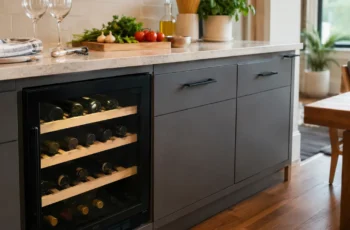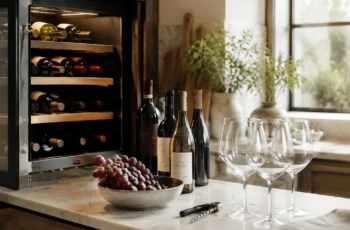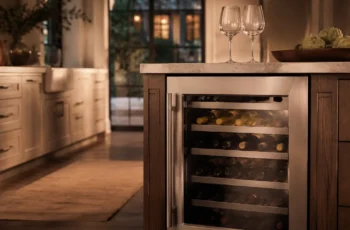
Quick Answer: A portable wine cooler is either a powered appliance that actively chills bottles or an insulated carrier that keeps pre-chilled wine cold during short trips.
Compare cooling method, temperature range, stability, bottle fit, ventilation, door clearance, construction, weight, and storage needs.
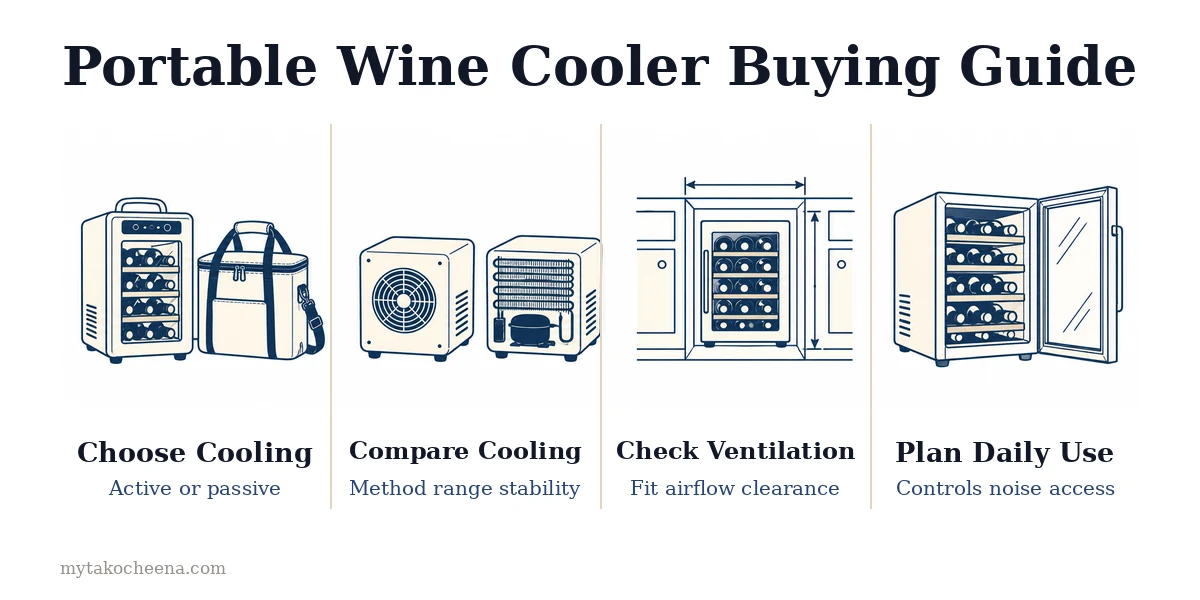
Choose active cooling for dependable serving temperature near power, or insulation for simpler, shorter outings.
- Choose power: Pick active cooling when you want bottles held at serving temperature near a reliable outlet.
- Use insulation: Choose an insulated carrier for short trips with pre-chilled wine, not for cooling warm bottles quickly.
- Check capacity: Bottle shape matters, so leave room for Champagne, Burgundy, sparkling wine, and wider rosé bottles.
- Measure placement: Confirm footprint, ventilation, door swing, and storage space before a portable cooler crowds your kitchen.
- Inspect durability: Shelves, hinges, feet, controls, handles, and insulation matter more than polished product photos.
Decide First: Powered Cooler or Insulated Carrier
Choose between active cooling and passive insulation before comparing finishes, shelves, or control panels.
A powered cooler is a small appliance for holding wine near serving temperature, while an insulated carrier is a transport solution for bottles that are already cold.
Start with the place you will use it: a kitchen counter, RV, patio, boat, car, or picnic table. The right choice should fit that setting without becoming bulky equipment you avoid storing or carrying.
Choose Active Cooling for Repeatable Serving Temperature
A powered cooler makes sense when bottles need to remain ready over a longer period or when you want to cool wine without relying on ice packs. It suits homes, offices, RVs, and other locations with dependable access to an outlet.
Power introduces practical appliance concerns. Check the unit’s ventilation path, plug location, door clearance, operating noise, controls, and storage footprint before buying.
A cooler that fits the counter but blocks a cabinet door or produces distracting hum may be inconvenient every day.
Temperature claims also need context. Wine preferences vary, and a portable cooler may offer a broad adjustment range rather than a single ideal setting.
Compare the stated operating range with the styles you usually drink, especially sparkling, white, rosé, and lighter red wines.
| Specification | Common range | Why it matters |
| Storage temperature range | 40–65°F | Shows whether the cooler suits your preferred wine styles |
| Rear or side ventilation clearance | 2–4 inches | Helps prevent restricted airflow in a tight kitchen |
| Typical portable capacity band | 4–20 bottles | Provides a realistic starting point before accounting for bottle shape |
Choose Insulation for Short Trips
An insulated carrier is usually the better fit for picnics, beach visits, tailgates, gifts, and quick trips to a friend’s home.
Pack it with pre-chilled wine and suitable ice packs, because insulation slows warming but does not cool warm bottles quickly.
Prioritize insulation thickness, leak resistance, washable lining, secure closures, comfortable handles, and a stable base.
Weight matters after adding bottles and cold packs, so compare the empty carrier with the load you can comfortably carry.
Match capacity to real bottles rather than product photos. Champagne, Burgundy, sparkling wine, and wide rosé bottles can use more room than standard Bordeaux-style bottles.
Choose powered cooling for regular at-home readiness; choose insulation when portability and compact storage matter more.

Look at Cooling Method, Temperature Range, and Stability
Cooling method determines whether a portable wine cooler can chill warm bottles or simply preserve wine that is already cold.
Temperature range matters just as much: serving preferences vary, and a narrow control range can limit how you use the appliance.
Stability separates a useful cooler from one that cycles constantly, vibrates, or warms noticeably after the door opens.
Compare Active Cooling Options
Thermoelectric coolers are often compact, lightweight, and relatively quiet, making them suitable for counters, bedrooms, and occasional entertaining.
Their performance can depend heavily on room temperature, ventilation, and how full the cabinet is.
Compressor models usually cool more assertively and recover faster after opening. They may be heavier or louder, but that trade-off can make them better for frequent use, warmer rooms, RVs, or bottles that need dependable chilling.
| Cooling category | Typical advertised range | Best fit |
| Thermoelectric | About 46–66°F | Quiet, moderate-climate use |
| Compressor | About 40–64°F | Faster recovery and warmer rooms |
| Insulated carrier | No active temperature range | Pre-chilled wine for short trips |
Check Ventilation and Temperature Stability
A stated temperature range is not a guarantee that every bottle will reach the same temperature. Read whether the range assumes a particular room temperature, an empty cabinet, or a long uninterrupted cooling period.
Owner reports can reveal whether the unit holds temperature consistently or swings after each opening.
Leave space around powered cooling vents instead of pushing the cabinet tightly against a wall.
A practical clearance of about 2–4 inches on ventilated sides is common, but the manual takes priority because blocked airflow can reduce cooling and shorten component life.
| Placement | Common planning range | Why it matters |
| Rear or ventilated side | About 2–4 inches | Allows heat to escape |
| Door side | Enough for full swing | Prevents blocked shelves and seals |
| Top or handle area | Enough to lift and store | Improves portability |
Match Controls to Your Routine
- Choose adjustable controls if you serve different wine styles and want flexibility.
- Look for steady feet and a secure door seal if the cooler will sit on a counter, boat, or uneven surface.
- Prioritize quiet operation for bedrooms, offices, and open-plan kitchens.
- Prefer simple controls and readable displays when the cooler will travel frequently.
Read whether the cooler needs clearance around its sides, rear, or top. A cabinet that fits the counter opening may still run poorly if a wall, backsplash, or upper shelf blocks airflow.
Measure the usable space, then compare it with the manufacturer’s required ventilation gap.
Use the tape measure in three directions: width between neighboring objects, depth from the front edge to the wall, and height beneath cabinets. Include the door swing and handle in your planning.
A cooler that cannot open fully may become awkward to load and may stay open longer.
Measure the route to its final location as well. Doorways, stair landings, narrow hallways, and RV storage compartments can restrict a unit that appears suitable once it reaches the kitchen.
Record the narrowest point rather than relying on the appliance’s listed exterior dimensions alone.
Check whether the floor or shelf is level and strong enough for the appliance. An uneven surface can worsen vibration and make bottles or racks shift.
If the cooler will sit on a counter, measure the counter depth and leave room to access the controls without moving other appliances.
Temperature consistency also depends on placement. Direct sunlight, a range, dishwasher, radiator, or warm enclosed cabinet can make the cooling system work harder.
Choose the coolest practical location, while preserving the airflow space specified in the product instructions.
Think about how often you will add bottles at room temperature. Occasional loading favors a compact unit that maintains an existing collection, while frequent restocking makes recovery behavior more important.
In that case, prioritize clear operating guidance and a cooling method suited to your room.
Controls and sensors deserve a close read. Some displays show the selected setting rather than the wine’s actual temperature, and readings can change after loading.
Treat the range as a planning guide, not a promise that every shelf will perform identically.
Finally, compare noise and vibration information with the intended location. A cooler beside a dining table or bed may need quieter operation than one in a utility area.
The best choice is the model whose cooling method, clearances, and stability match the space you measured.

Measure the Hidden Space: Ventilation, Door Swing, and Storage
Placement determines whether a portable wine cooler becomes a useful appliance or an obstacle. Measure the surface, the opening in front of it, and the place where you will store it before choosing capacity, controls, or finish.
Leave room for airflow around any powered unit. A cooler that is pressed against a wall, cabinet side, or backsplash may run longer, make more noise, and struggle to hold its selected temperature.
Plan Clearance Around the Cooling System
Check the manufacturer’s installation guidance first, because vents may sit at the rear, sides, or underneath.
Without model-specific instructions, use the following planning ranges as a starting point rather than treating them as universal requirements.
| Placement concern | Useful planning range | Why it matters |
| Open space behind the cooler | 2–4 inches | Helps warm air escape from rear vents |
| Open space beside side-vented units | 1–3 inches per side | Reduces blocked airflow and heat buildup |
| Overhead space below a cabinet | 2–6 inches | Allows access to controls and improves circulation |
| Storage depth for a countertop unit | 16–24 inches | Accommodates the body, cord, and rear clearance |
Do not measure only the cooler’s box. Add the plug, cable bend, ventilation gap, and any handle that projects from the body.
A narrow counter can look suitable on paper but become unusable once the door opens and the power cord occupies the nearest outlet.
Check Door Swing and Bottle Access
Open the door fully during your measurement. Hinges, handles, and thick bottle shoulders can require more forward space than the published width suggests, especially when the cooler sits beside a wall or another appliance.
Look for hinge reversibility if the cooler will live in a tight kitchen.
A reversible door can solve an awkward layout, but confirm that the required hinge-change process does not leave exposed holes, restrict the seal, or void the warranty.
- Mark the door’s opening arc with painter’s tape.
- Confirm that shelves can slide out without striking a wall.
- Keep the handle clear of cabinet pulls and nearby appliances.
- Place the most frequently used bottles where they are easy to reach.
Reserve a Real Storage Location
Portable does not mean effortless to store.
Choose a shelf, pantry bay, closet, or cabinet area that can support the cooler without crushing its cord, blocking ventilation openings, or exposing an insulated carrier to moisture and sharp objects.
Measure the storage route as well as the final location. Doorways, stair turns, car trunks, and crowded utility shelves can be more restrictive than the countertop.
For occasional use, a lighter carrier may be preferable to a powered cooler that is difficult to lift and put away.
Before checkout, compare the measured space with the cooler’s exterior dimensions, open-door depth, ventilation needs, and packed weight.
A slightly smaller unit that remains accessible often serves better than a larger model that stays unplugged in storage.

Check Build Quality Where It Actually Gets Used
Build quality matters at the points your cooler touches, opens, carries, and stores.
Inspect those contact points for the setting you will use, because a polished finish cannot compensate for a loose handle, weak hinge, poor seal, or base that slides across a counter.
Start with the surface beneath it. Countertop use exposes the feet to spills, crumbs, and repeated movement, while a vehicle or boat exposes the cooler to vibration and uneven surfaces.
Look for broad, non-slip feet and a base that stays stable without requiring constant repositioning.
Check the lid, door, and seal
A door should open cleanly without scraping nearby cabinets or requiring excessive force. The hinge should feel supported across its movement, and the latch should close positively rather than relying on pressure from a warped panel.
Examine the gasket around the opening. It should sit evenly, compress consistently, and remain attached when you wipe the cooler clean.
A poor seal lets cold escape, makes active cooling work harder, and shortens the useful time an insulated carrier can hold pre-chilled bottles.
| Use or measurement | Common range to verify |
| Ventilation space around powered units | About 2–4 inches |
| Compact portable cooler capacity | About 2–6 bottles |
| Insulated carrier capacity | About 1–4 bottles |
Use the manufacturer’s clearance guidance rather than treating the table as a universal rule.
A cooler squeezed against a wall, cabinet, car seat, or patio cushion may run hotter, shed heat poorly, or become difficult to lift and clean.
Inspect parts that take the abuse
Handles deserve more attention than decorative panels.
Lift the cooler by its intended grip, check whether the attachment points flex, and look for a handle that leaves enough room for gloved hands or a full carry without pressing against the bottles.
Shelves and dividers should support bottles without rattling or catching on labels. Removable inserts are useful when bottle shapes change, but they should slide out smoothly and return without forcing the door or reducing the seal.
- Controls: Choose buttons or dials that are readable, protected from accidental knocks, and simple to operate in dim light.
- Feet and corners: Prefer surfaces that resist sliding and corners that do not snag bags, blankets, or car upholstery.
- Interior: Look for wipeable lining, protected wiring, and drainage or spill management where applicable.
For outdoor use, prioritize seams, zippers, handles, and insulation thickness over appearance. For kitchen use, prioritize quiet operation, accessible controls, and parts that can be cleaned without moving the entire appliance.
Read owner reports for recurring complaints about cracked hinges, noisy fans, loose handles, condensation, and difficult cleaning. Those patterns reveal how construction performs in daily use more reliably than product photography.

Balance Portability Against Everyday Convenience
Portability matters only when it makes the cooler easier to use, store, and transport. Start with its everyday location, the bottles you genuinely chill, and whether you need powered cooling or simple insulation.
Measure the Space Before Choosing Capacity
A portable cooler should fit the counter, car, picnic setup, or storage shelf without becoming another appliance you avoid.
In a small kitchen, footprint matters as much as bottle capacity because a larger cabinet can displace prep space, a coffee maker, or an air fryer.
| Placement | What to check | Typical planning range |
| Countertop | Side, rear, and top ventilation | About 2–4 inches of open clearance |
| Cabinet storage | Door, cord, and handle space | About 12–20 inches of usable depth |
| Vehicle or boat | Lift path and tie-down room | Compact carry format preferred |
Check door swing, handle position, feet, cord routing, and ventilation before buying. A unit that technically fits may still be inconvenient if its door cannot open fully or its controls face a wall.
Match Cooling Method to the Trip
Powered cooling suits bottles that need to remain near serving temperature at home, in an RV, or beside a dependable outlet.
Insulated carriers suit short outings with wine that is already cold; they preserve chill but do not rapidly cool warm bottles.
| Format | Common capacity band | Best fit |
| Insulated carrier | 1–4 bottles | Picnics, gifts, short trips |
| Compact powered cooler | 4–8 bottles | Small kitchens and occasional hosting |
| Larger portable cooler | 8–20 bottles | Entertaining, RVs, and dedicated storage |
Capacity labels can overstate practical storage because Champagne, Burgundy, sparkling, and wide rosé bottles need more room than standard Bordeaux shapes.
Leave spare space if your collection includes mixed bottle profiles, removable shelves, or protective sleeves.
Inspect Handling and Long-Term Convenience
Weight, insulation, handles, hinges, shelves, feet, and controls matter more than polished product photos.
A cooler used outdoors should be easy to lift and stable on uneven surfaces, while a countertop model should operate quietly enough for nearby conversation or sleep.
- Choose active cooling for ready-to-serve bottles and regular access to power.
- Choose insulation for pre-chilled wine and short transport without an outlet.
- Prioritize storage efficiency when the cooler will spend more time put away than in use.
Buy for the routine you will repeat, not the maximum capacity you might use once. The most convenient portable wine cooler is the one that fits its space, handles your real bottles, and remains easy to carry, clean, and store.

Asked and Answered
Portable wine cooler buying decisions come down to placement, bottle shape, cooling method, and how often the unit will move.
Match the appliance to your kitchen, car, patio, boat, or picnic routine instead of choosing capacity or features that create storage problems.
Should I buy a powered wine cooler or an insulated carrier?
Choose active cooling for bottles that need to reach or hold serving temperature near a dependable outlet. Choose an insulated carrier for pre-chilled wine, short trips, and situations where low weight matters more than rapid cooling.
A carrier cannot cool warm wine quickly, while a powered unit needs ventilation, storage space, and access to electricity. Your usual destination should decide the format.
What temperature range should a portable wine cooler have?
Look for a temperature range that covers the styles you drink, rather than selecting the coldest advertised setting. White, rosé, sparkling wine, and lighter reds may need different serving zones.
| Wine style | Typical range |
|---|---|
| Sparkling and light whites | 38–46°F |
| Rosé and fuller whites | 45–55°F |
| Lighter reds | 54–62°F |
How many bottles should a portable wine cooler hold?
Buy for the number of bottles you regularly chill, not the largest capacity shown in a product listing. A smaller unit may be easier to use daily, while a larger one can justify its footprint for entertaining.
| Capacity band | Best fit |
|---|---|
| Two to four bottles | Travel and occasional use |
| Six to twelve bottles | Small kitchens and regular use |
| Thirteen to twenty bottles | Entertaining and larger storage needs |
Will Champagne and wide wine bottles fit?
Check interior width, shelf spacing, and door clearance because bottle shapes vary. Champagne, Burgundy, sparkling wine, and broad rosé bottles can reduce usable capacity even when standard Bordeaux bottles fit easily.
Removable shelves help, but removing one may sacrifice organization. Review interior diagrams and owner photographs before relying on the stated bottle count.
How much space does a portable wine cooler need?
Measure the footprint, door swing, handle projection, and ventilation area before ordering. Countertop placement often needs roughly 2–4 inches of open space around ventilation points, depending on the design.
Keep the unit away from ovens, direct sun, and crowded corners. A cooler that cannot release heat efficiently may run louder and perform less consistently.
Are portable wine coolers loud?
Fans and compressors create more noticeable sound than an insulated carrier.
For bedrooms, offices, or open-plan kitchens, compare reported noise experience and look for quiet-operation claims without treating them as guaranteed silence.
Noise can become more apparent when the unit cycles frequently or sits on a resonant counter. Stable, level placement may reduce rattling from shelves and feet.
What should I inspect before buying a portable wine cooler?
Inspect handles, hinges, feet, shelves, controls, seals, and cable storage. These parts affect everyday reliability more than glossy exterior styling.
- Confirm the power connection suits your destination.
- Check whether shelves remove for wider bottles.
- Verify the cooler can be stored without blocking vents.
- Choose durable insulation and closures for frequent travel.

- Check vent placement before choosing the storage spot
- Leave breathing room around walls, cabinets, and cookbooks
- Test door swing against handles, walls, and nearby appliances
- Keep glass doors away from direct sunlight
- Compare counter space against appliances used every day
- Plan storage for rigid baskets, totes, bags, or hard cases