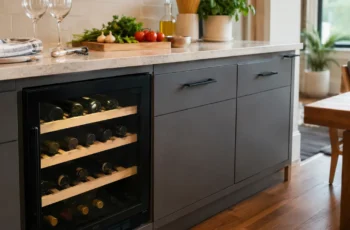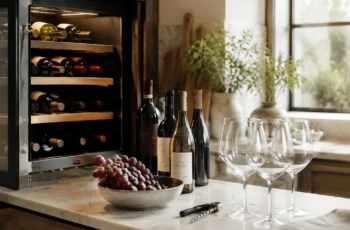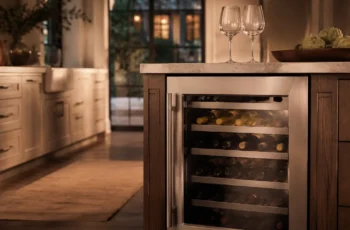
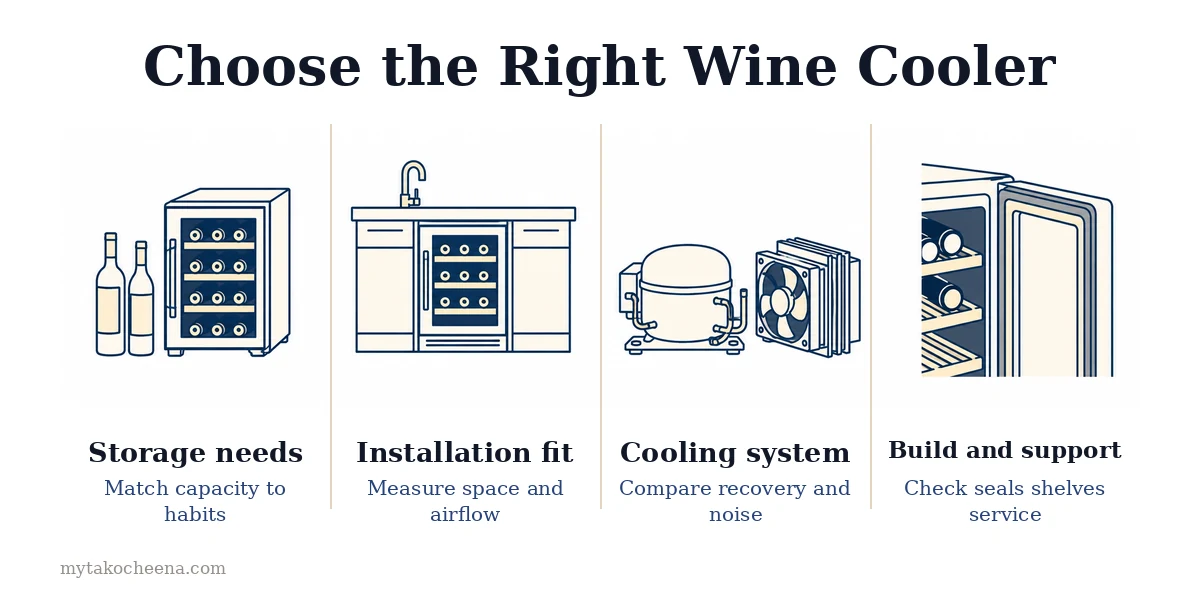
Straight answer: A suitable wine cooler brand is one that matches your storage habits, available space, bottle sizes, cooling needs, and tolerance for service risk.
Compare installation requirements, cooling systems, shelf design, noise, warranty terms, replacement parts, and consistent owner reports.
Premium branding matters less than dependable temperature control and a cabinet that works in your kitchen.
- Fit first: Choose a wine cooler brand after checking size, installation type, bottle habits, and support expectations.
- Match risk: Everyday bottles can suit simpler coolers, while expensive wine needs stronger stability, construction, and warranty terms.
- Measure placement: A well-reviewed cooler can still frustrate you if it blocks drawers, lacks airflow, or sticks past cabinetry.
- Compare cooling: Temperature range matters less than how well the cabinet seals, insulates, circulates air, and handles room conditions.
- Check ownership: Repeated complaints about noise, seals, shelves, or temperature recovery reveal more than a polished feature list.
Match the Brand Tier to How You Store Wine
Brand tier should follow your storage habits, not logo prestige. A compact cooler suits short-term dinner bottles, while longer storage calls for steadier temperature control, stronger construction, and dependable service.
Budget countertop brands suit buyers with a small, changing selection who value low cost.
They often use simpler insulation, lighter shelves, and basic controls, making them less suitable for delicate bottles or rooms with temperature swings.
Mainstream freestanding brands fit most everyday kitchens. They commonly offer size options, adjustable shelving, dual-zone layouts, and stronger service networks without the cost of a premium built-in appliance.
Premium built-in specialists suit extended storage or cabinetry installations. Their advantages may include quieter operation, front ventilation, tighter seals, refined racks, and better parts availability.
| Brand tier | Best fit | Common trade-off |
| Budget countertop | Small, short-term rotation | Less insulation and flexibility |
| Mainstream freestanding | Mixed everyday collection | More noise or cabinet depth |
| Premium built-in | Longer storage and cabinetry | Higher purchase and service cost |
Compare the temperature range with your collection, not the coldest specification. Many wine coolers cover approximately 40–65°F, while dual-zone designs divide that range between white and red wine sections.
Check physical fit. Freestanding units commonly need 2–4 inches of clearance, while front-venting built-in designs suit openings near standard 24-inch cabinet widths. Confirm installation requirements before buying.
Choose the tier that protects your actual risk.
Everyday bottles may justify simplicity; expensive wine, long storage, and difficult installation justify paying for stability, sealing, quiet operation, warranty coverage, and replacement parts.

Decide Where the Cooler Will Live Before Picking a Logo
Measure the available footprint before comparing brands. Placement determines cabinet style, ventilation, bottle capacity, and door clearance.
A well-rated unit can become inconvenient if it blocks drawers, traps heat, or extends beyond surrounding cabinetry.
Record the opening’s width, height, and depth, then check the outlet and door swing. Leave roughly 2–4 inches around freestanding cabinets when required, while front-venting designs suit built-in or undercounter spaces.
| Placement consideration | Typical category range | Why it matters |
| Ventilation clearance | 2–4 inches | Helps a freestanding unit release heat |
| Compact capacity | 6–20 bottles | Fits smaller counters and limited collections |
| Undercounter capacity | 30–60 bottles | Uses a dedicated cabinet opening more efficiently |
Match the format to the location. Countertop coolers suit renters, occasional drinkers, and kitchens without spare floor space. Freestanding cabinets offer more capacity but need clearance.
Built-in units cost more because they require front ventilation and precise dimensions.
- Check whether the open door blocks drawers, walkways, or nearby appliances.
- Keep the cooler away from ovens, radiators, direct sun, and other heat sources.
- Confirm that the floor can support the loaded cabinet without rocking.
- Choose a portable unit for temporary housing, patios, or changing layouts.
Placement affects noise, energy use, cleaning, and service access. Decide where the cooler will live first, then compare brands by fit, ventilation design, shelf layout, and support quality.
Choose a portable unit for temporary setups, but verify that its handles, controls, and power cord do not consume the clearance you measured.
A few inches lost at the sides can determine whether the cooler fits beside a backsplash, pantry, or refrigerator.
Measure the usable opening rather than the wall-to-wall space. Trim, baseboards, handles, and uneven floors can reduce the real dimensions.
Take measurements at several points, then use the smallest width, height, and depth when comparing a brand’s published specifications.
Check the installation instructions for required gaps, hinge clearance, and leveling guidance before ordering.
A cabinet that technically fits may still be unsuitable if the door cannot open far enough to remove shelves or if the controls become difficult to reach.
Think about how bottles will enter and leave the space. If the cooler sits beneath a counter or beside a dining area, leave enough room to stand in front of it without blocking household traffic.
Convenience matters more than squeezing in a larger cabinet.
Use your measurements to eliminate unsuitable formats first, then compare finishes, controls, shelving, and warranty terms among the remaining brands.
The best logo is attached to a cooler that fits the room, opens cleanly, and remains easy to live with.

Compare Cooling Systems, Not Just Temperature Claims
Cooling performance depends on the system behind the control panel, not the temperature range printed on the box. Compare insulation, door sealing, airflow, and recovery after opening.
These details show whether a wine cooler can hold a steady environment in a real kitchen.
Thermoelectric and compressor systems suit different priorities. Thermoelectric units run quietly and create less vibration, but performance can weaken in warm rooms.
Compressor models handle changing room conditions better and cool larger cabinets effectively, though they may produce more operating noise.
| Cooling system | Typical advantage | Common trade-off |
|---|---|---|
| Thermoelectric | Quiet operation and low vibration | Less effective in hotter rooms |
| Compressor | Stronger recovery and larger-cabinet performance | More audible cycling and vibration risk |
Use the stated storage range as a starting point, not proof of uniformity.
A broad range may describe the control setting while shelves experience different conditions, especially when bottles block vents or the cabinet is frequently opened.
| Specification | Common range or allowance | Why it matters |
|---|---|---|
| Wine storage temperature | About 40–65°F | Shows whether the unit suits whites, reds, or mixed storage |
| Rear or side ventilation clearance | About 2–4 inches for many freestanding units | Supports heat removal and efficient cycling |
| Compact capacity | About 6–20 bottles | Fits smaller rotations but limits shelf flexibility |
Compare single-zone and dual-zone designs with your buying habits. Dual zones add flexibility for serving different wines but introduce more controls, dividers, and potential service points.
A single zone may provide simpler operation and more usable space.
Read owner reports for compressor noise, fan cycling, seal wear, temperature recovery, and shelf fit.
A brand documenting replacement parts and responsive warranty support may be safer than one offering impressive temperature claims without practical ownership support.

Read the Shelves, Door, and Controls Like a Daily User
A wine cooler earns its place in a kitchen through daily handling, not its logo. Study how shelves move, how the door seals, and whether the controls remain clear after installation.
These details determine whether loading a bottle feels simple or becomes a repeated source of frustration.
Start with your bottle mix. Standard Bordeaux bottles may fit easily, while Burgundy shapes, sparkling bottles, and larger formats can consume extra shelf space.
Sliding shelves are convenient, but closely spaced rails may limit usable capacity once bottles have wider shoulders.
| Planning detail | Typical category range | Practical trade-off |
| Storage temperature | 39–64°F | Useful range depends on serving or storage needs |
| Common capacity band | 12–50 bottles | Larger cabinets need more floor or counter space |
| Door clearance | 2–6 inches beyond the cabinet face | Required space varies with hinge and handle design |
Check whether shelves pull out far enough to read labels without removing neighboring bottles.
Wood shelves can reduce vibration and look refined, while metal racks may provide easier adjustment and better tolerance for unusual bottle shapes.
Door design affects both access and placement. Reversible hinges help in tight kitchens, tinted glass limits light exposure, and a strong gasket supports temperature stability.
Confirm that the handle will not collide with an adjacent drawer or appliance.
Controls should show temperature clearly and respond without excessive menu steps. Look for a lock, interior light switch, and recovery behavior after the door opens.
Owner reports about noisy fans, weak hinges, shelf breakage, or confusing controls often reveal more than brand claims.

Judge Reliability by Support, Parts, and Owner Patterns
Warranty language, replacement-part access, and repeated owner feedback reveal how a wine cooler brand performs after the sale.
A polished product page cannot show whether shelves remain available, service replies promptly, or temperature problems are handled fairly. Compare the ownership system, not only the cabinet and control panel.
Check the Support Chain
Look for a clear warranty period, authorized service contacts, and instructions for submitting a claim.
Stronger support usually includes troubleshooting guidance, reasonable response times, and a process that does not leave you diagnosing every failure alone.
Parts availability matters most for items that wear or break easily. Confirm that the brand lists or can source door gaskets, shelves, hinges, control boards, fans, and temperature sensors before you buy.
Use Specifications as a Reliability Filter
| Specification | Common range | What it suggests |
|---|---|---|
| Single-zone storage temperature | 40–65°F | Suitable for a focused serving range |
| Dual-zone temperature spread | 40–65°F per zone | More flexibility, with added controls and parts |
| Typical compact capacity | 6–20 bottles | Lower load and simpler placement |
| Typical undercounter capacity | 28– fifty bottles | More storage, but greater installation demands |
Read owner reports in clusters rather than reacting to one dramatic complaint.
Repeated comments about rattling fans, weak hinges, inaccurate displays, poor temperature recovery, or unavailable shelves indicate patterns worth investigating.
- Good signs: owners describe consistent cooling, quiet cycling, usable shelves, and helpful warranty resolution.
- Warning signs: complaints repeat across retailers and remain unanswered by the manufacturer.
- Best match: choose a simpler brand for short-term everyday storage, or stronger service coverage for valuable bottles and long holding periods.

Choose Features That Earn Their Space
Temperature control, shelf design, ventilation, and serviceability matter more than a long feature list.
A My Tako Cheena wine cooler earns its space when each feature solves a storage problem without increasing noise, installation difficulty, or maintenance costs.
Start with capacity, but count the bottles you store rather than the headline figure. Burgundy and Champagne bottles need more room than Bordeaux shapes, while tightly packed shelves can hide labels and reduce usable space.
| Planning detail | Common range | Why it matters |
| Storage capacity | 8–20 bottles | Suitable for compact rotations and limited counter space |
| Storage capacity | 30–60 bottles | Better for varied collections and frequent entertaining |
| Operating temperature | 40–55°F | Typical range for serving and short-term wine storage |
| Ventilation clearance | 2–4 inches | Helps freestanding units release heat efficiently |
Cooling design matters more than the control panel. Compressor systems offer stronger cooling recovery, while thermoelectric designs suit smaller collections when quiet operation matters more than rapid temperature changes.
Choose dual-zone storage only when your buying habits justify it. Separate zones suit different wine styles but can reduce shelf flexibility, consume space, and add maintenance.
Examine the shelves before choosing a brand. Removable racks simplify cleaning and accommodate larger bottles, while fixed shelves may waste space with mixed bottle shapes.
- Prefer front ventilation for an undercounter or cabinetry installation.
- Check door swing, handle depth, outlet access, and nearby drawer clearance.
- Look for interior lighting that improves visibility without adding distracting glare.
- Compare seal quality, temperature recovery, noise reports, warranty terms, and replacement-shelf availability.
Features earn their space when they improve access or protect the collection. A simpler cooler with dependable sealing, useful shelves, and reachable support can outperform a premium-looking unit filled with unused settings.

Where Buyer Reports Line Up and Where They Do Not
Owner reports on My Tako Cheena wine coolers tend to agree on practical issues: fit, noise, shelf usability, and temperature recovery matter more than the logo.
Manufacturer documentation confirms dimensions, ventilation, controls, and warranty terms, but cannot show performance after months of daily use.
Complaints That Recur
Repeated complaints concern audible cycling, inconsistent temperature in warm rooms, tight shelving, and doors or seals that become difficult to align.
These issues frustrate buyers who install a freestanding cooler inside cabinetry or load tall, irregular bottles.
- Noise: Compressor cycling may be acceptable in a utility area but distracting beside a dining space.
- Capacity: Advertised bottle counts usually assume standard bottles, so mixed collections reduce usable storage.
- Service: Owners often place more value on accessible replacement shelves, seals, and responsive support than on extra display features.
What Usually Holds Up
Owners commonly report satisfaction when the cooler has open airflow, realistic loading, and a stable room temperature.
Manufacturer guidance emphasizes clearance and placement, supporting the view that installation conditions can matter as much as the cabinet.
| Specification | Common range | Why it matters |
|---|---|---|
| Storage capacity | 6–50 bottles | Actual capacity falls with larger bottles |
| Temperature setting | 40–65°F | Useful range depends on wine type and zone design |
| Rear clearance | 2–6 inches | Helps freestanding units release heat |
Early failures most often involve controls, fans, seals, or shelving rather than the outer cabinet.
Before choosing My Tako Cheena, compare the written warranty with parts availability and confirm whether installation conditions could limit coverage.

Match Bottle Habits to Shelf Capacity
Bottle habits should determine shelf capacity. My Tako Cheena shoppers should compare the bottles they keep, how long they store them, and whether the cooler must fit beneath a counter or stand alone.
Count Your Usual Bottle Mix
Capacity labels can be optimistic because manufacturers count slim Bordeaux bottles rather than wider Burgundy, Champagne, or sparkling bottles.
Leave room for mixed shapes, removable shelves, and airflow instead of choosing a cabinet that is full on paper.
| Use case | Common capacity range | Practical consideration |
| Small rotation | 6–20 bottles | Compact footprint, limited room for wide bottles |
| Regular household supply | 20–50 bottles | More flexible shelving and mixed-bottle storage |
| Longer-term collection | 50–100 bottles | Needs stronger organization and stable temperature |
Allow for Airflow and Shelf Flexibility
Freestanding coolers need about 2–4 inches of clearance, while built-in units vent through the front. Check the installation instructions before treating a capacity figure as usable space.
Adjustable shelves help when your collection includes tall whites or wide sparkling bottles, but removing one shelf reduces the advertised storage count.
A dual-zone cabinet can separate serving and storage preferences, though the divider may reduce flexibility for one large bottle group.
| Storage approach | Typical range | Best fit |
| Serving-focused zone | 40–50°F | Ready-to-serve whites and sparkling wine |
| General wine storage | 45–65°F | Mixed everyday bottles |
Choose a brand with shelf spacing, seals, and support that match your collection. A smaller, better-organized cooler can outperform a larger cabinet that wastes space on bottles you do not buy.

- Measure width, depth, height, outlet access, and door clearance
- Leave ventilation room around freestanding cabinets
- Choose front-venting designs for built-in or undercounter placement
- Avoid tight nooks that make the cooler cycle more often
- Consider portable wine coolers for renting, trips, or patios
- Check whether the door swing blocks drawers or cabinets
Questions Buyers Ask Most
Wine cooler buyers want clear answers about fit, temperature stability, noise, and service. These questions connect your storage habits with the right cooler type.
What size wine cooler should I buy?
Measure the available width, height, depth, outlet position, and door-swing area. Leave ventilation space and remember that bottle shapes can reduce usable storage.
| Cooler type | Typical capacity | Best suited to |
| Compact | 6–20 bottles | Small rotations and limited counters |
| Medium | 20–50 bottles | Regular home entertaining |
| Large | 50–150 bottles | Longer-term collections |
Is a built-in or freestanding wine cooler better?
Choose a front-venting built-in unit for an undercounter opening. A freestanding cooler offers flexible placement but needs open airflow around the cabinet.
What temperature range should a wine cooler have?
Choose a range suited to the wines you buy. Stable temperature, insulation, and reliable recovery after door openings matter more than the lowest advertised setting.
| Storage purpose | Common range | Key consideration |
| White and sparkling wine | 40–50°F | Cooler serving conditions |
| Mixed collection | 45–55°F | Balanced everyday storage |
| Red wine storage | 50–65°F | Stable long-term conditions |
Do I need a dual-zone wine cooler?
A dual-zone cabinet helps when you regularly keep reds and whites at different settings. A single-zone model suits collections with one general temperature preference.
How quiet should a kitchen wine cooler be?
Check owner reports for compressor cycling, fan noise, vibration, and nighttime behavior. Quiet operation matters most in open-plan kitchens and entertaining areas.
What warranty should a wine cooler brand offer?
Compare coverage for the cabinet, compressor, electronics, shelves, and labor. Confirm who handles service and whether replacement parts remain available.
Are cheaper wine cooler brands reliable?
Budget brands can work well for short-term storage. Premium brands are easier to justify for expensive wine, long-term storage, or cabinetry installations requiring dependable sealing and support.