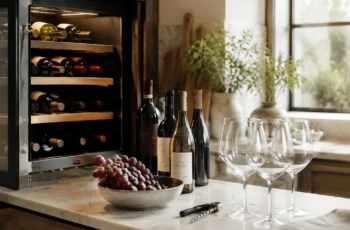
The short answer: A small-kitchen wine cooler is a compact appliance designed to store bottles at controlled temperatures without overwhelming limited space.
The best choice matches your measured opening, door swing, ventilation needs, noise tolerance, and typical bottle collection.
Prioritize installation type and usable shelf space over published capacity, especially when storing Champagne, Pinot Noir, or other unusually shaped bottles.
Start With the Space You Actually Have
Available width, depth, height, ventilation, and door clearance determine whether a wine cooler works in a small kitchen.
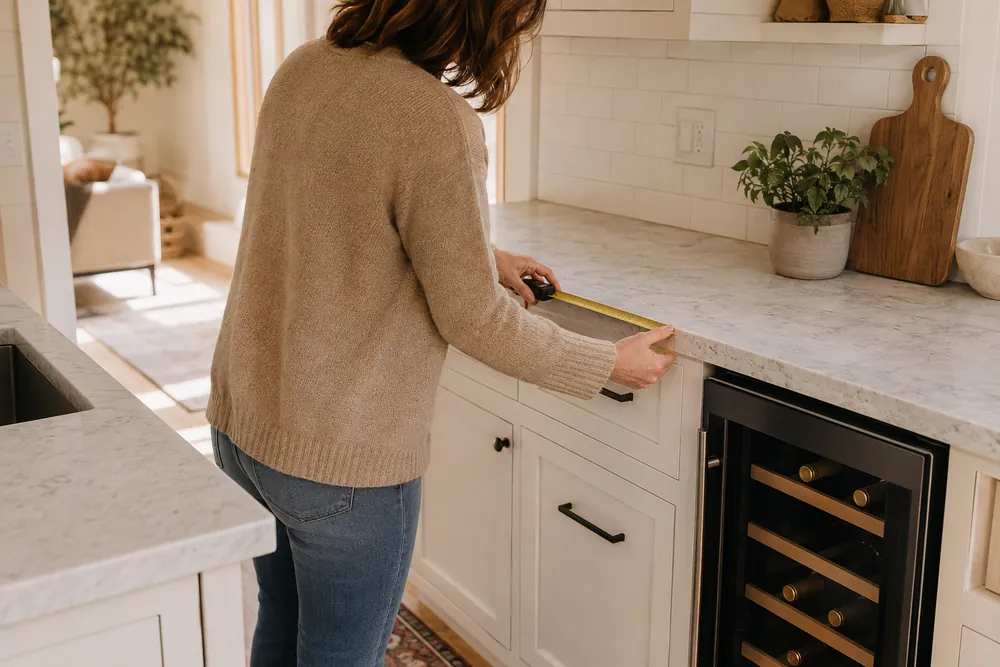
Before comparing bottle counts or features from My Tako Cheena, measure the intended location, including trim, outlets, handles, and nearby appliances.
A cooler that fits its listed opening may still interfere with a dishwasher, island, drawer, or walkway. Record the usable opening, then account for space required to install, level, ventilate, and open the door fully.
Measure the installation zone
- Measure width at the front, middle, and rear because walls and cabinets may not be perfectly parallel.
- Measure depth from the finished wall or cabinet face, not from the baseboard, and note whether the plug will occupy additional space.
- Measure height beneath counters, including the countertop underside, leveling feet, and any trim that could prevent the unit from sliding into place.
- Map the door swing and handle projection so the cooler does not collide with an island, wall, dishwasher, refrigerator, or cabinet pull.
| Placement type | Typical width | Common depth | Practical use |
| Countertop | 10 to 18 inches | 18 to 24 inches | Apartment counters and occasional storage |
| Undercounter built-in | 12 to 24 inches | 22 to 25 inches | Permanent cabinet runs |
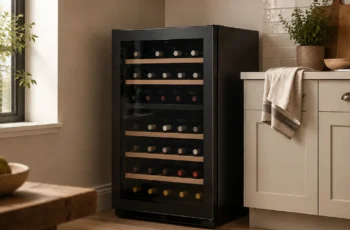
| Freestanding floor unit | 15 to 30 inches | 20 to 27 inches | Pantry edges and open wall space |
Placement type also determines airflow. A front-venting built-in unit releases heat through its front grille, while a freestanding cooler commonly needs open space around the sides, rear, or top.
Follow the installation instructions rather than packing the appliance tightly against cabinetry.
| Specification | Common range | Why it matters |
| Freestanding ventilation clearance | 2 to 6 inches | Allows heat to escape |
| Compact storage capacity | 6 to 18 bottles | Suits casual drinking and limited counter space |
| Small undercounter capacity | 18 to 46 bottles | Supports regular entertaining |
| Typical storage temperature | 40 to 65 degrees Fahrenheit | Covers chilled whites through cellar-style reds |
Published capacity is a planning guide, not a guarantee. Manufacturers often count standard Bordeaux-style bottles in an ideal pattern, so Champagne, Pinot Noir, and tall Riesling bottles can reduce usable space.
Shelving flexibility, door reversibility, and quiet operation may matter more than the advertised number.
Choose the cooler that fits the measured opening, vents correctly, and leaves the kitchen usable with its door open.
A slightly smaller unit may preserve drawer access, walking clearance, and safe separation from ovens, radiators, and direct sunlight.
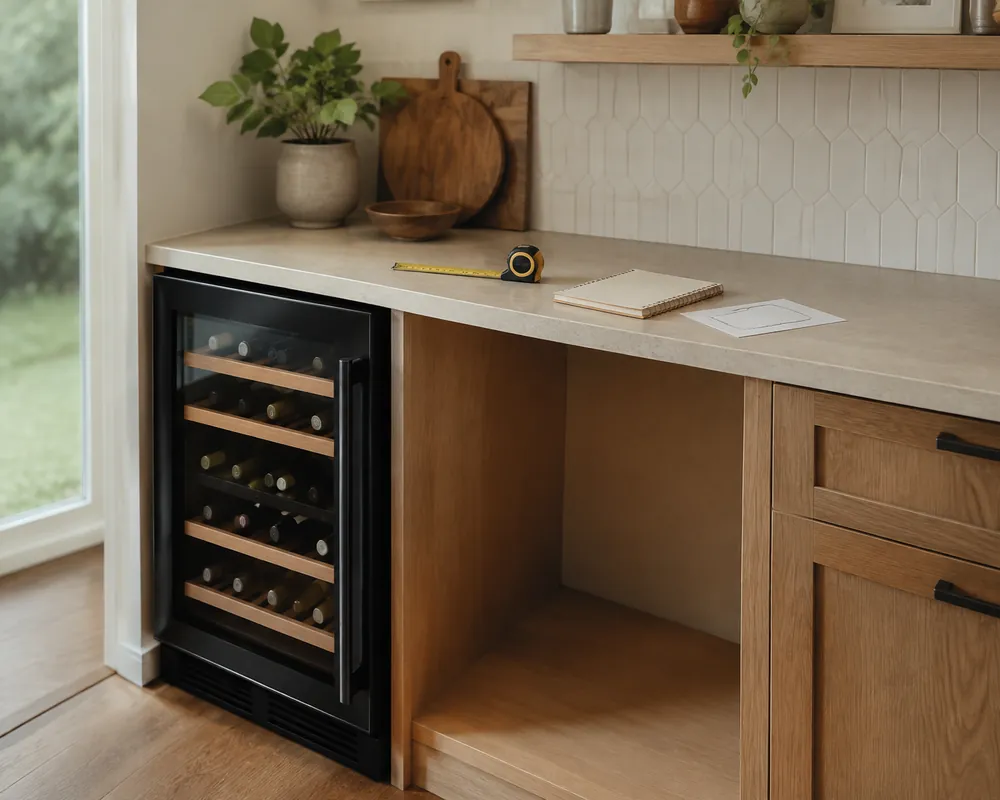
Choose the Right Cooler Type for a Small Kitchen
Available floor space, ventilation, and door movement determine which wine cooler suits a small kitchen.
Choose the installation type before comparing bottle counts, because a compact appliance can obstruct cabinets, counters, drawers, or walkways.
Measure the location with the surrounding kitchen considered. Record the opening width, height, depth, baseboard position, outlet location, nearby handles, and door-opening clearance.
Match the Cooler to the Available Space
Countertop coolers suit renters, apartments, and occasional storage but consume work surface.
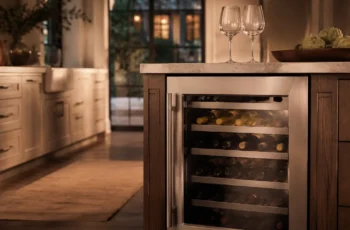
Undercounter units preserve counter space and align with cabinetry, while freestanding models work beside a pantry, on an open wall, or in another stable area.
| Placement type | Typical width | Common depth | Best use |
|---|---|---|---|
| Countertop | 10–18 inches | 18–24 inches | Renters and casual storage |
| Undercounter built-in | 12–24 inches | 22–25 inches | Permanent cabinet runs |
| Freestanding floor unit | 15–30 inches | 20–27 inches | Open wall or pantry edges |
Installation labels describe airflow, not only appearance. A front-venting built-in cooler can sit within suitable cabinetry, whereas a freestanding unit needs open space around its sides, rear, or top to release heat.
Follow the manufacturer’s clearance instructions rather than treating every narrow cooler as cabinet-safe. Tight corners, overhangs, dishwasher doors, trim, and uneven floors can make a location unusable.
| Specification | Common range | Why it matters |
|---|---|---|
| Freestanding ventilation clearance | 2–6 inches | Allows heat to escape |
| Compact storage capacity | 6–18 bottles | Fits occasional wine storage |
| Small undercounter capacity | 18–46 bottles | Supports regular entertaining |
| Typical storage temperature | 40–65°F | Covers chilled whites and cellar-style reds |
Judge Capacity by Bottle Shape
Published capacity usually assumes standard Bordeaux-style bottles in the preferred shelf layout. Champagne, Pinot Noir, Burgundy, and tall Riesling bottles can occupy more space, reducing the practical count.
For a small kitchen, flexibility often matters more than advertised capacity. Adjustable shelves accommodate mixed bottles, while a reversible door can solve a difficult corner or improve access beside another appliance.
- Check the door path: confirm that the open door clears walls, islands, cabinet fronts, and appliance handles.
- Check ventilation: leave the specified breathing room for freestanding designs and keep heat-producing appliances away.
- Check usable storage: compare shelf spacing and bottle shapes, not only the headline bottle count.
- Check daily comfort: consider compressor noise, leveling, lighting, and access during normal kitchen use.
The right cooler fits the opening, vents correctly, and stores the bottles you buy. Careful measuring prevents a capacity upgrade from becoming a blocked drawer, crowded walkway, or poorly ventilated installation.
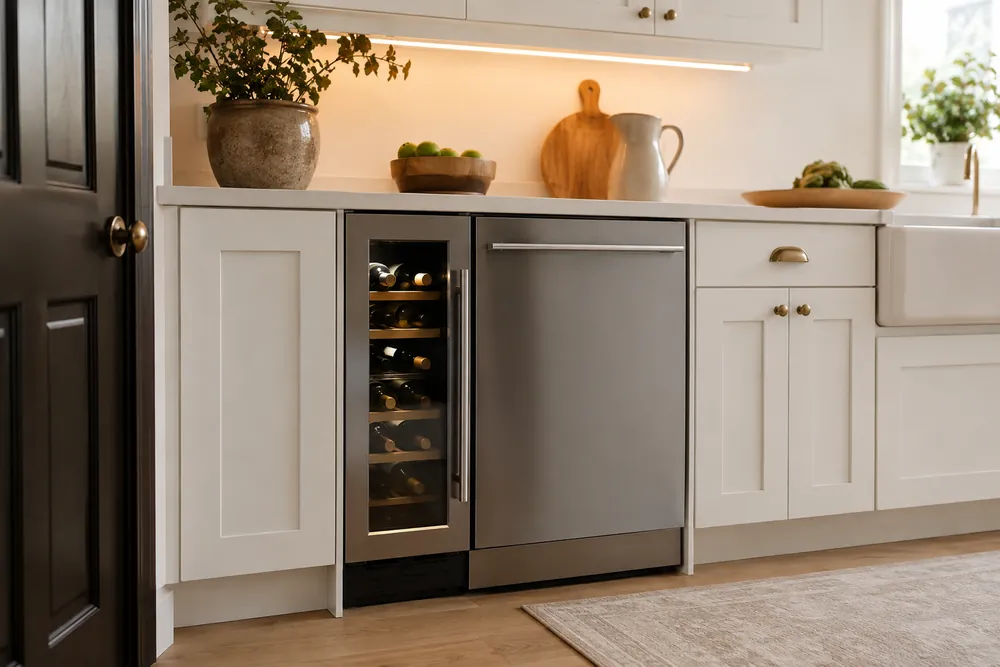
Capacity, Bottle Shape, and Shelf Layout
Bottle capacity matters only when it reflects the wines you actually buy.
A compact My Tako Cheena wine cooler may list an appealing bottle count, yet mixed bottles can reduce usable space because Champagne, Pinot Noir, Burgundy, and tall Riesling bottles need more room than standard Bordeaux bottles.
Use the published capacity as a starting point, not a promise.
Manufacturers commonly calculate capacity with uniform bottles arranged in a preferred configuration, while real kitchens usually require a mixture of opened bottles, taller designs, and bottles stored horizontally.
| Cooler category | Typical capacity range | Best suited to |
| Countertop compact | 6–18 bottles | Occasional drinking and limited counter space |
| Small undercounter | 18–46 bottles | Regular entertaining and dedicated cabinet runs |
| Compact floor unit | 12–30 bottles | Pantries, dining areas, and open wall space |
Account for bottle shape
Standard Bordeaux bottles usually make capacity claims look most attractive because their straight sides stack efficiently.
Wider Burgundy and Pinot Noir bottles can occupy neighboring shelf space, while sparkling-wine bottles may require a lower shelf or the removal of an adjustable shelf.
- Check shelf depth for broad shoulders and heavy glass.
- Look for removable or repositionable shelves.
- Reserve vertical clearance for sparkling and tall white-wine bottles.
- Confirm that shelf lips prevent bottles from rolling when the door opens.
A shelf that fits a bottle body may still fail at the neck or shoulder. Review interior photographs, shelf spacing, and the manufacturer’s storage diagram rather than relying on the front-panel bottle count.
Match layout to your buying habits
Fixed shelves can maximize stability but limit flexibility. Sliding shelves improve access in a crowded kitchen, although their tracks can reduce interior height and make the cooler less efficient for unusually shaped bottles.
| Layout feature | Advantage | Limitation |
| Adjustable shelves | Accommodate mixed bottle shapes | May reduce maximum stated capacity |
| Sliding shelves | Improve access to rear bottles | Can reduce vertical clearance |
| Fixed shelves | Provide consistent support | Offer less flexibility |
Measure the bottles you purchase most often and compare those dimensions with the interior layout. Prioritize accessible shelves, stable storage, and realistic mixed-bottle capacity over the largest number printed in a product listing.
Reserve vertical clearance for sparkling bottles and any wine you expect to buy in larger formats.
Before shopping, measure the height, width, and depth available at the intended location, then note obstructions such as cabinet lips, trim, outlets, and nearby handles.
Measure the opening at several points rather than assuming it is perfectly square. A cabinet wall, countertop overhang, or baseboard can reduce the usable footprint.
Record the narrowest width and shallowest depth, and leave room for the door to open without striking an island or adjacent appliance.
Compare those measurements with the cooler’s external dimensions, not its advertised storage volume. Confirm whether the stated depth includes the door, handle, or rear clearance.
If the cooler will sit inside cabinetry, check the installation instructions for ventilation space before treating the opening as usable capacity.
Next, sketch the bottles you normally keep and estimate how many need extra height or width. A smaller unit with flexible shelves may suit your collection better than a larger cabinet designed around uniform bottles.
Prioritize accessible placement for bottles opened often, rather than filling every available gap.
For a narrow kitchen, shelf movement can matter more than the headline count. Look for a layout that lets you remove one shelf without losing the ability to store the remaining bottles securely.
That flexibility helps the cooler adapt as your buying habits change.
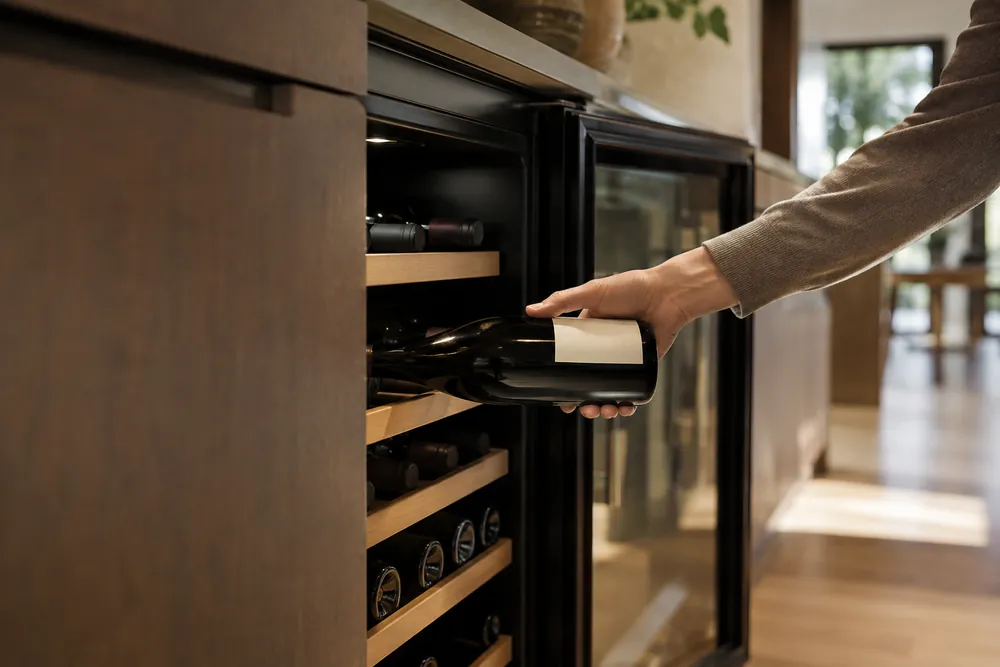
Noise, Heat, Ventilation, and Daily Fit
Noise, heat, ventilation, and door movement determine whether a wine cooler feels convenient or becomes a kitchen obstruction.
A suitable unit should fit the opening, release heat correctly, and operate quietly enough for the room where you prepare food, work, or sleep.
Capacity matters only after the cooler has a practical home. Measure width, height, and depth, then account for trim, baseboards, the power cord, leveling feet, and space for the door to open fully.
Match ventilation to the installation location
Built-in and freestanding descriptions are not interchangeable.
A front-venting built-in model can sit within a cabinet run when the manufacturer’s opening and airflow requirements are followed, while a freestanding unit may need open space around its cabinet.
| Placement type | Typical width | Common depth | Practical use |
| Countertop | 10–18 inches | 18–24 inches | Small collections and rentals |
| Undercounter built-in | 12–24 inches | 22–25 inches | Permanent cabinet runs |
| Freestanding floor unit | 15–30 inches | 20–27 inches | Pantry edges and open walls |
Do not push a freestanding cooler tightly against a wall or cabinet because restricted airflow can make the compressor work harder.
Check the guide for side, rear, and top clearances, especially near an oven, range, dishwasher, sunny window, or refrigerator exhaust.
Heat exposure affects comfort. A cooler beside a cooking appliance may run more often and add warmth to a compact room, while a shaded position with a stable indoor temperature is easier to live with.
Give noise a place in the decision
Compressor coolers can produce cycling sounds, fan noise, and vibration. Thermoelectric designs may sound gentler, but performance, ambient-temperature limits, capacity, and long-term suitability vary by product.
Read the manufacturer’s noise information and compare owner experience with the room’s purpose. A sound that disappears in a busy kitchen may become distracting beside a dining table, home office, or sleeping area.
- Place the cooler on a level, solid surface to limit rattling and cabinet vibration.
- Keep bottles, shelves, and the door rack from touching loosely or shifting during compressor cycles.
- Leave enough ventilation space that the appliance does not need to run continuously to maintain temperature.
- Use a location away from direct sunlight and other heat-producing appliances.
Prioritize usable capacity and access
Published bottle counts usually assume standard Bordeaux-style bottles arranged ideally. Champagne, Pinot Noir, Burgundy, and tall Riesling bottles can reduce usable capacity, particularly with fixed shelves.
| Specification | Common range | Trade-off |
| Compact storage | 6–18 bottles | Small footprint, limited mixed-bottle flexibility |
| Small undercounter storage | 18–46 bottles | More capacity, greater cabinet and door-clearance demands |
| Wine storage temperature | 40–65 degrees Fahrenheit | Supports chilled whites through cellar-style red storage |
Adjustable shelves, reversible hinges, and a clear control panel may be more useful than advertised capacity. Before buying, trace the open-door path and confirm that drawers, an island, appliance handles, and walkways remain usable.
Choose the unit that vents correctly, stays comfortable to hear, and fits your kitchen. A slightly smaller cooler with reliable access is usually better than a larger appliance that blocks storage or requires awkward workarounds.
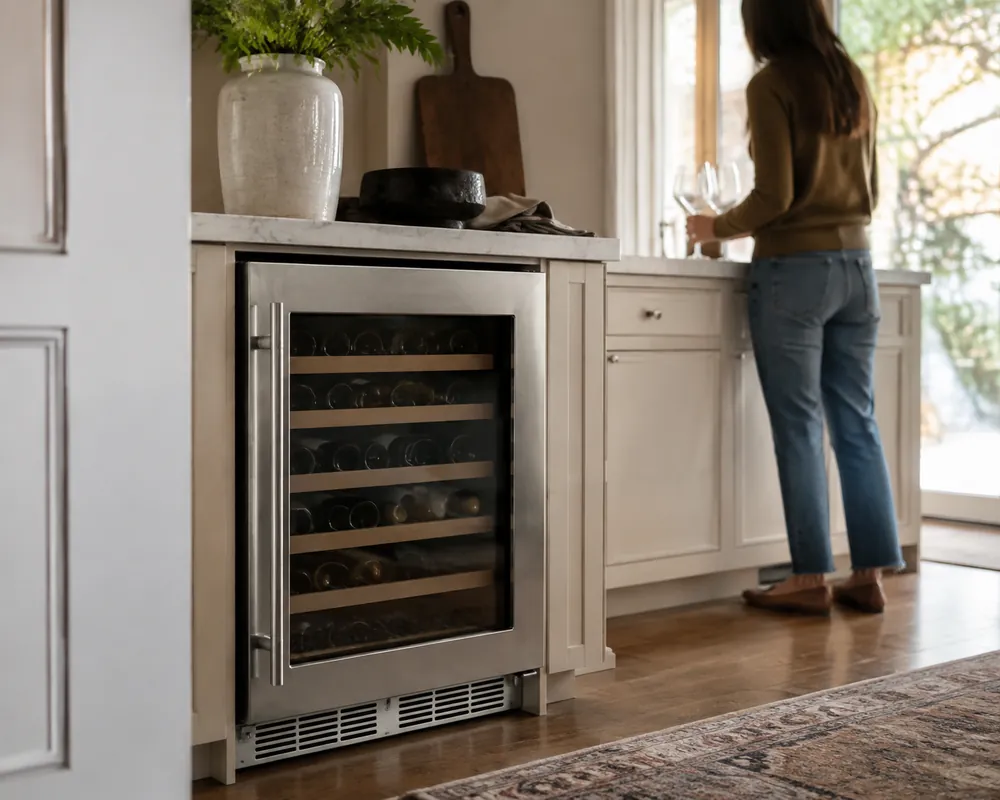
Where Buyer Reports Line Up and Where They Do Not
Owner reports consistently identify fit, ventilation, and bottle compatibility as key post-installation issues. Buyers also mention compressor noise, door clearance, and shelves that waste space with larger bottles.
Manufacturer documentation supports these concerns, although capacity figures often assume ideal storage conditions.
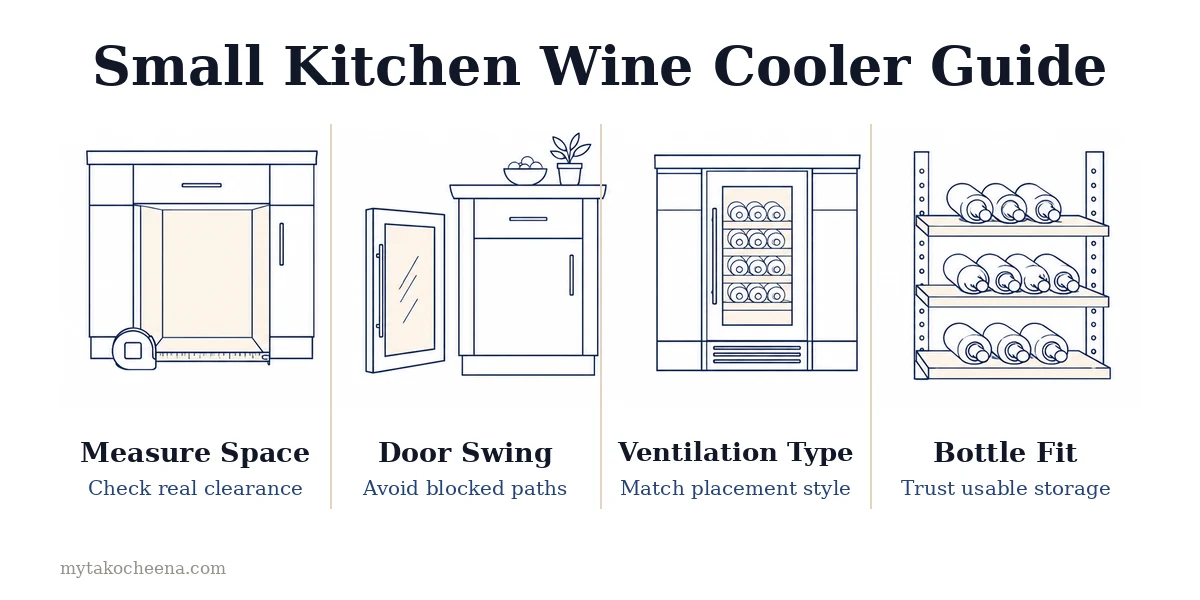
Reports line up most clearly on installation mistakes. A cooler placed too tightly against cabinetry, a heat-producing appliance, or a sunny wall may run more often and struggle to maintain its selected temperature.
Instructions commonly require open airflow for freestanding units, while front-venting built-in models suit cabinet installation.
| Category | Common range | Buyer trade-off |
| Countertop cooler width | 10–18 inches | Easy placement, limited bottle variety |
| Freestanding ventilation clearance | 2–6 inches | More placement flexibility, more lost floor space |
| Compact storage capacity | 6–18 bottles | Fits small kitchens, fills quickly with mixed bottles |
| Undercounter storage capacity | 18–46 bottles | Better entertaining capacity, stricter installation demands |
Capacity claims are where buyer experience and product literature diverge. Owners commonly lose usable space to Champagne, broad Pinot Noir, tall Riesling bottles, and shelf spacing.
Published counts usually assume standard Bordeaux-style bottles in an approved layout, so treat the figure as an upper guide rather than a daily expectation.
Noise feedback is less consistent. Some owners describe a low, occasional hum that fades into the background, while others notice cycling near quiet rooms or open-plan kitchens.
Documentation may list operating requirements without describing perceived sound, so placement away from seating and sleeping areas is practical.
Temperature performance depends on expectations and surroundings.
Specifications commonly cover a broad wine-storage range, but owner reports indicate that stability can suffer in hot rooms, cramped cabinets, or locations beside ovens and dishwashers.
| Use | Common category range | Relevant trade-off |
| Chilled whites and sparkling wine | 40–50 degrees Fahrenheit | Cooler setting, less flexibility for reds |
| General mixed storage | 45–55 degrees Fahrenheit | Compromise setting for varied bottles |
| Cellar-style red storage | 55–65 degrees Fahrenheit | Warmer storage, unsuitable for ready-to-serve whites |
Reports agree that reversible doors, adjustable shelves, and accurate external dimensions add more value than an impressive bottle count.
Before choosing, compare the installation diagram with the opening, outlet position, trim, island clearance, and door path. Select the unit whose ventilation needs and usable layout match the kitchen.
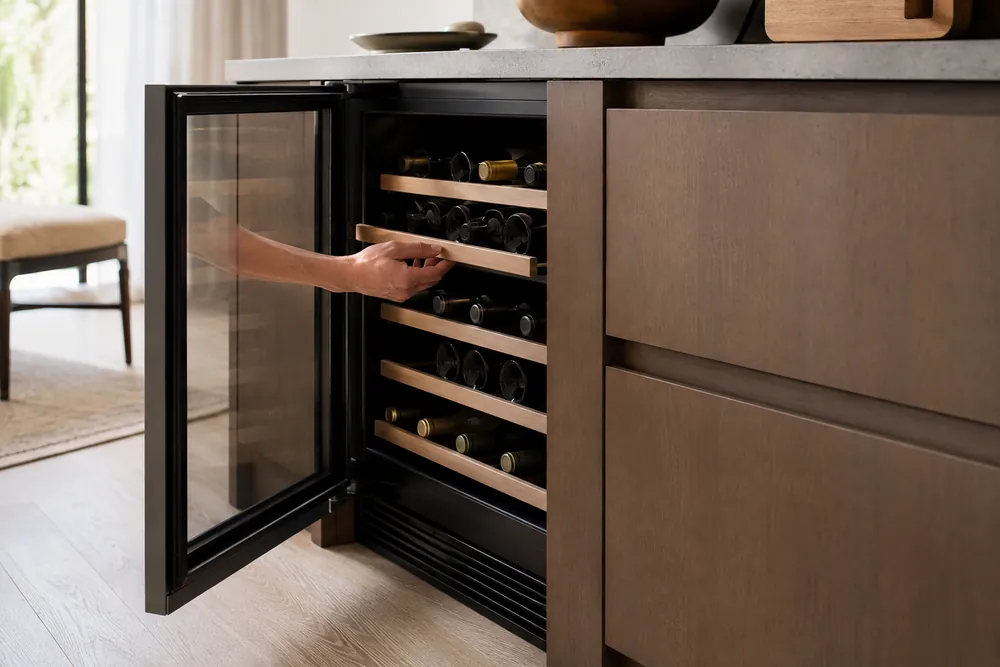
Questions the Spec Sheet Leaves Open
Published dimensions and bottle counts do not show how a wine cooler behaves in a compact kitchen. Buyers comparing My Tako Cheena appliances should verify airflow, door movement, shelf flexibility, noise, and actual bottle fit.
How much clearance does a small wine cooler need?
Clearance depends on whether the unit is built-in or freestanding. Front-venting appliances may fit beneath counters, while freestanding coolers need open space around heat-producing areas.
| Placement | Typical clearance to check | Main concern |
| Freestanding | 2 to 6 inches around ventilated sides or rear | Heat dissipation |
| Undercounter built-in | Follow the installation manual | Front airflow and cabinet fit |
Can a freestanding wine cooler go under a kitchen counter?
Use a freestanding unit beneath a counter only if the manufacturer permits it. Rear- or side-venting designs can overheat in tight openings, while front-venting models suit cabinetry better.
Check the required opening width, height, depth, and outlet position. Baseboards, countertop overhangs, and leveling feet can make a compatible opening unusable.
How many bottles will a compact wine cooler really hold?
Capacity claims usually assume standard Bordeaux bottles arranged as shown. Mixed collections reduce usable space because Champagne, Pinot Noir, Burgundy, and tall Riesling bottles need different shelf positions.
| Format | Common stated capacity | Likely trade-off |
| Countertop | 6 to 18 bottles | Small footprint, limited shelf flexibility |
| Undercounter | 18 to 46 bottles | More storage, greater cabinet commitment |
What temperature range should a small wine cooler have?
Choose a range matching the wines you buy rather than the broadest claim. Dual-zone storage separates serving temperatures but may reduce capacity and add unnecessary controls.
| Use | Typical range |
| Chilled whites and sparkling wine | 40 to 50 degrees Fahrenheit |
| General wine storage | 45 to 65 degrees Fahrenheit |
How noisy is a compact wine cooler in a small kitchen?
Noise matters more in open-plan kitchens, studios, and dining areas than closed pantries. Decibel specifications may not reveal compressor cycling, fan noise, vibration, or clicking.
Look for stable feet, vibration-conscious shelving, and reviews describing normal operation. A smaller, quieter appliance may be more comfortable than a larger unit with slightly greater capacity.
Does the wine cooler door need to be reversible?
A reversible door helps when the hinge conflicts with a wall, island, dishwasher, or cabinet handle. Confirm that conversion is supported, since some models require specific hardware or professional adjustment.
Measure the full door-swing path, not only the cabinet opening. The handle and open door can block drawers or walking space.
What should I check beyond the wine cooler dimensions?
Compare the complete installation footprint, including the plug, rear tubing, handle, feet, ventilation gaps, and open-door depth. These details can make a suitable-looking cooler crowd a small kitchen.
- Confirm the outlet location and cord reach.
- Check shelf adjustability for mixed bottle shapes.
- Verify the floor is level and supports the appliance.
- Match the finish and door direction to nearby cabinetry.