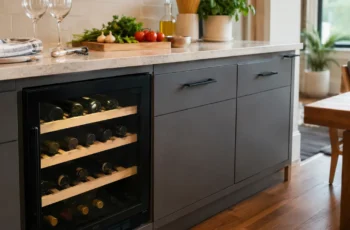
TL;DR: An under-counter wine cooler is a built-in appliance designed to fit inside a cabinet opening while venting heat safely from the front.
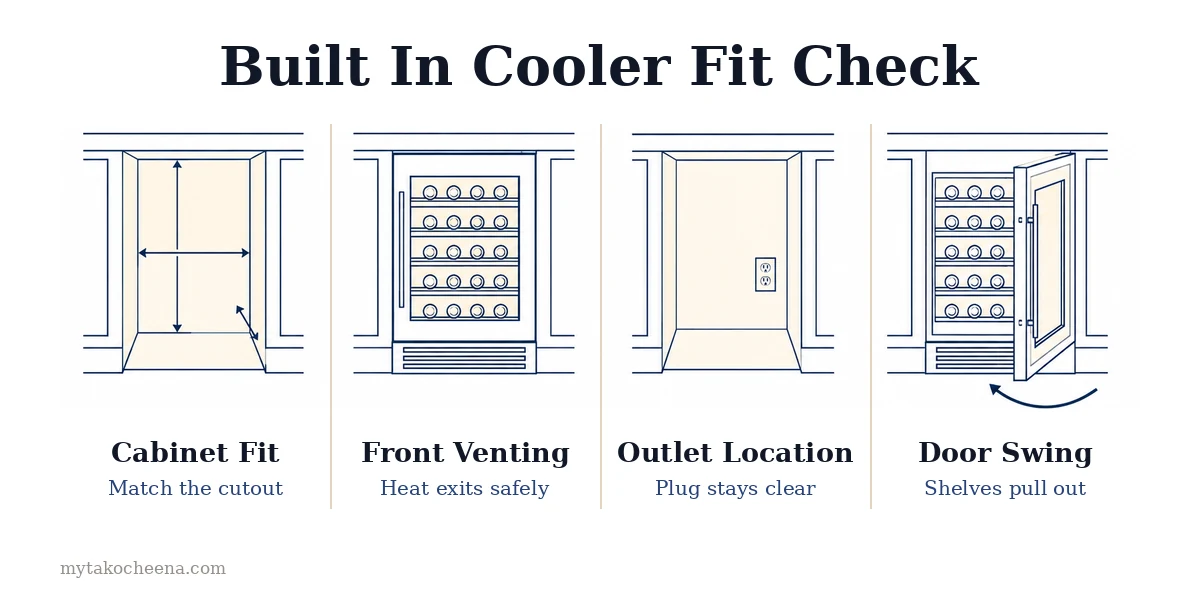
Before buying one, confirm the cutout dimensions, front ventilation, outlet location, door swing, leveling access, and bottle layout. A good installation depends more on fit and airflow than on appearance alone.
Built-In vs Freestanding Wine Coolers
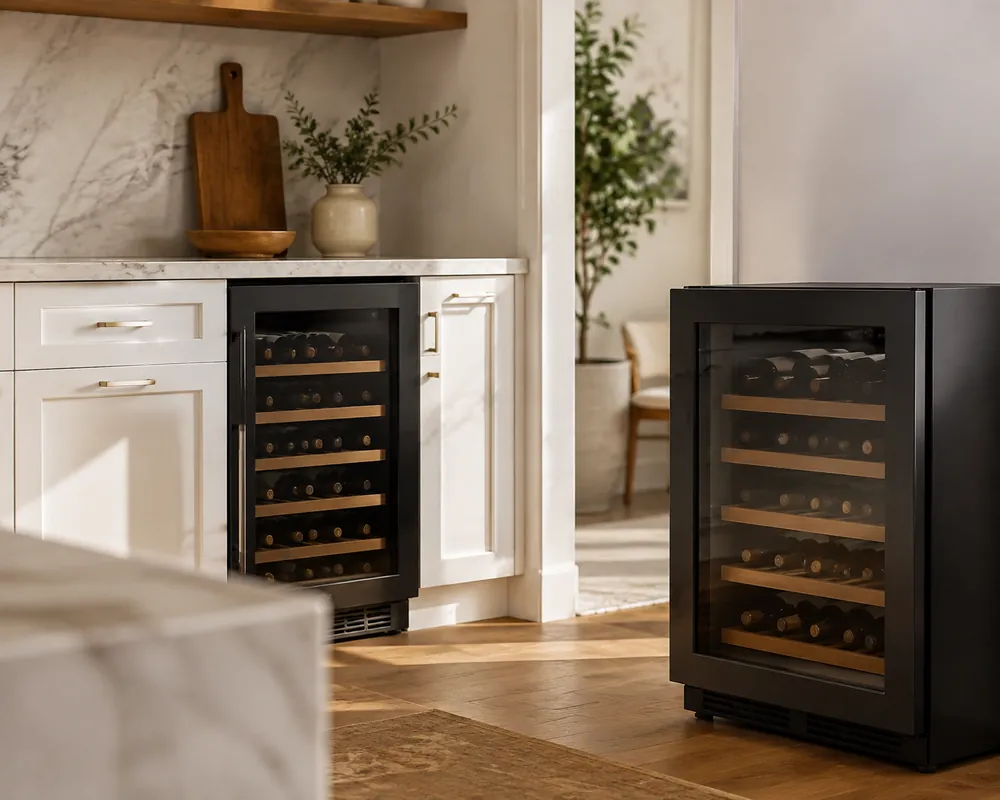
Built-in wine coolers are designed to slide into cabinetry and vent heat from the front. Freestanding wine coolers need open air around the cabinet, so they are easier to place but risk overheating inside a tight under-counter bay.
| Specification | Built-in wine cooler | Freestanding wine cooler |
| Typical cabinet opening width | About 15-24 inches | Not intended for enclosed openings |
| Common bottle capacity band | About 20-60 bottles | About 6-50 bottles |
| Typical operating temperature range | About 40-65°F | About 40-66°F |
| Typical side and rear clearance | About 0-2 inches, depending on instructions | About 2-6 inches, depending on instructions |
Built-in models cost more because the cabinet, hinges, door swing, and front ventilation are engineered for installation. They usually look cleaner under a counter and align better with kitchen appliance panels or stainless trim.
Freestanding models make sense for a pantry, dining room, basement, or open corner. They are less flexible under a counter because blocked side or rear airflow can shorten compressor life and raise internal temperatures.
- Choose built-in for a permanent kitchen run, island, bar cabinet, or butler’s pantry.
- Choose freestanding for movable placement where the unit has open air around it.
- Check the published cutout dimensions before ordering, not only the product’s exterior width.
- Confirm the door swing, handle depth, hinge clearance, and outlet location before installation.
Dual-zone models can help when storing reds and whites together, but they still follow the same ventilation rules.
A dual-zone freestanding cooler does not become safe for cabinet installation unless the manufacturer lists it for built-in use.
For an under-counter project, treat “front venting” and “built-in rated” as required specifications. Style matters, but ventilation compatibility decides whether the cooler will work safely in the opening.
Measure the Cabinet Opening Before You Buy
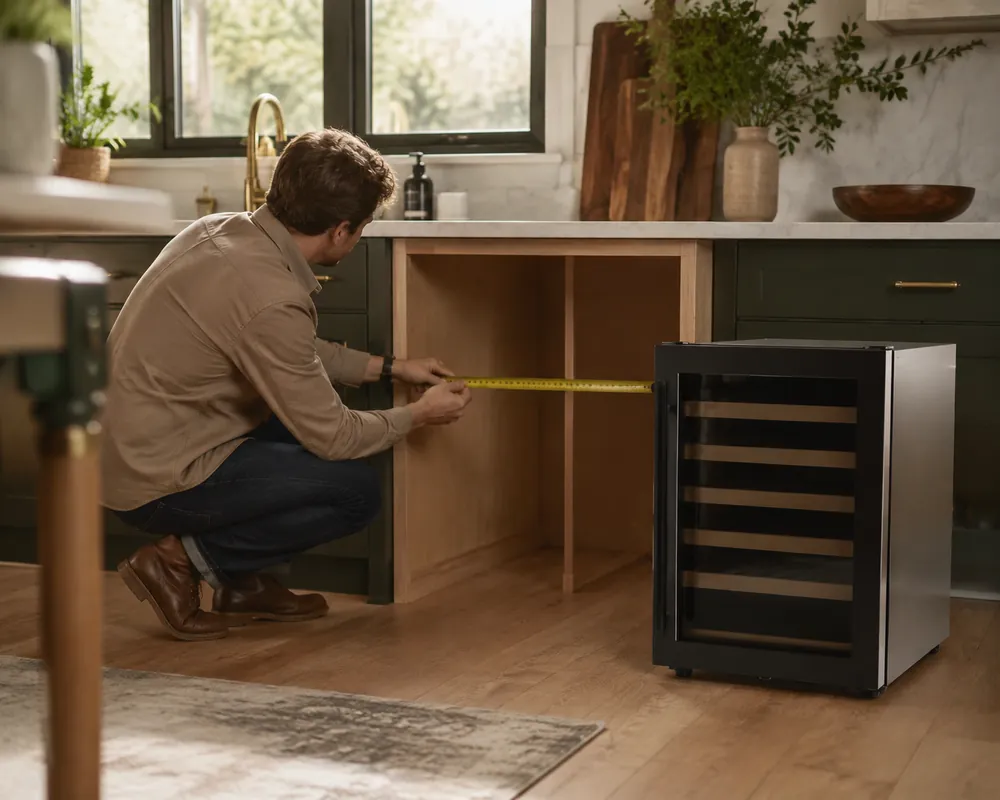
Cabinet measurements decide which under-counter wine cooler can fit, vent correctly, and look built in. Compare the published cutout requirements against your actual opening before you compare finishes, shelf layouts, or door styles.
Measure width, height, and depth at several points because older cabinets are not always square. Use the smallest reading as your usable opening, then compare it with the manufacturer’s required cutout range.
| Specification to compare | Common category range | Why it matters |
| Cabinet opening width | About 15-24 inches | Matches the most common built-in wine cooler categories |
| Cabinet opening height | About 34-35 inches | Fits typical under-counter placement below standard countertops |
| Cabinet opening depth | About 23-25 inches | Allows the cabinet face, plug, and door swing to work together |
| Typical ventilation clearance | About 0.25-2 inches | Depends on front-venting versus freestanding-style designs |
Depth causes many bad fits. A cooler can match the opening width but still sit proud because of the rear plug, anti-tip hardware, door gasket, or handle projection.
Check whether the published depth includes the handle. Also confirm that the door can open far enough for shelves to slide out without hitting a wall, dishwasher, or adjacent cabinet pull.
| Published specification | Common category range | Buying trade-off |
| Single-zone temperature range | About 40-65°F | Simpler control for one wine style or mixed short-term storage |
| Dual-zone temperature range | About 40-65°F across separate zones | More flexible, but shelf space may be divided |
| Common capacity band | About 20-50 bottles | Higher counts often assume standard Bordeaux-style bottles |
- Compare cutout size, not product size. Built-in units publish both, and the cutout requirement is the safer number.
- Look for front ventilation. True under-counter models usually exhaust through the front grille.
- Confirm electrical access. The outlet location should not force the cooler forward.
- Allow for flooring changes. New tile or thicker wood flooring can reduce usable height.
Use manufacturer specification sheets as the final reference, then compare owner reports for installation issues. That combination helps separate a good cabinet fit from a cooler that only fits on paper.
Ventilation, Clearances, and Airflow
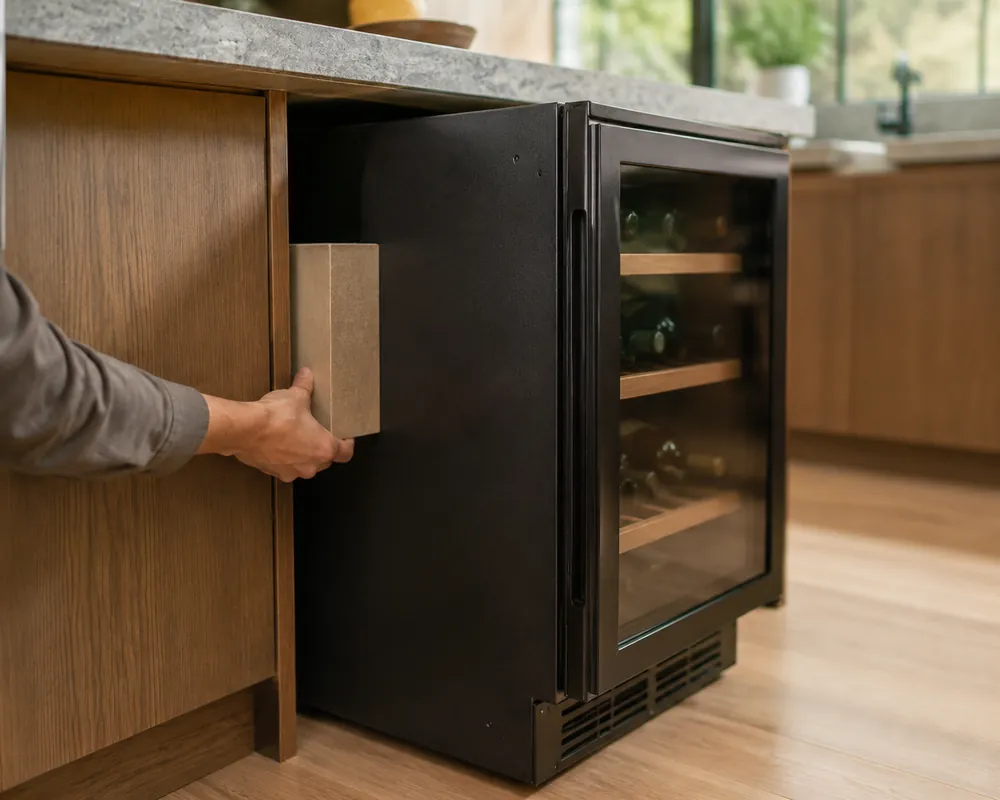
Ventilation determines whether an under-counter wine cooler can hold its rated temperature range without stressing the compressor.
Compare the installation diagram before comparing bottle capacity, because a flush look is only safe when the appliance is designed for that airflow path.
Built-in wine coolers usually vent through the front toe-kick area. Freestanding-style units often need side, rear, or top breathing room, so enclosing one under a counter can trap heat and shorten service life.
| Installation factor | Typical published range | Why it matters |
| Cabinet opening width | 15-24 inches | Matches common single-zone and wider dual-zone categories. |
| Cabinet opening height | 34-35 inches | Fits many under-counter layouts below standard countertops. |
| Side and rear clearance | 0.25-2 inches | Varies by front-venting versus freestanding airflow design. |
| Top clearance | 0.25-1 inch | Helps avoid heat buildup under the counter surface. |
Door swing also affects airflow and usability. Leave room for the handle, hinge movement, and shelf pull-out, especially beside a wall, dishwasher panel, or cabinet return.
Airflow checks before installation
- Confirm front venting: Look for a grille or toe-kick vent in the specifications, not only marketing language that says “built-in capable.”
- Match the cutout: Compare the listed appliance dimensions with the cabinet opening range, then allow the manufacturer’s stated clearance.
- Avoid sealed cavities: Do not block the lower grille with trim, flooring transitions, or a decorative panel.
- Plan service access: Leave enough slack in the cord and enough room to slide the cooler out without damaging cabinetry.
| Category spec | Common published range | Ventilation trade-off |
| Wine storage temperature | 40-65°F | Lower settings create more heat rejection at the vent. |
| Undercounter bottle capacity | 20-50 bottles | Larger cabinets usually need steadier front airflow. |
Owner reports often link noise complaints to tight installs, blocked grilles, or warm adjacent appliances. Keep the cooler away from ovens, direct sun, and heat-producing dishwashers where possible.
Electrical Requirements and Outlet Placement
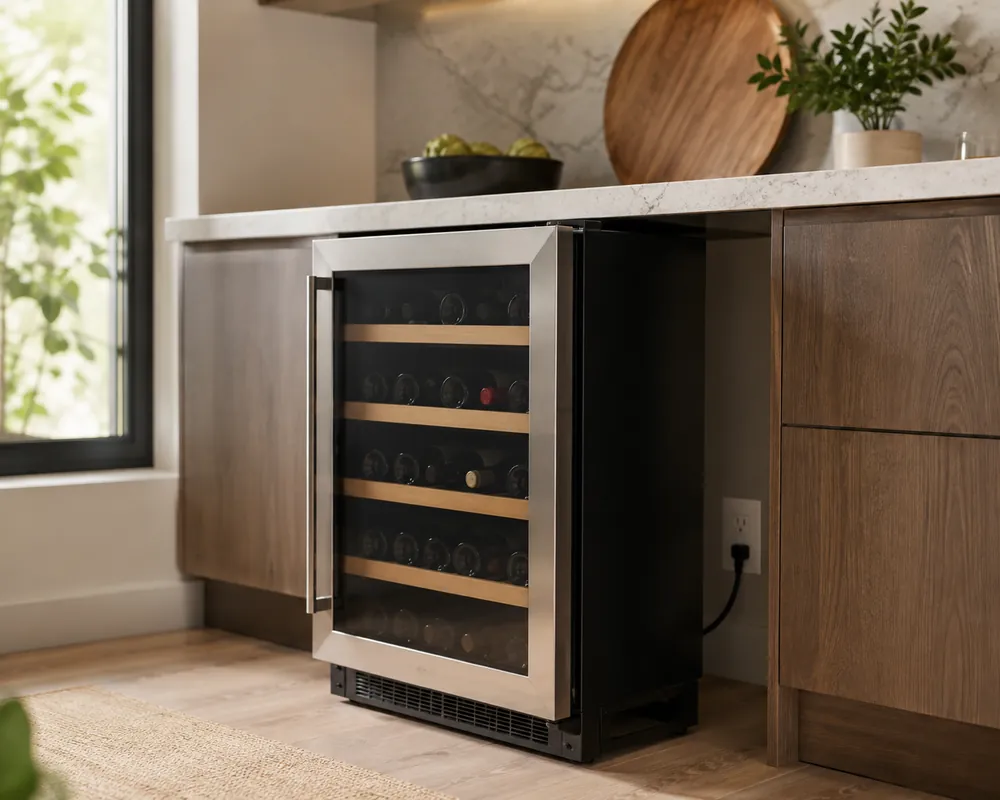
Electrical planning determines whether an under-counter wine cooler fits cleanly and remains serviceable.
Compare the manual, cabinet plan, and receptacle location before ordering, since published specs often assume a dedicated, accessible outlet.
Match the circuit to the published specification
Under-counter wine coolers are usually plug-in appliances. Check the nameplate and manual for voltage, plug type, circuit recommendation, and warnings against extension cords or power strips.
| Specification item | Typical published range | Why it matters |
| Branch circuit | 15-20 amps | Matches common US kitchen receptacle circuits and breaker ratings. |
| Operating draw | 70-200 watts | Helps compare compressor size, controls, lighting, and efficiency claims. |
| Storage temperature setting | 40-65 degrees Fahrenheit | Confirms the cooler suits white, sparkling, or red wine storage targets. |
A dedicated circuit is not always mandatory, but it often improves reliability. Sharing with disposers, microwaves, or countertop appliances can cause nuisance trips.
Place the outlet where the cooler can still be serviced
Outlet placement matters because the plug and cord need space behind the cabinet. A receptacle behind the compressor area can stop the cooler from sliding fully into the opening.
| Planning item | Common range | Trade-off to check |
| Standard under-counter width class | 15-24 inches | Narrow units save cabinet space; wider units usually increase bottle capacity. |
| Typical rear clearance allowance | 1-3 inches | More room helps cord bend, ventilation, and service access. |
| Common capacity band | 20-60 bottles | Higher capacity may require more cabinet width or deeper installation space. |
Place the outlet in an adjacent cabinet when allowed. This keeps the plug accessible and reduces the chance that the cord is crushed behind the cooler.
- Use a grounded receptacle: Wine coolers rely on a proper equipment ground for safe operation.
- Avoid extension cords: Many manuals prohibit them because they add resistance and heat.
- Check GFCI rules: Local code or kitchen layout may require GFCI protection.
- Leave service access: The plug should be reachable after installation without dismantling cabinetry.
Before cutting cabinets, compare the manual’s electrical diagram with the actual outlet location. The cord exit point, plug depth, and ventilation path determine whether the installation works.
Door Swing, Handle Clearance, and Toe Kick Fit
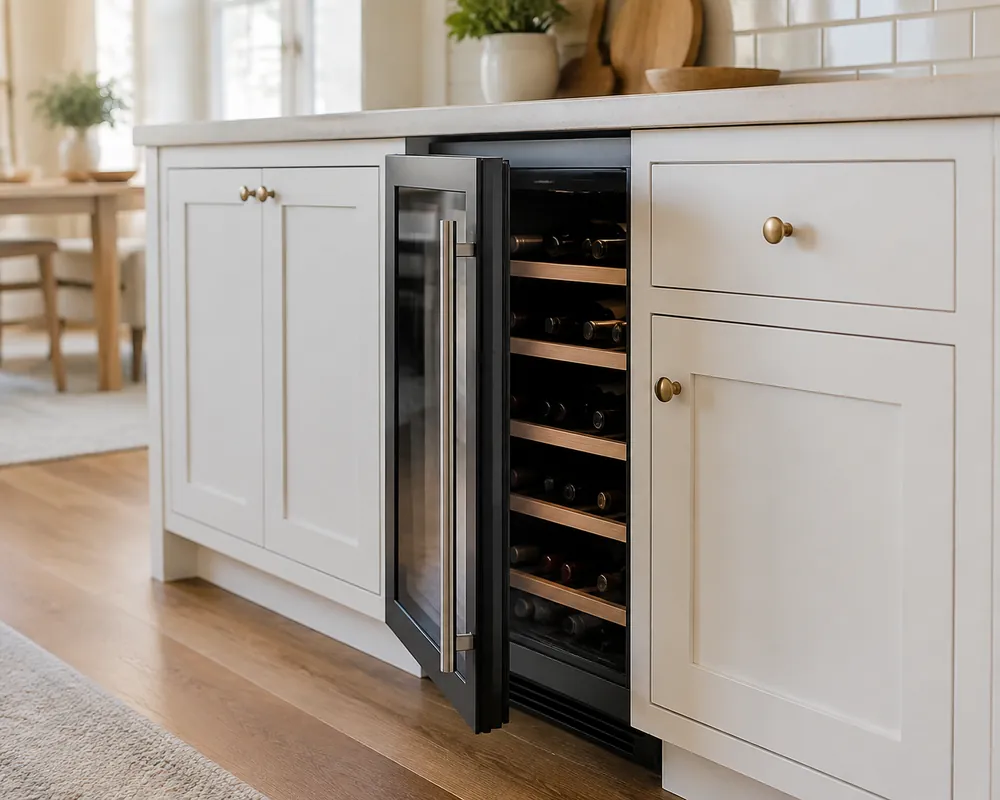
Door geometry decides whether an under-counter wine cooler feels built-in or becomes a daily annoyance. Compare the published cutout, hinge, handle, and ventilation notes before choosing a cooler.
Check the door swing diagram. A cooler may fit the opening yet still hit an island, dishwasher handle, wall return, or adjacent drawer front.
| Specification area | Typical category range | Why it matters |
| Cabinet opening width | 15 to 24 inches | Matches common single-zone and wider under-counter formats |
| Recommended side or rear clearance | 0.25 to 2 inches | Allows door movement, leveling, and ventilation, depending on design |
| Common under-counter height range | 32 to 35 inches | Helps align the cooler under standard countertop layouts |
Handle projection is easy to miss in product photos. Compare depth with and without the handle, especially in galley kitchens or beside a perpendicular cabinet run.
Reversible doors help, but not in every layout. Check whether the installer can reverse the hinge, and whether the badge, lock, or display affects the finished appearance.
- Beside a wall: Confirm the door can open wide enough to pull out shelves without scraping trim.
- Beside another appliance: Compare handle depth against dishwasher, range, or refrigerator pulls.
- At an island end: Allow walking clearance with the wine cooler door open.
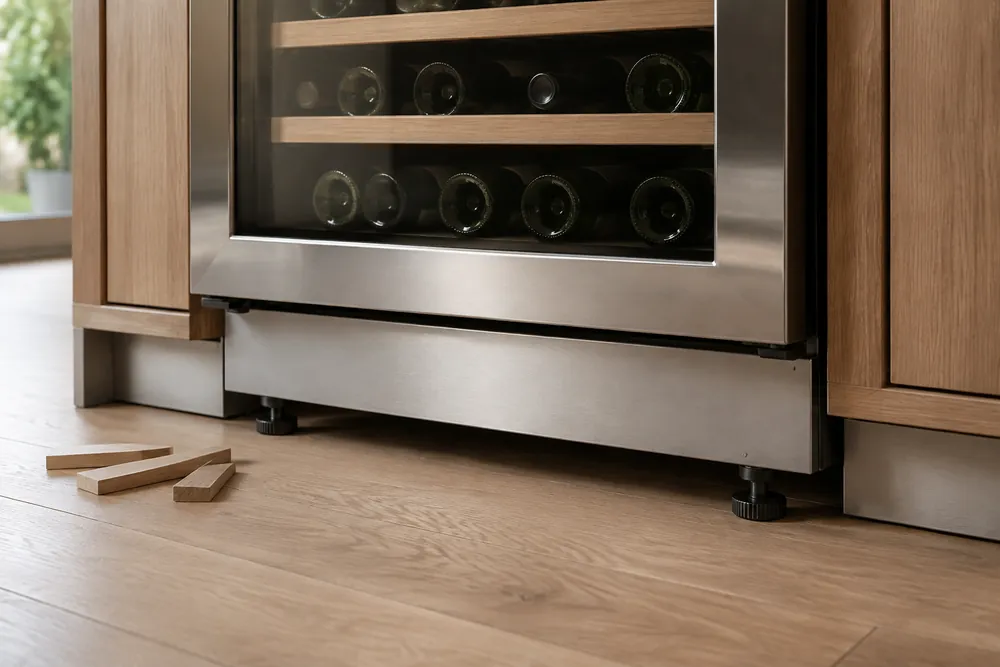
- Under a stone counter: Verify leveling feet adjustment before the unit is boxed in.
Toe kick fit affects looks and airflow. Built-in wine coolers often use front ventilation, so a custom toe kick should not block the grille unless the installation sheet allows it.
| Feature | Best fit scenario | Trade-off to check |
| Pro-style handle | Coordinates with stainless kitchen appliances | Adds projection beyond the cabinet face |
| Recessed handle | Helps in tight walkways | May feel less substantial to some owners |
| Front vent grille | Supports built-in installation | Must remain open below the door |
Final fit comes from drawings, not cabinet width alone. Print the specification sheet, mark the swing path, and confirm the toe kick plan before ordering trim panels or installation.
Leveling, Securing, and Sliding the Cooler Into Place
Leveling feet, anti-tip hardware, and a careful final push determine whether an under-counter wine cooler looks built-in or fights the cabinet.
Published specs usually give the cutout, clearance, and ventilation rules; follow those before trimming or fastening anything.
Check level before the final slide
Set the cooler near the opening, then adjust the front leveling feet until the cabinet sits square. A slight rearward stance can help the door close, but the unit should not rock or lean against surrounding cabinetry.
| Spec item | Typical published range | Why it matters |
| Cabinet opening width | 15-24 inches | Matches common single-zone and larger built-in formats |
| Ventilation clearance | 0.25-2 inches | Prevents heat buildup around sides, rear, or top |
| Wine storage temperature | 40-65°F | Covers common chilled white, sparkling, and red storage settings |
Use a carpenter’s level across the top and along the front edge. Recheck after loading bottles, because added weight can settle the feet and change the door alignment.
Secure without blocking ventilation
Built-in wine coolers may include brackets, toe-kick screws, or anti-tip points.
Use only the attachment locations shown in the installation sheet, because screws through the wrong panel can damage insulation, wiring, or the cooling system.
- Do not pinch the cord: Route it before the cooler enters the opening.
- Do not seal vent grilles: Front-venting models still need unobstructed intake and exhaust.
- Do not force the frame: Shim the cabinet opening instead of twisting the appliance body.
Slide the cooler in slowly, alternating pressure from each side to keep it centered. Stop before the front edge is flush, check the power cord, then complete the push by pressing on the cabinet frame, not the glass door.
| Approximate width band | Common bottle-capacity range | Trade-off |
| 15-inch class | 25-35 bottles | Narrow footprint, less shelf flexibility |
| 24-inch class | 40-60 bottles | More storage, larger cabinet commitment |
After the cooler is flush, open the door fully and confirm it clears adjacent drawers, handles, and hinges. Let the unit stand and stabilize per the manual before setting storage temperatures or loading valuable bottles.
Temperature Zones and Bottle Layout
Temperature zones determine whether an under-counter wine cooler works as short-term serving storage, longer-term holding space, or both.
Published specifications usually separate single-zone and dual-zone cabinets, so compare the stated ranges before comparing shelf count or door style.
Single-zone coolers keep every shelf at one target setting. They suit collections that lean toward one wine type, while dual-zone units help separate reds from whites or sparkling bottles without using a second appliance.
| Cooler type | Typical published range | Best use |
| Single-zone | About 40°F-65°F | One mixed collection held near a compromise setting |
| Dual-zone lower section | About 50°F-66°F | Red wine service or warmer storage |
| Dual-zone upper section | About 38°F-55°F | White, rosé, or sparkling wine service |
Published bottle capacity assumes standard Bordeaux-style bottles arranged exactly as shown by the brand. Burgundy, Champagne, and wide-shouldered bottles reduce the count because they need more shelf height or must be staggered.
| Nominal width category | Common published capacity range | Layout trade-off |
| 15-inch class | About 25-35 standard bottles | Narrow footprint, fewer display options |
| 24-inch class | About 40-60 standard bottles | More flexible shelves, larger cabinet opening |
| Wide or double-door class | About 80-150 standard bottles | Higher capacity, more demanding installation space |
Shelf layout affects daily use more than the headline capacity. Sliding wood shelves feel convenient, but fixed or tighter racks may hold more bottles on paper.
- Store reds higher in many dual-zone layouts because the warmer compartment is often above or separately controlled.
- Keep sparkling bottles lower when shelf spacing allows, since heavier bottles are easier to lift from a lower position.
- Leave room for airflow instead of packing every gap, because blocked vents can make temperature recovery slower.
Compare the diagram in the manual with the bottle shapes you actually buy. A cooler with a smaller stated capacity can be the better fit if its shelves accept your preferred mix without constant rearranging.
What Buyers Notice Once It Is Installed
Noise is the issue buyers mention most after an under-counter wine cooler is installed. Owner reports often describe a low compressor hum, fan cycling, or vibration that seems more noticeable once the unit is surrounded by cabinets.
Manufacturer documentation usually separates built-in models from freestanding units by ventilation path.
Front-venting designs are the safer match for under-counter openings, while rear-venting units can run warm or short-cycle if boxed in too tightly.
| Specification | Typical category range | Why buyers notice it |
| Cabinet opening width | 15 to 24 inches | Small differences affect trim fit, door swing, and replacement options. |
| Wine storage temperature | 40 to 65°F | Buyers compare whether one zone can serve whites, reds, or mixed storage. |
| Typical clearance guidance | 0.25 to 2 inches | Clearance affects heat buildup, cabinet contact, and operating noise. |
| Common capacity bands | 18 to 60 bottles | Real capacity drops with wider bottles, angled shelves, and mixed shapes. |
What holds up best, according to repeated owner comments, is basic temperature consistency in correctly ventilated installations.
Shelving, door seals, and stainless trim also tend to satisfy buyers when bottle size expectations match the published capacity method.
Early failures are more often reported around control boards, interior lights, fans, and rattling shelves than around the sealed cooling system.
Documentation typically treats these as serviceable components, but owner reviews show frustration when access requires pulling the appliance from cabinetry.
- Recurring complaint: audible cycling or vibration after the cabinet cavity amplifies normal operation.
- Common strength: clean built-in appearance and acceptable holding temperatures when ventilation rules are followed.
- Common weak point: electronics, fans, lights, and shelf hardware appearing before major cooling failure.
Buyer satisfaction usually tracks installation accuracy more than premium styling.
Comparing published cutout, clearance, hinge, and temperature specifications against owner reports gives a better signal than relying on bottle count alone.
Frequently Asked Questions
Under-counter wine cooler installation depends on dimensions, ventilation, power, and temperature range. Compare specs with the cabinet opening, bottle needs, and built-in rating.
What size opening do I need for an under-counter wine cooler?
Common under-counter wine coolers fit standard cabinet widths, but cutout dimensions vary. Check width, height, depth, hinge clearance, and door swing before ordering.
| Opening type | Typical published range |
| Width | 15-24 inches |
| Height | 32-35 inches |
| Depth | 22-25 inches |
Does an under-counter wine cooler need ventilation?
Yes. Built-in models usually vent from the front. Freestanding models often need side or rear airflow and should not be enclosed tightly.
What temperature range should a wine cooler have?
Wine coolers cover serving and storage temperatures, not food-safe refrigeration. Single-zone models suit one range; dual-zone models separate reds and whites.
| Use | Typical range |
| Longer storage | 45-65°F |
| White wine serving | 40-55°F |
| Red wine serving | 55-65°F |
Can I install a freestanding wine cooler under a counter?
Usually no, unless the manufacturer says it is built-in rated. A trapped freestanding unit can overheat, run loudly, or shorten compressor life.
Look for built-in, front-venting, or under-counter approved in the specifications. Marketing photos are not enough.
How many bottles fit in an under-counter wine cooler?
Published capacity usually assumes standard Bordeaux-style bottles. Larger Pinot, Champagne, or irregular bottles can reduce usable storage.
| Cooler width class | Typical bottle range |
| Narrow under-counter | 20-35 bottles |
| Full-width under-counter | 40-60 bottles |
Do I need a dedicated outlet for a wine cooler?
Many under-counter wine coolers use a standard grounded household outlet. The manual should specify voltage, plug type, cord location, and extension-cord limits.
Should I choose single-zone or dual-zone for under-counter installation?
Choose single-zone for one storage style and often more shelf space. Choose dual-zone to keep reds and whites at different serving temperatures.