In short: A wine cooler is a relatively modest electricity user, but its consumption varies by size, cooling technology, temperature setting, room conditions, and installation.
Small units generally cost less to operate than large built-in or dual-zone models. The most useful comparison is the published annual energy-use figure, while advertised wattage shows power draw during active cooling.
How Wine Cooler Electricity Use Is Usually Estimated
Annual energy use provides the clearest starting point for estimating a wine cooler’s electricity consumption.
Published figures are more useful for comparisons than rated wattage alone because they account for compressor cycling under controlled conditions.
Product specification sheets may list annual consumption, running wattage, or both.
Wattage describes the power draw while the compressor, fans, or thermoelectric system operates; annual consumption better reflects how often those components run during normal cooling.
Specification figures to compare
| Specification | Typical category range | Effect on electricity use |
| Storage temperature | About 40°F to 65°F | Colder settings generally require longer or more frequent cooling cycles. |
| Rated running wattage | About 60W to 200W | Higher ratings may reflect a larger cabinet, stronger cooling, or additional fans. |
| Common capacity | About 6 to 50 bottles | Larger cabinets usually cool more internal air and have greater thermal mass. |
| Required clearance | About 1 to 5 inches | Insufficient ventilation can increase compressor run time. |
Energy labels assume controlled ambient conditions, proper installation, and a particular temperature setting.
A unit in a warm kitchen, sunny room, garage, or tightly enclosed cabinet may use more electricity than its published estimate.
Installation style also affects how efficiently heat leaves the cabinet. Built-in models usually vent through the front, while freestanding units often need open space around the sides or rear.
| Design type | Typical use | Electricity consideration |
| Countertop or compact | Small collection storage | Lower capacity, but frequent temperature changes can increase cycling. |
| Undercounter built-in | Permanent cabinet installation | Front ventilation helps, but blocked vents can reduce efficiency. |
| Freestanding cabinet | Larger collection storage | Greater capacity may require more cooling and clearance. |
How to make a fair estimate
- Compare matching figures: use annual energy against annual energy, rather than comparing annual use with running watts.
- Check the temperature range: lower settings generally increase consumption.
- Review installation instructions: ventilation requirements influence real-world performance.
- Match capacity to your collection: an oversized cabinet can waste energy when it remains mostly empty.
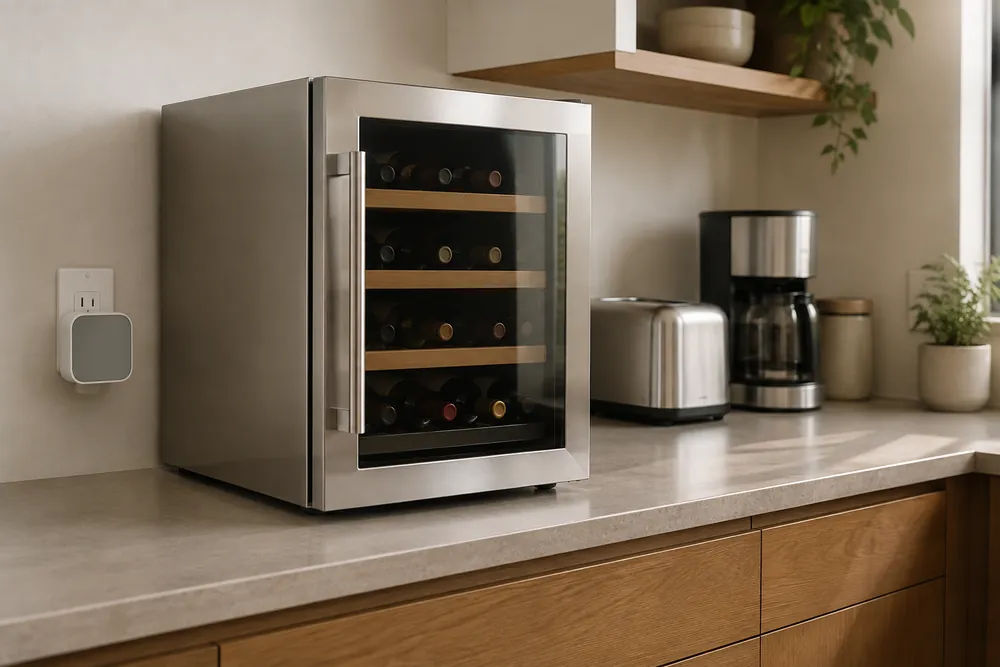
Main Factors That Change Power Consumption
Cabinet size, temperature setting, room conditions, ventilation, and door habits determine how much electricity a wine cooler uses.
The annual energy figure provides a baseline, but actual consumption rises when the compressor removes more heat or recovers from repeated temperature changes.
A larger, fully loaded cabinet usually needs more cooling capacity, particularly in a warm room. A compact cooler may use less electricity overall, although its compressor can cycle frequently because the cabinet has less thermal mass.
| Factor | Typical category range | Likely effect |
| Storage capacity | About 6 to 50 bottles | Larger cabinets generally require more energy |
| Storage temperature | About 40°F to 65°F | Lower settings usually increase compressor run time |
| Running wattage | About 60W to 200W | Higher draw can indicate greater cooling or fan demand |
| Required clearance | About 1 to 5 inches | Insufficient space can reduce heat release and raise usage |
Temperature setting directly affects workload. A cooler set near the lower end of its range must remove more heat, while a moderate setting may allow longer pauses between compressor cycles.
Room temperature matters because the cooler releases heat into the surrounding space. A unit in a hot kitchen, garage, enclosed cabinet, or sunny location may run longer than one in a shaded, climate-controlled room.
Ventilation is important for installation. Built-in models discharge heat through a specified path, while freestanding units commonly need open space around the sides, top, or rear.
- Keep air passages clear and follow the manufacturer’s installation instructions.
- Limit door openings and close the door fully after removing or adding bottles.
- Leave enough empty space for air to circulate around stored bottles.
- Avoid placing the cooler beside ovens, dishwashers, radiators, or direct sunlight.
Door openings affect recovery time. Warm room air enters whenever the door opens, so frequent browsing can increase compressor activity even when the room remains comfortable.
For fair comparisons, use annual energy consumption from units with similar installation types and temperature settings.
Treat rated wattage as an operating-load clue, not a yearly cost estimate, because the compressor does not run continuously.
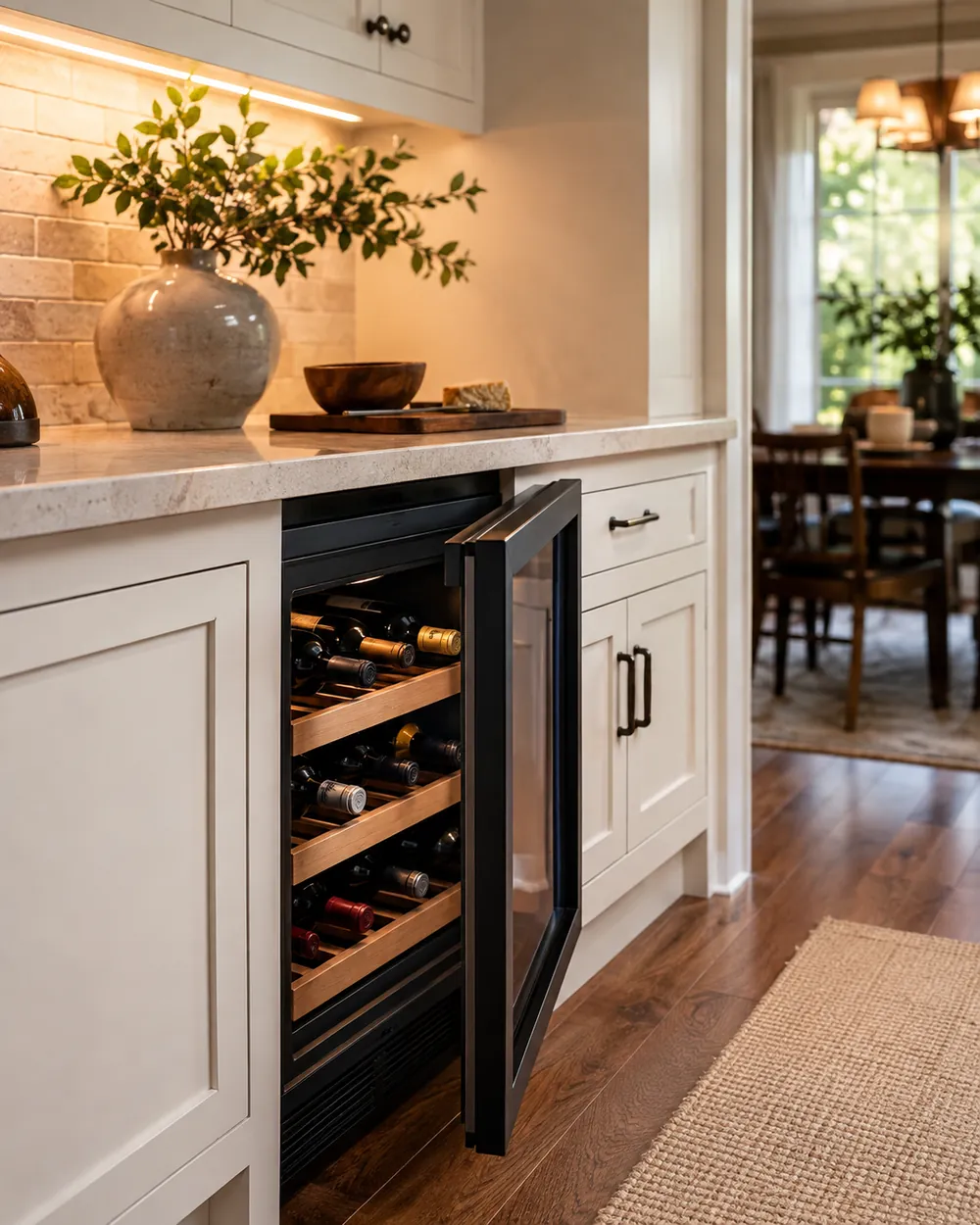
Thermoelectric vs Compressor Wine Coolers
Thermoelectric and compressor wine coolers remove heat in different ways, so their electricity use, noise, and temperature performance differ.
Thermoelectric designs suit smaller collections and moderate rooms, while compressor models generally handle larger cabinets and warmer surroundings more effectively.
Thermoelectric coolers use an electronic heat-transfer system with no conventional compressor or refrigerant cycle.
They are usually quiet and have fewer moving parts, but their cooling ability depends heavily on the room temperature and the cabinet’s heat dissipation.
| Feature | Common range or tendency |
| Storage capacity | About 6 to 20 bottles |
| Temperature range | About 46°F to 66°F |
| Best environment | Moderate indoor rooms away from direct sun |
| Main trade-off | Quiet operation but weaker performance in hot rooms |
Because thermoelectric units often have modest cooling capacity, they may run for long periods in a warm kitchen, enclosed cabinet, or garage.
Their lower apparent wattage does not automatically guarantee lower annual electricity use; operating duration matters as much as power draw.
Compressor coolers use a refrigeration cycle similar to a household refrigerator.
The compressor switches on and off as needed, allowing these units to reach lower temperatures and recover more effectively after door openings, new bottles, or warmer room conditions.
| Feature | Common range or tendency |
| Storage capacity | About 20 to 50 bottles |
| Temperature range | About 40°F to 65°F |
| Rated running power | About 60W to 200W |
| Main trade-off | Stronger cooling with compressor noise and cycling |
Compressor models can use more power while actively cooling, but cycling may reduce their average consumption under favorable conditions.
Ventilation remains important: blocked rear or front vents increase heat buildup, extend run time, and can erase the efficiency advantage suggested by the specification sheet.
Choose thermoelectric cooling for a small, quiet collection in a stable room. Choose a compressor model for larger storage, lower serving temperatures, dual-zone flexibility, or rooms that regularly become warm.
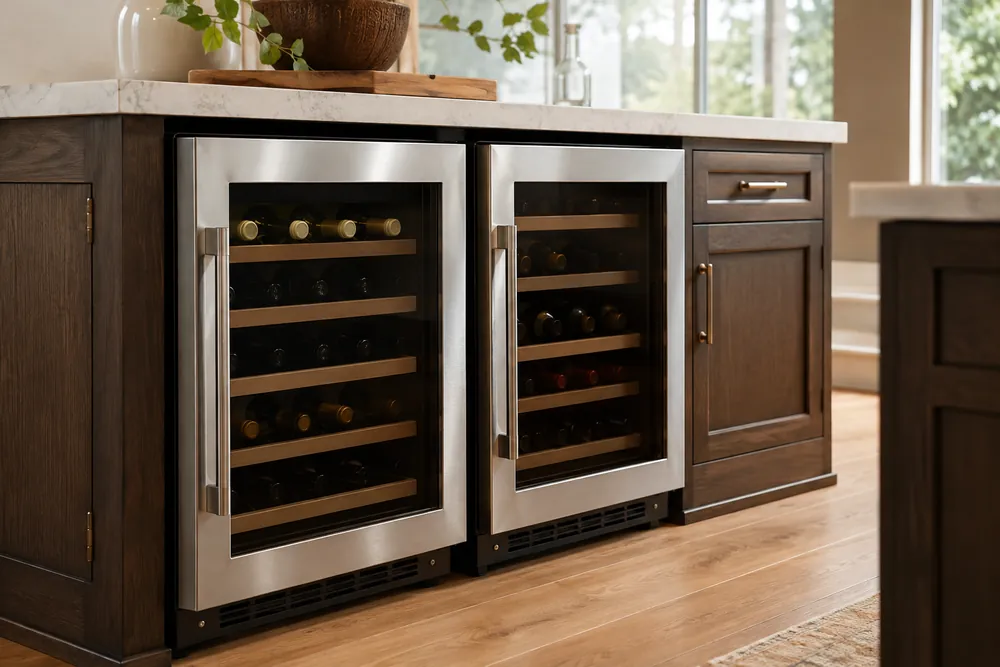
Small, Medium, and Large Wine Coolers Compared
Size directly affects wine cooler electricity use. Small units generally consume less, while medium and large cabinets need more cooling capacity and longer compressor cycles to maintain stable temperatures.
Capacity is not the only factor. Cooling technology, room temperature, ventilation, door openings, and storage temperature can cause similarly sized coolers to use different amounts of electricity.
| Category | Common storage range | Typical electrical trade-off |
|---|---|---|
| Small | About 6 to 18 bottles | Lower total consumption, but potentially more frequent cycling in warm rooms |
| Medium | About 19 to 35 bottles | Moderate consumption with more stable temperature retention |
| Large | About 36 to 50 bottles | Higher consumption because the cabinet cools more air and holds more thermal mass |
Small wine coolers suit apartments, counters, and occasional storage. Their compact cabinets usually need less energy per cooling cycle, but limited insulation and frequent door openings can reduce that advantage.
Medium wine coolers balance capacity and efficiency for regular household use. They provide more consistent storage than compact units, though electricity use rises as the cabinet fills and the compressor recovers after openings.
Large wine coolers suit larger collections but require careful placement. A full cabinet can retain temperature efficiently, while an oversized, mostly empty unit may use more electricity than necessary.
| Specification | Common range | Why it matters |
|---|---|---|
| Storage temperature | About 40°F to 65°F | Lower settings usually increase compressor run time |
| Rated running power | About 60W to 200W | Shows likely draw while cooling components operate |
| Required clearance | About 1 to 5 inches | Insufficient airflow can increase heat buildup and consumption |
Built-in and freestanding designs require separate comparisons. Front-venting built-in models fit under counters, while freestanding models need open space around the cabinet to release heat.
For fair comparisons, use annual energy consumption from product specifications rather than comparing running wattage with an annual estimate. The annual figure better reflects compressor cycling under controlled conditions.
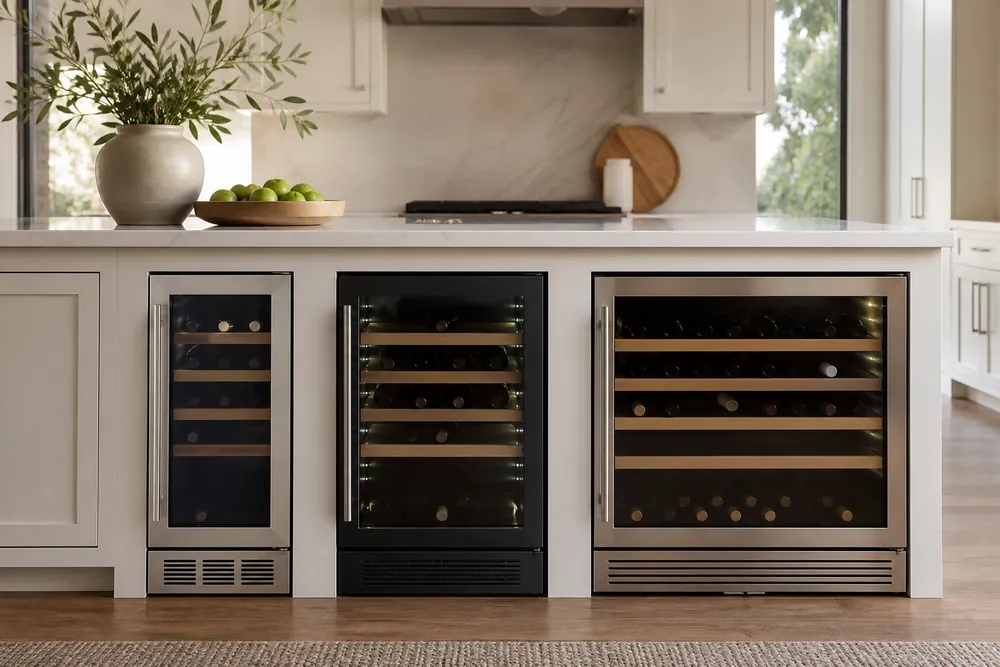
Where You Place the Cooler Matters
Placement can change how hard a wine cooler works, even when the cabinet, temperature setting, and bottle load stay the same.
A unit surrounded by heat or blocked from releasing warm air may run longer, cycle more often, and use more electricity than its published estimate suggests.
Freestanding coolers need open space around their sides, back, or top, depending on the manufacturer’s instructions.
Built-in models are designed to vent through the front, but they still require the correct cabinet opening and unobstructed airflow.
| Placement factor | Typical category range | Why it matters |
| Rear or side clearance | About 1 to 5 inches | Allows heat to escape from freestanding cabinets |
| Undercounter opening width | About 15 to 24 inches | Helps match the appliance to the available cabinet space |
| Common storage capacity | About 6 to 50 bottles | Larger interiors generally need more cooling work |
| Typical storage temperature | About 40°F to 65°F | Lower settings can increase compressor run time |
Kitchen heat is another concern. A cooler next to an oven, range, dishwasher, radiator, or sunny window receives extra heat that its compressor must remove.
A cooler in a shaded, temperature-controlled room usually has an easier workload.
Garages and enclosed utility rooms can be poor locations because temperatures may move well beyond the appliance’s intended operating environment.
Extreme heat can increase energy use, while cold conditions can interfere with temperature control, especially in compressor-based designs.
Placement also affects door-opening habits. A cooler located in a crowded corner may have its door opened longer while bottles are searched for, allowing more chilled air to escape.
Leave enough working space to identify bottles quickly and keep the door seal unobstructed.
- Follow the clearance instructions for the exact installation style.
- Keep vents, grilles, and the door gasket free of dust and obstructions.
- Avoid direct sunlight and nearby heat-producing appliances.
- Do not install a freestanding unit inside a tight cabinet unless it is specifically approved for that use.
How to Read Energy Labels and Product Specs
Energy labels and product specifications reveal more about a wine cooler’s likely running cost than advertised wattage alone. Annual energy use is usually the most useful comparison because it reflects compressor cycling.
Actual consumption still changes with room temperature, door openings, loading, and installation.
Start with annual energy use
Use annual energy consumption to compare products with similar capacity, cooling technology, and installation style.
Treat the figure as a controlled-condition estimate rather than a guarantee, especially if the cooler will sit in a warm kitchen, garage, or sunny area.
| Specification | Typical category range | Why it matters |
| Storage temperature | About 40°F to 65°F | Lower settings generally increase compressor run time. |
| Rated running wattage | About 60W to 200W | Shows likely draw while cooling components operate, not yearly use. |
| Capacity | About 6 to 50 bottles | Larger cabinets usually cool more air and interior material. |
| Required clearance | About 1 to 5 inches | Insufficient airflow can increase heat buildup and electricity use. |
Check installation requirements
Built-in and freestanding designs should not be judged by bottle count alone. A built-in unit typically vents through the front, while a freestanding cabinet needs open space around its sides or rear to release heat.
- Confirm the listed annual energy use under comparable conditions.
- Check whether the rating applies to the intended temperature setting.
- Measure the opening and ventilation space before choosing an undercounter model.
- Avoid oversizing the cabinet if it will remain mostly empty.
Wattage remains useful for understanding electrical load, but it does not predict the bill by itself. A higher-wattage compressor may run for shorter periods, while a lower-wattage cooler may operate more often in poor conditions.
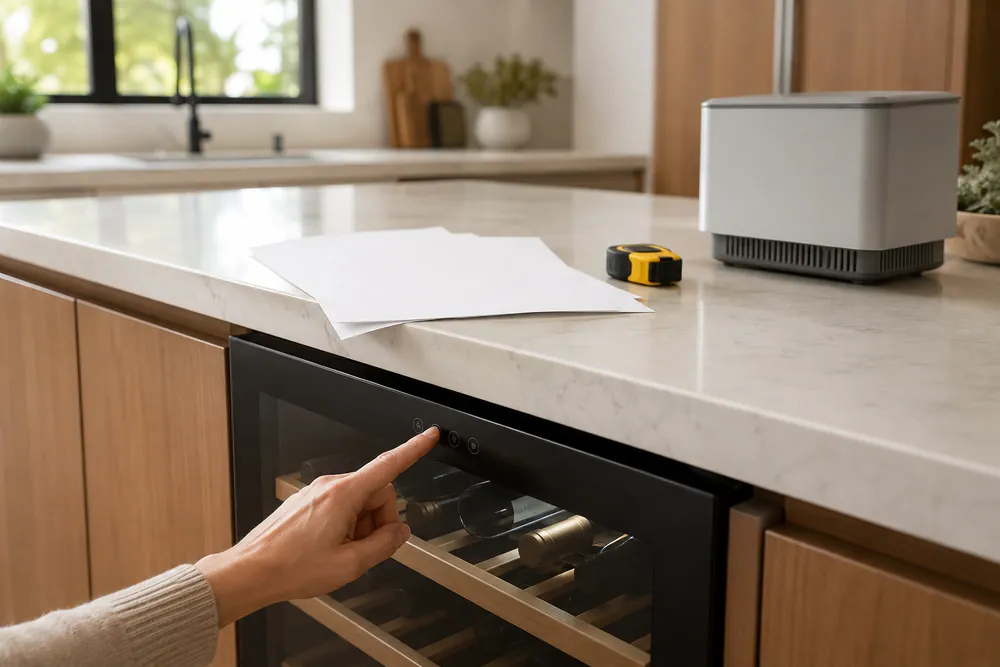
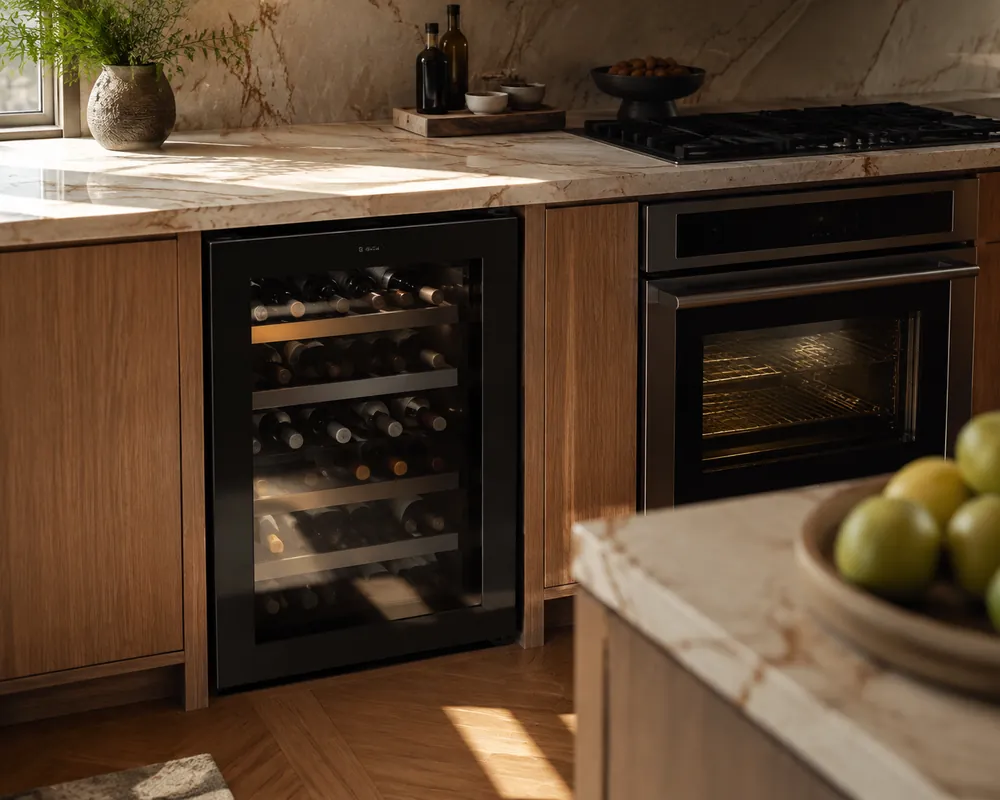
Before comparing energy figures, measure the space where the wine cooler will actually stand.
Record the opening’s width, height, and depth, then check whether the door can open fully without striking a cabinet, wall, island, or appliance.
Measure beyond the cabinet footprint. A freestanding cooler may need room behind or beside it for ventilation, while a front-venting built-in model may fit more cleanly under a counter.
Use the manufacturer’s clearance instructions as the deciding limit.
Compare the measured opening with the cooler’s external dimensions, not its advertised storage capacity. Include the handle, hinges, power cord, and any rear protrusion.
A unit that technically fits can still be difficult to install or prevent nearby drawers from opening.
Location also affects the label’s usefulness. A sunny kitchen corner, warm cooking area, or poorly ventilated enclosure can make the compressor run more often than the listed annual estimate suggests.
Choose the coolest practical position away from direct heat.
Finally, compare annual energy use only among models that fit the same installation conditions.
A slightly lower figure is less useful if the cooler requires unsuitable clearance, blocks a walkway, or cannot maintain airflow in the space you measured.
Where Buyer Reports Line Up and Where They Do Not
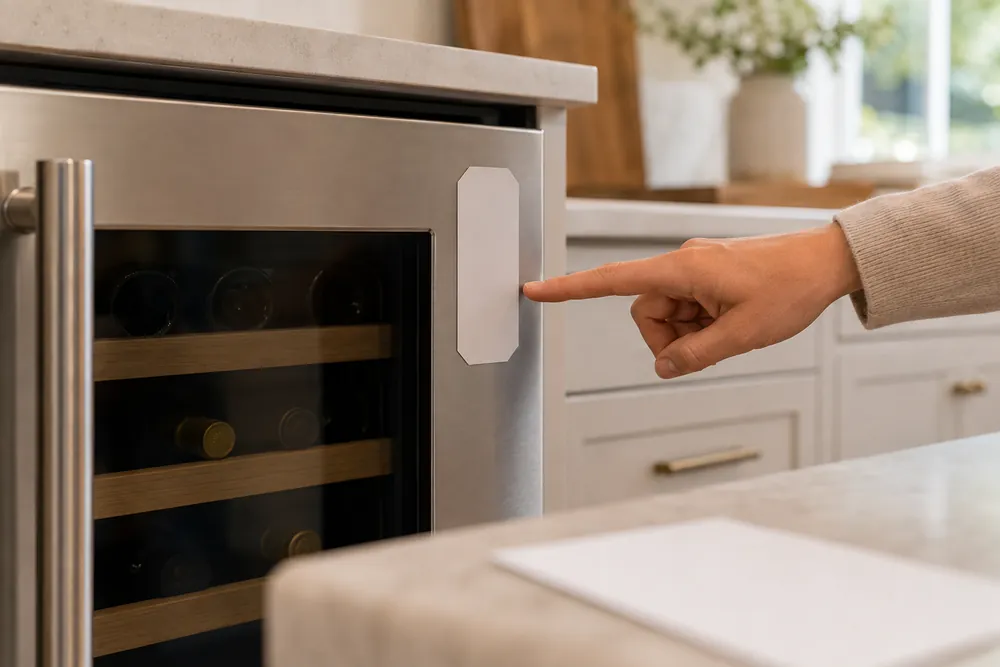
Owner reports and manufacturer documentation agree that wine coolers are inexpensive to operate compared with larger kitchen appliances.
Both also identify higher electricity use when the cabinet sits in a warm, cramped, or poorly ventilated location.
Temperature stability is the benefit owners mention most often. Buyers say a properly sized cooler maintains its setting with modest cycling when the door stays closed and the cabinet is away from an oven, dishwasher, or sunny window.
Manufacturer documentation supports that pattern under controlled conditions.
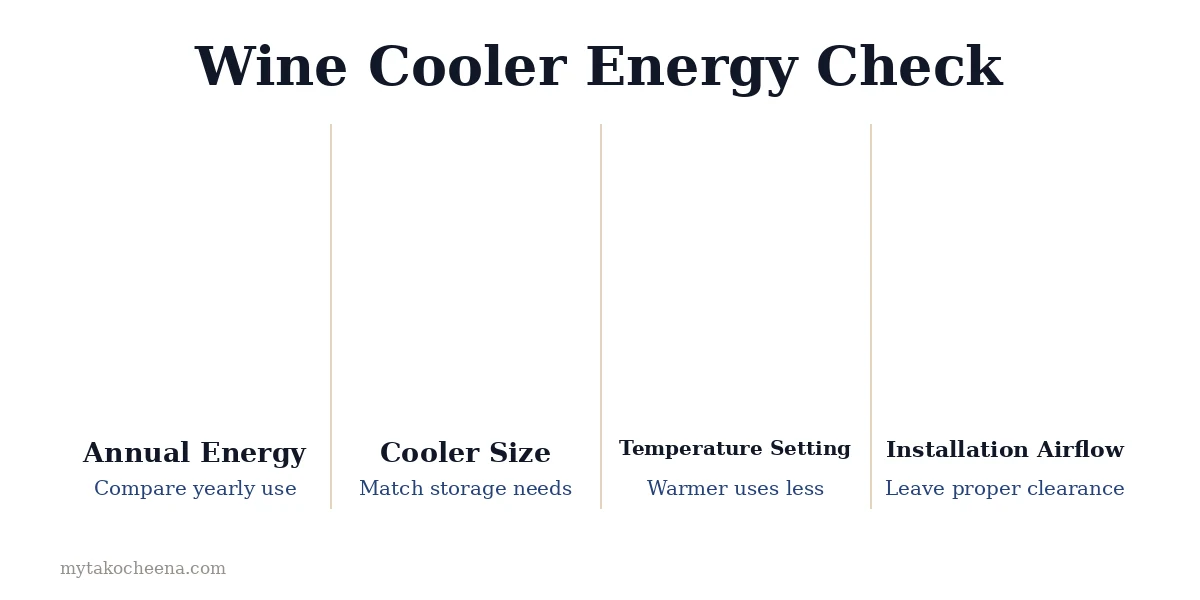
Published annual energy use is useful for comparison, while rated wattage describes electrical draw only while the compressor, thermoelectric system, or fans operate.
| Specification | Common range | Why reports differ |
|---|---|---|
| Storage temperature | About 40°F to 65°F | Colder settings can increase cycling. |
| Typical capacity | About 6 to 50 bottles | Larger cabinets cool more air and contents. |
| Rated running draw | About 60W to 200W | Actual runtime changes with room conditions. |
| Required clearance | About 1 to 5 inches | Restricted airflow can extend compressor operation. |
The recurring complaint involves noise, heat, or longer running after installation. Owners often connect these issues to inadequate clearance, frequent door openings, an empty cabinet, or room temperatures outside the documented range.
Early failures show no consistent pattern. Some owners report fans, thermostats, displays, or cooling systems failing early, while others report years of routine service.
Warranties and service terms matter because these components can be costly to replace.
Buyer accounts also disagree about efficiency. Smaller models usually use less energy, but frequent cycling can narrow the difference; larger models consume more electricity but may hold temperature more steadily when properly loaded.
Compare annual energy figures, installation requirements, and warranty coverage together. This reflects both documented operating design and recurring ownership problems.
Questions Still Worth Raising
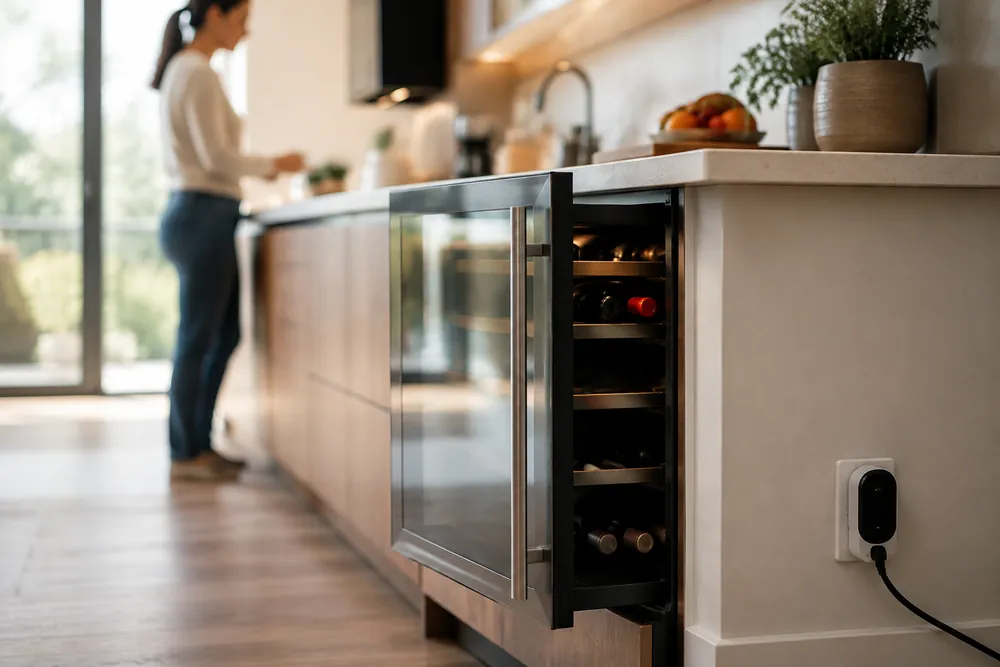
Wine cooler electricity use depends on advertised wattage, annual consumption, temperature, ventilation, cabinet size, and door-opening frequency.
How much electricity does a wine cooler use?
Annual energy use provides the most useful comparison. Rated wattage shows the draw while the compressor or fans operate, but the cooler cycles on and off.
| Specification | Typical category range | What it indicates |
| Rated running wattage | About 60W to 200W | Power draw during active cooling |
| Storage temperature | About 40°F to 65°F | Lower settings usually increase cycling |
Does a larger wine cooler cost more to run?
Usually, yes. A larger cabinet cools more air and holds more bottles, although insulation and compressor efficiency also matter.
Compare annual energy use with capacity instead of assuming more bottle space offers better value.
Do dual-zone wine coolers use more electricity?
Dual-zone designs often use more energy because they maintain separate temperatures. Check the annual-use figure for the exact configuration.
Does the temperature setting affect wine cooler power use?
Yes. Colder settings generally make the compressor operate more frequently, especially in a warm room.
Set each zone only as cold as needed to reduce unnecessary cycling.
How much clearance does a wine cooler need?
Clearance depends on ventilation design and installation type. Freestanding cabinets need open space around heat-dissipating areas, while built-in models commonly vent through the front.
| Installation type | Common guidance | Energy concern |
| Compact or countertop | About 1 to 3 inches | Restricted airflow can increase run time |
| Freestanding cabinet | About 2 to 5 inches | Heat buildup reduces efficiency |
Does opening the door make a wine cooler use more power?
Repeated openings release cooled air and introduce warmer air, so the compressor runs longer to restore the set temperature.
Keep bottles organized and avoid placing the cooler near sunlight, ovens, or other heat sources.
Is a wine cooler expensive to operate?
Many compact wine coolers use modest electricity, but cost depends on local rates and annual consumption.
Multiply the annual kilowatt-hour figure by your electricity rate. Treat the result as an estimate because room conditions can increase usage.