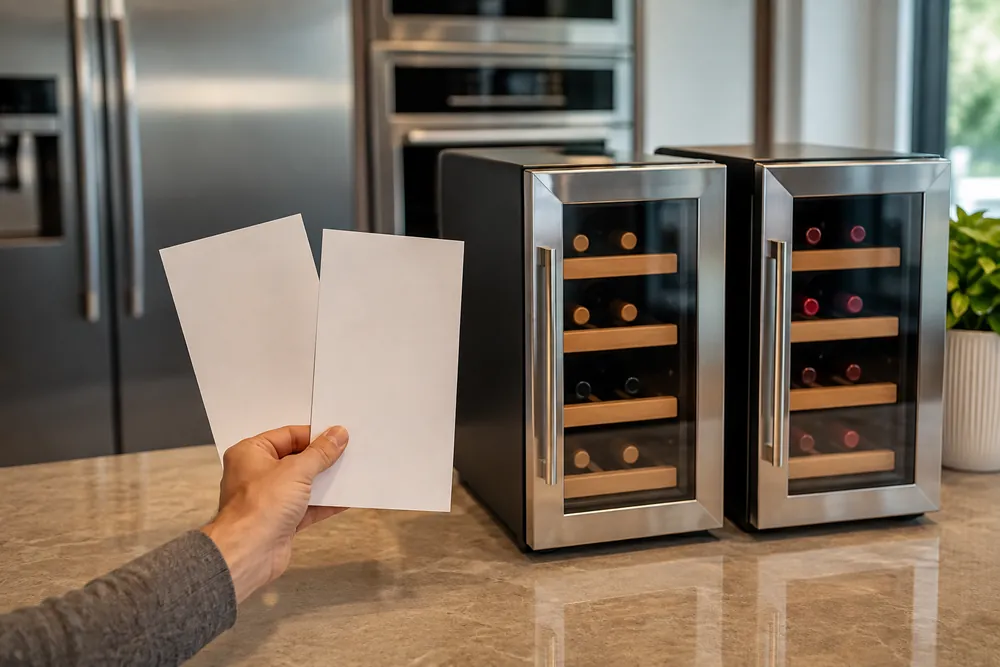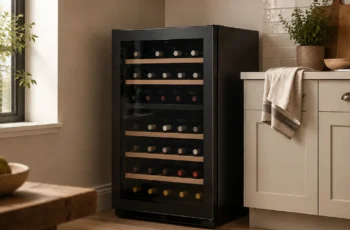
Quick Answer: Compressor wine coolers use a refrigerant system like a small refrigerator, while thermoelectric wine coolers use an electric cooling plate with fewer moving parts.
Compressor models usually cool more strongly and handle warmer rooms better. Thermoelectric models are often quieter and simpler, but they depend more on room temperature and placement.
Thermoelectric vs Compressor Wine Coolers: The Core Difference
Cooling method is the main split between thermoelectric and compressor wine coolers. One uses a solid-state heat pump, while the other uses a refrigerant system similar to a compact refrigerator.
That difference affects cabinet size, noise, vibration, temperature range, placement, and energy use. Published specifications usually show the trade-off before you compare trim, shelving, or door finish.
How each cooling system works
Thermoelectric wine coolers move heat through an electronic module. They have no compressor, so they are often marketed as quiet and low-vibration choices for small collections.
Compressor wine coolers use refrigerant, a compressor, and a condenser. They usually cool more strongly, recover temperature faster after door openings, and handle warmer rooms better.
| Specification | Thermoelectric wine coolers | Compressor wine coolers |
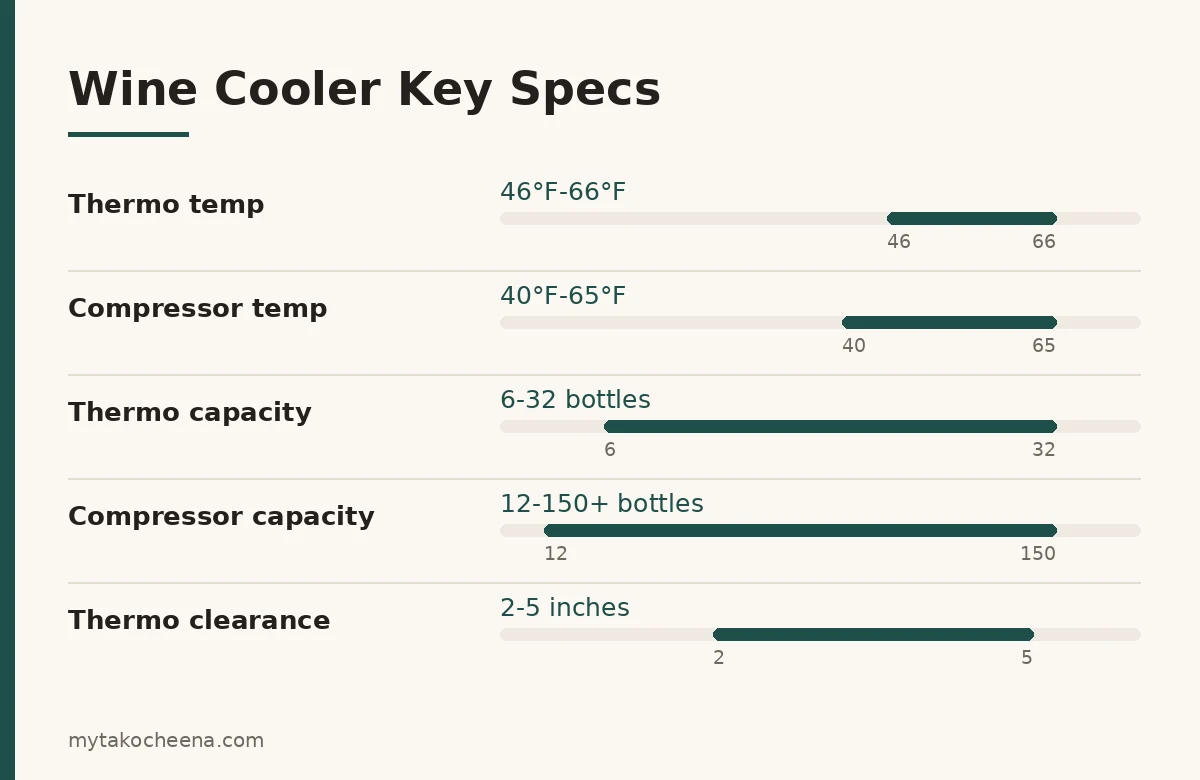
| Common storage temperature range | About 46°F-66°F | About 40°F-65°F |
| Common bottle capacity band | About 6-32 bottles | About 12-150+ bottles |
| Typical rear or side clearance need | About 2-5 inches | About 0.25-5 inches, depending on built-in or freestanding design |
Thermoelectric models are usually best for stable indoor rooms. Their cooling depends heavily on ambient temperature, so a hot garage or sunny dining area can push them beyond their useful range.
Compressor models are better suited to larger cabinets, dual-zone layouts, and warmer installation spots. They can cycle audibly, but many current units list low-noise operation in the product specifications.
What the difference means for buyers
For casual countertop storage, thermoelectric can make sense. It keeps the design simple, reduces moving parts, and avoids the start-stop hum associated with a compressor.
For long-term storage, larger collections, or tighter temperature control, compressor cooling is usually the safer category. It gives manufacturers more cooling headroom, which matters when the door opens often or the room runs warm.
| Decision point | Thermoelectric advantage | Compressor advantage |
| Small apartment or office | Quiet operation and compact sizes | Better cooling if room temperature swings |
| Kitchen built-in installation | Less common in true built-in formats | More venting options, including front-vented designs |
| Mixed red and white storage | Works for mild single-zone storage | More common in dual-zone cabinets |
Published listings sometimes make both types look interchangeable. They are not, because a target temperature range does not prove equal performance under real household conditions.
Check the installation type before the cooling type alone. A freestanding unit usually needs open air around it, while a built-in unit must be designed to vent safely inside cabinetry.
- Choose thermoelectric for small collections, quiet rooms, and moderate indoor temperatures.
- Choose compressor for larger capacity, built-in placement, dual zones, or warmer locations.
- Compare specifications for temperature range, capacity band, venting, dimensions, and noise claims before styling.
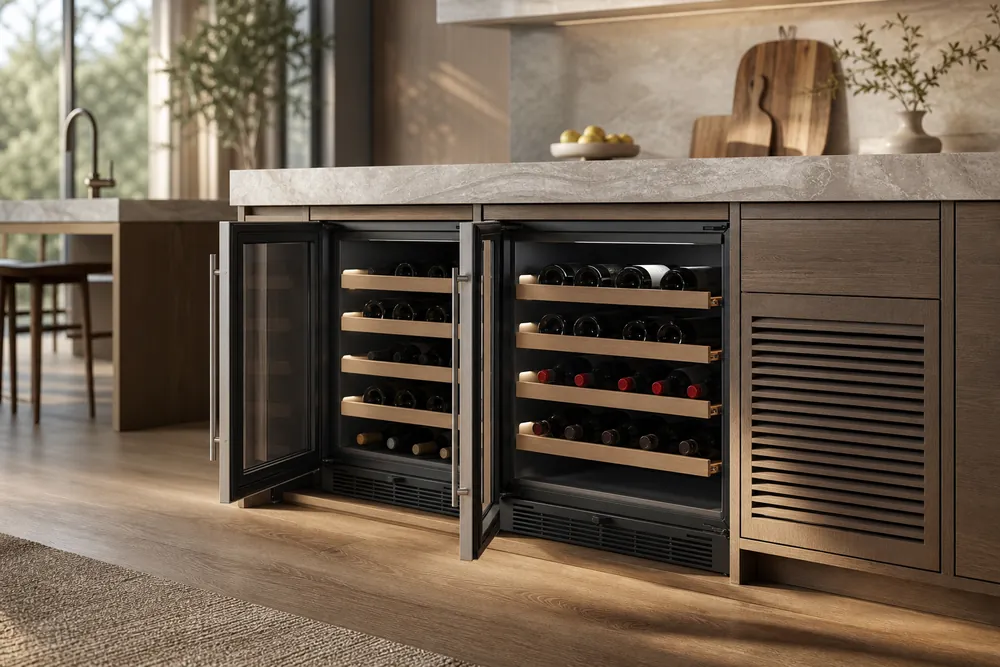
Cooling Performance, Noise, and Energy Use
Cooling performance separates thermoelectric wine coolers from compressor wine coolers more than style or shelf layout. Published specifications usually show the gap in temperature range, placement requirements, and power draw.
Thermoelectric units use a solid-state cooling module, so they avoid the cycling hum of a compressor. They are usually quiet, but they depend heavily on room temperature and airflow around the cabinet.
| Specification | Thermoelectric wine coolers | Compressor wine coolers |
| Common storage temperature range | About 46°F-66°F | About 40°F-65°F |
| Common capacity band | About 6-24 bottles | About 12-150+ bottles |
| Typical ventilation clearance | About 2-5 inches around vents | About 1-3 inches for freestanding units |
| Usual power draw band | About 50-100 watts | About 80-200 watts |
Compressor coolers are stronger when the room runs warm or the cabinet holds more bottles. They also recover faster after the door opens, which matters for kitchens, bars, and dining rooms with frequent use.
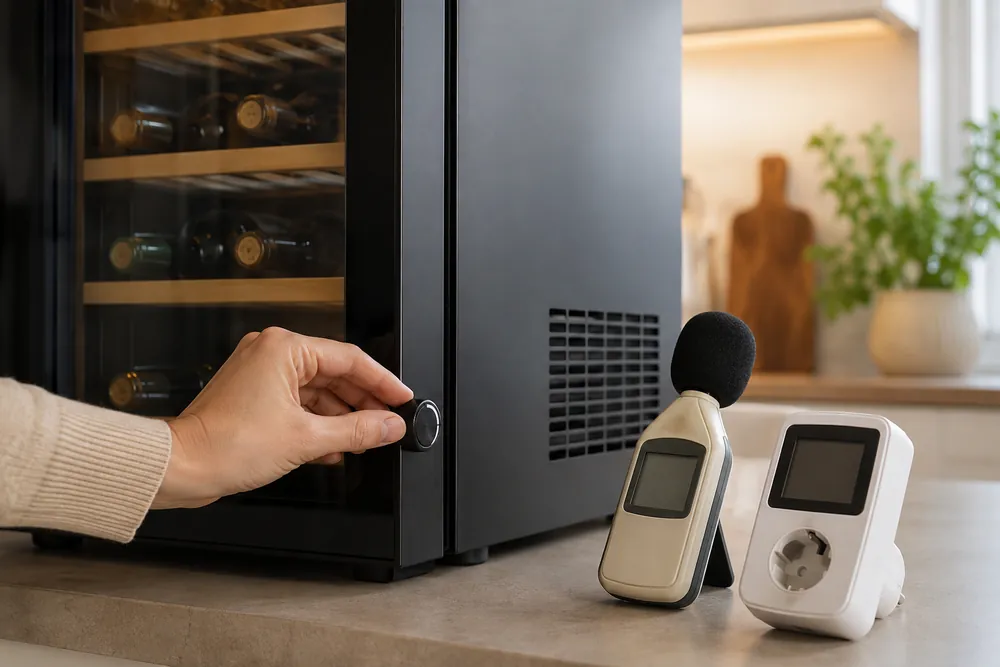
Noise is not only about decibel claims. Thermoelectric coolers often produce a steady fan sound, while compressor models add start-stop cycles, vibration risk, and fan noise.
- Choose thermoelectric for small collections, mild rooms, and low-vibration placement.
- Choose compressor for wider temperature control, larger storage, and warmer household locations.
- Check ventilation before buying, because blocked airflow can raise noise and reduce cooling performance.
Energy use depends on insulation, door glass, room temperature, and how often the door opens.
A thermoelectric unit can run continuously in a warm room, while a compressor unit may cycle more efficiently once it reaches set temperature.
For built-in installations, confirm the manual says front-venting or undercounter approved. Freestanding-only wine coolers should not be boxed into cabinetry, because trapped heat can shorten component life and make the unit louder.
For specification shopping, compare the stated temperature range, bottle count, venting instructions, and noise notes together.
A quieter cooler on paper may be the wrong choice if it cannot hold the storage temperature your wine needs.
Which Type Fits Your Kitchen, Bar, or Apartment
Kitchen fit starts with heat, vibration, noise, and space. Thermoelectric wine coolers suit quiet, stable indoor rooms, while compressor wine coolers handle warmer kitchens, larger cabinets, and broader storage needs.
For a small apartment, thermoelectric units can make sense because they have fewer moving parts and usually run with a softer sound profile.
They also depend more on room temperature, so they are weaker near ovens, sunny windows, or hot utility spaces.
Compressor coolers are the safer pick for built-in bars, busy kitchens, and mixed red-white storage. Published specifications usually show wider temperature control, stronger cooling recovery, and more cabinet-size options.
| Specification | Thermoelectric wine coolers | Compressor wine coolers |
| Typical storage temperature range | About 46°F-66°F | About 39°F-65°F |
| Common bottle capacity bands | About 6-28 bottles | About 12-150 bottles |
| Typical rear or side clearance | About 2-5 inches | About 0-5 inches, depending on venting style |
| Usual power draw band | About 50-100 watts | About 70-200 watts |
For small apartments
Apartment buyers usually care about noise, heat output, and floor space. A thermoelectric cooler can work well for a compact countertop or freestanding corner setup, especially for short-term storage and a modest bottle count.
Check the required clearance before placing any freestanding unit under a counter. Blocking side or rear ventilation can raise cabinet temperature, increase run time, and shorten component life.
For built-in kitchen cabinets
Built-in installation usually favors compressor cooling because many models are designed with front ventilation. That matters under countertops, where side and rear airflow may be restricted by cabinetry.
Standard undercounter openings often fall around 15-24 inches wide, with height and depth tied to the cabinet run. Compare the appliance cutout requirements against your actual opening, not only the exterior product width.
| Location | Better fit | Why it fits |
| Countertop apartment use | Thermoelectric | Compact sizes, lower vibration, simple placement |
| Undercounter kitchen cabinet | Compressor | More front-vented choices and stronger cooling |
| Home bar with mixed bottles | Compressor | Larger capacity bands and wider temperature ranges |
| Quiet office nook | Thermoelectric | Soft operation when room temperature stays stable |
For home bars and entertaining areas
Home bars often need faster recovery after the door opens repeatedly. Compressor systems generally handle that better, especially with larger bottle loads or warmer ambient conditions.
Dual-zone compressor models also appear more often in published specifications. They are useful when you want whites cooler and reds slightly warmer without buying two separate appliances.
Quick fit checklist
- Choose thermoelectric for small collections, quiet rooms, and stable indoor temperatures.
- Choose compressor for built-in cabinets, larger collections, warmer kitchens, and dual-zone storage.
- Check ventilation before buying, because clearance needs affect real kitchen fit.
- Compare temperature ranges against the wine you store, not only the lowest advertised setting.
- Measure the opening including trim, hinges, plug space, and door swing.
The best choice is the cooler that matches the room first and the bottle count second.
For My Tako Cheena readers comparing US appliance specs, compressor models usually win for permanent kitchen or bar installs, while thermoelectric models stay useful for compact, quiet spaces.
Installation, Ventilation, and Placement Limits
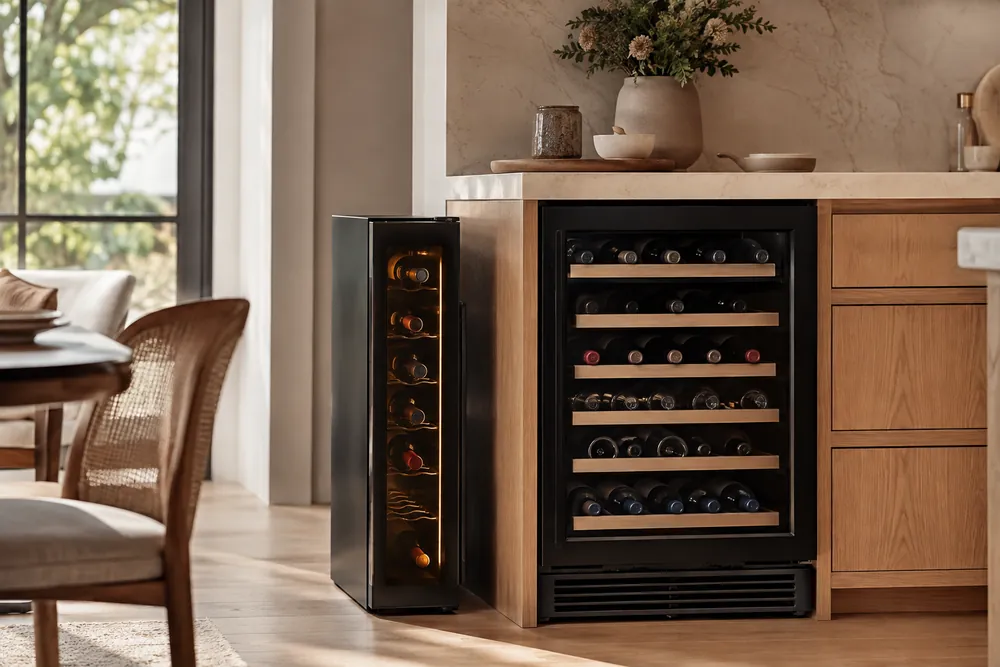
Placement drives the biggest practical difference between thermoelectric and compressor wine coolers.
Published specs usually show whether a unit is freestanding, built-in, or under-counter, and that label matters as much as bottle count.
Thermoelectric coolers often need more open air around the cabinet because they shed heat less forcefully.
Compressor models can handle tighter installations when the manufacturer designs front ventilation, but rear-vented versions still need breathing room.
| Specification category | Thermoelectric wine coolers | Compressor wine coolers |
| Typical side and rear clearance | About 2-6 inches for freestanding use | About 0.25-4 inches, depending on front or rear venting |
| Common temperature setting range | About 46-66°F | About 40-65°F, with some dual-zone ranges split by compartment |
| Common capacity band | About 6-32 bottles | About 12-150 bottles across countertop, under-counter, and tall cabinets |
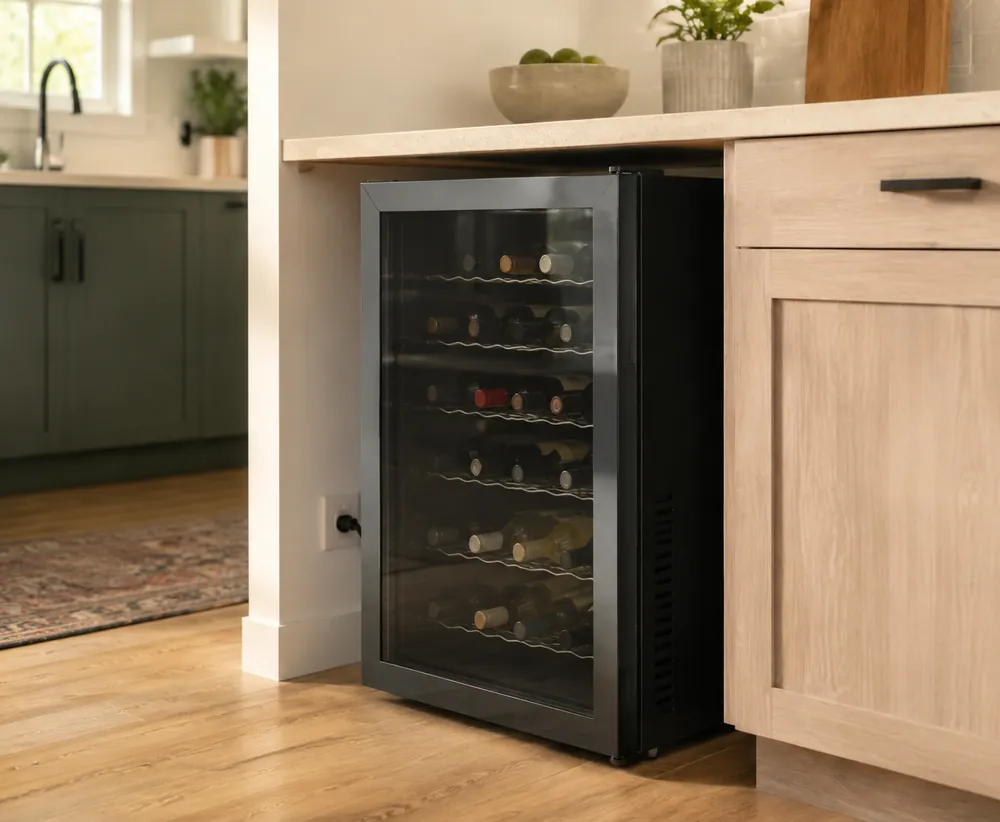
Built-in installation is not the same as sliding any cooler into a cabinet gap. A true under-counter wine cooler usually vents through the front grille, so heat can escape without being trapped behind the unit.
Freestanding models should stay freestanding unless the manual says otherwise. Enclosing a rear-vented cooler can raise internal temperature, increase run time, and shorten component life.
Cabinet fit and floor location
Under-counter compressor coolers are commonly matched to standard kitchen openings. Buyers should compare the cutout width, hinge swing, handle depth, and leveling foot range before ordering.
| Opening type | Typical published width range | Typical use |
| Narrow under-counter slot | About 12-15 inches | Small bottle storage beside cabinets or beverage centers |
| Standard under-counter bay | About 24 inches | Primary built-in wine cooler location |
| Tall freestanding or column space | About 24-30 inches | Larger collections where height and door clearance matter |
- Choose thermoelectric for quiet rooms, small collections, and open placement away from heat sources.
- Choose compressor for built-in plans, warmer rooms, larger capacities, and lower serving temperatures.
- Check the manual before enclosing any cooler, because vent direction overrides marketing photos.
Placement limits also include ambient room temperature. Thermoelectric units are more affected by hot garages, sunny bars, and tight pantries, while compressor units usually recover faster after door openings.
For a US kitchen, the safest comparison is the installation diagram, not the product image. Match the cooler type to the opening, ventilation path, and temperature range before comparing shelves or finishes.
How These Hold Up After a Year
Owner reports tend to converge on one theme: temperature stability matters more than the cooling technology label.
Manufacturer documentation explains why, because thermoelectric and compressor units manage heat, ventilation, and room temperature in different ways.
Repeated complaints cluster around warm cabinets, noisy cycling, condensation, and shelves that feel less sturdy once fully loaded.
Owners also report that placement errors, especially tight built-in installs without clearance, make either style seem worse than its specifications suggest.
| Specification area | Thermoelectric wine coolers | Compressor wine coolers |
| Typical wine storage setting range | About 46°F-66°F | About 40°F-65°F |
| Common bottle-capacity band | About 6-32 bottles | About 12-150 bottles |
| Typical ventilation clearance for freestanding use | About 2-6 inches | About 2-6 inches |
Thermoelectric coolers get the most repeat criticism for struggling in warm rooms.
Owner reports often describe the display showing a set temperature while the cabinet runs warmer than expected, especially in kitchens, sunrooms, garages, or tight corners.
Manufacturer documentation usually notes ambient-temperature limits for thermoelectric systems.
That warning matters because these units move heat rather than using a refrigerant compressor, so surrounding air conditions can directly limit their cooling headroom.
What holds up well on thermoelectric models is the simple cooling assembly and low-vibration feel.
Buyers who place them indoors, away from heat sources, often report steady service for casual short-term storage and countertop or small-cabinet use.
Early failures reported for thermoelectric units usually involve fans, control boards, or power supplies.
A failed fan is especially noticeable because the unit may still power on, while cabinet temperature drifts outside the selected range.
Compressor wine coolers draw more complaints about sound. Owner reports often mention humming, clicking, or cycling that becomes more noticeable in open kitchens, apartments, or rooms used for sleeping or working.
Manufacturer documentation supports that trade-off.
Compressor systems generally offer stronger cooling recovery and wider installation options, but they use moving refrigeration parts that can create vibration, startup noise, and periodic cycling.
| Buyer concern | Thermoelectric pattern | Compressor pattern |
| Recurring complaint | Weak cooling in warm rooms | Audible cycling and vibration |
| What tends to hold up | Quiet operation when ventilated | Cooling strength under heavier loads |
| Early weak points | Fans and electronics | Relays, thermostats, seals, and fans |
Compressor models tend to age better for buyers storing larger collections or opening the door frequently.
Owner reports more often praise their ability to recover after loading bottles, adjusting shelves, or dealing with warmer household conditions.
Early compressor complaints still appear. Buyers report faulty thermostats, rattling fans, loose handles, door gasket gaps, and units that arrive damaged after shipping, which can matter as much as the underlying cooling system.
- For quiet rooms: thermoelectric units usually draw better owner feedback, provided the room stays cool and the cabinet has breathing space.
- For warm kitchens: compressor units usually earn stronger feedback because they have more cooling reserve.
- For built-in installs: buyers should follow front-venting and clearance documentation rather than assuming any freestanding cooler can be enclosed.
Bottom line: the recurring complaint is not one universal defect. Thermoelectric buyers most often complain about insufficient cooling, while compressor buyers most often complain about noise.
The better long-term choice depends on room temperature, placement, capacity, and tolerance for cycling sound.
Common Questions Before You Buy
Buyers comparing thermoelectric and compressor wine coolers usually see similar bottle counts, but the cooling systems behave differently.
Published specifications help narrow the choice, especially for temperature range, clearance, placement, and noise expectations.
Is a thermoelectric or compressor wine cooler better?
Compressor wine coolers are usually better for wider temperature control, warmer rooms, and larger cabinets. Thermoelectric wine coolers can make sense for small collections, quiet rooms, and stable indoor temperatures.
Compare the listed operating temperature range, cabinet size, and installation type before choosing. A quiet cooler that cannot reach your target temperature is still the wrong fit.
What temperature range should I look for in a wine cooler?
Published wine cooler specs commonly show different ranges by cooling type and zone layout. Single-zone units usually target one storage range, while dual-zone units split reds and whites into separate compartments.
| Cooler type | Typical listed range |
| Thermoelectric single-zone | About 46°F-66°F |
| Compressor single-zone | About 40°F-65°F |
| Compressor dual-zone | About 40°F-72°F across zones |
Use those ranges as category guidance, not a guarantee for every cabinet. Ambient room temperature, door openings, and bottle loading can affect real-world performance.
Do thermoelectric wine coolers use less electricity?
Thermoelectric models are often marketed as efficient because they use no compressor. In practice, energy use depends on cabinet size, insulation, room temperature, and how hard the unit runs.
Compressor models may draw more power while cycling, but they can cool faster and shut off between cycles. Compare the EnergyGuide label or published annual energy use where available.
How much clearance does a wine cooler need?
Freestanding wine coolers usually need open space around the cabinet for heat to escape. Built-in models vent through the front and are designed for tighter cabinet openings.
| Installation type | Common clearance guidance |
| Freestanding rear or side venting | About 2-6 inches around vented areas |
| Built-in front venting | About 0.25-1 inch at sides or top |
Always follow the manual for the specific product. Blocking ventilation can raise cabinet temperature, increase noise, and shorten component life.
What size wine cooler fits under a counter?
Under-counter wine coolers are commonly built to fit standard kitchen and bar cabinet openings. Width is the first specification to compare, followed by height, depth, hinge clearance, and plug location.
| Width category | Typical opening range |
| Narrow built-in | About 15-18 inches wide |
| Standard built-in | About 24 inches wide |
Depth matters because handles, doors, and rear plugs can push the front beyond surrounding cabinets. Check whether the listed depth includes the handle.
Are compressor wine coolers louder than thermoelectric models?
Compressor models can produce a low hum and occasional cycling sounds. Thermoelectric models often have fan noise instead, which may sound steadier but lighter.
Published decibel ratings are useful when available, but placement changes perception. A cooler in a pantry feels different from one beside a desk, bed, or open dining area.
Can I put a thermoelectric wine cooler in a garage?
Thermoelectric wine coolers are usually poor garage choices because they depend heavily on surrounding room temperature. Hot or cold swings can push the cabinet outside its advertised range.
For garages, look for compressor cooling and a stated ambient operating range. Outdoor or garage-rated language matters more than bottle count or shelf style.
Does bottle capacity match what I can actually store?
Listed capacity usually assumes standard Bordeaux-style bottles loaded in an ideal arrangement. Wider Pinot, Champagne, or irregular bottles can reduce usable storage.
- Small countertop units: commonly listed around 6-18 bottles.
- Mid-size freestanding units: commonly listed around 20-50 bottles.
- Large built-in or cellar-style units: commonly listed around 50-150 bottles.
Check shelf spacing, removable racks, and bottle orientation. Capacity is a comparison starting point, not a promise for mixed collections.