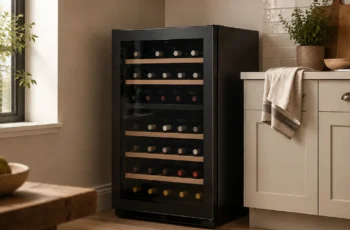
In short: A wine cooler usually uses modest electricity compared with major kitchen appliances, but actual use depends on size, cooling type, room temperature, door openings, and temperature setting.
Small units often cost little to run, while larger built-in or dual-zone coolers use more. The best estimate comes from the product’s published annual energy use, not the advertised wattage alone.
How Wine Cooler Electricity Use Is Usually Estimated
Electricity estimates for a wine cooler usually come from published energy labels, product specification sheets, and owner-reported operating patterns.
They are best read as comparisons, not exact promises, because room temperature, loading, door openings, and installation space change real use.
Manufacturers usually publish annual energy use, rated power, or both.
Annual energy use is easier to compare because it reflects cycling, while wattage mainly shows how much power the cooler may draw while the compressor or fans are running.
| Specification | Typical category range | Why it matters |
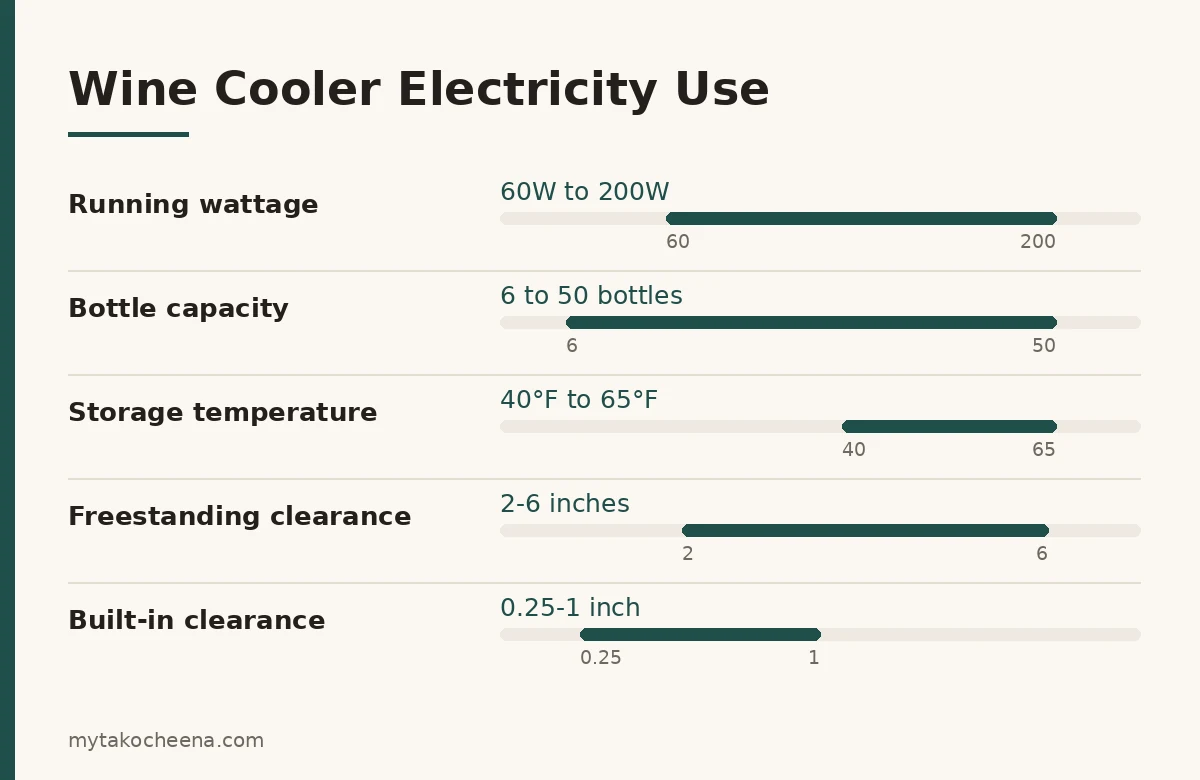
| Storage temperature | About 40°F to 65°F | Lower settings usually make the compressor run more often. |
| Rated running wattage | About 60W to 200W | Higher wattage can mean faster cooling, larger size, or more fan load. |
| Common capacity bands | About 6 to 50 bottles | Larger cabinets cool more air and usually use more electricity. |
| Rear or side clearance | About 1 in. to 5 in. | Poor ventilation can raise compressor run time. |
Energy labels normally estimate use under controlled conditions. A cooler placed in a warm kitchen, tight cabinet, garage, or sunny area can use more electricity than the label suggests.
Built-in and freestanding designs should not be compared only by bottle count. Built-in units often use front ventilation, while freestanding units may require open space around the cabinet to shed heat properly.
| Design type | Common fit range | Energy-use trade-off |
| Countertop or compact | About 6 to 18 bottles | Lower capacity, but less thermal mass and more frequent temperature swings. |
| Undercounter built-in | About 15 in. to 24 in. wide openings | Cleaner installation, but ventilation design matters more. |
| Freestanding cabinet | About 20 to 50 bottles | More storage, but needs clearance to avoid heat buildup. |
For a fair comparison, look for the same type of figure across products. Compare annual energy use to annual energy use, not annual use from one brand against running watts from another.
- Check the temperature range: colder settings usually raise consumption.
- Check the installation notes: required clearance affects real-world efficiency.
- Check capacity honestly: oversized coolers waste energy if they stay mostly empty.
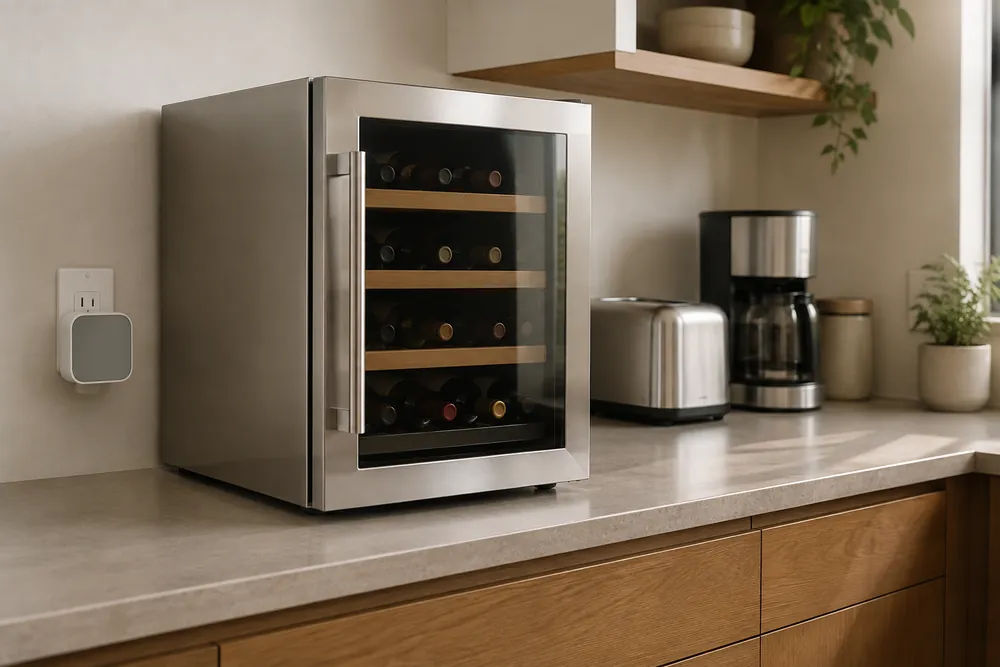
Main Factors That Change Power Consumption
Power use changes with cabinet size, temperature setting, room conditions, and cooling design. Published energy figures are useful, but they make the most sense when compared within the same installation type and capacity class.
A larger wine cooler usually needs more electricity because it has more air space, glass, shelving, and bottle mass to stabilize. Compact countertop units and tall built-ins should not be compared as equals.
| Category | Typical published range | Power-use trade-off |
| Compact countertop | 6-18 bottles | Lower total load, less thermal buffer |
| Undercounter | 20-50 bottles | Moderate load, installation airflow matters |
| Full-height freestanding | 80-150 bottles | Higher load, steadier temperatures when full |
Temperature setting is another major factor. A cooler set near cellar temperature runs differently than one pushed toward colder beverage-style storage, especially in a warm room.
| Storage use | Common range | Energy impact |
| Red wine storage | 54-66°F | Lower compressor demand in many homes |
| White wine storage | 40-55°F | More cooling required than warmer settings |
| Dual-zone operation | 40-66°F across zones | More controls and temperature balancing |
Installation type matters because heat must leave the cabinet. Built-in units usually vent from the front, while freestanding units often need open space around the back and sides.
| Installation type | Typical clearance range | Why it affects electricity |
| Built-in undercounter | 0.25-1 inch at sides or top | Designed for tighter openings with front venting |
| Freestanding | 2-6 inches around rear or sides | Poor airflow can increase run time |
Door design also changes consumption. Glass doors look good and help with visibility, but insulation quality, pane count, gasket fit, and UV coating affect how often the compressor cycles.
- Ambient room temperature: garages, sunrooms, and hot kitchens usually raise energy use.
- Compressor type: inverter compressors may run longer at lower speed, while standard compressors cycle on and off.
- Loading pattern: a partly filled cabinet changes temperature faster when the door opens.
- Maintenance: dusty vents and weak door seals make published specifications less realistic.
Compare models by matching capacity band, installation style, temperature range, and listed energy rating. That gives a fairer estimate than comparing one attractive spec across very different cabinet designs.
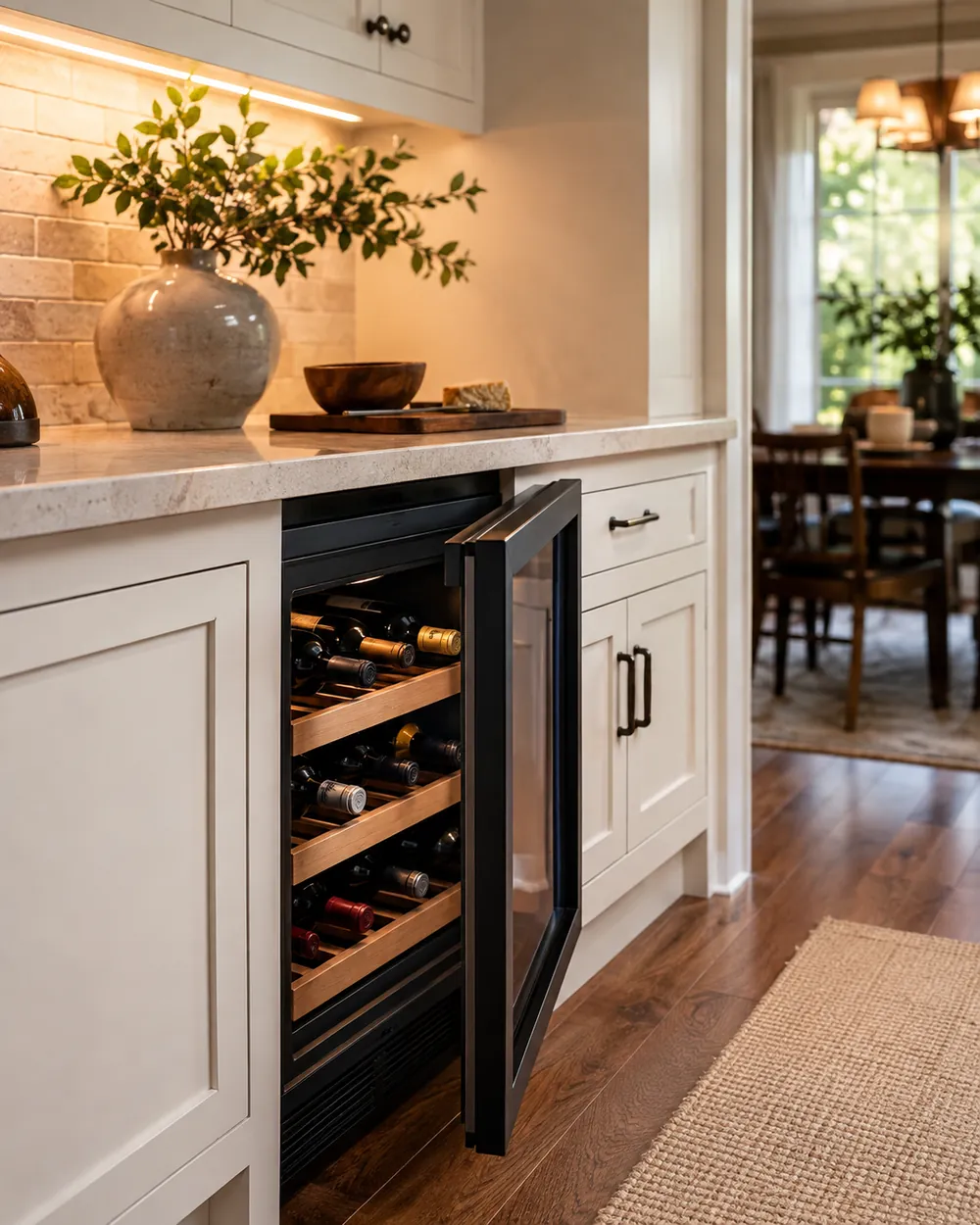
Thermoelectric vs Compressor Wine Coolers
Thermoelectric and compressor wine coolers use different cooling systems, so their electricity use is not directly interchangeable.
Published specs usually show compressor models drawing higher running watts, while thermoelectric models often trade lower vibration for tighter placement limits.
Thermoelectric coolers move heat with a solid-state module and fan. They have fewer moving parts, but they struggle more in warm rooms or tight cabinets because they depend heavily on steady airflow around the unit.
Compressor coolers work more like mini refrigerators. They cycle on and off, handle wider room conditions better, and are more common in larger freestanding and built-in wine cabinets.
| Specification | Thermoelectric wine coolers | Compressor wine coolers |
| Common bottle capacity bands | 6 to 24 bottles | 12 to 150 bottles |
| Usual running wattage bands | 40 to 100 watts | 70 to 200 watts |
| Typical storage temperature range | 46°F to 66°F | 40°F to 65°F |
| Typical rear or side clearance | 2 to 5 inches | 0.25 to 5 inches, depending on venting |
Energy use depends on duty cycle, not only the watt number printed in a manual. A compressor unit may draw more watts while running, but it may run for shorter periods after reaching set temperature.
Thermoelectric models can be efficient in a cool, stable room with plenty of clearance. In a hot kitchen, garage, or enclosed nook, the fan and cooling module may run longer, narrowing the expected savings.
- Choose thermoelectric for small countertop storage, low vibration, and quiet operation in a temperature-controlled room.
- Choose compressor for larger collections, dual-zone layouts, built-in installations, or rooms with wider temperature swings.
- Check the spec sheet for rated power, annual energy estimate, installation clearance, and allowable ambient temperature before comparing models.
For electricity cost, compare the published energy label or manual estimate before comparing cooling technology alone.
Capacity, insulation, door glass, ambient temperature, and ventilation usually explain more of the monthly cost than the cooling label by itself.
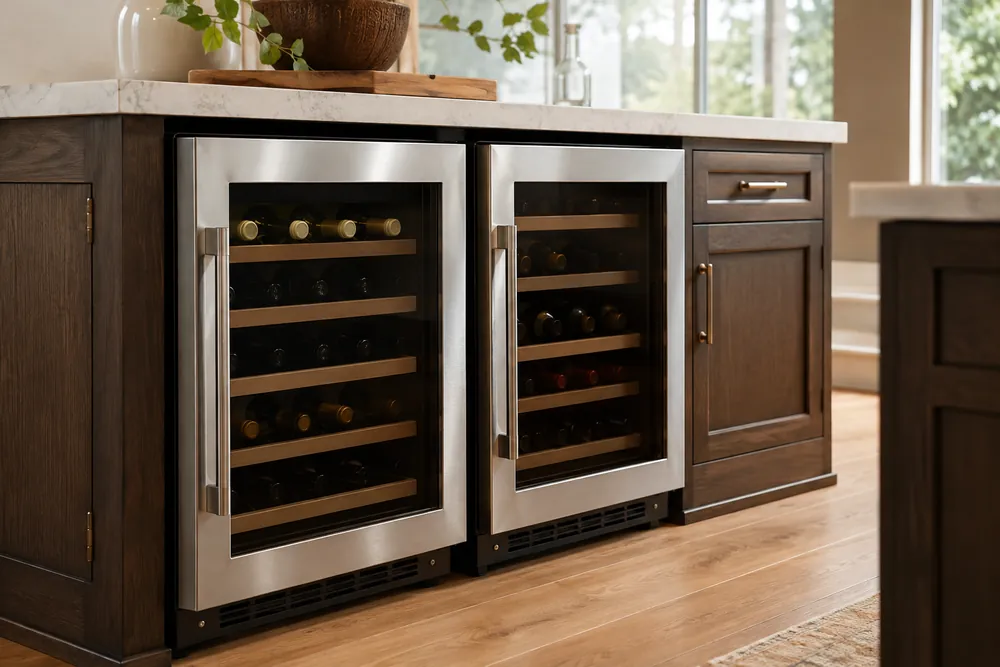
Small, Medium, and Large Wine Coolers Compared
Wine cooler size drives electricity use because cabinet volume, insulation, compressor cycling, and door opening habits all change together.
Published specifications usually show capacity, installation type, temperature range, and sometimes annual energy use, so compare those fields before comparing style.
| Category | Common bottle capacity range | Typical placement | Electricity-use pattern |
|---|---|---|---|
| Small | 6-20 bottles | Countertop, compact freestanding, or narrow under-counter | Lower total load, but less thermal mass can mean frequent cycling |
| Medium | 21-50 bottles | Freestanding or built-in under-counter | Balanced capacity and compressor runtime for many households |
| Large | 51-150+ bottles | Full-height freestanding, built-in column, or cellar-style cabinet | Higher total load, often steadier temperatures when well filled |
Small wine coolers can look efficient because the cabinet is compact. They may still cycle often in warm kitchens, especially when lightly loaded or placed with poor ventilation.
Medium units are usually the easiest category to compare. Many buyers can match capacity, shelf layout, and installation type without moving into the higher energy demand of a large cabinet.
| Specification | Common published range | Why it affects electricity use |
|---|---|---|
| Storage temperature range | About 40-65°F | Lower settings usually require longer compressor runtime |
| Single-zone wine serving range | About 45-64°F | Narrower ranges may simplify cooling control |
| Built-in cabinet opening width | About 15-24 inches | Tight openings require front ventilation and correct fit |
| Freestanding rear or side clearance | About 2-6 inches | More airflow helps reject heat and reduce strain |
Large wine coolers make sense for collectors, entertainers, and mixed red-white storage. Their advantage is capacity, not necessarily lower electricity use, so check the energy label and installation requirements carefully.
- Choose small for limited bottles, short-term storage, and flexible placement.
- Choose medium for everyday home use where capacity and energy use both matter.
- Choose large for long-term storage, larger collections, or dual-zone needs.
For My Tako Cheena readers comparing US kitchen appliances, the safest approach is specification-first shopping.
Match the bottle range, temperature range, ventilation clearance, and listed energy consumption to your actual use instead of assuming bigger or smaller is automatically better.
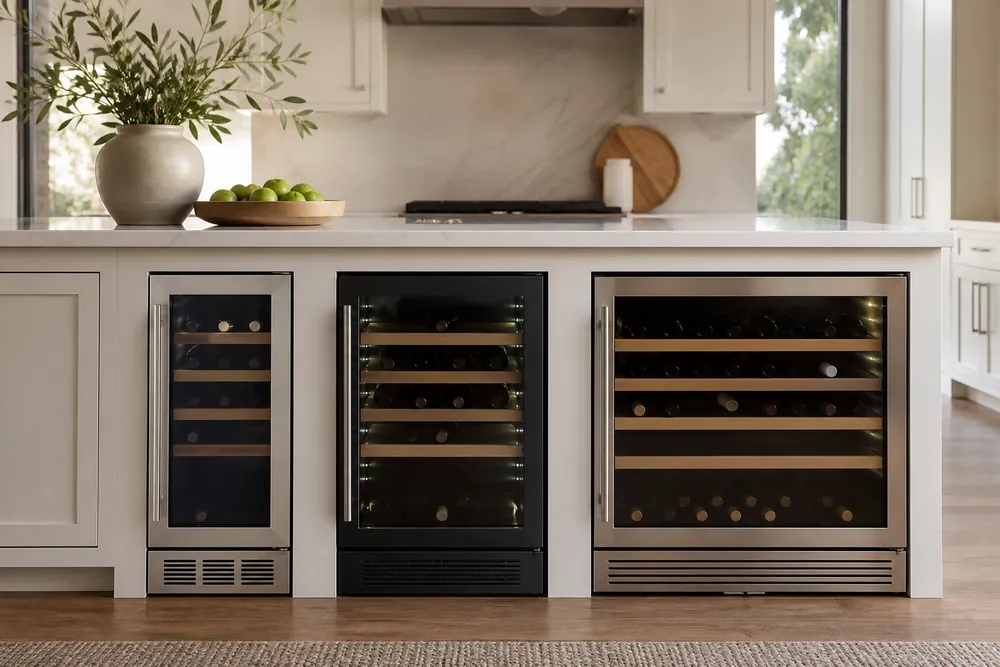
Where You Place the Cooler Matters
Placement changes how hard a wine cooler has to work. Published energy use assumes controlled conditions, while a warm corner, tight cabinet, or sunny wall can push the compressor to cycle more often.
For a US buyer comparing specifications, treat location as part of the energy estimate. A cooler with the same listed annual kWh can behave differently depending on airflow, room temperature, and installation type.
Built-in vs. freestanding placement
Built-in wine coolers are designed to vent from the front, so they can sit under a counter with less side breathing room. Freestanding units usually need open space around the back and sides because heat leaves through those areas.
| Placement factor | Typical category range | Why it affects electricity use |
| Freestanding clearance | About 2 to 6 inches around venting surfaces | Less airflow traps heat and makes the compressor run longer. |
| Built-in cabinet opening width | About 15 to 24 inches for many undercounter categories | A poor fit can restrict front ventilation or leave unstable gaps. |
| Wine storage temperature range | About 40 to 65 degrees Fahrenheit | Lower set points usually require more cooling effort. |
Heat sources matter too. Keep the cooler away from ovens, dishwashers, sunny windows, and HVAC registers because nearby heat raises the temperature the unit must reject.
What to compare before installation
- Vent location: Front venting suits built-in placement; rear or side venting usually needs open space.
- Ambient temperature rating: Some specifications list the room-temperature range where the cooler is expected to operate properly.
- Door swing: A door that cannot open fully may lead to longer loading time and more warm-air exchange.
- Sun exposure: Direct sunlight can warm the cabinet and glass door, especially on compact units.
Use the energy label as a baseline, then read the installation clearances before comparing annual electricity cost.
Better airflow will not make a wine cooler free to run, but it helps the appliance stay closer to its published efficiency.
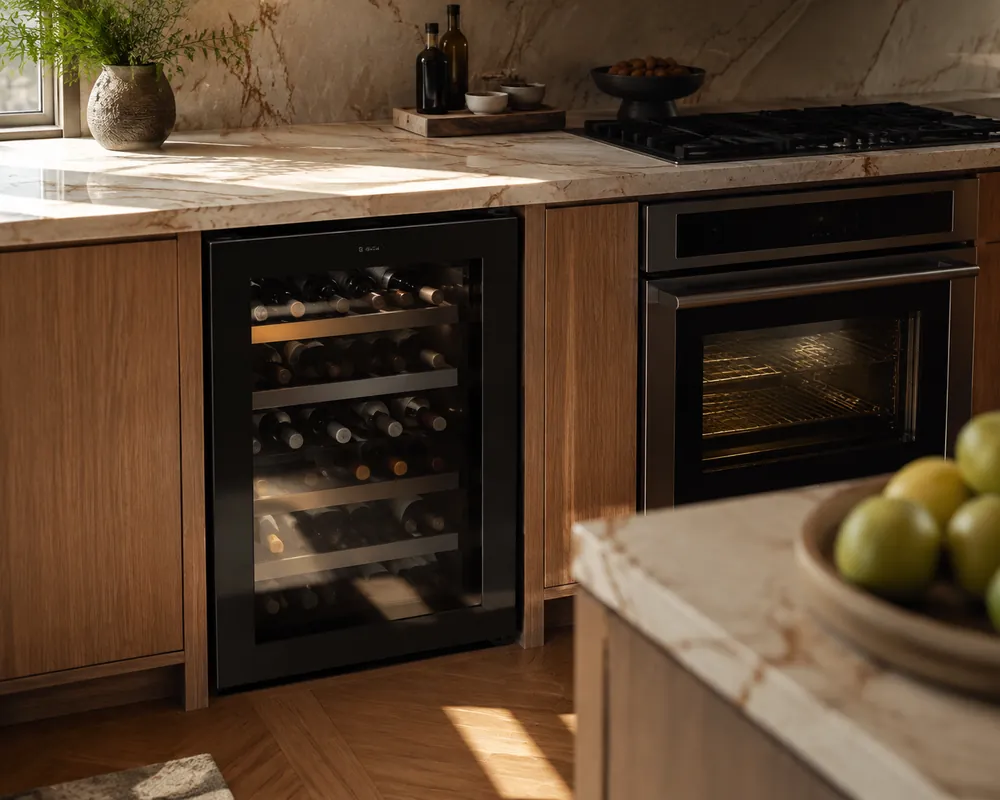
How to Read Energy Labels and Product Specs
EnergyGuide labels show estimated annual electricity use, usually in kWh, so compare that number before comparing style or bottle count.
Product specs add context: installation type, temperature range, capacity band, and required clearance all affect real-world use.
Use the label for energy comparison and the spec sheet for fit. A wine cooler that looks efficient on paper can work harder if it is squeezed into the wrong cabinet opening or placed beside a heat source.
Key label and spec terms to compare
- Annual energy use: Lower kWh means lower estimated electricity use under standardized conditions.
- Capacity: Bottle counts are estimates and often assume standard Bordeaux-style bottles.
- Temperature range: Wider ranges help if you store reds, whites, or sparkling wine differently.
- Installation type: Freestanding and built-in models usually have different ventilation needs.
| Specification | Common published range | Why it matters |
| Storage temperature | About 40°F to 65°F | Shows whether the unit can handle white, red, or mixed storage. |
| Compact capacity band | About 6 to 24 bottles | Useful for countertops, apartments, and occasional storage. |
| Mid-size capacity band | About 25 to 60 bottles | Common for under-counter or dedicated home bar layouts. |
| Ventilation clearance | About 1 to 3 inches | Poor airflow can raise compressor run time and noise. |
Do not compare bottle count alone. A dual-zone cabinet, glass door, interior lighting, and tighter temperature control can use more electricity than a simpler single-zone unit with similar capacity.
For built-in models, read the cutout dimensions and vent location before relying on the EnergyGuide estimate. A front-venting design is usually better suited to cabinetry than a rear-venting freestanding cooler.
Match the published kWh figure to your electricity rate for a rough operating cost. Then compare that result against the cooler’s size, temperature range, and installation requirements.
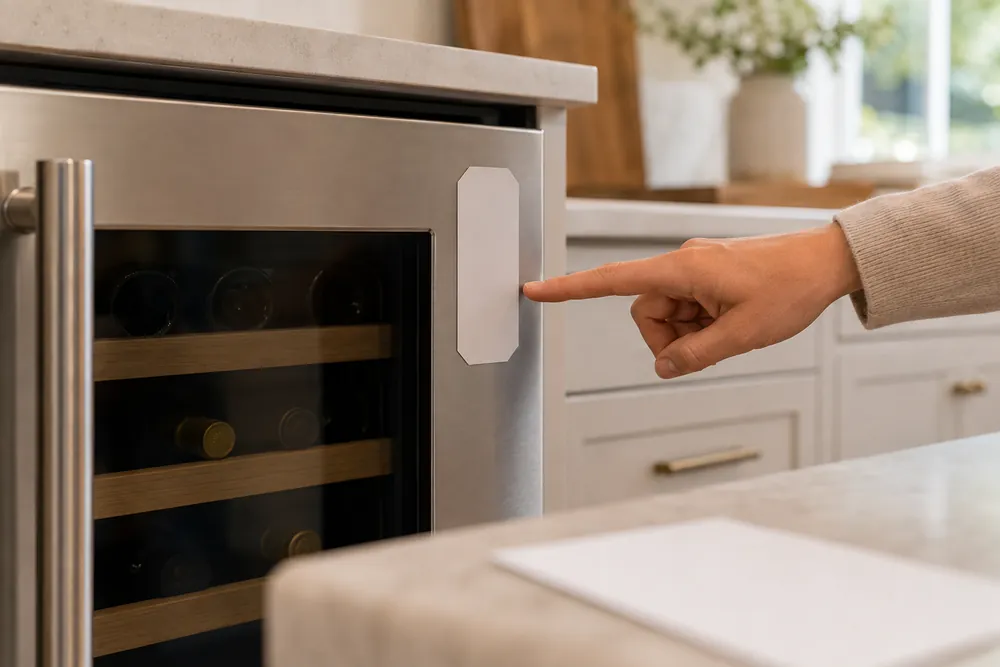
What Owners Report After Six Months
Six-month owner reports usually center on noise, temperature stability, and whether the cooler still matches its published specification.
Manufacturer documentation gives the operating ranges and installation limits; reviews show where daily use exposes the trade-offs.
Recurring complaints mention compressor cycling, fan hum, and small temperature swings after the cabinet is loaded.
Built-in units draw more comments about installation sensitivity, while freestanding units draw more comments about rear clearance and warm rooms.
| Category item | Typical published range | Owner-reported concern after use |
| Wine storage temperature setting | About 40°F-65°F | Digital setting may not match bottle-level temperature exactly |
| Common bottle capacity bands | About 12-50 bottles for compact home units | Real loading drops with wider Burgundy, Champagne, or odd-shaped bottles |
| Typical ventilation clearance | About 2-5 inches for many freestanding designs | Tight placement can increase heat, cycling, and noise complaints |
The complaint that recurs most is not outright cooling failure.
It is mismatch: owners expect silent operation, exact capacity, or a perfect set temperature, while manufacturer documentation usually allows normal cycling, airflow space, and variation by room conditions.
What tends to hold up is basic cooling on correctly installed units. Buyers repeatedly say the cabinet, shelves, lighting, and door seal remain acceptable when the appliance is kept level, ventilated, and away from high ambient heat.
- Noise: Owner reports commonly describe a low hum, fan whir, or click during cycles rather than constant silence.
- Capacity: Published bottle counts usually assume standard Bordeaux-style bottles and careful alternating placement.
- Temperature: Documentation commonly frames settings as a control range, not a laboratory guarantee at every shelf.
Early failures reported by buyers often involve the control panel, interior fan, thermostat behavior, or door condensation.
These reports appear more often where units are pushed into cabinetry without the required ventilation or used in garages, sunrooms, or warm kitchens.
| Owner theme | Specification area to check | Practical trade-off |
| Runs more often than expected | Ambient temperature and clearance range | Better airflow can reduce cycling, but takes more space |
| Holds fewer bottles | Capacity method and shelf layout | Flexible shelves help, but may reduce total count |
| Feels warmer near the top | Single-zone versus dual-zone design | Dual-zone control adds flexibility and complexity |
Manufacturer documentation is the better source for installation limits, electrical requirements, and allowable operating conditions.
Owner reports are better for spotting repeated annoyances, especially noise tolerance, shelf usability, and how the cooler behaves in real rooms.
Questions Buyers Ask Most
Wine cooler electricity use depends on cabinet size, cooling system, room temperature, and door habits.
Published specifications usually show annual kWh, amperage, or both, so buyers should compare labels instead of assuming all compact coolers cost the same.
How much electricity does a wine cooler use per month?
Use the published annual kWh figure, then divide it by your billing periods. Smaller thermoelectric units often draw less at steady temperature, while larger compressor units may cycle harder but cool more reliably.
| Category | Typical published range |
| Compact countertop or small freestanding | About 100-250 kWh per year |
| Mid-size freestanding or built-in | About 150-400 kWh per year |
| Large or dual-zone cabinet | About 250-700 kWh per year |
Does a built-in wine cooler use more electricity than a freestanding one?
Not automatically. Built-in models usually need front ventilation, tighter cabinetry fit, and steady airflow through the grille. Freestanding models often need more open clearance around the sides or rear.
| Installation type | Typical clearance range |
| Built-in front-venting | About 0-1 inch at sides, per manual |
| Freestanding rear-venting | About 2-5 inches at rear or sides |
What temperature should I set my wine cooler to save power?
Set the cooler for the wine you store, not the coldest setting available. Lower setpoints usually increase compressor run time, especially in warm rooms or sunny spaces.
| Wine type or use | Typical setting range |
| Long-term general storage | About 50-59°F |
| White wine service | About 45-55°F |
| Red wine service | About 55-65°F |
Is a dual-zone wine cooler more expensive to run?
Dual-zone coolers can use more electricity because they manage separate compartments, fans, sensors, and setpoints. The difference depends on cabinet size, insulation, and how far apart the two temperature zones are set.
How many bottles should I buy capacity for?
Published bottle counts usually assume standard Bordeaux-style bottles. Pinot, Champagne, and wide-shouldered bottles reduce real storage, so buyers often size up rather than filling every slot tightly.
| Use case | Typical capacity range |
| Countertop or apartment use | About 6-18 bottles |
| Everyday home storage | About 24-50 bottles |
| Collector or entertainment storage | About 60-150 bottles |
Will a wine cooler raise my electric bill a lot?
Usually, the bill impact is modest compared with major kitchen appliances, but it runs continuously. Check the annual kWh on the EnergyGuide label or specification sheet, then multiply by your local electricity rate.
Why does my wine cooler run more than expected?
Warm ambient air, poor clearance, frequent door opening, dirty condenser areas, and a weak door seal can all increase run time. A cooler placed in a garage or near sunlight may work harder than the same unit in conditioned space.
What specs matter most before buying a wine cooler?
Compare annual kWh, installation type, bottle capacity, temperature range, noise rating, and warranty terms.
For My Tako Cheena readers comparing US kitchen appliances, the useful move is matching the cooler’s published limits to the actual room and cabinet opening.