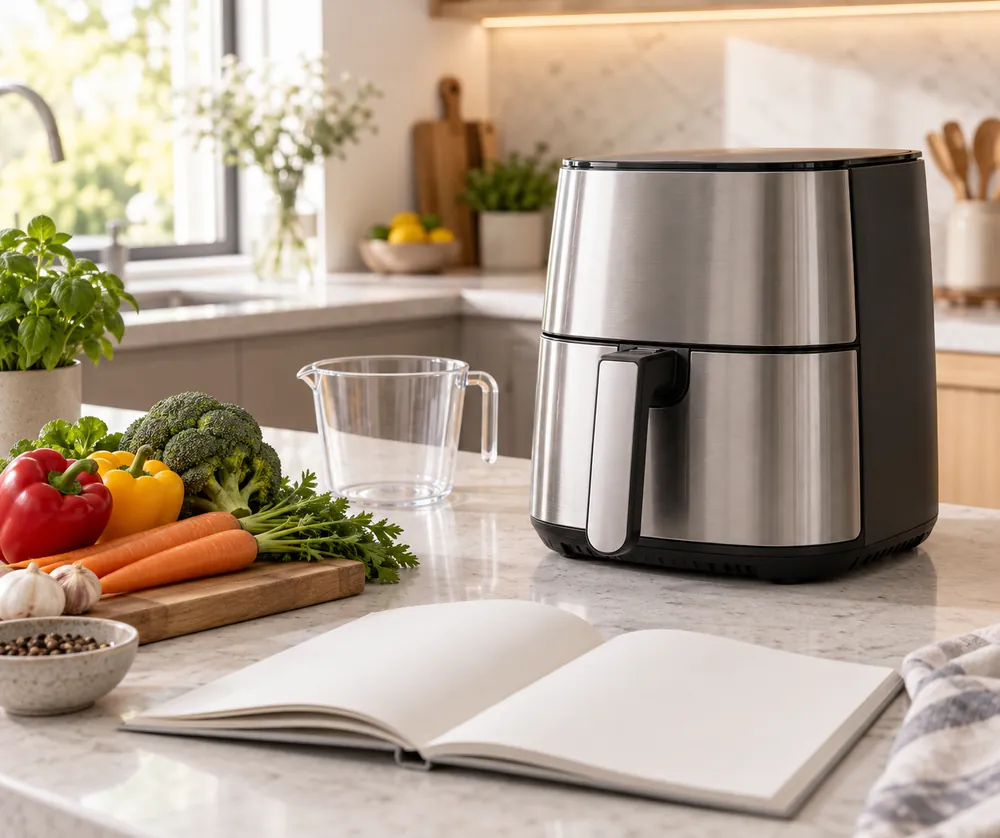
Key takeaway: A family air fryer is a countertop convection cooker that prepares everyday portions with circulating hot air.
Most families should choose a model with enough usable basket space for normal meals, rather than relying only on the advertised quart rating.
Single baskets suit simple meals, dual baskets separate foods, and oven-style designs accommodate racks, flatter items, and larger portions.
What Size Air Fryer a Family Actually Needs
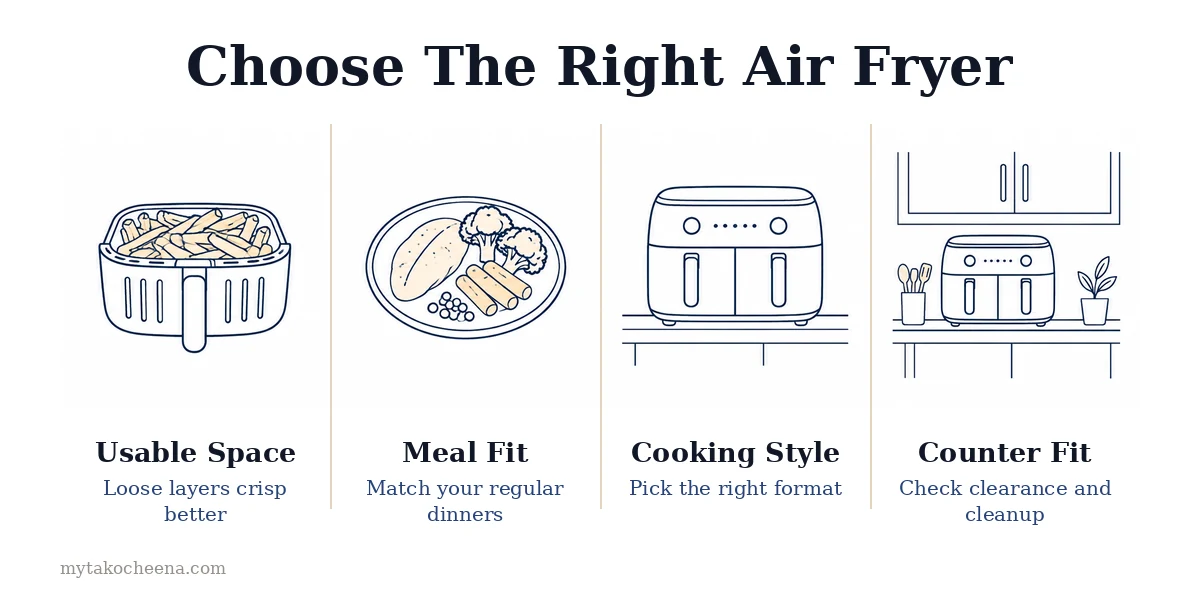
Usable cooking space matters more than the largest quart figure printed on an air fryer box. Family portions cook more evenly in a loose layer, so basket width, drawer shape, and rack design often matter as much as advertised capacity.
Published capacity helps compare categories, but quart ratings are not standardized across brands.
A tall, narrow basket may hold a similar stated volume to a wider drawer while offering less practical space for fries, wings, vegetables, or salmon fillets.
Use capacity as a starting point
| Published capacity | Practical fit | Best suited to |
| 2 to 4 quarts | Small portions | One or two people, snacks, reheating |
| 4 to 6 quarts | Moderate portions | Two or three servings with limited leftovers |
| 6 to 8 quarts | Family portions | Three to five servings, depending on food shape |
| 8 to 12 quarts | Large or divided portions | Batch cooking, dual baskets, or oven-style racks |
A family usually benefits from starting in the middle of this range and adjusting for eating habits.
Choose more usable surface area when crisping frozen food or cooking several proteins, because stacking blocks airflow and can force repeated batches.
Smaller units heat quickly, store easily, and suit households that cook limited quantities. Larger units reduce batch cooking but occupy more counter space, weigh more, and can be harder to wash in a sink.
Match the basket to the meals
- Single-drawer baskets suit fries, nuggets, wings, vegetables, reheated leftovers, and meals that can be shaken together.
- Dual-basket designs help when a protein and side need different temperatures or cooking times. Check whether both baskets provide useful space rather than splitting one modest cavity.
- Oven-style units offer flatter racks for toast, vegetables, pizza pieces, or larger foods. They can be more versatile, but doors, trays, and interior surfaces usually create more cleaning work.
Check counter and electrical fit
| Specification | Common range | Why it matters |
| Cooking temperature | About 90°F to 450°F | Lower settings help with warming or dehydrating; higher settings support browning. |
| Typical power draw | About 1,200 to 1,800 watts | Large appliances may compete with other devices on the same circuit. |
| Rear and side clearance | About 4 to 6 inches | Hot exhaust needs space near walls and beneath cabinets. |
| Cabinet opening height | About 15 to 18 inches | Tall lids, racks, and oven doors may not fit comfortably below cabinets. |
Measure height, depth, door swing, handle projection, and vent location before choosing capacity.
Plan where the appliance will cool and where its removable parts will be washed, because a large basket is useful only when the family can use it conveniently.
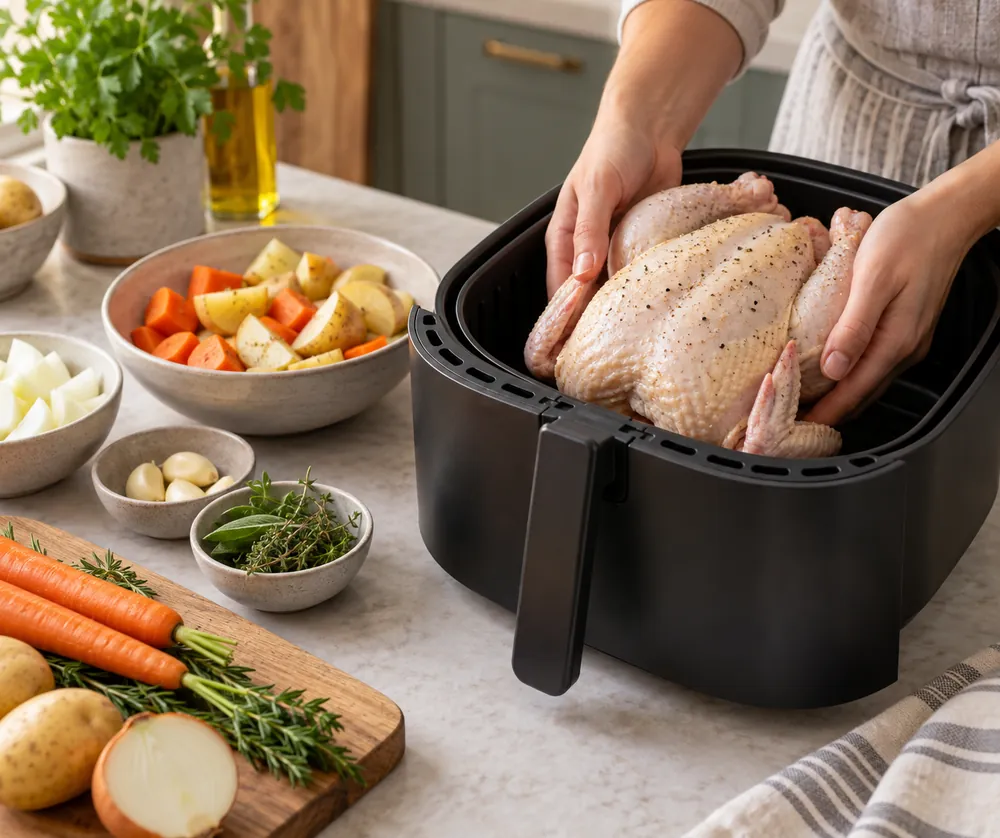
Basket, Dual-Basket, or Oven-Style Air Fryer
Basket layout affects how easily a family cooks a complete meal.
A single basket suits straightforward batches, dual baskets separate foods with different settings, and oven-style units provide flatter space for larger or delicate items.
Choose according to your regular meals, counter space, and how much food must finish together. Larger appliances reduce batch cooking but can be harder to store, clean, and fit beneath cabinets.
Single-basket air fryers
A conventional basket suits fries, wings, vegetables, nuggets, fish, and reheated leftovers. Its removable drawer usually shakes easily, while the compact chamber often preheats faster than an oven-style appliance.
Single-basket models work best when you cook one main food at a time or coordinate with the stovetop. They are practical for smaller kitchens because they are generally easier to place and store.
Usable surface matters more than advertised capacity. A broad, shallow basket can crisp food more evenly than a narrow, deep basket because pieces can remain in a loose layer.
| Published capacity | Typical fit | Main trade-off |
| 2 to 4 quarts | One or two people, snacks, and reheating | Small footprint but frequent batches |
| 4 to 6 quarts | Two or three servings | Balanced size for moderate portions |
| 6 to 8 quarts | Family dinners and larger portions | More cooking space but greater counter demand |
| 8 to 12 quarts | Batch cooking or larger households | Less batching but more storage and cleaning effort |
Dual-basket air fryers
Dual-basket models suit meals with different cooking times or temperatures. One drawer can cook chicken or fish while the other handles vegetables, potatoes, or dessert without mixing flavors.
Look for independent controls, a finish-together function, and baskets removable without blocking each other. Two drawers offer flexibility, but each may be too narrow for broad foods.
Dual baskets add removable parts, seals, and corners to wash. Check whether baskets, crisper plates, and dividers are dishwasher-safe, while following the manufacturer’s instructions.
Oven-style air fryers
Oven-style units suit larger or flatter foods, including toast, fish fillets, vegetables, pizza portions, and multiple snack racks. Their doors and shelves ease loading but make shaking less convenient.
Compare usable tray dimensions, rack positions, door swing, and accessories rather than stated capacity. Multiple racks add flexibility, though crowded shelves restrict airflow and can brown unevenly.
| Specification | Common range or consideration | Why it matters |
| Cooking temperature range | About 90°F to 450°F | Lower settings support warming or dehydrating; higher settings improve browning |
| Typical power draw | About 1,200 to 1,800 watts | Large appliances may share a circuit poorly with other countertop devices |
| Rear and side clearance | About 4 to 6 inches | Hot exhaust needs room, especially near walls or beneath cabinets |
| Cabinet opening height | About 15 to 18 inches | Tall lids, doors, and racks may not fit comfortably below cabinets |
Make the final choice
- Choose a single basket for simple meals, easy shaking, compact storage, and minimal cleaning.
- Choose dual baskets when proteins and sides need separate settings or finish times.
- Choose oven-style when trays, racks, toast functions, or flatter cooking space matter most.
Measure appliance height, depth, door swing, vent location, and storage route before ordering. The best family air fryer offers enough usable cooking area while remaining accessible for daily cooking and cleaning.
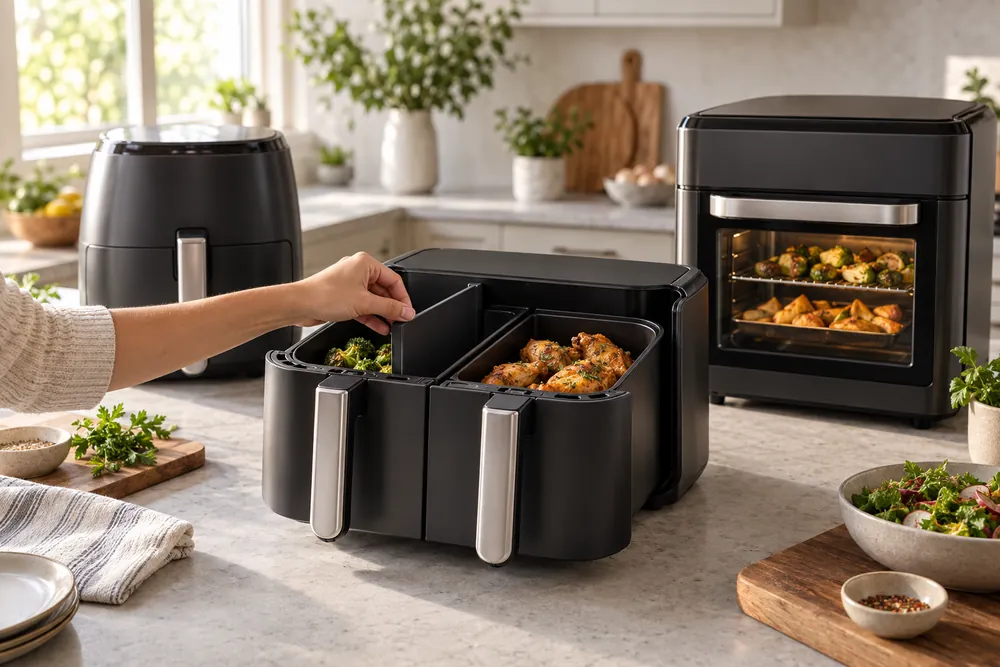
Features That Matter for Family Meals
Usable cooking space, basket layout, cleaning effort, and countertop fit determine whether an air fryer simplifies family meals. Capacity matters, but the cooking area often matters more than the advertised quart rating.
Choose a model that lets common foods sit in a loose layer. Fries, wings, vegetables, nuggets, and salmon need airflow, so a wide basket can outperform a taller basket with similar capacity.
Match capacity to the way your family eats
| Published capacity | Practical fit |
| 2 to 4 quarts | Snacks, reheating, and small portions |
| 4 to 6 quarts | Smaller family meals with limited leftovers |
| 6 to 8 quarts | Family dinners for several people, depending on food shape |
| 8 to 12 quarts | Large portions, batch cooking, dual baskets, or oven-style racks |
Use capacity as a starting point, then inspect basket width, usable depth, rack spacing, and the manual’s food examples. A narrow, deep drawer may force stacking, while a broad drawer can cook family portions more evenly.
Dual-basket models suit foods with different cooking times or temperatures. Separate controls can synchronize a protein and side, although two drawers may limit space for one large item.
Oven-style units suit flatter foods, toast functions, trays, and less-crowded cooking. They offer flexible loading, but doors, racks, and crumb areas usually require more cleaning than a removable drawer.
Check the countertop and storage requirements
| Specification | Common category range | Why it matters |
| Cooking temperature | About 90°F to 450°F | Lower settings help with warming or dehydrating; higher settings support browning |
| Power draw | About 1,200 to 1,800 watts | Large units may compete with other appliances on one circuit |
| Rear and side clearance | About 4 to 6 inches | Hot exhaust needs room near walls and cabinets |
| Cabinet opening height | About 15 to 18 inches | Tall units and hinged doors may be awkward below cabinets |
Measure height, depth, handle reach, door swing, and vent direction before buying. A unit that fits only when pulled forward may be inconvenient, while one stored in a cabinet must cool fully first.
Prioritize dishwasher-safe removable parts, accessible corners, and a basket that empties without spilling. For family use, easy cleanup often matters as much as extra presets or a larger display.
Start with the counter, not the appliance. Measure the space between cabinets, the distance from the wall, and the height beneath any shelf.
Leave room for the handle, controls, ventilation, and enough clearance to remove a hot basket without twisting it.
Measure the storage location as well. An air fryer that fits during cooking may not slide into a cabinet afterward, especially if its basket, racks, or door needs to remain attached.
Check the appliance’s widest points rather than relying on the body shape shown in photos.
Next, compare the interior dimensions with the foods your household cooks most often. A pizza, salmon fillet, chicken pieces, or a layer of vegetables may need more width than a nominal capacity suggests.
Bring a tape measure to the store, or compare the listed interior measurements at home.
Account for the clearance needed to load and unload safely. A drawer model needs space in front to pull out fully, while an oven-style model needs room for the door and access to racks.
A tight corner can turn a convenient appliance into a daily obstacle.
Finally, picture your normal serving routine. If dinner requires two rounds, ask whether the first batch can stay warm without blocking preparation.
If you cook several components together, check whether the usable surfaces align with your dishes, rather than assuming every included accessory will be useful.
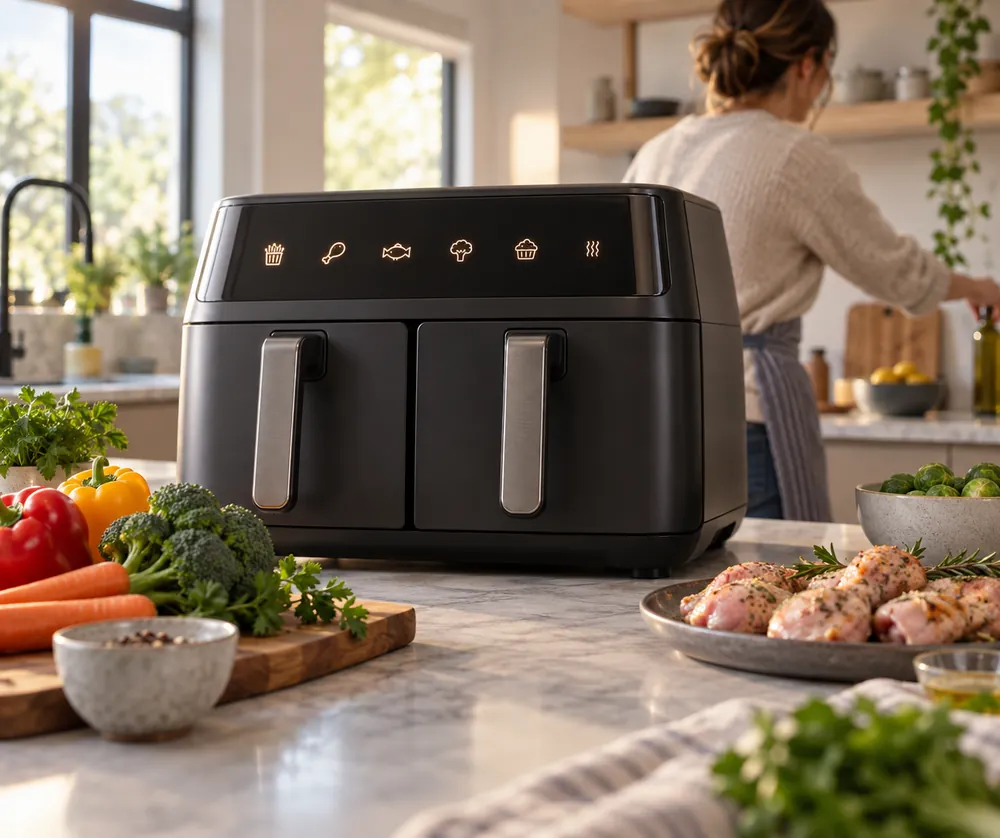
Cleaning, Storage, and Everyday Convenience
Cleaning and storage determine whether an air fryer becomes a daily appliance or another bulky gadget.
A family model should make it easy to remove crumbs, wash food-contact parts, and return the unit to its place without moving several items first.
Look for a dishwasher-safe basket and crisper plate, but confirm which parts qualify.
Even dishwasher-safe components may last longer with gentle hand washing, especially when nonstick coatings, silicone feet, or removable handles are involved.
Choose a design that is easy to clean
Smooth baskets with few seams collect less grease than deeply textured designs. A removable crisper plate helps drain fat and lets you clean beneath it, while a fixed perforated base may leave more residue in corners.
- Check whether the basket, tray, racks, and drip pan are removable.
- Prefer wide openings that let a sponge reach the corners.
- Look for clear instructions on soaking, detergents, and dishwasher use.
- Inspect the heating area for a removable shield or an accessible surface that can be wiped safely.
Dual-basket models add flexibility but create more parts to wash. Oven-style units can handle flatter foods and multiple trays, yet racks, door channels, and crumb trays may require more frequent attention than a single drawer.
Plan for counter and cabinet storage
Measure the appliance with its handle, open drawer, and door fully extended. Also check the exhaust direction; a compact footprint can still be inconvenient if hot air blows toward a wall, backsplash, or cabinet underside.
| Fit consideration | Typical category range | Why it matters |
| Rear and side clearance | About 4 to 6 inches | Allows heat and steam to escape |
| Cabinet opening height | About 15 to 18 inches | Helps accommodate tall lids and doors |
| Cooking temperature range | About 90°F to 450°F | Supports warming, roasting, and crisping |
Store accessories beside the unit rather than inside the basket if they can scratch its coating.
A shelf, rolling cart, or clear counter corner can make a larger family air fryer practical, provided it remains easy to lift, ventilate, and clean.
For everyday convenience, prioritize readable controls, a removable cord or tidy cable path, and a basket that slides smoothly when full.
The best choice is the model your household can clean quickly and access without rearranging the kitchen.
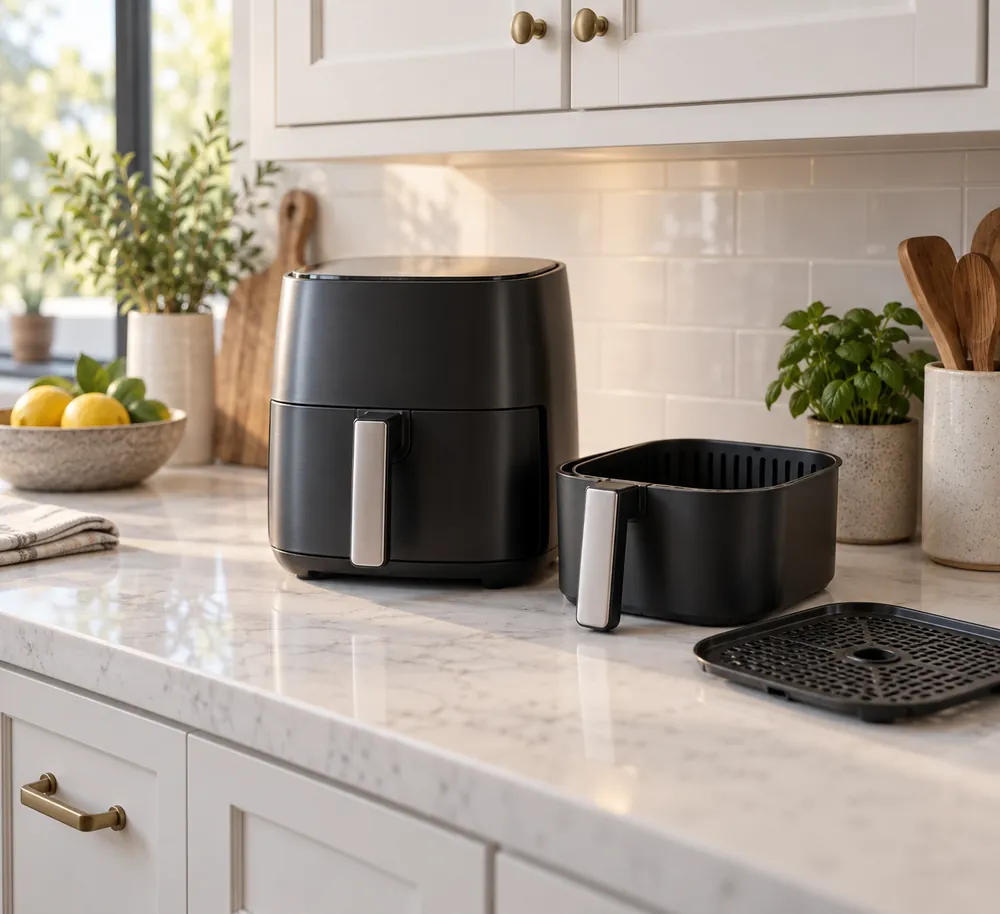
What Owners Change After the First Month
Owner reports reveal a common shift: families stop judging an air fryer by advertised capacity and focus on usable surface area.
Manufacturer guidance supports this distinction, warning against crowding food and recommending ventilation space.
The recurring complaint is batch cooking. A basket that looks large may hold only one loose layer of fries, wings, vegetables, or breaded portions.
Owners then change meal plans, cook sides first, or choose a wider, dual-basket, or oven-style design.
What owners complain about most
- Crowding: Stacking food slows browning and makes shaking less effective. Owners commonly report that family portions require multiple cycles, especially with bulky foods such as chicken pieces or frozen snacks.
- Countertop demands: The appliance stays out more often than expected because it is heavy, tall, or inconvenient to store. Owners who put it away after every use often use it less.
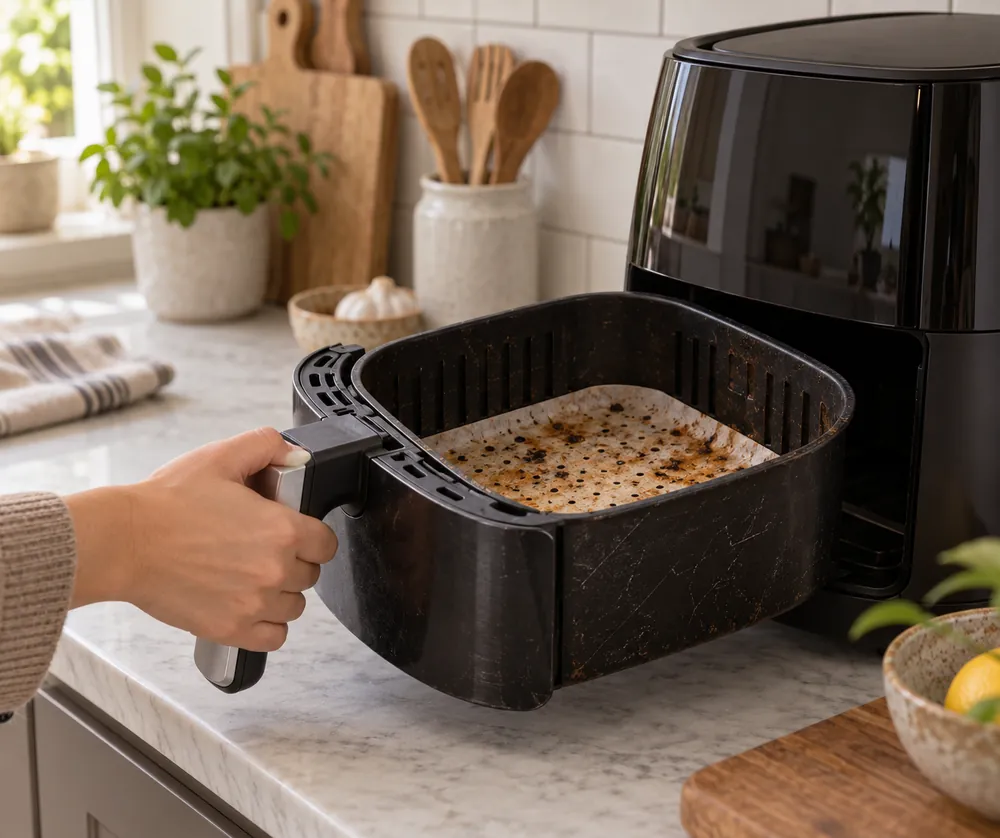
- Cleaning friction: Grease collects around drawer edges, racks, hinges, and vents. Dishwasher-safe removable parts help, but manufacturer instructions may still require hand-cleaning seals, heating areas, or coated surfaces.
| First impression | Later adjustment |
| “The basket is large enough.” | Check whether the food fits in a loose layer and whether the drawer is wide enough for the usual meals. |
| “It can replace the oven.” | Use it for smaller portions, reheating, crisping, and quick sides rather than every family-sized dish. |
| “It will store easily.” | Measure the counter, cabinet opening, handle clearance, and rear exhaust area before buying. |
What tends to hold up
Owners favor simple controls, sturdy drawers, removable baskets, and adjustable cooking programs. A range of about 90°F to 450°F supports warming, dehydrating, roasting, and crisping, although the usable range varies by design.
Dual-basket models suit households preparing a protein and side at different temperatures. Confirm both drawers’ capacity, synchronized finish times, and whether cleaning two baskets is acceptable.
What fails or disappoints early
Early complaints include peeling nonstick coatings, loose drawers, noisy fans, unreliable touch controls, and persistent odors.
These reports do not establish failure rates, so check the warranty, care instructions, replacement parts, and return policy.
Ventilation also matters. Common guidance calls for roughly 4 to 6 inches of clearance around hot exhaust, while a tall oven-style unit may need a cabinet opening of about 15 to 18 inches.
After a month, the best choice usually remains accessible, fits the family’s food shapes, and cleans easily.
Measure the location, compare interior layouts rather than quart labels, and read owner reports for recurring maintenance complaints.
Questions Still Worth Raising
Family air-fryer decisions become clearer when capacity, basket shape, counter space, and cleaning effort are considered together. Choose an appliance suited to the meals your household actually cooks, not its advertised capacity.
These questions highlight practical compromises that specifications and owner reports may reveal.
What air fryer size is best for a family?
Consider how much food you cook in a loose layer. A wide drawer may outperform a tall, narrow basket because food browns evenly and needs less rearranging.
| Published capacity | Typical household use |
| 2 to 4 quarts | Snacks, reheating, and small portions |
| 4 to 6 quarts | Smaller family meals |
| 6 to 8 quarts | Family dinners and larger portions |
| 8 to 12 quarts | Batch cooking, dual baskets, or oven-style cooking |
Is a dual-basket air fryer better for family meals?
Dual baskets help when a protein and side need different temperatures or cooking times. They simplify dinner coordination, but each compartment may offer less usable room than one large drawer.
Check whether both baskets finish together and whether the controls suit everyday use. Separate baskets also require more washing and storage space.
Should I buy a basket air fryer or an oven-style air fryer?
Choose a basket design for fries, wings, vegetables, reheating, and quick shaking. Choose an oven-style unit for flatter shelves, toast functions, or larger food shapes.
Oven-style appliances offer flexible racks, but doors, trays, and crumb areas may need more cleaning. Confirm shelves are removable and replacement accessories are available.
How much counter space does a family air fryer need?
Measure height, depth, width, door swing, and drawer-removal space. A model may fit but remain inconvenient if steam vents toward cabinets or the handle blocks nearby workspace.
| Specification | Common range or consideration |
| Rear and side clearance | About 4 to 6 inches |
| Upper cabinet opening | About 15 to 18 inches high |
| Storage depth | Measure the full appliance depth and cord position |
| Door or drawer movement | Allow unobstructed opening space |
How powerful should a family air fryer be?
Power affects heat recovery, cooking speed, and electrical load. Check the kitchen circuit before placing a larger model beside another high-draw appliance.
| Specification | Common category range |
| Power draw | About 1,200 to 1,800 watts |
| Cooking temperature | About 90°F to 450°F |
| Low-temperature use | Warming or dehydrating, depending on the controls |
| High-temperature use | Browning and crisping, depending on airflow |
Which air fryer is easiest to clean?
Look for a dishwasher-safe basket, removable crisper plate, smooth corners, and few exposed heating elements. Nonstick coatings simplify cleanup but still require suitable utensils and gentle washing.
- Check whether grease collects beneath the basket.
- Confirm that racks and trays can be removed without tools.
- Read owner reports about peeling, staining, and difficult-to-reach areas.
What should I check before buying an air fryer for my family?
Compare cooking area, meal separation, controls, noise, cleanup, storage, and warranty support. Product photographs should show food examples, not only advertised capacity.
Prioritize features that prevent repeated inconvenience. A smaller appliance with an accessible basket may serve a family better than a larger unit that is difficult to load, wash, or store.