The short answer: A microwave convection setting turns the appliance into a small convection oven by using a heating element and fan instead of microwave energy alone.
Use it for browning, crisping, roasting, and baking when regular microwave mode would steam or soften food.
Preheat when the recipe calls for oven-style cooking, use oven-safe cookware, and expect timing to differ from a full-size oven.
What the Convection Setting on a Microwave Actually Does
Convection mode turns a microwave into a small forced-air oven. Instead of relying only on microwave energy to excite water molecules, it uses a heating element and a fan to move hot air around the cavity.
That airflow is the key difference. It helps dry surfaces, brown edges, and cook thicker foods more evenly than microwave-only heating, though it still has less space and thermal mass than a full-size oven.
Microwave heat versus convection heat
A standard microwave setting is fast because it heats food internally and unevenly by density, moisture, and shape. Convection is slower, but it behaves more like baking or roasting.
| Spec category | Typical published range | What it affects |
| Convection temperature range | About 100°F-450°F | Proofing, warming, baking, roasting, and browning |
| Countertop capacity band | About 0.9-2.2 cu. ft. | Pan fit, batch size, and airflow clearance |
| Over-the-range capacity band | About 1.1-2.1 cu. ft. | Family meal size and cabinet fit |
| Microwave power band | About 900-1,200 watts | Speed during microwave-only or combination cooking |
Published specs often separate microwave wattage from convection behavior. A higher microwave wattage helps with reheating, but browning depends more on the convection element, fan pattern, rack position, and available airflow.
What convection mode is best for
Use convection for foods that benefit from dry heat. It is useful when texture matters more than raw speed.
- Baked foods: cookies, biscuits, frozen pastries, and small cakes.
- Roasted foods: vegetables, chicken pieces, and reheated pizza.
- Crisping tasks: fries, breaded snacks, and leftovers that turn soggy in microwave mode.
Combination modes add another trade-off. Microwave energy speeds the center while convection browns the outside, but delicate baked goods may cook unevenly if the microwave portion is too aggressive.
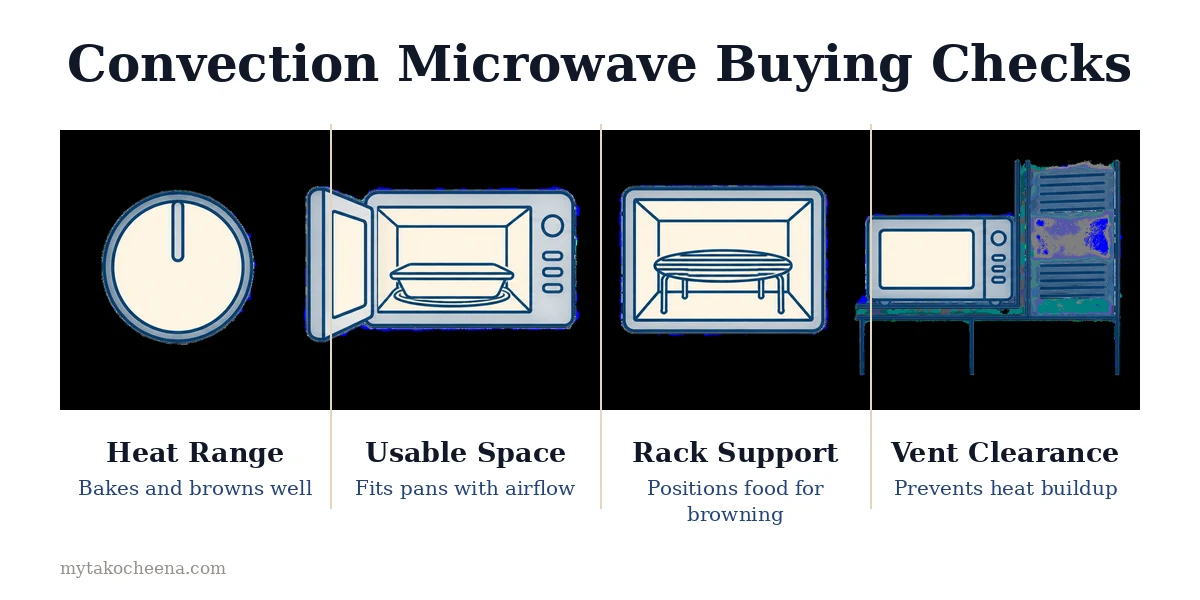
For specification shopping, compare usable cavity size, temperature range, rack support, and required ventilation space before comparing presets.
Owner reports are especially useful for noise, preheat time, and whether browning is consistent across the turntable or rack.
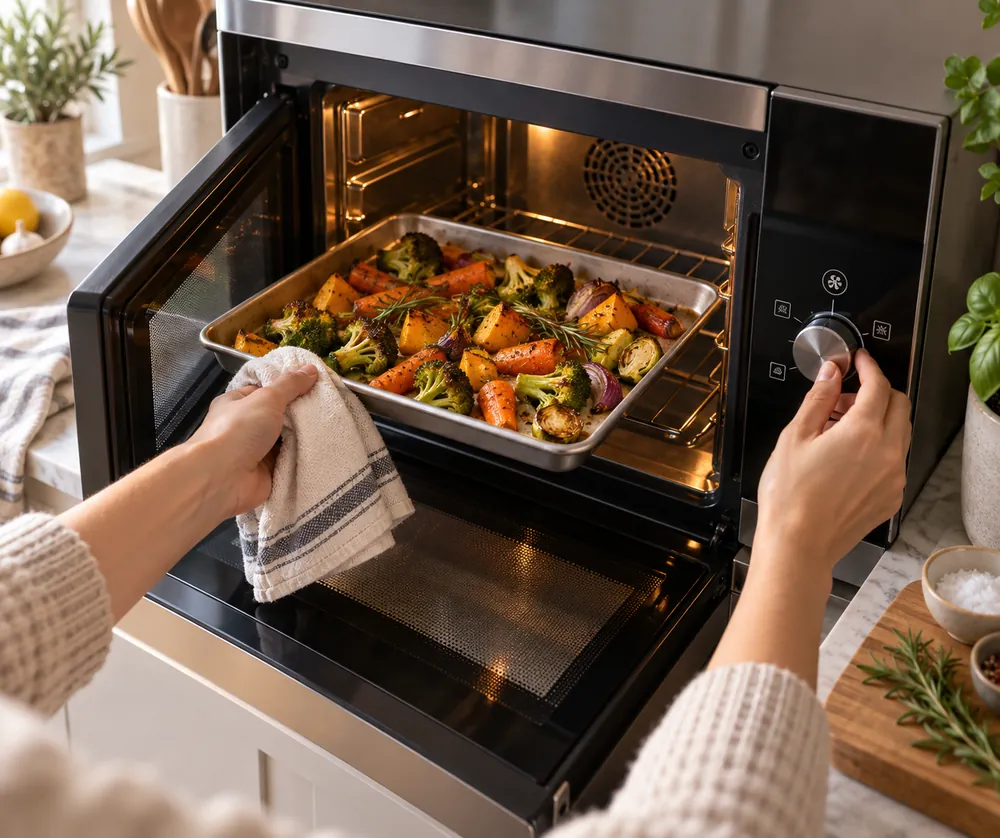
When to Use Convection Instead of Regular Microwave Mode
Convection mode is for browning, crisping, and baking. Regular microwave mode is for speed, reheating, and steaming, because it heats water molecules directly instead of circulating hot air.
Choose convection when texture matters as much as temperature. It is better for foods that suffer in regular microwave mode, such as frozen pizza, roasted vegetables, biscuits, and reheated fried foods.
| Specification area | Convection mode | Regular microwave mode |
| Common cooking temperature range | About 100°F-450°F | Power levels instead of oven temperatures |
| Typical microwave power band | Often paired with about 900-1,200 watts microwave output | About 700-1,200 watts microwave output |
| Common countertop capacity band | About 0.9-1.6 cubic feet | About 0.7-2.2 cubic feet |
| Typical rear or side clearance guidance | About 2-6 inches, depending on vent design | About 1-4 inches, depending on vent design |
Use regular microwave mode for soup, leftovers, rice, vegetables, and drinks. It is usually the better choice when moisture retention matters more than browning.
Use convection for dry-heat foods that need airflow. Owner reports commonly favor it for crisping edges, reducing sogginess, and making small-batch baking more practical without heating a full-size oven.
- Pick convection for pizza, pastries, fries, roasted vegetables, casseroles with toppings, and baked chicken pieces.
- Pick microwave mode for defrosting, reheating plated meals, melting butter, steaming vegetables, and warming beverages.
- Use combination modes only when the manual supports them for that food type, because power cycling and airflow vary by brand.
Check the label, manual, and installation guide before relying on convection performance.
The useful comparison is not one advertised feature, but temperature range, usable interior space, rack support, vent clearance, and owner-reported consistency.
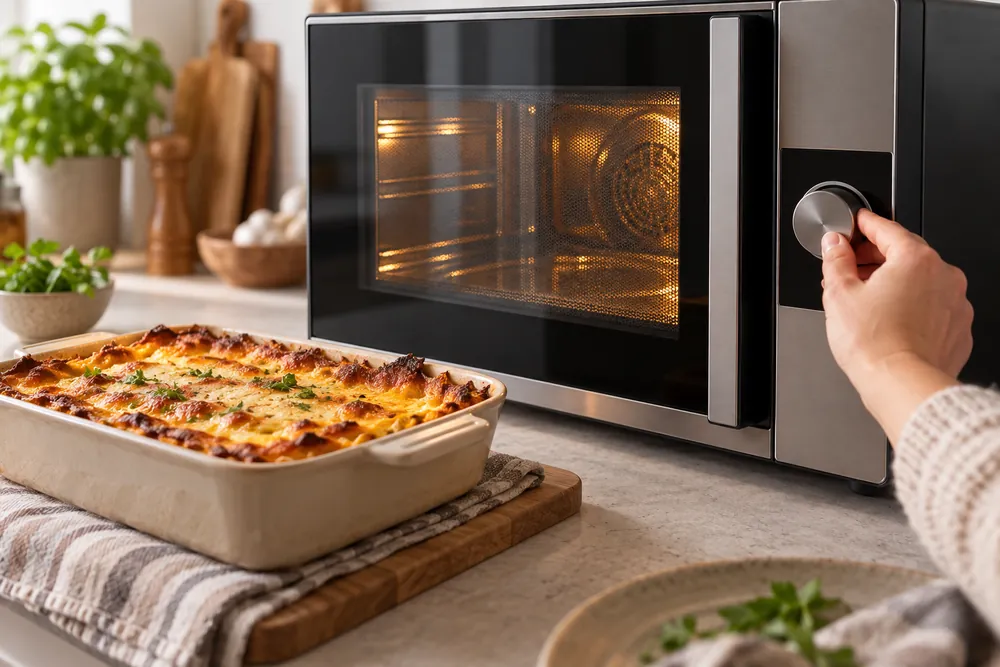
How to Set Up the Oven Before You Cook
Setup starts with confirming that the microwave is rated for convection cooking, not only reheating. Check the label, manual, and control panel terms so you know whether it uses a fan, a heating element, or preset combination modes.
Published specifications matter because convection microwaves vary by installation type, cavity size, and required airflow.
A countertop unit usually needs more visible breathing room, while a built-in or over-the-range unit depends on the cabinet and vent instructions.
| Specification | Typical published range | Why it matters |
| Convection temperature range | About 100°F to 450°F | Shows whether the oven can handle warming, baking, roasting, or crisping. |
| Usable capacity band | About 0.9 to 2.2 cubic feet | Affects pan fit, airflow, and how evenly hot air can circulate. |
| Typical side and rear clearance | About 1 to 3 inches | Helps prevent heat buildup around countertop models. |
Prepare the cavity and cookware
Remove plastic trays, splatter covers, and anything marked microwave-only. Convection mode uses dry heat, so cookware must be oven-safe as well as sized to leave space around the sides.
- Use the rack only as directed: Many convection modes rely on a metal rack for airflow, but placement rules vary by brand.
- Choose low-sided pans: Shallow metal pans and oven-safe glass usually allow better browning than tall dishes.
- Leave airflow space: Do not press foil, pans, or liners against the walls, ceiling, or fan cover.
Preheat and select the right mode
Use a preheat cycle for baking, roasting, and foods that need browning. Skipping it can leave the outside pale while the center cooks more slowly than expected.
| Mode | Best use | Setup note |
| Convection only | Baked goods, roasted vegetables, crisp reheating | Use oven-safe cookware and allow preheating. |
| Microwave plus convection | Faster casseroles, poultry pieces, dense foods | Use cookware approved for both microwave energy and oven heat. |
Set the rack, pan, and food before starting the timer so the door is not open during heat recovery. Then follow the manual’s convection sequence, because button names differ even when the published specifications look similar.
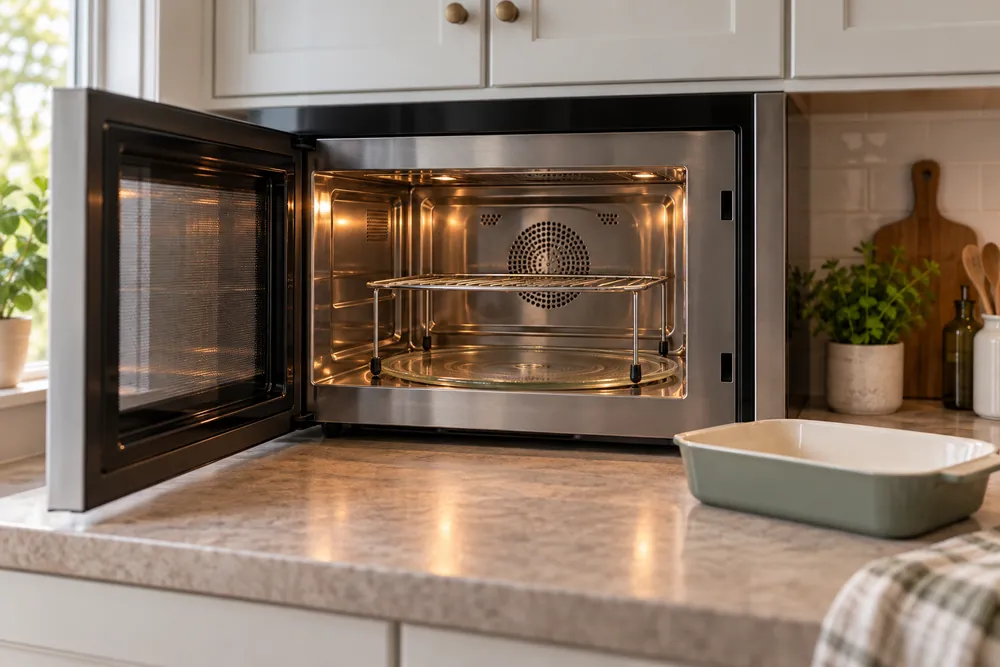
Cookware, Racks, and Pans That Work Safely
Convection-safe cookware matters because the microwave is acting more like a small oven. Use pieces that tolerate dry heat, leave airflow around the food, and match the manual’s approved accessory list.
Metal is not automatically banned in convection mode, but it must be used as the manufacturer allows. Avoid metal during microwave-only or combination cycles unless the manual specifically permits it.
| Cookware type | Typical published heat range | Best use |
| Oven-safe glass or ceramic | About 350°F-500°F | Casseroles, baked pasta, reheating with browning |
| Metal baking pan | About 400°F-500°F | Cookies, biscuits, roasted vegetables |
| Silicone bakeware | About 400°F-450°F | Muffins, small cakes, soft baked items |
Check the cookware label before relying on it. “Microwave-safe” does not always mean “convection-safe,” because plastic lids and storage containers can deform under oven-style heat.
- Use the supplied rack for better air circulation and browning.
- Choose shallow pans so hot air reaches the food surface.
- Avoid sealed lids because pressure and trapped steam can build quickly.
- Keep foil limited to small shielding pieces only when the manual allows it.
| Item to check | Common safe range | Why it matters |
| Clearance around pan edges | About 1-2 inches | Supports airflow and more even browning |
| Countertop exterior clearance | About 3-6 inches | Helps ventilation and heat release |
| Common microwave capacity bands | About 0.9-2.2 cubic feet | Affects rack height, pan size, and turntable space |
Rack placement affects results as much as pan choice. A higher rack can brown the top faster, while a lower position gives taller foods more clearance.
Before cooking, confirm that the pan rotates freely or fits the non-turntable floor design. Scraping, blocked vents, or contact with the oven wall means the pan is too large for safe convection use.
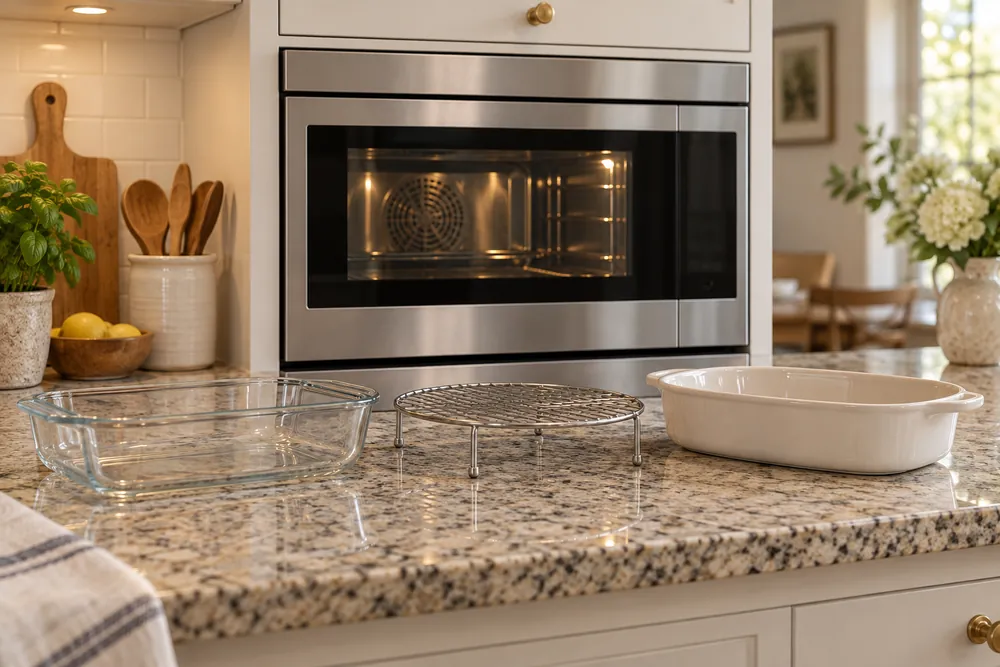
Temperature, Time, and Preheating Basics
Convection microwave settings depend on three controls: target temperature, cook time, and preheating. Published specifications usually show a temperature range, while recipe results depend on pan type, food thickness, and airflow.
Countertop and over-the-range convection microwaves commonly cover oven-style baking temperatures, but they do not always heat like a full-size range. Compare the spec sheet first, then adjust recipes in small steps.
| Specification | Typical category range | Why it matters |
| Convection temperature setting | About 100°F-450°F | Lower settings support warming and drying; higher settings support roasting and baking. |
| Cooking capacity | About 0.7-2.2 cu. ft. | Larger cavities fit wider pans but may need more warm-up time. |
| Microwave output band | About 700-1,200 watts | Microwave power affects combination modes, not pure convection baking alone. |
Preheating expectations
Preheating gives the cavity, rack, and air stream time to stabilize. For baking, frozen foods, and browned finishes, skipping preheat can leave pale tops or underdone centers.
Some units signal ready before every surface is evenly hot. Reported owner experience often points to better results after allowing a short extra stabilization period, especially with dense pans or multiple portions.
| Situation | Typical adjustment range | Trade-off |
| Converting from a full-size oven recipe | Reduce time by about 10%-25% | Smaller cavities can circulate heat faster, but thick foods still need doneness checks. |
| Using combination microwave-convection | Shorten time by about 20%-40% | Food cooks faster, but crisping may be less even. |
| Cooking on dark metal or thin pans | Lower temperature by about 25°F | Helps reduce over-browning before the center finishes. |
- Use an oven-safe rack: Airflow under the food is part of the convection setting.
- Check early: Start checking before the shortest recipe time.
- Match the mode: Pure convection bakes; combination mode speeds cooking with microwave energy.
Foods That Benefit Most from Microwave Convection
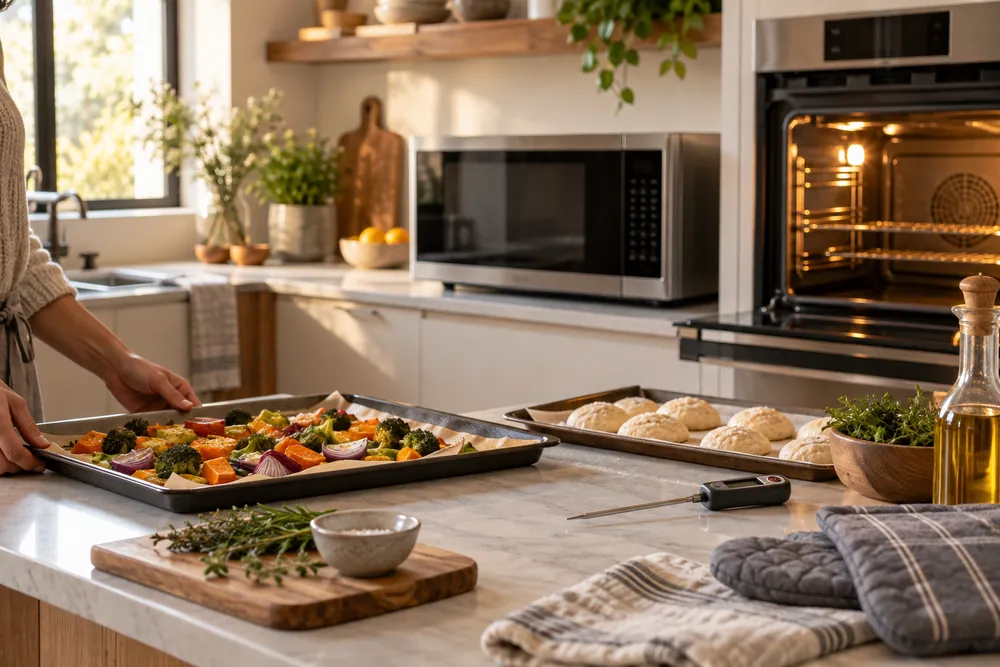
Convection-friendly foods are items that improve with dry, moving heat rather than steam alone. Use this setting for browning, crisping, and more even surface drying, especially when the microwave-only mode would leave food soft.
Microwave convection works best where texture matters. Published specifications and owner reports usually point to the same winners: baked goods, roasted vegetables, small cuts of meat, and reheated fried foods.
| Food type | Useful category range | Why convection helps |
| Cookies, biscuits, small pastries | Common cooking temperatures around 325°F-425°F | Dry heat supports browning and firmer edges. |
| Frozen pizza, flatbreads, fries | Common cooking temperatures around 375°F-450°F | Air movement reduces sogginess compared with microwave-only heating. |
| Chicken pieces, fish fillets, vegetables | Common countertop capacity bands around 0.9-1.6 cu. ft. | Smaller portions fit better and brown more evenly. |
| Casseroles and baked pasta | Common over-the-range capacity bands around 1.5-2.2 cu. ft. | Larger cavities suit shallow dishes that need a browned top. |
Best everyday uses
- Frozen snacks: Use convection for fries, nuggets, pizza rolls, and breaded appetizers when crispness matters.
- Leftovers: Reheat pizza, fried chicken, and roasted potatoes with convection to avoid the rubbery texture microwave-only heating can create.
- Baking: Choose cookies, biscuits, muffins, and small cakes before attempting tall loaves or large layered desserts.
- Roasting: Use shallow pans for vegetables, sausage, chicken thighs, and fish portions so air can reach the food surface.
Dense foods still need judgment. A thick casserole may heat faster with microwave power first, then finish better with convection for the browned top.
Accessories matter as much as the setting. A low rack, microwave-safe metal tray approved by the manufacturer, or shallow convection pan helps airflow reach the underside instead of trapping moisture.
Common Mistakes That Lead to Pale, Soggy, or Uneven Results
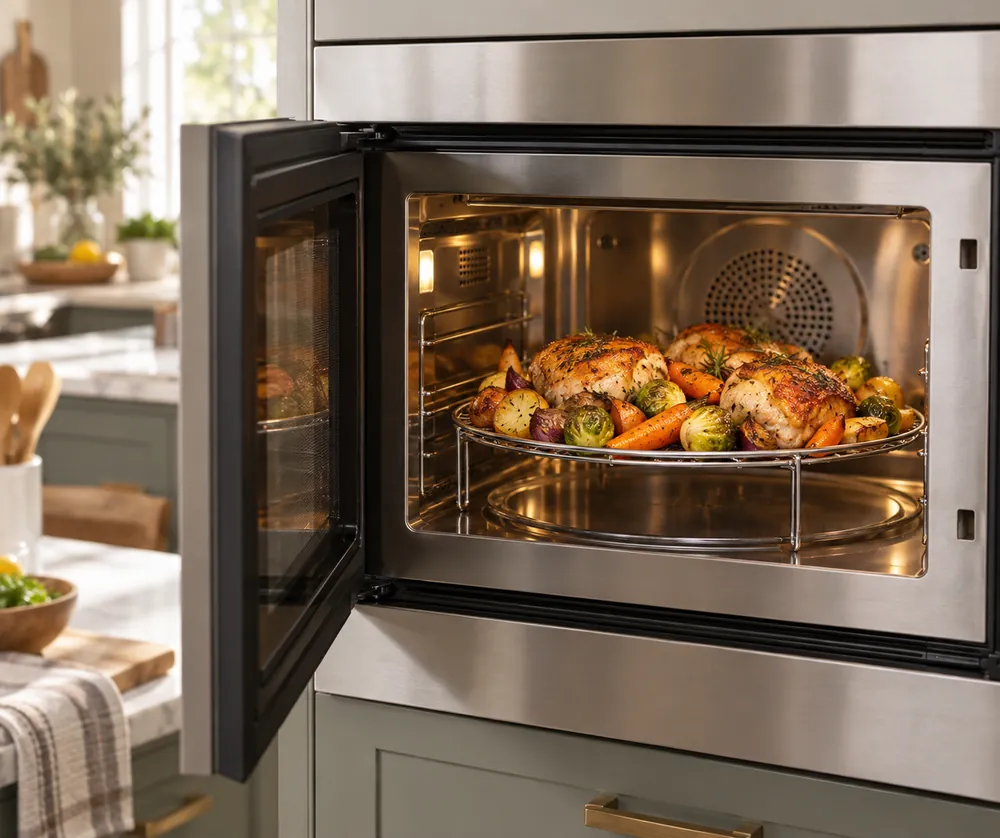
Steam trapped around the food is the main reason convection microwave results look pale or turn soggy. Convection needs moving hot air, so the pan, rack position, and preheat step matter as much as the setting itself.
A frequent mistake is using a deep glass dish for foods that need browning. Glass and ceramic can work for casseroles, but they slow surface drying compared with a shallow metal pan approved for convection use.
| Specification area | Typical published range | Why it matters |
| Convection temperature range | About 100°F to 450°F | Lower limits help with warming or proofing; higher limits improve browning. |
| Countertop interior capacity bands | About 0.7 to 2.2 cu. ft. | Smaller cavities brown faster but crowd pans more easily. |
| Typical ventilation clearance | About 1 to 3 inches | Blocked vents reduce airflow and can cause uneven heating. |
Skipping preheat is another common cause of soft crusts. Many convection microwaves need the cavity, rack, and pan to reach temperature before food goes in.
- Using microwave-only covers: Covers trap moisture, which works against crisping and browning.
- Overcrowding the rack: Food needs open space around it so hot air can circulate.
- Choosing combi mode by mistake: Microwave energy can cook the inside quickly while the surface stays pale.
- Ignoring rack height: Food placed too low may brown slowly; food too close to the element may brown unevenly.
Frozen foods can also disappoint when cooked straight from a dense stack. Separate pieces, shake off loose ice, and use a perforated or shallow pan when the manual allows it.
Owner reports often point to the same pattern: soggy results usually come from moisture management, not a weak appliance. Check the manual’s approved cookware list, vent clearance, and mode labels before changing recipes.
Where Owner Feedback Agrees and Where It Splits
Owner feedback clusters around one issue: convection microwave performance depends heavily on expectations.
Manufacturer documentation usually frames these appliances as space-saving hybrids, while buyers often judge them against full-size ovens.
Recurring complaints focus on uneven browning, slower preheating, and learning-curve controls.
Reports are more positive when owners use the convection setting for reheating, frozen foods, small baked items, and crisping tasks rather than large roasting jobs.
| Specification area | Common range in published listings | Why owners mention it |
| Interior capacity | About 0.9-2.2 cu. ft. | Smaller cavities heat faster but limit cookware and batch size. |
| Convection temperature range | About 100-450°F | Lower ranges help warming; higher ranges matter for browning. |
| Typical clearance guidance | About 1-3 inches around vents | Restricted airflow is often tied to heat buildup complaints. |
Where feedback agrees, durability of the basic microwave function is usually better than enthusiasm for the convection feature.
Owner reports commonly say the microwave mode remains useful even when convection results feel less oven-like than expected.
Where feedback splits, controls and presets are the dividing line. Some owners like sensor programs and combo modes; others say the same menus make simple baking steps harder than using a regular oven.
- Most repeated complaint: convection cooking can brown unevenly or take longer than expected, especially with crowded pans or tall dishes.
- What tends to hold up: everyday reheating, defrosting, and compact-kitchen convenience get the steadiest approval in owner reports.
- What may fail early: door switches, turntable parts, control panels, and fan noise are the issues owners most often flag before total appliance failure.
Manufacturer documentation is useful for confirming cavity size, venting needs, cooking modes, and temperature settings.
Owner reports are better for spotting practical trade-offs, especially noise, interface frustration, and whether convection performance matches the buyer’s cooking habits.
Questions Buyers Ask Most
Convection microwave questions usually come down to fit, heat range, and whether the feature replaces another appliance. Published specifications help compare cavity size, clearance, modes, and installation type before you buy.
What does the convection setting on a microwave actually do?
Convection mode uses a fan and heating element to circulate hot air around the food. It is meant for browning, roasting, and baking tasks that a standard microwave mode does not handle well.
Can a convection microwave replace a regular oven?
It can replace a regular oven for small batches, reheating with crisping, and many weeknight baking jobs. It is less convenient for large sheet pans, multi-rack cooking, or holiday-size roasting.
| Spec category | Typical published range |
| Interior capacity | About 0.9-2.2 cubic feet |
| Convection temperature range | About 100-450°F |
| Microwave power band | About 900-1,200 watts |
What size convection microwave should I buy?
Choose by the cookware you use, not only by cubic feet. A wider turntable or flatbed interior can matter more than total capacity if you use dinner plates, casserole dishes, or small baking pans.
Does convection mode use more electricity than microwave mode?
Convection mode usually runs longer and uses resistance heat, so it can draw more total energy for some foods. Microwave mode is usually faster for steaming, melting, and simple reheating.
Do I need special pans for convection microwave cooking?
Use oven-safe metal pans only when the manual allows convection-only cooking. Do not use metal during microwave or combination modes unless the manufacturer specifically says it is safe.
- Convection only: oven-safe metal may be allowed.
- Microwave only: use microwave-safe glass, ceramic, or approved plastic.
- Combination mode: follow the manual closely because rules vary.
How much clearance does a convection microwave need?
Countertop models commonly need open space around vents, while over-the-range models follow cabinet and ducting requirements. Published specs often call for roughly 2-6 inches of side, rear, or top clearance, depending on design.
| Installation type | Typical specification range |
| Countertop clearance | About 2-6 inches near vents |
| Over-the-range cabinet width | About 30 inches common opening class |
| Built-in trim opening | Varies by trim kit and cabinet cutout |
Is a convection microwave better than an air fryer?
A convection microwave is more versatile for reheating, defrosting, baking, and combination cooking. An air fryer often feels simpler for fries, wings, and small crispy foods because the basket shape promotes airflow.
What specs matter most before buying?
Compare capacity, exterior dimensions, vent location, convection temperature range, microwave wattage band, and included racks. Also check owner reports for noise, control clarity, preheat speed, and how easy the interior is to clean.