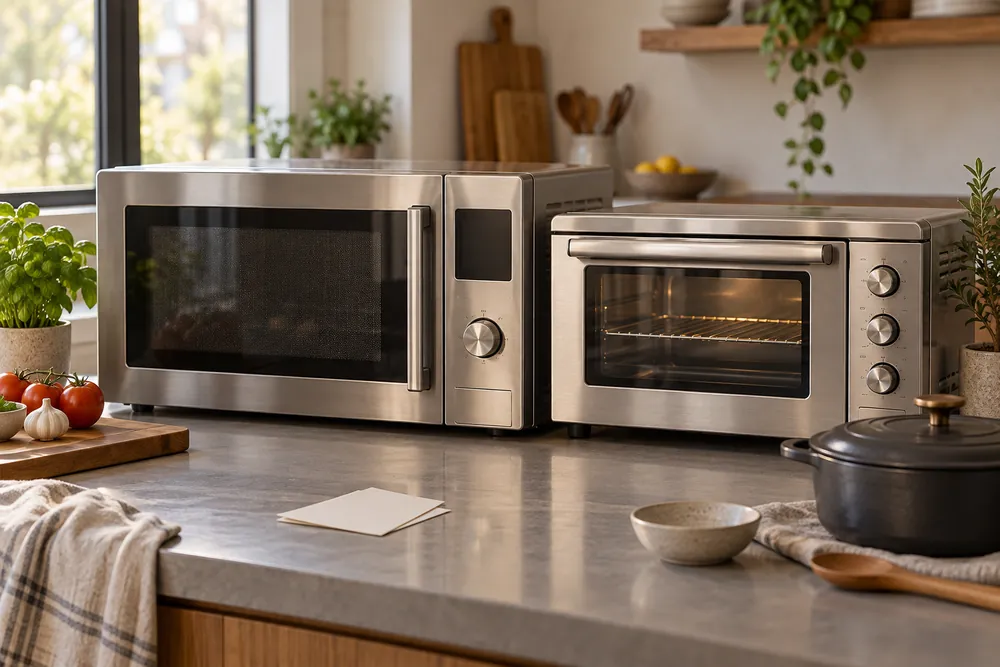
The gist: A convection microwave is a microwave, heating element, and circulating fan in one appliance.
It can replace a regular oven for many small meals, baking projects, roasted vegetables, and reheating jobs, especially in apartments or compact kitchens.
It cannot match a full-size oven for large batches, oversized cookware, multiple racks, or extended holiday cooking.
How a Convection Microwave Works
Convection microwave cooking combines microwave energy with fan-circulated heat in one cavity.
Microwave energy warms food quickly from within, while a heating element and fan create the dry, moving heat needed for browning, roasting, baking, and crisping.
This combination makes the appliance more versatile than a standard microwave, but it does not provide the same usable space as a regular oven.
It works best for everyday portions, smaller households, apartments, RVs, and kitchens where counter or cabinet space is limited.
Two heat sources in one appliance
Microwave mode targets moisture, fat, and sugar inside food, which makes it effective for reheating leftovers, defrosting ingredients, steaming vegetables, and softening butter.
Because the cavity air remains relatively cool, microwave-only cooking rarely produces the browned surface associated with oven cooking.
Convection mode uses an electric heating element to warm the cavity, while a fan moves that hot air around the food.
The circulating air removes moisture from the surface and encourages browning, so roasted vegetables, baked goods, casseroles, and frozen foods can develop a firmer exterior.
| Specification | Typical category range | What it affects |
|---|---|---|
| Countertop capacity | About 0.7 to 2.2 cubic feet | Plate, pan, and casserole fit |
| Microwave cooking power | About 700 to 1,200 watts | Reheating and defrosting speed |
| Convection temperature | About 170°F to 450°F | Warming, baking, roasting, and crisping |
How combination cooking changes results
Combination mode runs microwave energy and convection heat during one program.
A frozen entrée can heat internally with microwave energy while the fan and element dry the surface, reducing the soft texture that microwave-only cooking often leaves behind.
Settings differ by appliance, so check whether combination cooking allows separate power and temperature adjustments.
Some programs prioritize speed, while others provide more time for browning; the best choice depends on the food’s thickness, moisture, and desired finish.
Why airflow and space matter
Air movement helps reduce hot and cool pockets, but it cannot overcome an overcrowded cavity.
Large pans, tightly packed food, or cookware that blocks the fan can restrict circulation and produce uneven browning, even when the published capacity appears adequate.
- Microwave mode: Best for reheating, defrosting, steaming vegetables, and softening ingredients.
- Convection mode: Better for baking, roasting, browning, and drying food surfaces.
- Combination mode: Useful when food needs fast internal heating and a firmer exterior.
Installation affects expectations
Countertop units need unobstructed ventilation space, while over-the-range and built-in-style models depend on cabinet dimensions, electrical requirements, and manufacturer-specified clearances.
Measure the opening and the usable interior before assuming an appliance can replace a regular oven.
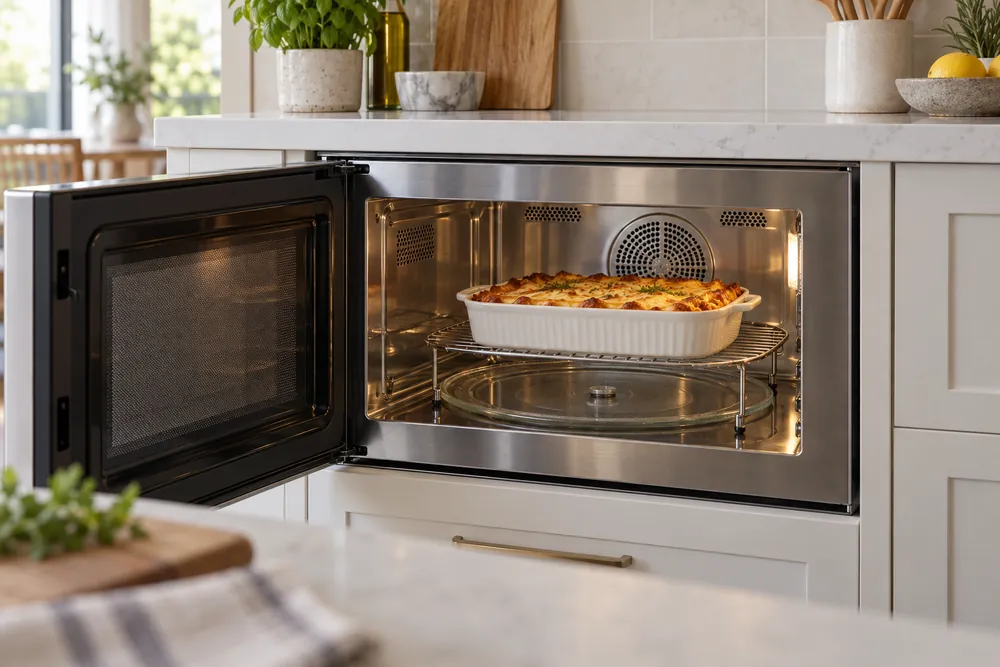
Where It Can Replace a Regular Oven
A convection microwave can cover much of the daily work handled by a regular oven, especially in a small household, apartment, dorm, office, or RV.
It combines microwave speed with fan-circulated heat, giving you one appliance for reheating, roasting, baking, browning, and crisping.
That replacement works best for modest portions and routine meals rather than large cooking projects. The smaller cavity saves space and energy, but it limits pan size, airflow, and the number of dishes you can cook at once.
Everyday foods it handles well
Microwave mode remains useful for soup, leftovers, frozen meals, defrosting, steaming vegetables, and softening butter.
Convection mode adds the dry heat needed for roasted vegetables, baked potatoes, small casseroles, chicken pieces, and cookies.
Combination mode can shorten cooking time for foods that need to heat internally and brown externally. A frozen entrée, for example, can warm with microwave energy while the heating element and fan help reduce a soft, wet surface.
- Small pizzas, flatbreads, biscuits, and pastries that need a browned top.
- Roasted vegetables, fish fillets, chicken portions, and other compact proteins.
- One-pan casseroles, baked pasta, and side dishes for a few people.
- Small batches of cookies, muffins, or other simple baked goods.
Capacity determines the practical replacement
Published capacity does not equal usable baking space. A pan needs clearance from the walls, and crowded food blocks the airflow that makes convection cooking effective.
| Category | Typical range | What it supports |
| Countertop capacity | About 0.7 to 2.2 cubic feet | Single portions to small family pans |
| Microwave cooking power | About 700 to 1,200 watts | Reheating, defrosting, and internal cooking speed |
| Convection temperature | About 170°F to 450°F | Warming, baking, roasting, and browning |
Measure the turntable or usable rack area rather than relying only on the headline capacity. A compact model may handle a plate or small dish well but reject a full-size casserole, loaf pan, roasting tray, or multiple baking sheets.
Where a regular oven remains better
A regular oven retains an advantage for holiday meals, large roasts, multiple trays, tall cookware, and recipes requiring steady heat over a broad surface.
Its larger cavity also makes it easier to maintain airflow around several dishes.
Choose the convection microwave as an oven replacement when portion size, counter space, and speed matter more than batch capacity. Treat it as a companion appliance when you regularly cook for a crowd or depend on oversized cookware.
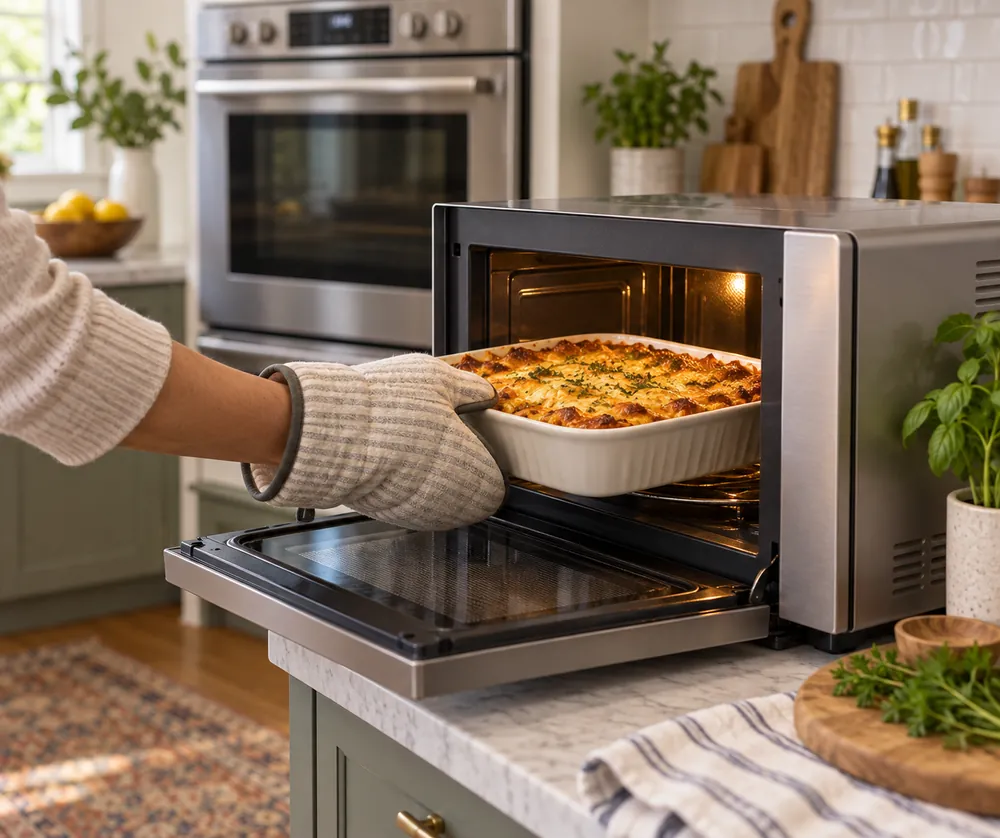
Where a Regular Oven Still Wins
A convection microwave can cover many daily cooking tasks, but a regular oven remains the stronger choice for volume, flexibility, and long cooking sessions.
Its larger cavity gives heat and airflow more room to work, especially when several dishes need to cook at the same time.
Large batches expose the main limitation of a convection microwave. A small cavity may handle a modest casserole, but multiple racks, wide baking sheets, and tall roasting pans can crowd the airflow or fail to fit at all.
| Appliance category | Common published capacity range | Practical advantage |
| Countertop convection microwave | About 0.7 to 2.2 cubic feet | Compact cooking and reheating |
| Over-the-range convection microwave | About 1.1 to 2.2 cubic feet | Integrated placement above a cooktop |
| Full-size regular oven | About 4.0 to 6.0 cubic feet | Large pans, multiple dishes, and wider spacing |
More room for consistent baking
A regular oven provides a broad, stable cooking area for foods that need even spacing.
Cookies, biscuits, sheet-pan vegetables, and layered casseroles can spread across a pan instead of being limited to a small turntable or compact rack.
That space also helps when a recipe depends on predictable airflow. Crowding a convection microwave can slow browning, create uneven textures, and require rotating or cooking in separate batches.
Better for long cooking sessions
Regular ovens are better suited to extended roasting, braising, and holiday meals.
They can hold a large roast while another rack handles vegetables or dessert, reducing the interruptions that come with repeatedly clearing and reloading a compact appliance.
| Cooking function | Typical category range | Best suited to |
| Convection microwave | About 170°F to 450°F | Small roasts, baking, crisping, and reheating |
| Regular oven | About 200°F to 550°F | Low-and-slow cooking, high-heat roasting, and broader recipe coverage |
When the regular oven is the better investment
- Choose a regular oven for frequent family-size meals or batch baking.
- Prefer it for oversized cookware, multiple racks, and large holiday dishes.
- Use it when recipes require steady heat for several hours.
- Keep a convection microwave as a companion appliance if speed and compact reheating matter more than capacity.
For a small household, the microwave’s combination modes may cover enough ground to replace an oven. For demanding baking, entertaining, or meal preparation, the regular oven’s capacity and sustained heat remain difficult to match.
Buying Factors That Matter Most
Cooking capacity, ventilation, controls, and installation determine whether a convection microwave can replace a regular oven in daily use.
The right choice depends less on having every cooking mode and more on whether the cavity, airflow, and heating performance match the meals you prepare most often.
Choose usable capacity, not just the advertised cavity
Manufacturers list internal volume, but usable space also depends on the turntable, rack position, interior shape, and door clearance.
A rounded cavity may hold a plate well while offering less practical room for a square casserole or baking pan.
| Appliance category | Typical published capacity | Best suited to |
| Compact countertop | About 0.7–1.0 cubic feet | Single portions, reheating, small dishes |
| Standard countertop | About 1.1–1.5 cubic feet | Small households and everyday baking |
| Larger countertop or over-the-range | About 1.6–2.2 cubic feet | Family portions and larger cookware |
Check the manufacturer’s interior dimensions before buying. A stated capacity does not guarantee that a standard roasting dish, loaf pan, or tall container will fit comfortably.
Check temperature range and heating power
Convection temperature range affects which oven-style tasks are realistic.
Lower settings help with warming and gentle cooking, while higher settings support roasting, browning, and baking, though small cavities can brown food faster than expected.
| Specification | Common published range | What it affects |
| Microwave cooking power | About 700–1,200 watts | Reheating speed and defrosting |
| Convection temperature | About 170–450°F | Baking, roasting, warming, and crisping |
| Over-the-range width | About 29–30 inches | Compatibility with common range openings |
Prioritize the modes you will actually use
Microwave-only mode handles reheating, defrosting, steaming vegetables, and softening ingredients efficiently.
Convection mode is better for browning and drying surfaces, while combination mode speeds internal heating and adds a firmer exterior.
- Choose combination settings for frozen meals, casseroles, and foods that are wet inside but should finish crisp.
- Look for adjustable power levels, clear presets, and manual temperature control.
- Confirm whether the fan, rack, and turntable can be used safely in each mode.
Account for installation and ventilation
Countertop models need open space around vents and a stable, heat-resistant surface.
Over-the-range or built-in-style units require accurate cabinet measurements, suitable electrical service, and attention to ducting or recirculating ventilation.
Treat a convection microwave as a compact oven replacement rather than a full-size duplicate. It can handle many everyday meals, but large batches, oversized cookware, and extended holiday cooking still favor a regular oven.
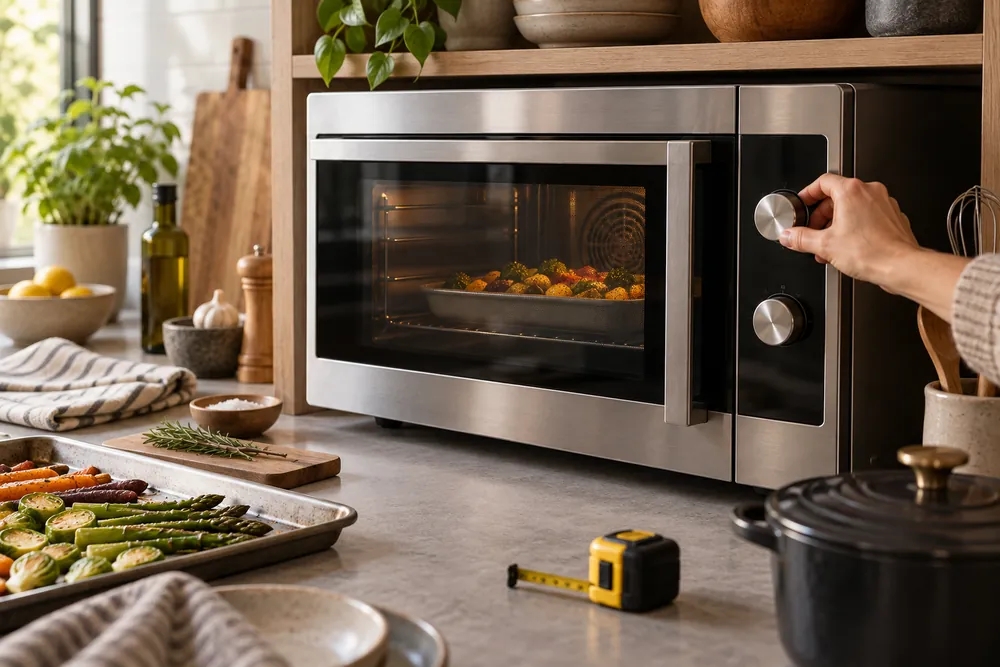
How These Hold Up After a Year
Owner reports commonly praise convection microwaves for replacing several small appliances without taking over the kitchen.
The recurring complaint is limited usable space: the appliance handles everyday portions well, but large dishes, crowded trays, and back-to-back baking expose its compromises.
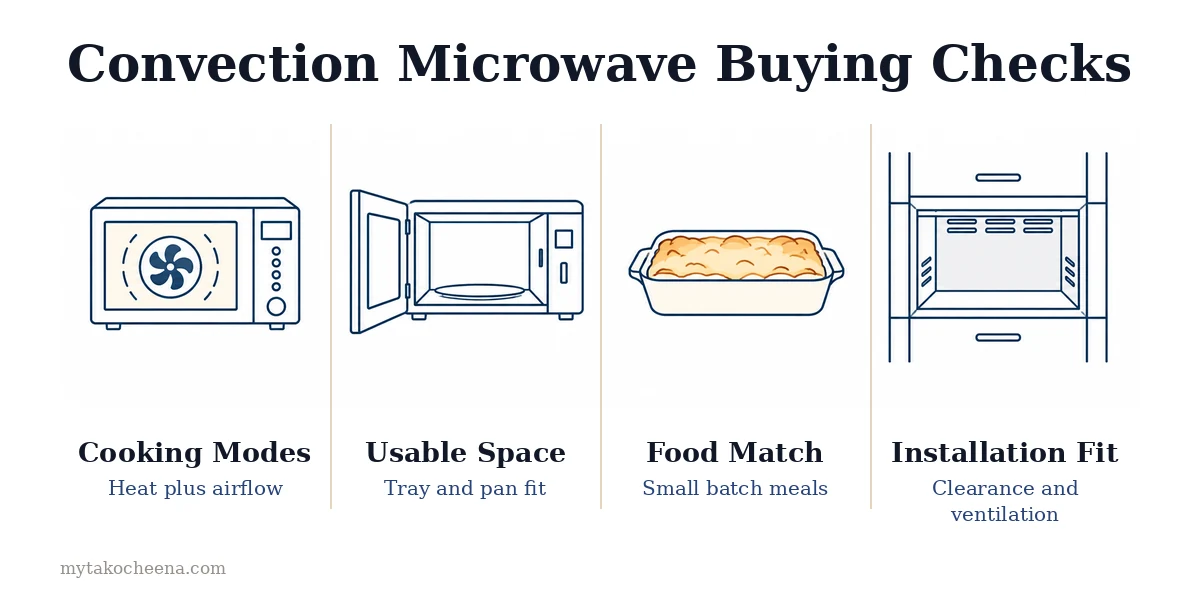
Manufacturer documentation supports that trade-off. These appliances combine microwave energy with a heating element and fan, so they can reheat food quickly and brown surfaces more effectively than a standard microwave.
They still have a smaller cavity and less airflow than a regular oven.
What owners continue to like
- Microwave mode remains convenient for reheating soup, defrosting ingredients, softening butter, and steaming vegetables.
- Convection mode adds useful flexibility for roasting vegetables, baking small batches, warming bread, and crisping foods that would become soft in microwave-only mode.
- Combination cooking can shorten preparation time by heating the center with microwave energy while the fan and element improve the exterior.
- Countertop models can suit apartments, RVs, offices, and smaller households that rarely prepare full-size casseroles or multiple trays.
Owner feedback also frequently mentions a learning curve.
Microwave, convection, grill, and combination programs do not behave identically, and manufacturer instructions often recommend different cookware, rack positions, preheating steps, and power settings for each mode.
| Specification | Typical range | Practical effect |
|---|---|---|
| Countertop capacity | About 0.7 to 2.2 cubic feet | Determines plate, pan, and casserole fit |
| Microwave cooking power | About 700 to 1,200 watts | Affects reheating and defrosting speed |
| Convection temperature | About 170°F to 450°F | Sets the range for warming, baking, and roasting |
What tends to fail or frustrate first
The turntable, door hardware, control panel, interior light, and convection fan are common points of concern in owner reports.
Some complaints involve noisy fans, uneven browning, unreliable sensors, or controls that become difficult to read or operate.
Manufacturer warranty terms and care instructions matter because grease buildup, blocked vents, unsuitable metal, and repeated overheating can affect performance.
A clean filter or vent path, adequate clearance, and the recommended cookware can reduce avoidable problems, but they cannot create full-size oven capacity.
The practical verdict is favorable for small portions and mixed cooking tasks.
Buyers who regularly prepare large roasts, holiday meals, several pizzas, or multiple baking sheets should keep a regular oven, while smaller households may find the convection microwave sufficient for most daily cooking.
For a buyer with a tape measure, the listed exterior dimensions are only the starting point.
Measure the counter depth, then allow room for the door to open fully and for your hands to remove a hot dish without hitting a wall or cabinet.
Check the space above and beside the appliance before deciding where it will live.
Ventilation requirements vary, and a tight alcove can make controls awkward, trap heat, or prevent the door from opening far enough for regular cookware.
Measure the dishes you already use, not an idealized baking pan. A favorite dinner plate, loaf tin, glass casserole, or small roasting dish may reveal limitations that an advertised interior measurement does not make obvious.
Also consider the path between storage, preparation, and serving.
A countertop unit placed across the kitchen may technically fit but create an inconvenient routine, especially when it needs to be opened repeatedly during cooking or when dishes are hot.
Door clearance matters more in a narrow kitchen than it does on a product page. Mark the swing with painter’s tape, including the handle, and confirm that nearby drawers, cabinet doors, and walking space remain usable.
Plan for accessories and cleanup as well. Racks, trays, oven mitts, and splatter covers need a storage spot, while the turntable or interior surfaces need enough access for wiping.
A crowded counter can erase the convenience the appliance provides.
The practical trade-off is therefore less about replacing every oven function and more about matching the appliance to the kitchen’s daily scale.
It makes sense when the available footprint and typical cookware align; otherwise, a regular oven may remain easier to use.
What Shoppers Ask Before Ordering
A convection microwave can replace a regular oven for small households, apartments, RVs, and everyday meals, but it is not a full-size oven.
Choose based on cooking volume, cookware size, ventilation, and whether speed matters more than baking space.
Can a convection microwave replace a regular oven?
It can handle reheating, roasting vegetables, baking small portions, crisping frozen foods, and everyday meals. Its smaller cavity limits large casseroles, multiple baking sheets, oversized roasting pans, and holiday cooking.
Combination cooking uses microwave energy for faster internal heating while the fan and heating element brown the outside. It is more versatile than a standard microwave but cannot match a full-size oven’s capacity.
What can you cook in a convection microwave?
Use microwave mode for reheating, defrosting, steaming vegetables, softening butter, and warming drinks. Convection mode suits cookies, biscuits, roasted vegetables, small pizzas, chicken pieces, and foods needing a drier surface.
Combination mode suits foods needing quick heating and browning. Results depend on the recipe, pan material, food thickness, and space around the cookware.
How much cooking space does a convection microwave have?
Published countertop capacities commonly span about 0.7 to 2.2 cubic feet. Usable space is smaller because turntables, racks, rounded corners, and airflow clearance reduce room for pans.
| Capacity category | Typical range | Best suited to |
| Compact countertop | About 0.7–1.0 cubic feet | Single portions and small plates |
| Mid-size countertop | About 1.1–1.6 cubic feet | Everyday meals and smaller baking pans |
| Larger countertop or over-the-range | About 1.7–2.2 cubic feet | Family portions and wider cookware |
What temperature range should a convection microwave have?
Many convection settings cover roughly 170°F to 450°F, though steps vary. A wider range supports warming, baking, roasting, and browning.
Check for adjustable increments, preheating, broil or grill functions, and combination programs. These matter more than maximum temperature alone.
Can I use regular oven cookware in a convection microwave?
Use cookware marked microwave-safe when microwave or combination mode is active. Metal may be acceptable during convection-only cooking, but manufacturer instructions determine whether racks, foil, or metal pans are permitted.
Measure the turntable or flat cooking surface before ordering. A pan may fit the cavity but block rotation, touch the walls, or restrict airflow.
Does a convection microwave need special installation?
Countertop units need specified clearance around vents and should not sit tightly against a wall.
Over-the-range and built-in-style models require attention to cabinet dimensions, electrical requirements, ventilation, and trim-kit compatibility.
| Item | Typical category range | Why it matters |
| Over-the-range width | About 29–30 inches | Matches many standard range openings |
| Built-in trim opening | About 24–30 inches | Determines cabinet and trim compatibility |
| Countertop ventilation clearance | Often several inches | Protects airflow and appliance performance |
Is a convection microwave worth buying for a small kitchen?
It is often worthwhile where counter, apartment, or RV space is limited. One appliance handles microwave reheating and smaller oven tasks, reducing the need for separate equipment.
Choose a regular oven for multiple trays, large roasts, tall dishes, or meals requiring steady heat for hours. Compare capacity, controls, clearance, and cookware fit before ordering.