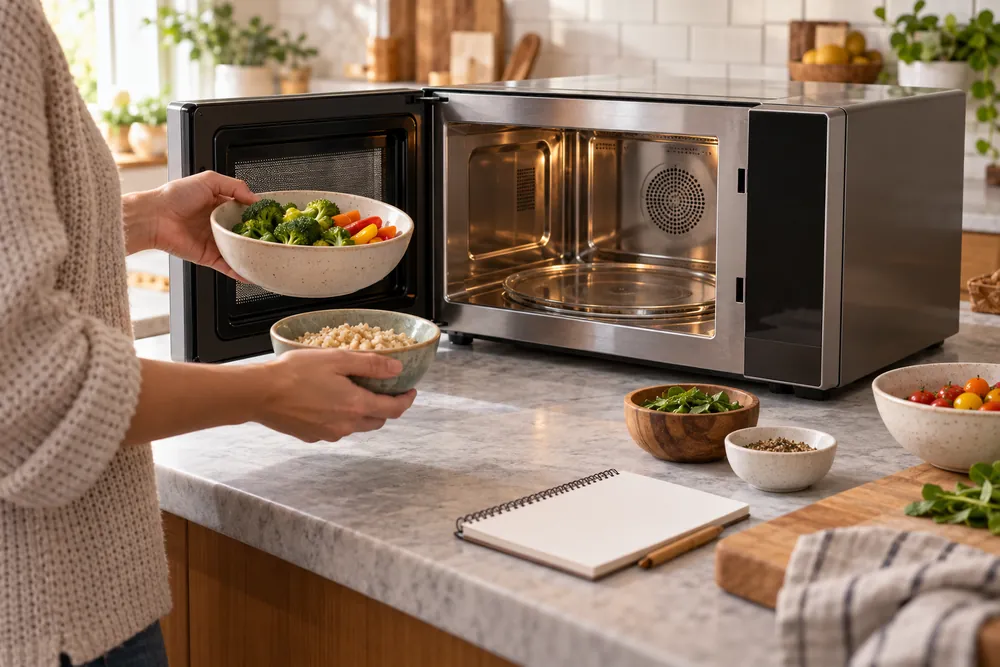
The gist: Convection microwave wattage describes the electrical power available for microwave heating, convection baking, or both, depending on the specification.
Higher microwave output usually means faster reheating, while convection performance also depends on airflow, cavity size, temperature control, and rack design.
Compare the wattage for each function, then match it to your cookware, recipes, space, and cooking habits.
What Convection Microwave Wattage Actually Means
Convection microwave wattage describes the power available to more than one heating system. A higher number can shorten reheating and preheating, but it does not automatically produce better baking, browning, or roasting.
Specifications may separate microwave output, convection-element power, grill power, and total electrical input. These ratings describe different jobs, so comparing only the largest number can lead to the wrong conclusion.
Read each wattage rating by function
| Specification | Typical range | What it affects |
| Microwave output | 800–1,200 watts | Reheating, defrosting, packaged foods |
| Convection element | 1,200–1,800 watts | Baking, roasting, browning, preheat recovery |
| Grill or broil element | 1,000–1,600 watts | Top browning and crisping |
| Total electrical input | 1,400–2,000 watts | Power drawn from the outlet |
Microwave output matters most for soup, leftovers, frozen meals, and defrosting. Convection power works with the heating element and fan, helping the cavity bake and roast more like a compact oven.
Higher microwave output may reduce waiting, but it cannot compensate for weak airflow or uneven temperature control.
Cookies, baked potatoes, casseroles, and chicken also depend on cavity shape, rack placement, sensor behavior, and how consistently the appliance holds its selected temperature.
Capacity changes how wattage feels
| Capacity | Typical fit | Practical trade-off |
| 0.7–1.1 cu. ft. | Mugs, plates, compact counters | Less food volume to heat, smaller cookware |
| 1.2–1.6 cu. ft. | Everyday meals and small casseroles | Balanced space and counter use |
| 1.7–2.2 cu. ft. | Large plates and bigger cookware | More usable space, potentially slower heating |
Temperature range deserves comparison beside wattage.
A broad operating range can support gentle warming through high-heat browning, while stable controls and effective fan circulation determine whether that range performs consistently.
For US buyers, match microwave output to reheating habits, convection power to baking expectations, capacity to cookware, and total input to the available circuit.
Owner-reported reliability and control quality then help separate similar specifications.
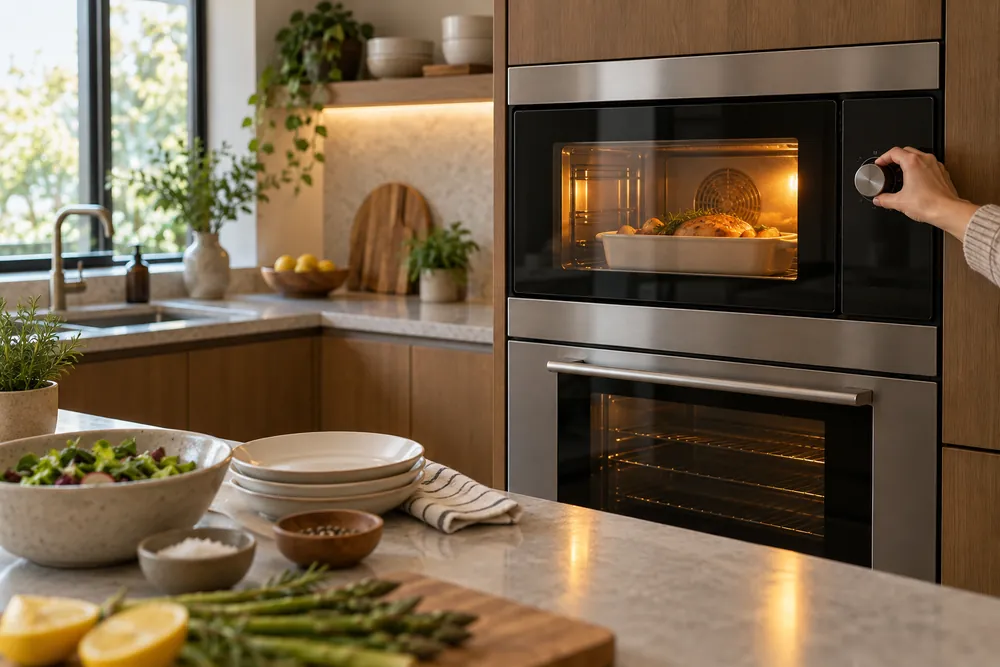
Microwave Power vs Convection Power
Microwave output and convection power describe different heating systems, so the larger wattage number is not automatically the better cooking specification.
Microwave energy heats moisture inside food, while convection power supports the heating element and fan that bake, roast, brown, and crisp the surface.
What each wattage rating controls
Microwave output has the clearest effect on reheating, defrosting, and cooking foods that follow microwave directions.
Higher output can shorten cooking time, but results still depend on portion size, food density, moisture, turntable performance, and the appliance’s power-control method.
| Specification | Common category range | Primary effect |
| Microwave output | 800–1,200 watts | Reheating, defrosting, everyday microwave cooking |
| Convection element | 1,200–1,800 watts | Baking, roasting, browning, and preheat recovery |
| Grill or broil element | 1,000–1,600 watts | Top browning, crisping, and finishing |
| Total electrical input | 1,400–2,000 watts | Power drawn from the outlet or circuit |
Convection wattage matters more for baked potatoes, casseroles, cookies, pizza, and roasted meats.
It does not work alone: airflow, fan placement, cavity shape, rack position, temperature accuracy, and preheat behavior can produce a larger difference than a modest wattage increase.
Capacity changes the practical effect
A given output may feel quicker in a compact cavity because there is less air and food volume to heat. A larger cavity offers more cooking flexibility but may need stronger airflow and better heat distribution to bake evenly.
| Capacity | Typical fit |
| 0.7–1.1 cu. ft. | Small plates, mugs, dorms, and tight counters |
| 1.2–1.6 cu. ft. | Daily reheating, leftovers, and small casseroles |
| 1.7–2.2 cu. ft. | Large plates, cookware, and family portions |
Compare microwave output with your reheating habits, then evaluate convection temperature control, usable capacity, controls, ventilation, and owner-reported reliability.
For baking or roasting, the most useful appliance is the one that balances power with even airflow and a cavity that fits the cookware you already use.
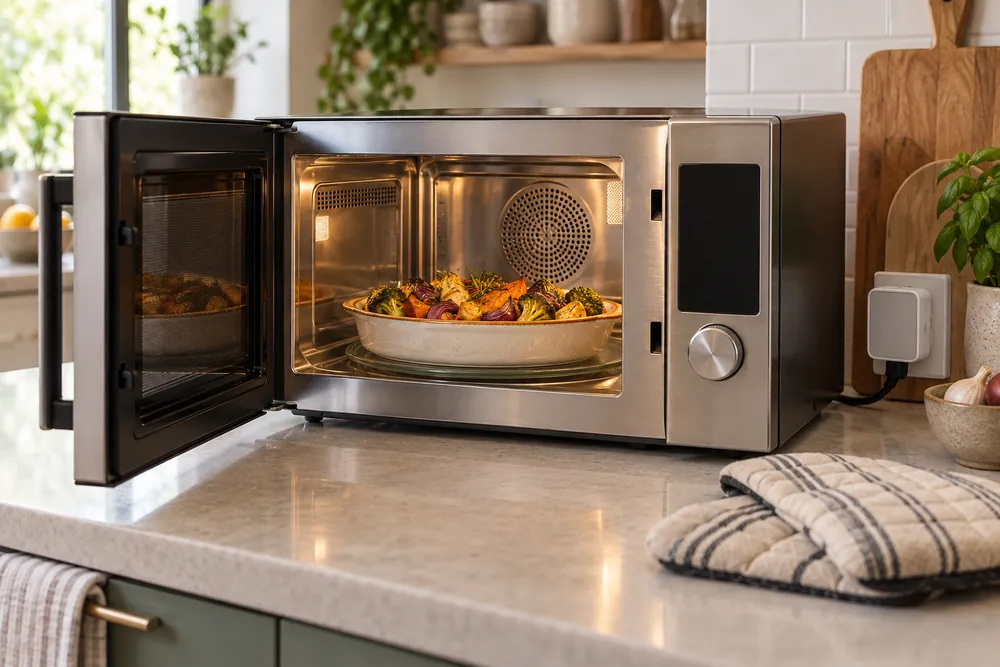
When Higher Wattage Matters Most
Higher wattage matters most when a convection microwave handles frequent reheating, dense portions, or back-to-back cooking.
Extra power can shorten cooking time, but the benefit depends on cavity size, food volume, airflow, and how accurately the appliance maintains its settings.
Microwave output has its clearest advantage during everyday reheating and defrosting.
Soup, frozen meals, leftovers, and beverages generally reach serving temperature faster at higher output, while lower-powered units may require longer cycles and more frequent stirring.
| Power specification | Common range | Where higher power helps |
| Microwave output | 800–1,200 watts | Reheating, defrosting, packaged foods |
| Convection element | 1,200–1,800 watts | Baking, roasting, browning, preheat recovery |
| Grill or broil element | 1,000–1,600 watts | Surface browning and crisping |
Convection wattage becomes more important for foods that need sustained heat, including roasted vegetables, casseroles, pizza, and baked goods.
A stronger element can recover temperature more quickly after the door opens, but wattage alone cannot guarantee even browning or reliable baking.
Large portions make power differences easier to notice. A compact cavity may feel fast with moderate output, while a larger interior needs more energy to heat additional air, cookware, and food.
| Capacity | Typical use |
| 0.7–1.1 cu. ft. | Small plates, mugs, compact kitchens |
| 1.2–1.6 cu. ft. | Daily reheating and small casseroles |
| 1.7–2.2 cu. ft. | Large plates and family-sized cookware |
Choose higher wattage when speed, large portions, or frequent convection cooking are priorities.
Otherwise, compare temperature control, fan circulation, rack placement, usable capacity, controls, and reported owner reliability before paying for a larger power figure.
Start with the space available, not the wattage printed on the box. Measure width, height, and depth where the appliance will sit, then check the manufacturer’s required clearances.
A powerful unit is not useful if it cannot fit safely or open fully.
Measure the route to that location as well. Doorways, counters, shelves, and cabinet openings can limit which convection microwave reaches the kitchen.
Include the appliance’s packaging dimensions when planning delivery, because a unit that fits its final position may not fit through the entry path.
Depth deserves particular attention. The listed exterior depth may not account for a rear plug, a projecting handle, or space needed for ventilation.
Mark the maximum footprint with tape, then compare that outline with the manufacturer’s installation instructions before choosing a higher-output model.
Next, measure the dishes you use most often. Check the diameter of your largest dinner plate, the height of your usual casserole dish, and the clearance needed for a tall mug.
Interior shape can matter more than exterior size when selecting everyday capacity.
A wider cavity may accommodate a plate comfortably while leaving limited height for a baking dish. A taller interior can handle deeper cookware but may occupy more vertical space.
Match the cavity’s usable dimensions to your cookware rather than relying on a capacity figure alone.
Consider the space around the appliance when the door opens. A nearby wall, cabinet, or countertop appliance can obstruct the handle or reduce access to the turntable.
Leave enough working room to remove hot food without twisting or reaching across a narrow gap.
For built-in or shelf-mounted placement, verify whether the appliance is approved for that installation. Countertop designs may require open airflow around specific sides or the rear.
Never treat a tight cabinet opening as interchangeable with a purpose-built trim or ventilation arrangement.
The wattage label is most useful after these fit checks. If two suitable appliances offer different output levels, higher power can favor households that reheat several portions or cook repeatedly.
If your use is occasional, convenient access and compatible cookware may matter more.
Also inspect the electrical requirements before purchase. Confirm the outlet location, circuit suitability, and cord reach without using an extension arrangement that the instructions prohibit.
A model that fits the counter but needs an unsafe connection is not a practical upgrade.
Use your measurements to narrow the field, then read the operating instructions for preheating, cookware limits, and clearance requirements.
The best match combines adequate output with a cavity, door swing, installation position, and electrical setup that work in your actual kitchen.
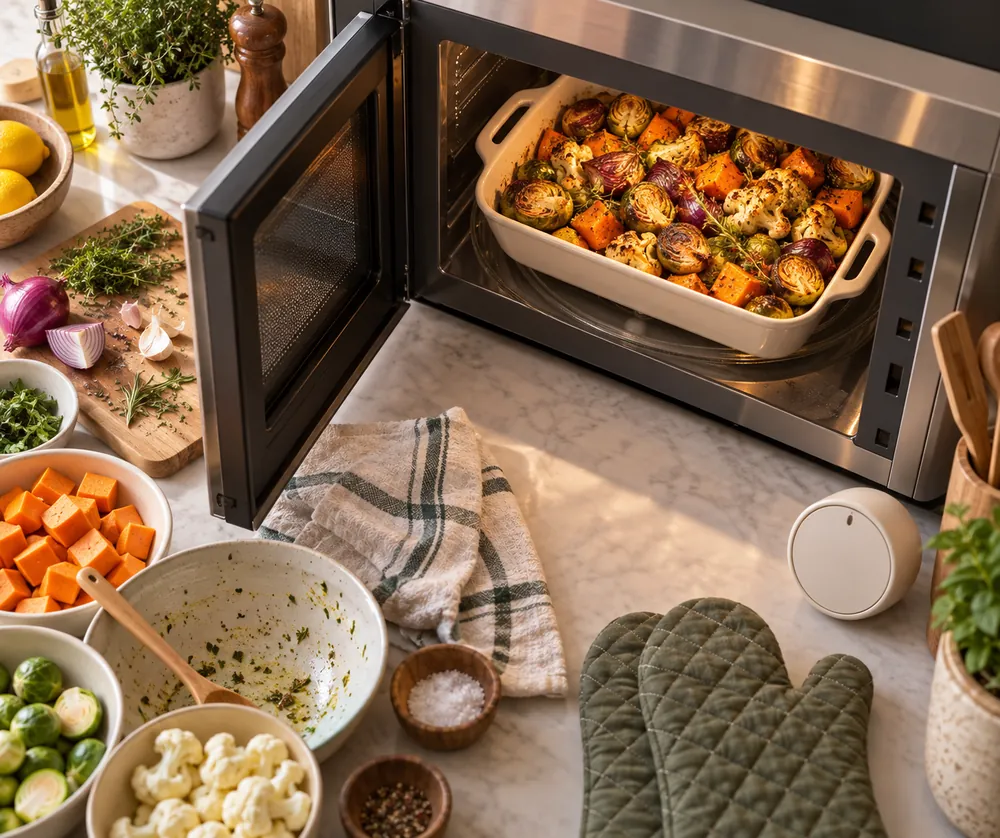
Where Wattage Can Mislead You
A wattage label describes available electrical power, not guaranteed cooking performance.
A higher number can shorten reheating, but it cannot compensate for weak airflow, uneven temperature control, a crowded cavity, or controls that make precise cooking difficult.
Manufacturers may publish several ratings for one appliance.
Microwave output applies to reheating and defrosting, while convection and grill ratings describe separate heating elements; total input describes electrical demand rather than the heat delivered directly to food.
| Published rating | Typical category range | What it tells you |
| Microwave output | 800–1,200 watts | Reheating, defrosting, and microwave cooking speed |
| Convection element | 1,200–1,800 watts | Baking, roasting, browning, and preheat recovery |
| Grill or broil element | 1,000–1,600 watts | Top browning and crisping |
| Total input | 1,400–2,000 watts | Electrical load from the outlet or circuit |
Microwave output is often the easiest figure to compare, but it says little about cookies, roasted vegetables, or casseroles.
Those results depend on fan circulation, rack placement, cavity shape, door sealing, and how consistently the appliance maintains its selected temperature.
Capacity can also change how wattage feels.
Identical output may seem quicker in a compact cavity because there is less air and food volume to heat, while a larger interior may offer better cookware flexibility but require more time for convection recovery.
| Category | Typical range | Practical trade-off |
| Convection temperature | 250–425°F | Covers everyday baking and roasting |
| High-heat or broil assist | 425–500°F | Supports browning and crisping |
| Compact capacity | 0.7–1.1 cu. ft. | Fits smaller dishes and tighter counters |
| Mid-size capacity | 1.2–1.6 cu. ft. | Balances daily reheating with small casseroles |
| Large capacity | 1.7–2.2 cu. ft. | Accepts larger cookware but heats more volume |
Compare wattage with the manual’s circuit requirements, usable interior dimensions, temperature range, and accessory guidance.
Owner-reported reliability and control quality may matter more than a modest power advantage during everyday use.
That difference matters when you compare a countertop unit with the space available. Measure the opening’s width, depth, and height, then check the appliance’s installation instructions for required ventilation clearance.
A unit that fits exactly may still overheat, block a cabinet, or leave the door difficult to open.
Measure from the front edge of the counter to the wall, not only across the appliance footprint. Include the handle and any door swing in your planning.
If the microwave must sit beneath a cabinet, confirm that the door can open without striking the cabinet or adjacent appliance.
Depth deserves particular attention because published dimensions may exclude the handle, rear plug, or a control panel that projects forward. Mark the available space with removable tape, then compare the full exterior dimensions.
This reveals whether the unit will intrude into your working area.
Also measure the interior width and height when you need to use specific cookware. Exterior size does not tell you whether a square baking dish, tall casserole, or rack-supported pan will fit.
Check the usable cavity shape, turntable clearance, and distance above the cooking surface.
For convection cooking, rack position can matter more than a headline wattage number. A shallow cavity may limit the height of a roast, while a wide cavity may better accommodate a baking tray.
Look for a layout that suits the dishes you already use.
Consider how the unit will share the counter. Leave enough room to remove a hot dish without twisting around a sink, wall, or cooktop.
If the outlet is behind the appliance, account for the plug and avoid pressing the cord against a hot surface.
Electrical planning belongs in the same comparison. Check the product’s total electrical requirement and the circuit serving the intended location.
Avoid relying on an extension cord unless the manufacturer specifically permits it; a crowded circuit can become a practical limitation even when the oven fits.
Controls also affect how useful the available power becomes.
From standing height, check whether the display is readable, the temperature settings are easy to select, and the timer can be adjusted without interrupting a cooking program.
Clear controls reduce mistakes during longer convection cycles.
Finally, treat wattage as one part of a fit-and-use decision. Choose the model that fits your measured space, cookware, ventilation, outlet, and routine.
A slightly lower rating can be the better purchase if the cavity and controls make everyday cooking more predictable.
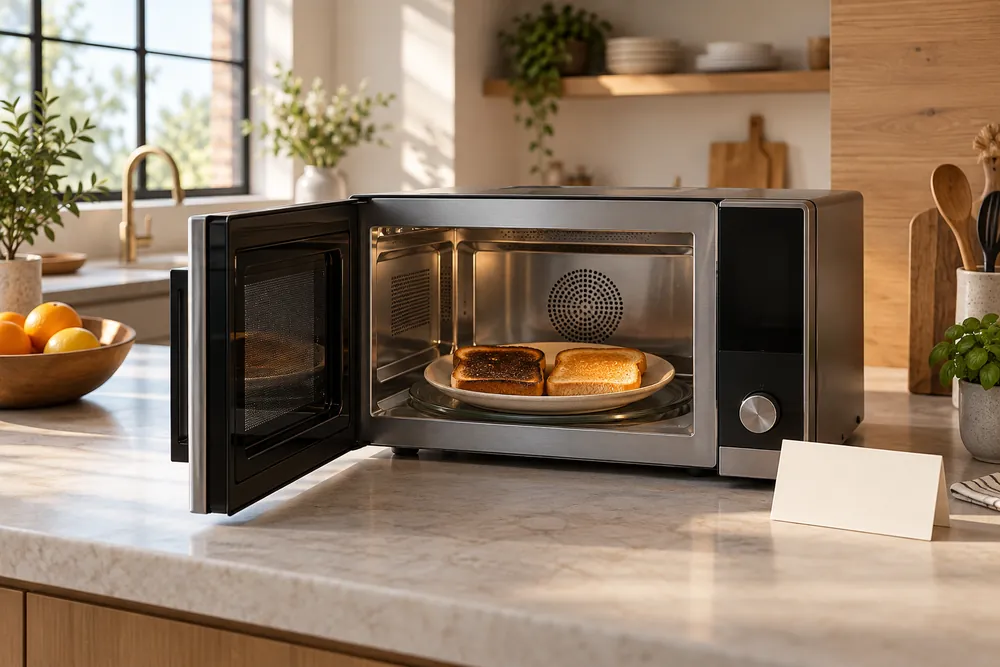
Matching Wattage to Your Cooking Habits
Wattage should match the foods you prepare most often, the speed you expect, and the space available in your kitchen.
A higher rating can shorten reheating and preheating, but capacity, airflow, controls, and temperature stability determine whether the appliance performs well across everyday tasks.
Start with your most common jobs
Microwave output matters most for soup, leftovers, defrosting, and packaged meals. Convection and grill power matter more for casseroles, baked goods, roasted vegetables, pizza, and foods that need browning.
| Function | Common range | Best suited to |
| Microwave output | 800–1,200 watts | Reheating and defrosting |
| Convection element | 1,200–1,800 watts | Baking, roasting, and preheating |
| Grill or broil element | 1,000–1,600 watts | Crisping and top browning |
| Total input power | 1,400–2,000 watts | Electrical demand from the outlet |
These ratings describe different systems, so the largest figure is not automatically the best choice.
A strong microwave output can heat food quickly without producing evenly browned cookies or roasted chicken if airflow, rack placement, and temperature control are weak.
Balance power with cavity size
Capacity changes how wattage feels during use. The same output may seem faster in a compact cavity and slower in a large one because more air, cookware, and food must reach the target temperature.
| Capacity | Typical range | Practical fit |
| Compact | 0.7–1.1 cu. ft. | Mugs, small plates, and tight counters |
| Mid-size | 1.2–1.6 cu. ft. | Everyday meals and small casseroles |
| Large | 1.7–2.2 cu. ft. | Family leftovers and larger cookware |
- Choose higher microwave output for frequent reheating and speed-sensitive cooking.
- Prioritize convection wattage, temperature range, and fan design for baking and roasting.
- Check total input power against the outlet, circuit, and installation instructions.
- Compare owner reports for uneven heating, noisy fans, difficult controls, and long-term reliability.
The best match is the appliance whose power distribution fits your routine, not the model with the biggest advertised wattage.
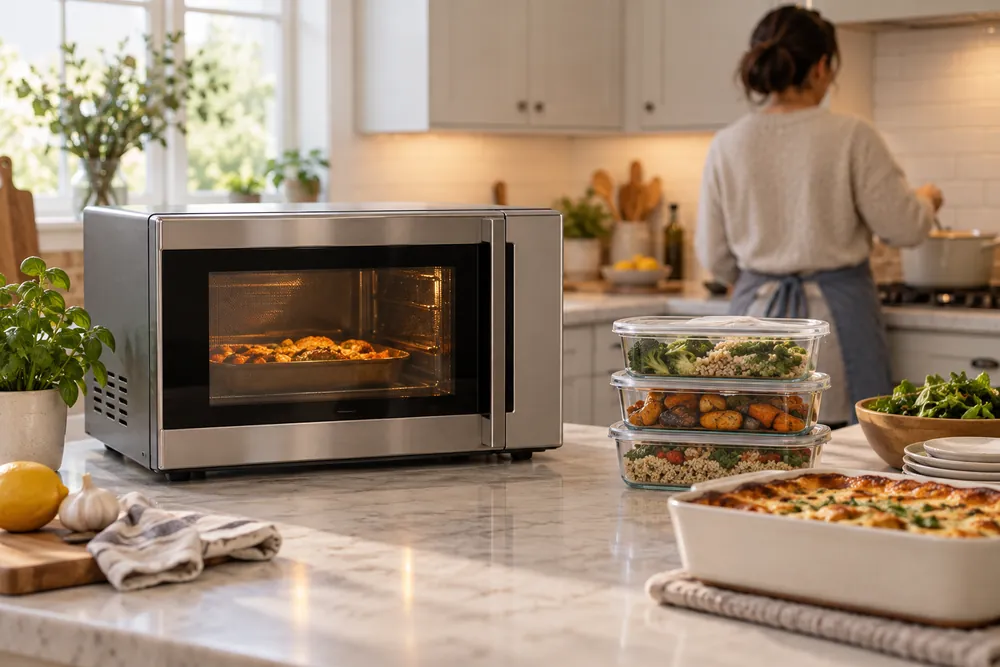
Where Owner Feedback Agrees and Where It Splits
Owner reports tend to agree on one point: convection microwave wattage matters most for speed, while everyday satisfaction depends on controls, airflow, cavity size, and service support.
The recurring complaint is uneven or slow convection cooking, not usually weak microwave reheating.
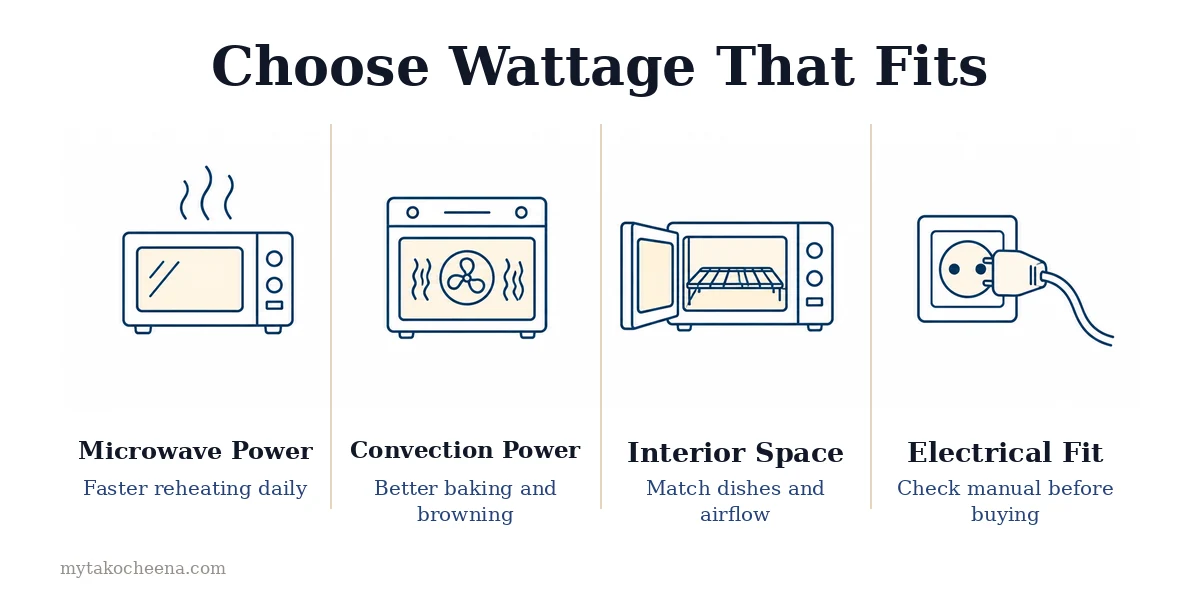
What owners consistently praise
Higher microwave output commonly earns positive comments for reheating soup, leftovers, and frozen meals without long waits.
Manufacturer documentation also supports that relationship, although programmed cooking times still vary with food density, starting temperature, container shape, and the selected power level.
Owners also value a straightforward control panel, readable displays, a useful interior light, and a turntable or rack system that accommodates ordinary cookware.
These features do not raise the published wattage, but they make the available power easier to use consistently.
Convection functions generally receive better feedback when the cavity preheats predictably and the fan circulates air evenly.
Manufacturer instructions commonly recommend space around the food and correctly positioned racks, because blocked airflow can leave one side pale while the other browns too quickly.
Where complaints repeatedly appear
The most common criticism concerns baking and roasting performance. Owners report longer cooking times, uneven browning, or a need to rotate pans, especially when they expect a compact convection cavity to behave like a full-size oven.
Published specifications help explain some disagreements.
Microwave output and convection-element wattage describe different systems, while total input describes electrical demand; comparing only the largest number on a product page can create unrealistic expectations.
| Specification | Typical category range | What feedback suggests |
|---|---|---|
| Microwave output | 800–1,200 watts | Speed for reheating and defrosting |
| Convection element | 1,200–1,800 watts | Baking, roasting, and browning potential |
| Compact capacity | 0.7–1.1 cu. ft. | Faster-feeling cavity, limited cookware |
| Mid-size capacity | 1.2–1.6 cu. ft. | More flexible everyday use |
Where feedback splits
Some owners consider fan noise, preheating, and automatic programs acceptable trade-offs for countertop convenience.
Others find the same features disruptive or inconsistent, particularly when sensors, presets, or touch controls do not match their cooking habits.
Early failures are most often associated in reports with door switches, touch panels, turntables, or heating elements rather than wattage alone.
Manufacturer warranty terms and service availability therefore deserve comparison alongside output ratings.
For a US buyer, the practical choice is the wattage range that matches frequent foods, available counter space, and electrical requirements.
Treat owner feedback as evidence about daily usability, not as a substitute for the manufacturer’s installation and operating documentation.
Questions Worth Answering First
Convection microwave wattage affects heating speed, baking performance, browning, and electrical demand, but the largest published number is not automatically the best choice.
Compare each rating with the foods you prepare, the cavity size, available counter space, controls, and reported owner experience.
What does convection microwave wattage actually mean?
Wattage may describe microwave output, convection-element power, grill power, or total electrical input.
These ratings measure different functions, so compare the label beside its function rather than treating every watt figure as interchangeable.
Microwave output mainly affects reheating and defrosting. Convection and grill power support baking, roasting, crisping, and browning through the heating element, fan, or broiler.
| Specification | Typical range | Main effect |
| Microwave output | 800–1,200 watts | Reheating and defrosting |
| Convection element | 1,200–1,800 watts | Baking and roasting |
| Grill element | 1,000–1,600 watts | Browning and crisping |
| Total input | 1,400–2,000 watts | Electrical draw |
How many watts should a convection microwave have?
Choose microwave output according to how often you reheat dense, frozen, or large portions.
Higher output generally shortens cooking time, while moderate output may suit occasional reheating and a kitchen with limited electrical capacity.
For convection cooking, airflow, temperature control, rack position, and cavity design can matter as much as the element rating. A higher number cannot guarantee evenly baked cookies or perfectly roasted chicken.
Does higher wattage make a convection microwave cook faster?
Higher microwave output can heat liquids, leftovers, and packaged meals more quickly. Actual results also depend on food volume, container shape, starting temperature, and whether the appliance reduces power through cycling.
Convection speed depends on preheating, fan circulation, insulation, and recovery after the door opens. Read owner reports for uneven heating, long preheats, or difficult-to-use presets.
What temperature range should a convection microwave have?
Temperature range indicates whether the appliance can handle gentle warming, ordinary baking, and high-heat browning. Compare the range with your recipes rather than selecting a feature that you rarely use.
| Cooking use | Common range | Suitable foods |
| Low convection | 100–250°F | Warming and gentle reheating |
| Standard baking | 250–425°F | Casseroles and baked goods |
| High heat or broil assist | 425–500°F | Pizza, crisping, and browning |
Does cavity size change how convection microwave wattage feels?
Yes. The same power can feel stronger in a compact cavity and slower in a larger one because the appliance must heat more air and food volume.
| Capacity | Typical range | Best fit |
| Compact | 0.7–1.1 cu. ft. | Small plates and tight counters |
| Mid-size | 1.2–1.6 cu. ft. | Everyday meals and casseroles |
| Large | 1.7–2.2 cu. ft. | Family portions and larger cookware |
Is convection microwave input wattage important for a US kitchen?
Yes. Total input power describes electrical demand, not cooking performance alone. Check the installation instructions for outlet, circuit, grounding, and clearance requirements before choosing a high-powered appliance.
What should I compare besides convection microwave wattage?
- Microwave output: Reheating speed and defrosting control.
- Convection range: Baking flexibility and browning potential.
- Capacity and cavity shape: Cookware fit and airflow.
- Controls and owner reports: Everyday usability and reliability concerns.