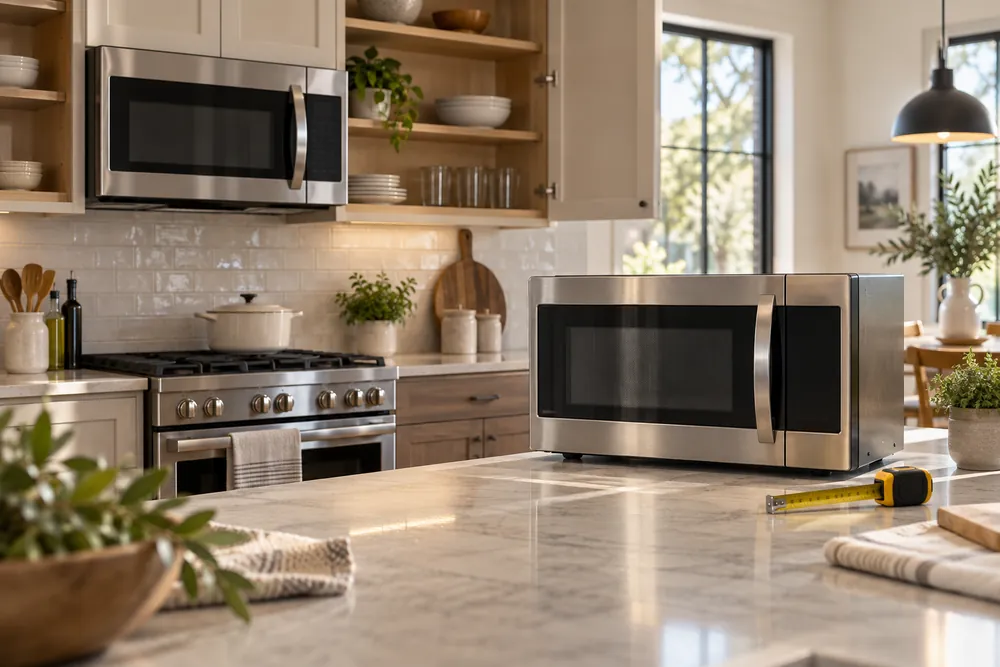
TL;DR: Over-the-range and countertop convection microwaves combine microwave heating with fan-assisted baking, but they fit different kitchens.
Over-the-range models mount above a cooktop, save counter space, and provide ventilation, while countertop models sit on a work surface and offer simpler placement.
Choose based on cabinet fit, venting needs, available counter space, installation limits, and plans to move or replace the appliance.
What Over-the-Range and Countertop Convection Microwaves Are
Over-the-range and countertop convection microwaves combine microwave energy with a heating element and fan that circulate hot air.
Both formats can reheat, defrost, crisp, brown, and bake small dishes, but one is built into the cooking area while the other remains a movable countertop appliance.
The distinction affects installation, ventilation, capacity, accessibility, and usable workspace.
An over-the-range model can replace a separate microwave and range hood; a countertop model delivers similar cooking modes without becoming part of the kitchen’s fixed layout.
How the two formats differ
An over-the-range convection microwave mounts above a cooktop or range, usually beneath a cabinet. Its underside may include task lighting, controls, and an exhaust system that collects cooking odors, steam, grease, or smoke.
A countertop convection microwave sits on a work surface, cart, or open shelf.
It needs clearance around its vents and a suitable electrical outlet, but it does not require wall mounting, cabinet reinforcement, ductwork decisions, or a permanent installation.
| Specification | Over-the-range convection microwave | Countertop convection microwave |
| Common capacity band | About 1.6-2.2 cu. ft. | About 0.9-1.6 cu. ft. |
| Usual microwave power band | About 900-1,100 watts | About 900-1,250 watts |
| Typical convection temperature range | About 100-450°F | About 100-450°F |
| Common cabinet opening width | Often about 30 inches | Not tied to a cabinet opening |
| Typical cooktop clearance | Often about 13-18 inches, subject to instructions | Not installed above a cooktop |
Capacity matters because convection cooking requires room for hot air to circulate around cookware. A larger cavity may accept wider dishes, while a smaller unit can occupy less depth and may suit compact kitchens better.
Microwave wattage mainly influences reheating speed. Convection results also depend on the fan, heating element, rack position, cavity shape, door seal, and temperature controls, so wattage alone does not predict baking performance.
What an over-the-range model adds
- Space efficiency: It frees the counter by combining microwave cooking, convection heating, lighting, and ventilation in one location.
- Installation demands: Buyers must verify cabinet width, mounting support, outlet placement, cooktop clearance, filters, and whether the exhaust vents outdoors or recirculates.
- Access trade-offs: The elevated cavity can be less convenient to reach, clean, load, and replace, especially for shorter users.
What a countertop model adds
- Flexible placement: It can move between kitchens, apartments, carts, or secondary cooking areas and is easier to replace.
- Simpler setup: It avoids overhead lifting and range-hood installation, while still requiring the manufacturer’s ventilation clearances.
- Workspace cost: It occupies counter area and cannot remove steam, grease, or odors from the cooktop.
Compare both formats through cavity dimensions, usable rack space, venting, controls, clearance requirements, and installation instructions rather than cooking modes alone.
The better choice is the one that matches available space, cooking habits, and willingness to manage permanent installation.
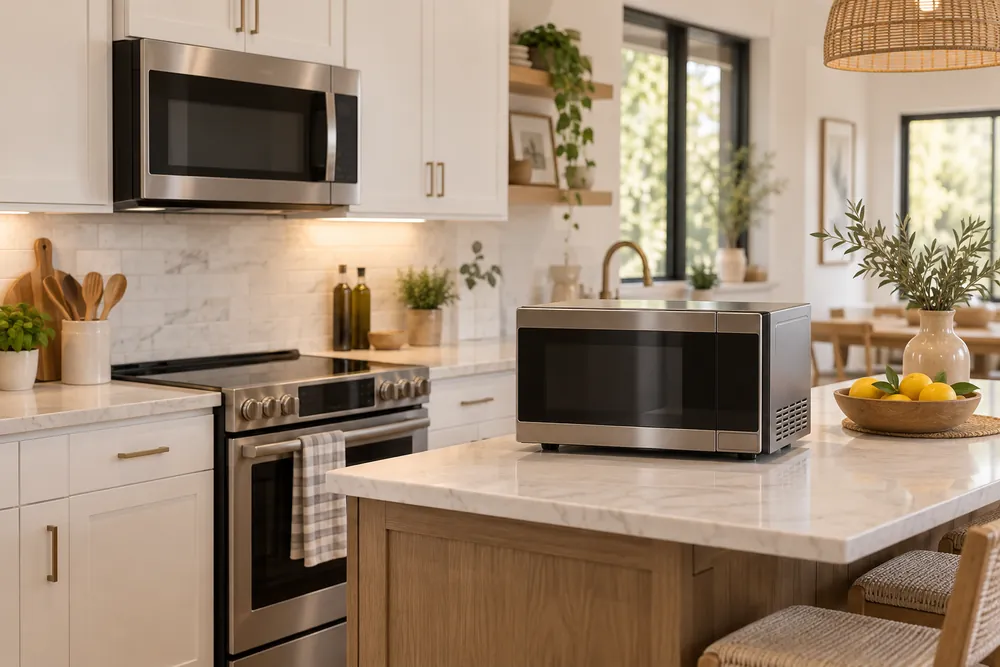
Key Differences in Installation, Space, and Venting
Installation separates these two convection microwave formats more than their cooking modes do.
An over-the-range unit becomes part of the cabinetry and cooktop ventilation system, while a countertop model needs a stable surface, a nearby outlet, and open space for airflow.
That difference affects kitchen layout, replacement difficulty, reach, cleaning, and long-term flexibility.
Compare the appliance dimensions with the available opening, clearance, duct path, and counter depth before comparing cooking presets.
Over-the-range installation requirements
Over-the-range convection microwaves typically fit a standard 30-inch cabinet opening, although the exact width, depth, height, and mounting pattern vary.
Installation may require a mounting plate, an overhead cabinet, a dedicated electrical connection, and enough structural support for the appliance.
Cooktop clearance is another essential check. Common installation guidance places the microwave bottom about 13–18 inches above the cooking surface, but the manufacturer’s instructions and local requirements control the final position.
| Consideration | Over-the-range convection microwave | Countertop convection microwave |
| Typical cabinet opening | About 30 inches wide | Not tied to a cabinet opening |
| Common cooktop clearance | About 13–18 inches | Not installed above a cooktop |
| Typical capacity band | About 1.6–2.2 cu. ft. | About 0.9–1.6 cu. ft. |
Venting may be configured for outside exhaust through a wall or roof, or for recirculation through filters.
Ducted ventilation can remove smoke and moisture more effectively, but it depends on an appropriate duct route and installation work.
Countertop placement and space trade-offs
Countertop models avoid wall mounting and overhead lifting, making them practical for renters, secondary kitchens, dorm-style spaces, and temporary layouts.
They can be unplugged, moved, or replaced without modifying cabinetry or the range-hood system.
They still need clearance around intake and exhaust vents, plus enough depth for the door to open safely. A compact footprint may save space compared with a full-size unit, but every countertop model occupies usable preparation area.
How venting changes the decision
An over-the-range appliance can combine microwave cooking, convection baking, lighting, and hood functions in one installation.
Its fan may be useful for everyday steam and cooking odors, but performance depends on fan design, filters, ducting, and correct installation.
- Choose over-the-range when preserving counter space and replacing a hood are priorities.
- Choose countertop when easy placement, simpler replacement, or rental-friendly flexibility matters more.
- Check first the cabinet opening, clearance, outlet location, duct option, vent clearances, and counter depth.
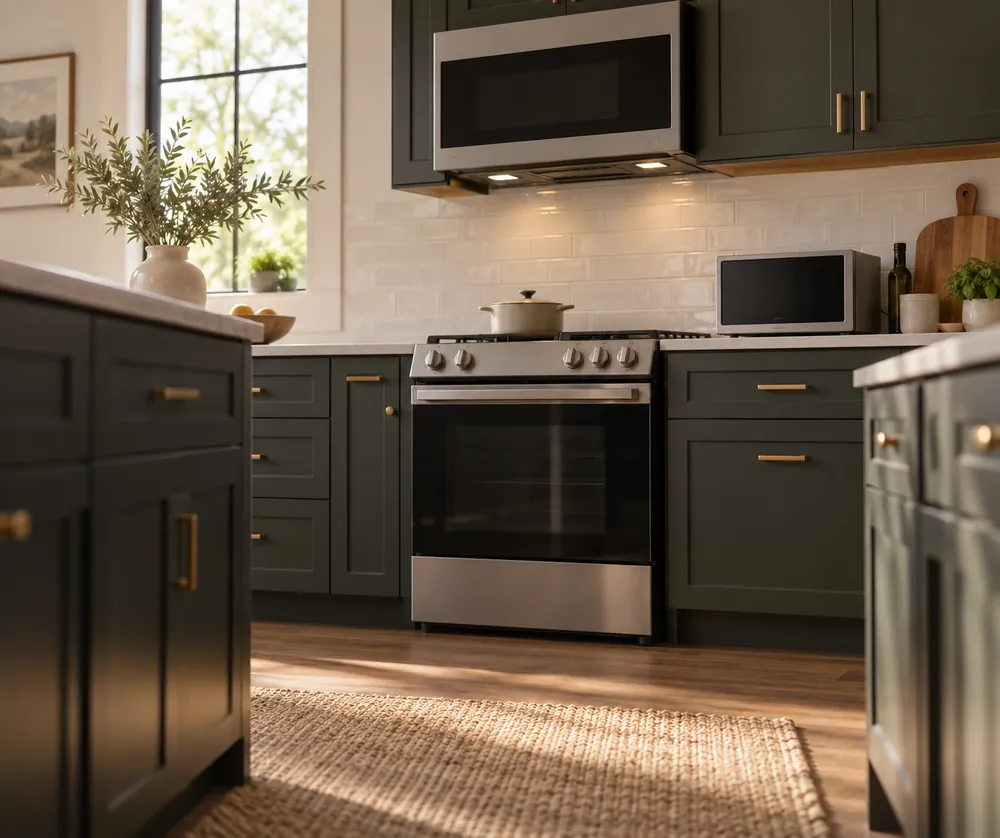
Cooking Performance: Convection, Microwave, and Combination Modes
Microwave energy, convection heat, and combination programs solve different cooking problems, even when they share one cavity.
Over-the-range and countertop convection microwaves can both reheat, crisp, roast, and bake, but results depend on power delivery, airflow, rack position, cookware, and the food’s quantity.
Microwave mode heats food quickly from within, making it useful for leftovers, beverages, sauces, and defrosting.
It does not create the dry surface browning associated with an oven, so foods such as pizza crust or breaded chicken can remain soft unless a combination or convection cycle follows.
How each cooking mode behaves
- Microwave mode: Best for speed and moisture retention. Stirring, rotating, or pausing during cooking can reduce cold centers, especially in dense portions.
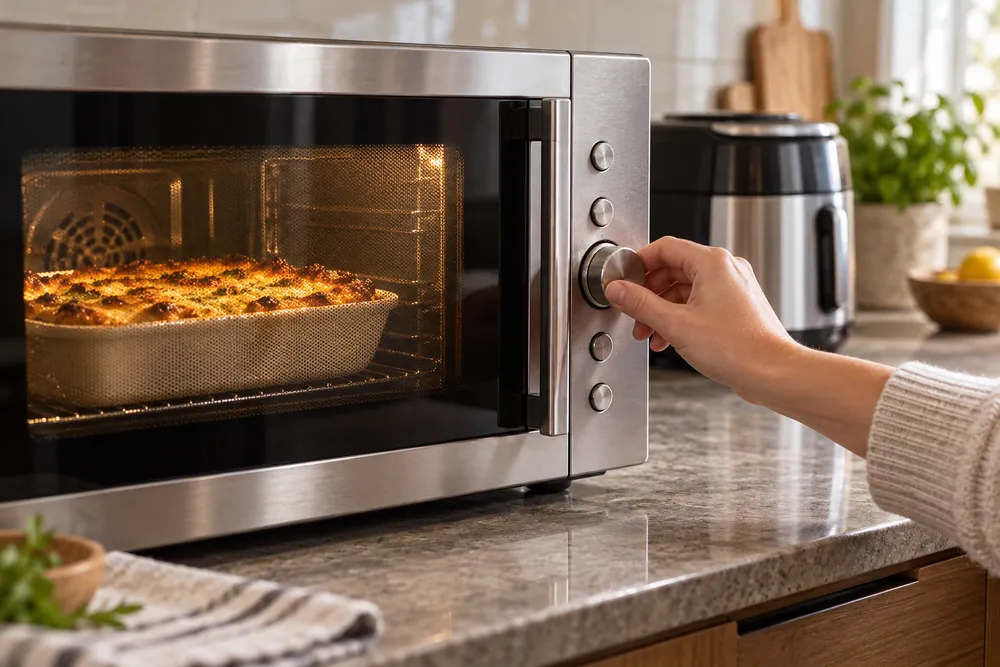
- Convection mode: Uses a heating element and fan to circulate hot air. It can brown casseroles, roast vegetables, bake small trays, and finish foods that need a drier surface.
- Combination mode: Uses microwave energy with convection heat, shortening cooking time while adding browning. It is useful for casseroles, covered-to-uncovered cooking, and foods that need both interior heating and surface color.
| Specification | Over-the-range convection microwave | Countertop convection microwave |
| Usual microwave power band | About 900–1,100 watts | About 900–1,250 watts |
| Typical convection temperature range | About 100–450°F | About 100–450°F |
| Common capacity band | About 1.6–2.2 cu. ft. | About 0.9–1.6 cu. ft. |
Published microwave wattage helps indicate reheating speed, but it does not predict convection quality by itself.
Fan strength, element placement, cavity shape, turntable or rack design, and temperature control can matter just as much, so compare operating instructions and owner reports alongside headline specifications.
Capacity affects practical cooking more than the label suggests.
A larger cavity may accept a wider baking dish or multiple rack positions, while a smaller cavity can suit compact counters but restrict tray size and airflow around food.
Format-specific performance trade-offs
Over-the-range units often provide a broader cavity and a fixed cooking position above the range.
That placement saves counter space, but reaching hot dishes is less convenient, and the ventilation fan may add noise while the appliance is used for convection cooking.
Countertop units are easier to position at a comfortable working height and replace without cabinet or duct changes.
Their performance still requires clearance around exterior vents, and their footprint can remove valuable preparation space.
For comparison shopping, prioritize the modes used most often, usable rack space, temperature controls, and cookware guidance.
Choose the format that supports the needed cooking capacity without sacrificing ventilation, access, or counter workspace.
When an Over-the-Range Convection Microwave Makes Sense
An over-the-range convection microwave makes sense when one appliance must handle microwave cooking, small-batch baking, and cooktop ventilation without occupying valuable counter space.
It is most suitable for a kitchen with a compatible range location, adequate cabinet support, and a ventilation path that meets the installation instructions.
This format replaces two separate appliances with one overhead unit. It can reheat food, circulate hot air for browning, illuminate the cooking surface, and pull steam or odors away from the range.
Choose it to recover counter space
The clearest advantage is reclaimed work surface.
A countertop convection microwave may require a large footprint plus clearance around its vents, while an over-the-range unit uses vertical space that would otherwise hold a hood or remain unused.
That benefit matters in compact kitchens, galley layouts, and busy prep areas. Removing the microwave from the counter can leave room for cutting boards, small appliances, or temporary serving dishes.
| Specification | Typical category range | Why it matters |
| Cabinet opening width | About 30 inches | Must match the intended installation space |
| Microwave capacity | About 1.6–2.2 cu. ft. | Determines dish and cookware fit |
| Microwave power | About 900–1,100 watts | Affects everyday reheating speed |
| Convection temperature | About 100–450°F | Indicates the available baking range |
| Cooktop clearance | Often about 13–18 inches | Must satisfy the installation manual and local requirements |
Check installation before choosing the format
Fit is more complicated than width alone. Confirm the cabinet opening, wall construction, electrical outlet location, mounting hardware, door swing, and distance above the cooking surface before ordering.
Ventilation also deserves careful attention. Some units recirculate air through filters, while others connect to an exterior duct; the available route can affect installation effort, performance, and ongoing filter maintenance.
- Best match: a permanent kitchen where counter space is limited and a hood is already needed.
- Important compromise: the appliance sits high, so shorter users may find racks, controls, and hot dishes less convenient to reach.
- Maintenance consideration: grease filters, interior surfaces, and the area above the range need regular cleaning.
- Replacement consideration: removing or upgrading the unit may require more work than unplugging a countertop appliance.
When another format is better
A countertop convection microwave is usually more practical for renters, temporary kitchens, secondary cooking areas, or households that may rearrange appliances.
It avoids overhead installation and can be replaced without modifying cabinetry or ventilation.
Select the over-the-range format when space savings and integrated ventilation outweigh installation complexity. Otherwise, a countertop model offers greater placement freedom and simpler ownership.

When a Countertop Convection Microwave Makes Sense
A countertop convection microwave suits kitchens that need flexible cooking without a permanent installation.
It provides microwave reheating, convection baking, and browning in one movable appliance, while leaving ventilation and cabinetry decisions separate from the purchase.
This format works especially well for renters, dorm-style kitchens, secondary cooking areas, and households that may remodel later.
It can sit on a counter, utility cart, open shelf, or sturdy island, provided the surrounding clearance matches the manufacturer’s instructions.
Choose flexibility over built-in integration
Countertop units avoid wall mounting, cabinet reinforcement, overhead lifting, and range-hood replacement. Installation usually means positioning the appliance, connecting power, and confirming that air can circulate around the vents.
That simplicity also makes replacement easier. A household can change capacity, cooking features, or location without removing mounting hardware or modifying ductwork, which matters when the kitchen layout changes frequently.
| Consideration | Common countertop range or condition | Why it matters |
| Capacity | About 0.9–1.6 cu. ft. | Determines dish size, interior airflow, and counter depth |
| Microwave power | About 900–1,250 watts | Influences reheating speed and cooking-time adjustments |
| Convection temperature | About 100–450°F | Supports tasks from gentle warming to small-batch baking |
| Installation | Not tied to a cabinet opening | Allows placement changes without overhead mounting |
Account for the counter-space trade-off
The main compromise is surface area. A larger cavity may accommodate wider cookware, but it can also occupy substantial depth and make nearby preparation space less usable.
- Measure the available width, depth, and height before shopping.
- Leave the required ventilation space around every vent, rather than pushing the unit tightly against a wall.
- Check door swing, handle clearance, and access to nearby outlets.
- Confirm that the counter or cart can support the appliance and a hot dish.
Convection capability does not make every countertop model a substitute for a full oven.
Review rack positions, preheat behavior, interior shape, fan operation, and included cookware support instead of comparing microwave wattage alone.
A countertop convection microwave makes the most sense when mobility, simpler setup, and replacement freedom outweigh the value of reclaimed counter space and integrated cooktop ventilation.
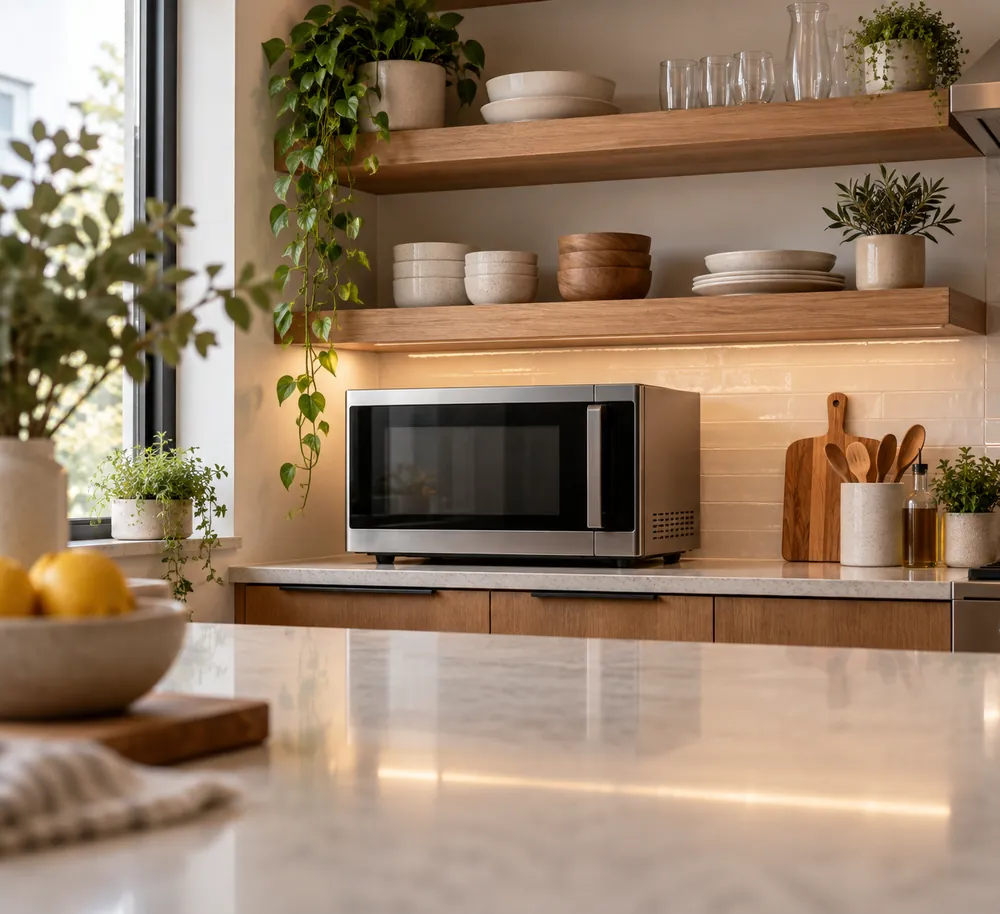
Start with the available footprint, then account for the space the door needs to open fully.
Measure from the rear wall to the counter edge, and check whether the handle or open door would project into a walkway or block a nearby drawer.
Measure the width between cabinets, but do not treat that number as the appliance’s maximum usable width. Leave the side, top, and rear clearances specified in the manual.
Tight cabinetry can restrict airflow even when the unit technically fits.
Look above the proposed location as well. A low shelf may interfere with the door, controls, or ventilation.
Mark the appliance’s height with painter’s tape, then stand in front of it to confirm that loading a hot dish would feel comfortable rather than awkward.
Check the counter surface before choosing a location. It should be level, stable, and deep enough to support the appliance without overhang.
Include the power cord’s route in the measurement, since a nearby outlet can prevent the unit from sitting flush against the wall.
Finally, measure the path from the delivery entrance to the kitchen, including turns and narrow doorways. A countertop unit may fit the final location but still be difficult to carry there.
These measurements reveal whether flexibility is useful in practice or only on paper.
Where Buyer Reports Line Up and Where They Do Not
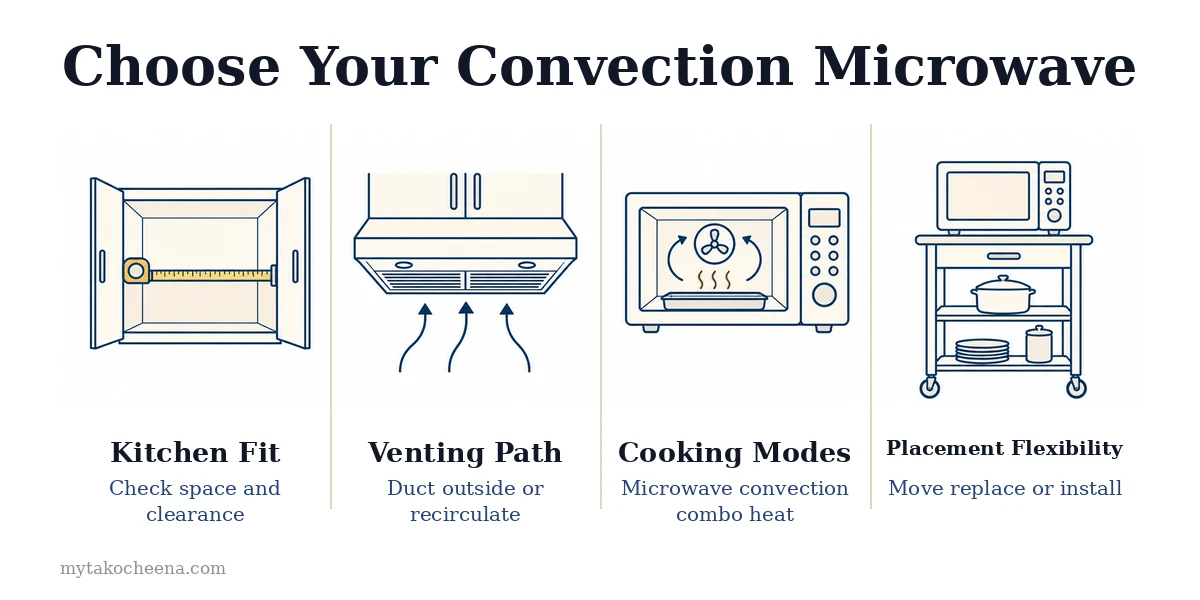
Owner reports and manufacturer documentation agree that the main difference is not microwave convenience but installation and ventilation.
Buyers repeatedly praise both formats for reheating and small-batch baking, while the most common complaints involve awkward cleaning, uneven browning, and a poor fit between the appliance and the kitchen.
Complaints that recur across both formats
Owners commonly report that convection cooking takes practice because rack position, pan material, and preheating affect results.
Manufacturer instructions also warn that microwave power and convection temperatures do not translate directly between appliances, so recipes may need adjusted times or temperatures.
Cleaning is another repeated weakness. Grease, splatters, and baked-on residue accumulate around the ceiling, turntable area, racks, and door edges.
Over-the-range units add the underside and exhaust filters; countertop units are easier to reach but may have more exposed vents and seams on the counter.
- What tends to hold up: microwave reheating, defrosting, interior lighting, and basic controls usually receive more consistent approval than convection baking.
- What tends to disappoint: weak ventilation, noisy fans, difficult-to-read controls, and browning that varies by rack position appear often in owner reports.
- What can fail early: door switches, control panels, turntables, exhaust fans, and convection heating components are recurring service concerns, although reports vary by appliance and installation.
Where the formats separate
Over-the-range buyers most often accept the trade-off of saved counter space in exchange for installation complexity.
Reports point to cabinet alignment, limited reach, inadequate venting, and replacement difficulty; manufacturer documentation emphasizes cabinet support, electrical access, clearance, and recirculating or ducted ventilation requirements.
Countertop buyers more often mention lost work surface, substantial depth, and the need to preserve clearance around ventilation openings.
Their advantages are easier placement, simpler replacement, and the ability to move the appliance when a layout changes.
| Specification | Over-the-range | Countertop |
|---|---|---|
| Common capacity band | About 1.6–2.2 cu. ft. | About 0.9–1.6 cu. ft. |
| Typical convection range | About 100–450°F | About 100–450°F |
| Typical cabinet opening | Often about 30 inches | Not cabinet-dependent |
Buyer reports therefore line up on convenience and compromise, but not on which format is superior.
Choose the over-the-range design when counter space and cooktop ventilation matter most; choose countertop when placement flexibility, reachability, and straightforward replacement matter more.
Questions That Come Up Most Often
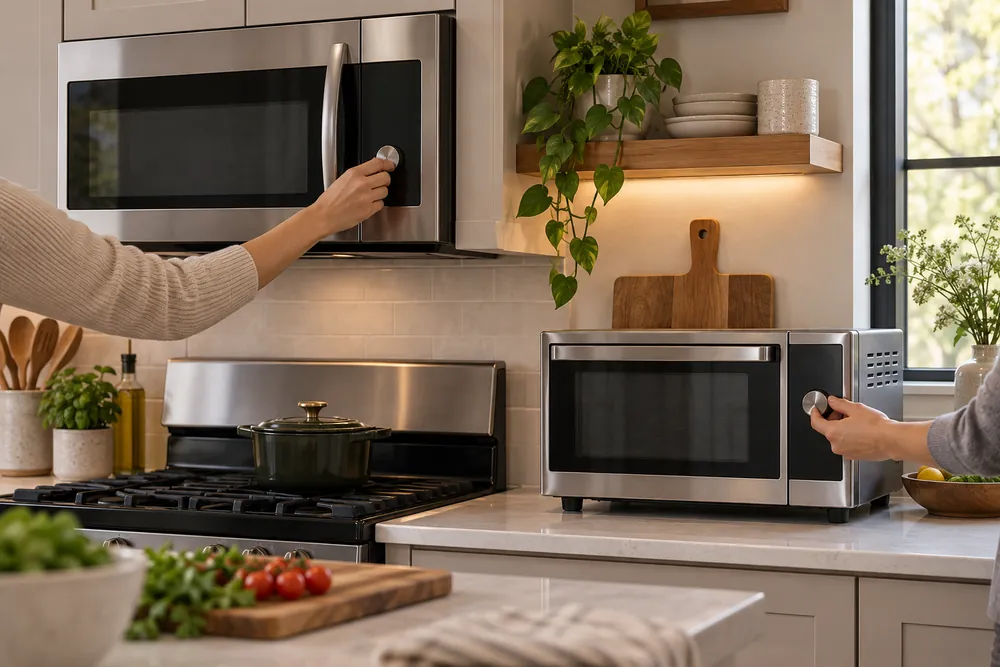
Over-the-range and countertop convection microwaves use similar cooking technology but suit different layouts. These answers cover cabinet fit, ventilation, cooking space, daily usability, and key trade-offs before purchase.
Is an over-the-range convection microwave better than a countertop model?
Neither format is universally better. An over-the-range model saves counter space and can replace a range hood, while a countertop model is easier to position, move, service, and replace.
Choose over-the-range for a permanent installation. Choose countertop placement when flexibility, simpler setup, or rental-friendly ownership matters more than preserving counter space.
How much space does an over-the-range convection microwave need?
Fit depends on cabinet width, mounting depth, outlet location, door swing, and manufacturer clearance instructions. Many models are designed for an opening close to the standard range-hood width.
| Specification | Over-the-range | Countertop |
| Common cabinet opening width | About 30 inches | Not tied to a cabinet opening |
| Typical cooktop clearance | About 13–18 inches, depending on instructions | Not installed above the cooktop |
Can a countertop convection microwave replace a range hood?
No. A countertop unit circulates hot air inside its cavity but does not capture steam, smoke, grease, or odors above a cooktop.
It may work beside a separate hood or downdraft system. Confirm suitable cooking-area ventilation before choosing countertop placement.
What size convection microwave is best for baking?
Interior capacity affects which dishes, pans, and racks fit. Convection cooking also needs airflow around the food, so a larger cavity is not automatically better.
| Format | Common capacity band | Typical benefit |
| Over-the-range convection | About 1.6–2.2 cu. ft. | More room for wider dishes |
| Countertop convection | About 0.9–1.6 cu. ft. | Smaller footprint and flexible placement |
Do convection microwaves bake as well as a regular oven?
They can brown, roast, and bake small portions using fan-circulated hot air, but cavity size limits what fits. They suit casseroles, frozen foods, small trays, and crisping reheats.
A full-size oven remains more practical for large pans, multiple racks, extended baking, or several dishes at once.
Are over-the-range convection microwaves hard to install?
Installation is more involved because the appliance must be mounted securely and connected to power. Buyers may also need to choose recirculating or externally ducted ventilation and verify cabinet, wall, and clearance requirements.
- Measure the opening and available depth.
- Check the outlet and mounting surface.
- Confirm the venting method and filter requirements.
- Follow the installation guide rather than relying on appearance alone.
Which convection microwave is easier to clean and replace?
Countertop models are usually easier to reach, unplug, move, and replace. Over-the-range models add hood filters, exterior surfaces above the cooktop, and harder-to-access mounting areas.
Compare removable racks, interior coatings, filter access, door design, and replacement dimensions. Access matters because grease and food residue accumulate differently in each format.