
Quick Answer: A properly sized range hood covers the cooking surface, provides enough depth to capture rising steam and grease, and moves air effectively through the duct system.
Match or slightly exceed the cooktop width, then adjust airflow for gas burners, high-heat cooking, duct length, bends, and acceptable noise. Installation clearances and manufacturer instructions complete the sizing decision.
Start With Your Cooktop Width
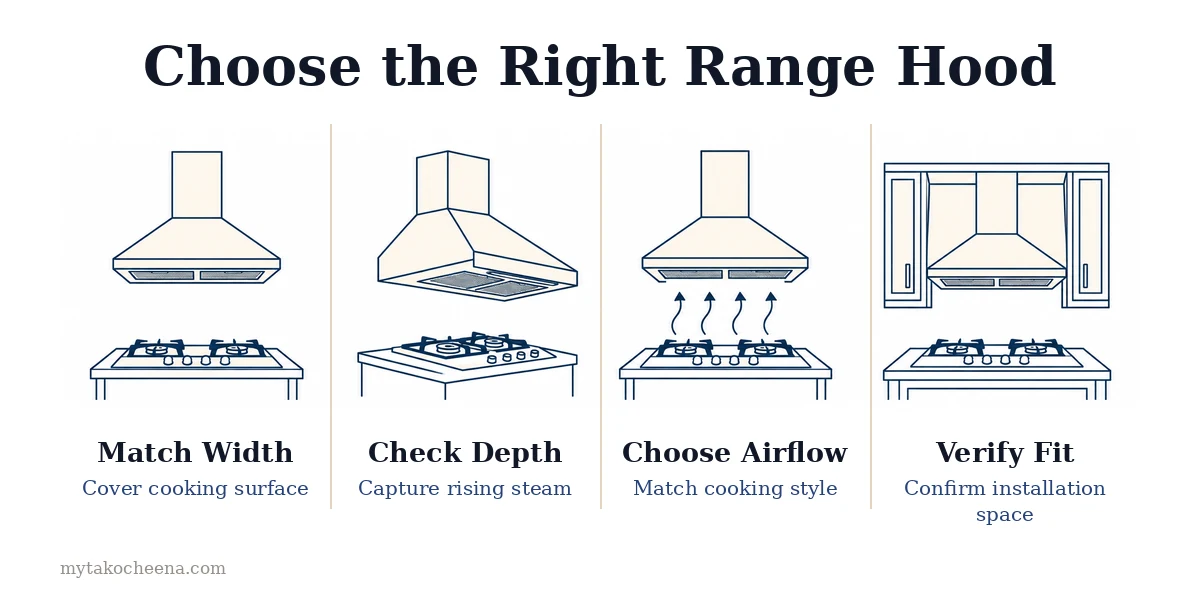
Cooktop width is the first filter for range hood sizing. Match the hood’s published overall width to the cooking surface before comparing airflow, ducting, noise, or finish.
A hood that is too narrow can leave edge burners outside the capture area, allowing smoke and grease to reach cabinets. A wider hood may capture better but fit poorly, cost more, or look oversized.
Compare common width ranges
| Cooking surface | Common cooktop width | Typical hood width to shop |
| Compact apartment or small-kitchen cooktop | 24–30 inches | 24–36 inches |
| Standard residential range or cooktop | 30–36 inches | 30–42 inches |
| Wide residential or pro-style cooking surface | 36–48 inches | 36–54 inches |
For an under-cabinet or wall-mounted hood, matching the cooktop width is a practical starting point. Extending beyond the cooking surface can improve edge capture, especially when walls or cabinets contain rising air.
Island and peninsula installations usually need more width because air can drift away on multiple sides. Extra width improves capture of steam, smoke, and odors but increases visual weight and may require stronger support.
| Hood location | Common width relationship | Reason |
| Under-cabinet or wall-mounted | Equal to the cooktop or about 3–6 inches wider | Nearby cabinets and walls help contain rising air |
| Island or peninsula | About 6–12 inches wider | Open sides allow fumes to spread before capture |
Check the finished cabinet opening
Product-page width does not guarantee a suitable fit. Measure the finished space between cabinets, trim, tile edges, and side panels, then compare it with the installation guide.
- Check required side clearances and mounting space.
- Confirm that duct access does not require extra room beyond the visible hood shell.
- Match the hood style to the layout, since inserts, chimney hoods, and under-cabinet models use space differently.
Use width as the first screening step, not the final decision. Then compare hood depth, duct size, airflow, sound ratings, filters, lighting, and owner experience.
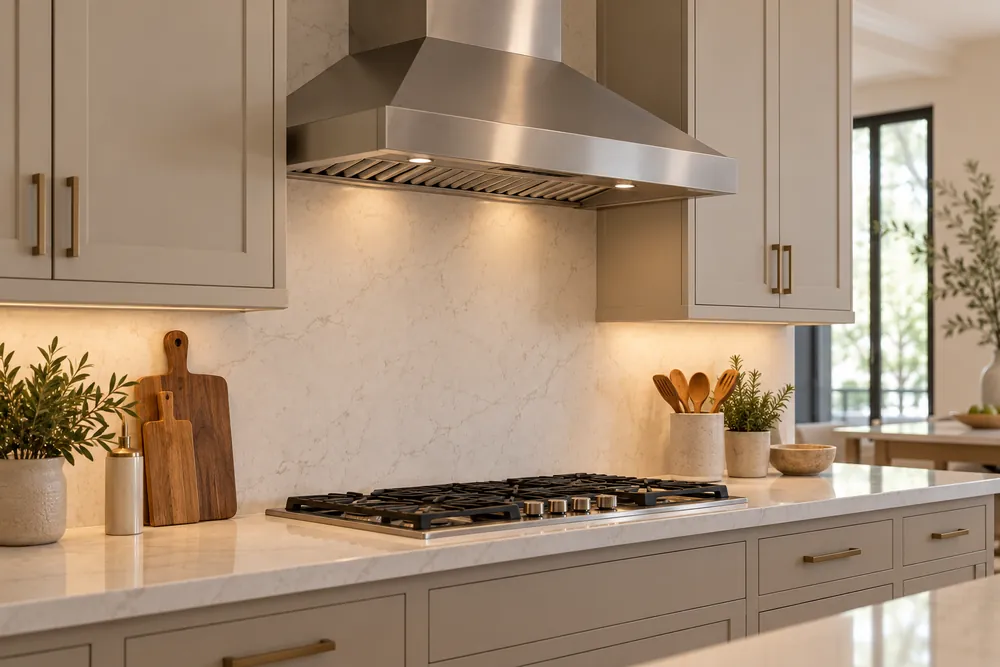
Match Hood Depth to Your Cooking Surface
Hood depth determines how much steam, grease, and odor reaches the capture area before rising past it.
Compare the hood’s published depth with the cooktop or range depth, then check cabinet depth, front-burner position, and available head clearance.
A shallow hood may look less intrusive but leave front burners outside the strongest capture zone. A deeper hood generally improves coverage, although it can project farther into the room and feel crowded above a standard cabinet run.
Compare common depth ranges
| Kitchen component | Common depth range | What to check |
| Standard cooktop or range | 24–30 inches | Front burners should sit beneath the hood capture area |
| Under-cabinet hood | 18–24 inches | Confirm it covers the cooking surface without reducing work space |
| Wall-mounted chimney hood | 18–27 inches | Check the canopy projection and front-burner coverage |
| Pro-style range hood | 24–30 inches | Use the larger end when the range is deep or high-output |
Prioritize front-burner coverage
Depth should extend far enough to catch fumes from the front cooking zones, not only the rear burners.
Look at the hood’s actual canopy or insert depth rather than relying on the overall product dimensions, which may include a chimney or rear housing.
Cabinet depth can limit your options.
An under-cabinet hood normally needs to sit within the cabinet line, while a wall-mounted design may project beyond it; compare the installation drawing with the finished cabinet faces, backsplash, and nearby doors.
- Choose a deeper hood for frequent frying, wok cooking, grilling, or tall cookware that sends fumes forward.
- Choose a shallower hood when cabinet clearance, walking space, or headroom is limited.
- Consider an insert when the surrounding custom canopy can be built deeper than the concealed blower housing.
Depth cannot compensate for poor width, weak airflow, or unsuitable ducting. After confirming front-burner coverage, compare the hood’s capture design, mounting height, duct path, and installation clearances.
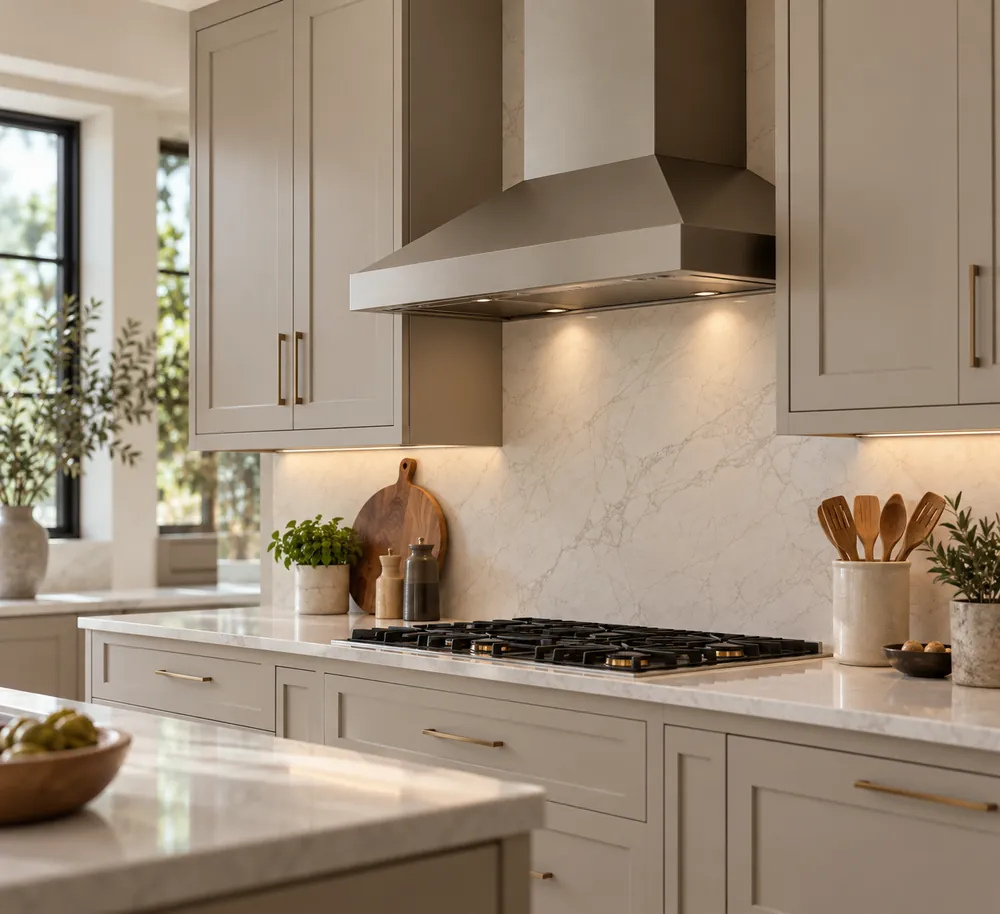
Choose Enough Airflow for Your Cooking Style
Airflow should match cooking style, not only range width. Too little capacity leaves grease, steam, and odors indoors; too much increases noise, energy use, and make-up air demands.
Match airflow to cooking intensity
Light cooking, including simmering and baking, needs less ventilation than frequent frying, searing, grilling, or wok cooking. Gas and high-output induction also produce more heat and vapor than compact electric cooktops.
| Cooking pattern | Common airflow range | What to consider |
| Light electric cooking | 200–400 CFM | Suitable for simmering and routine meal preparation |
| Regular mixed cooking | 300–600 CFM | Balances everyday frying, boiling, and sautéing |
| Frequent high-heat cooking | 500–900 CFM | Better suited to searing, wok cooking, and heavy frying |
These bands are starting points. Capture area, mounting height, filters, and duct performance determine how much air reaches the cooking surface.
Account for gas output and duct resistance
Gas cooking adds combustion byproducts. Compare total burner output with the manufacturer’s guidance, then account for duct length, elbows, roof caps, and restrictive transitions.
| Installation factor | Typical range or condition | Effect on sizing |
| Residential duct diameter | 6–10 inches | Larger, properly matched ducts usually support stronger airflow |
| Short, direct duct run | About 3–10 feet | Generally preserves more rated performance |
| Long or complex duct run | About 15–30 feet or multiple elbows | May require more capacity and careful installation planning |
Do not choose the highest advertised CFM. Undersized or poorly routed ductwork can make a powerful hood loud without removing fumes efficiently.
Balance performance with noise
Higher airflow usually creates more sound. Choose several speeds so normal cooking uses a quieter setting while high-heat tasks retain extra capacity.
- Prioritize capture width and depth before chasing maximum airflow.
- Verify the required duct diameter and permitted exhaust route.
- Check local requirements for make-up air at higher airflow levels.
- Compare sound ratings at comparable speed settings, not only the quietest claim.

Account for Duct Length, Turns, and Makeup Air
Duct design determines how much of a hood’s advertised airflow reaches the outside. Narrow ducts, repeated turns, long runs, and poor seals reduce performance, so size the ventilation system as a complete path.
Review the installation guide for the required duct diameter, approved materials, maximum equivalent length, and remote-blower options.
Estimate resistance before choosing airflow
Every elbow, transition, damper, and wall cap adds resistance. A short, straight route generally moves air more effectively and quietly than a longer route with several turns.
| Layout or component | Typical planning range | Effect on performance |
| Common residential duct diameter | 6–10 inches | Larger ducts generally reduce resistance, subject to the hood specification |
| Longer horizontal run | 20–40 feet | May require more blower capacity than a short direct route |
| Directional elbows | 1–4 turns | Each turn adds equivalent duct length and can increase noise |
Prefer smooth, rigid metal ducting with gradual bends. Flexible duct can sag, collect grease, and create turbulence. Seal joints with approved foil tape or mastic, and use a properly sized exterior cap.
Plan for makeup air
Outdoor exhaust creates negative pressure. Replacement air may enter through doors, cracks, combustion-appliance vents, or other unintended paths, reducing capture performance and creating drafts.
Requirements depend on local code, construction, fuel-burning appliances, and hood airflow. Ask a qualified installer whether interlocked supply air or combustion-safety testing is needed.
- Keep the duct route as short and direct as practical.
- Confirm every fitting matches the hood’s specified duct size.
- Do not reduce the duct diameter to fit an existing opening without professional guidance.
- Balance strong exhaust with acceptable noise and reliable makeup air.
Compare the hood’s airflow at operating settings, not only its maximum rating. A lower-capacity hood with a direct installation can outperform a stronger model on a restrictive route.
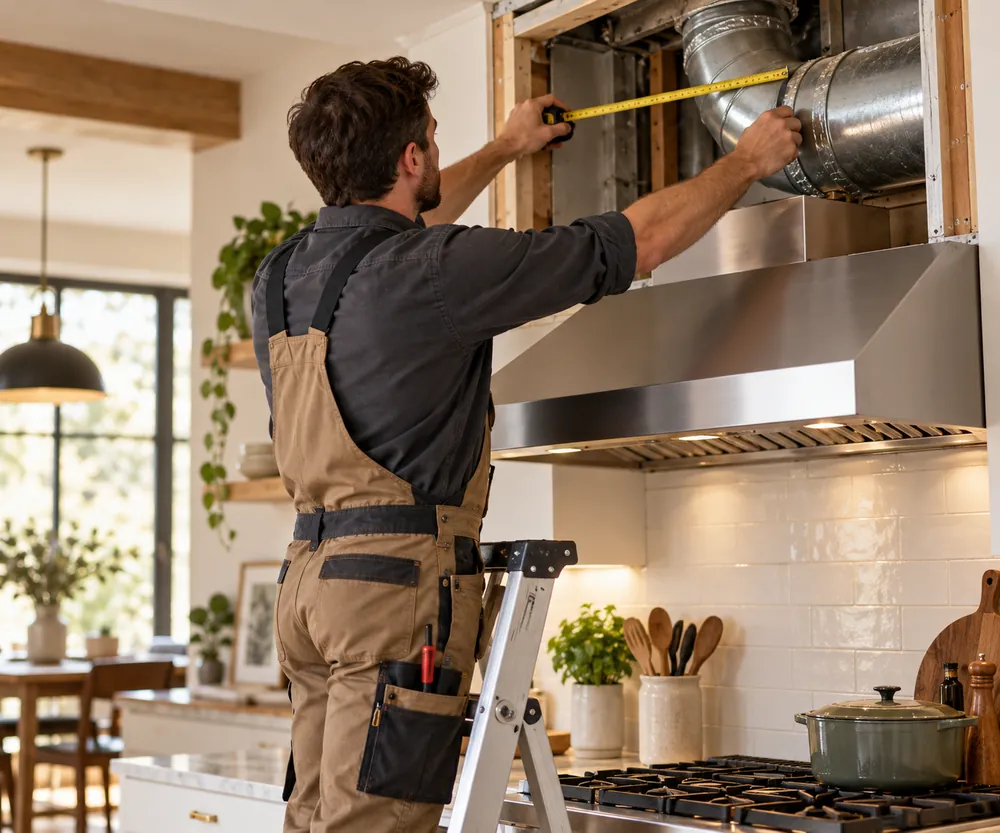
Pick the Right Mounting Height and Hood Type
Mounting height determines how effectively the hood captures steam, grease, and smoke without interfering with cooking.
Choose the hood type from your cabinet layout, cooking surface, and duct route, then follow the installation guide rather than relying on appearance alone.
Measure from the cooking surface to the bottom of the hood. Common installation ranges vary by fuel type and manufacturer, so confirm the permitted clearance for your exact hood and cooktop combination.
| Cooking surface | Typical clearance range | Key trade-off |
| Electric or induction | 24-30 inches | Lower placement can improve capture |
| Gas cooking surface | 27-36 inches | Higher heat may require more clearance |
| High-output or professional-style range | 30-36 inches or more | Follow the appliance and hood requirements |
A hood mounted too high may allow fumes to spread before reaching the filters. A hood mounted too low can obstruct sightlines, increase contact risk, or conflict with burner and manufacturer requirements.
Match the hood type to the kitchen
- Under-cabinet hoods: Fit beneath existing cabinets and suit standard wall installations, but cabinet depth can limit capture area and duct access.
- Wall-mounted chimney hoods: Make a strong choice when there are no cabinets above the range. Check chimney width, ceiling height, and the available wall space.
- Island hoods: Need broad coverage because air can drift from every side. They often require a wider hood and a carefully planned ceiling duct.
- Inserts: Hide inside custom cabinetry, but the enclosure must provide adequate depth, ventilation space, and service access.
Choose a ducted hood where possible for stronger removal of moisture and cooking odors. Recirculating designs offer simpler installation but depend on filters and cannot discharge humid air outdoors.
Stand at the range with a tape measure and check the distance to the planned hood position, not the ceiling or cabinet base.
Mark the lowest permitted height on the wall, then confirm that the hood will still cover the full cooking surface from front to back.
For an island range, an island hood or properly sized ceiling-mounted system may be necessary because there is no wall or cabinet to help contain rising air.
Measure the open area around the cooktop, including walkways, so the hood does not create an avoidable head-level obstruction.
Cabinet-mounted installations require a second measurement: the available space between the cabinets.
Compare that width with the hood’s actual body and required clearances, then trace the duct route to identify shelves, joists, or cabinet partitions that could block installation.
If the existing duct opening does not align with the hood, allow room for the transition without reducing clearance around the cooking surface.
A slightly different hood type may fit better than forcing a model into a cramped route or accepting a mounting height outside the manufacturer’s limits.
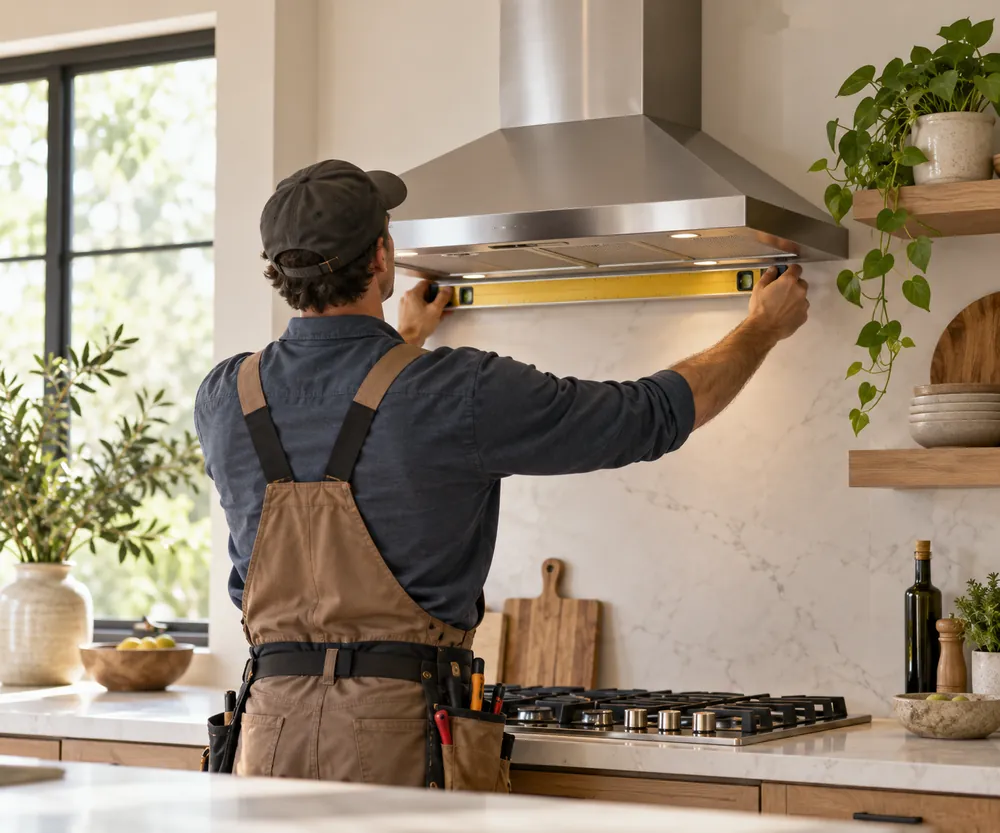
Balance Noise, Filters, and Everyday Cleaning
Noise, filter design, and cleaning access determine whether a correctly sized hood remains useful after installation.
Compare them with width, depth, airflow, and duct planning because a powerful hood that is unpleasant or difficult to maintain may be used less often.
Read sound ratings with the airflow setting
Published sound ratings vary by fan speed, so compare ratings at the airflow level you expect to use. Low settings may suit simmering, while searing, frying, and boiling require more capture power and produce more fan noise.
| Operating level | Common sound range | Best use |
| Low | 1–3 sones | Light simmering and routine cooking |
| Medium | 3–6 sones | Daily sautéing and boiling |
| High | 6–10 sones | Frying, searing, and heavy smoke |
Sound can increase when a duct is undersized, long, sharply bent, or poorly sealed.
Check the installation guide for the required duct diameter and compare sound information at matching airflow settings instead of choosing the quietest number on a product page.
Choose filters that match your cooking habits
Stainless-steel baffle filters are durable and often easier to clean after greasy cooking. Aluminum mesh filters are lighter and less expensive, but their fine layers may collect residue quickly and need careful washing.
| Cooking pattern | Useful filter priority | Trade-off |
| Frequent frying | Removable metal baffles | Heavier but convenient to wipe |
| Light daily cooking | Washable mesh or baffles | More filter styles to compare |
| High-heat cooking | Sturdy metal construction | Usually requires regular degreasing |
Plan for everyday cleaning
Look for filters that release without tools, fit securely after washing, and can be cleaned in a dishwasher when permitted. A smooth underside, accessible grease tray, and removable surfaces reduce buildup around the fan and controls.
Before buying, confirm replacement-filter availability and read the care instructions.
Clean filters when grease becomes visible or airflow declines, because restricted filters increase noise, reduce capture, and strain the ventilation system.

What Owners Report After Six Months
Owner reports after six months often converge on one complaint: a hood can meet its advertised width and still leave cooking odors, steam, or grease near the front burners.
Reports also show that reliable capture depends on installation quality, duct routing, filter cleaning, and choosing airflow that suits the cooking surface.
Manufacturer documentation supports these patterns.
Specifications explain that published airflow depends on duct size, elbows, termination, and operating mode, while installation guides commonly require clearance between the cooking surface and hood.
The recurring complaint: weak capture
Owners most often describe lingering smells, visible vapor escaping at the edges, or grease settling on nearby cabinets.
These reports are more common with shallow hoods, open-sided island layouts, long duct runs, and high-heat cooking than with properly enclosed wall installations.
A hood can sound powerful yet perform poorly when the duct is undersized, sharply bent, or reduced through an adapter.
Manufacturer guidance repeatedly emphasizes following the specified duct diameter and limiting restrictions rather than judging performance from the motor label alone.
What tends to hold up
- Stainless-steel shells and washable metal filters generally receive favorable durability comments.
- Simple fan controls usually create fewer complaints than touch panels exposed to grease and steam.
- Separate speed settings help owners balance everyday cooking with stronger ventilation for searing or frying.
| Category | Typical range |
| Common hood-to-cooktop clearance | 24–30 inches |
| Typical residential airflow band | 200–600 CFM |
What can fail early
Early complaints commonly involve noisy bearings, rattling filters, loose baffles, dim lights, and controls that respond inconsistently.
Owner reports also mention replacement filters or lights becoming difficult to source, so documentation and parts availability matter beyond the initial purchase.
Before buying, compare the warranty, cleaning instructions, duct requirements, and replacement-part listings.
A correctly sized hood with maintainable filters usually delivers better long-term satisfaction than a stronger-looking model that is difficult to install or service.
Questions Still Worth Raising
Range hood sizing involves capture depth, airflow, duct restrictions, clearances, and noise, not only cooktop width.
How much wider should a range hood be than the cooktop?
A wall-mounted or under-cabinet hood commonly matches the cooktop or extends slightly beyond it. An island hood often benefits from extra width because air can drift from every side.
| Installation position | Typical width relationship |
| Wall-mounted or under-cabinet | Equal width to about 3–6 inches wider |
| Island or peninsula | About 6–12 inches wider |
Does range hood depth need to match the cooktop?
Compare hood depth with the cooking surface. A shallow hood may miss front burners, while an overly deep model can obstruct movement or reduce head clearance.
- Check the product’s published capture area, not only its outer shell.
- Account for cabinet depth, backsplash thickness, and the hood’s mounting position.
How many CFM does a range hood need?
Required airflow depends on fuel type, burner output, cooking habits, and duct design. Gas cooking, wok use, searing, frying, and frequent high-heat cooking generally need more capacity.
Follow the manufacturer’s guidance and confirm the duct supports that airflow.
What range hood clearance is safe above a cooktop?
Installation guides specify a clearance range rather than one universal height. The distance depends on hood design, fuel type, cabinet arrangement, and local requirements.
| Planning item | Common category range |
| Hood above a residential cooktop | About 24–36 inches |
| Typical upper-cabinet depth | About 12–16 inches |
Will a longer duct run reduce range hood performance?
Yes. Long runs, multiple elbows, narrow ducting, flexible sections, and poor exterior terminations increase resistance and reduce airflow.
- Follow the specified duct diameter.
- Use the shortest practical route.
- Count elbows and transitions before comparing airflow claims.
Is a higher CFM range hood always better?
Higher airflow is not automatically better if the hood is noisy, poorly ducted, or too powerful for the room. Stronger ventilation can increase conditioned-air loss and require makeup-air planning.
Compare sound settings, airflow levels, filter design, and duct requirements instead of choosing the largest rating.
Can a range hood be too large for my kitchen?
A hood can be oversized for the cabinet opening, wall space, visual scale, or available duct route. Extra width may improve capture but create installation conflicts and add cost.
Measure the finished opening, inspect the installation guide, and confirm side clearances before ordering. Product width does not guarantee fit.