The short answer: A small-space toaster oven is a compact countertop appliance that reheats, toasts, and cooks food without requiring a full-size oven.
The best choice fits your available counter and storage space, leaves the required clearance, and offers useful functions without unnecessary bulk.
Compare exterior dimensions, interior capacity, controls, cleanup, safety guidance, and owner-reported durability before buying.
How to Choose a Toaster Oven for Small Spaces
Small-space toaster ovens must fit without blocking cabinets, outlets, or prep areas. Compare dimensions, door swing, controls, capacity, and ventilation guidance instead of choosing by exterior size alone.
Measure the footprint with the cord, handle, and open door included. A compact body may still be awkward if the door projects forward or cabinet trim limits control access.
| Specification | Typical category range | Small-space trade-off |
| Cooking capacity | 2–6 slices or about 0.3–0.8 cubic feet | Smaller interiors save counter space but limit dish size |
| Power draw | 1,000–1,500 watts | Higher output may cook faster but demands a suitable circuit |
| Temperature range | 200–450°F | Broader settings support more recipes but do not guarantee even heating |
Prioritize usable clearance
Follow manufacturer clearance instructions to protect cabinets and maintain airflow. Compare required space above, behind, and beside each oven with your location, leaving room to remove the crumb tray without moving the appliance.
| Measurement | Common planning range | Why it matters |
| Cabinet or shelf opening width | 18–24 inches | Helps screen models before checking exact exterior dimensions |
| Front operating clearance | 12–24 inches | Allows the door to open and food to be handled safely |
| Rear ventilation space | 2–6 inches | Supports airflow where the manual requires it |
Match functions to your routine
Convection can improve browning and shorten cooking times, but may add noise and require recipe adjustments.
Presets are convenient; independent temperature and timer controls offer flexibility for toast, reheating, baking, and broiling.
Check rack positions, included pans, removable trays, and cleaning access. Owner reports may reveal hot spots or difficult controls, but compare them with manufacturer specifications rather than relying on one review.
- Choose the smallest capacity that fits your usual cookware.
- Confirm outlet requirements and clearance before purchase.
- Prefer accessible controls and removable, dishwasher-safe parts when available.
What a Small-Space Toaster Oven Is
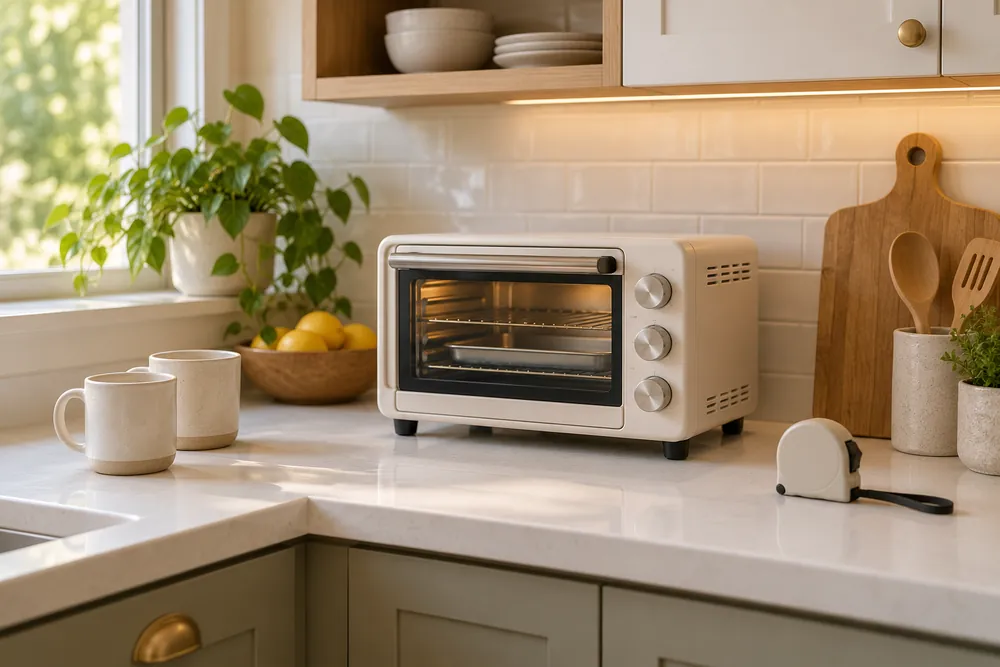
A small-space toaster oven suits limited counters, shared kitchens, apartments, and storage-conscious households. Evaluate its footprint, interior, ventilation needs, and portability.
Dimensions and capacity
Compare exterior dimensions with available space, including the handle, controls, door swing, cord route, and ventilation area.
| Specification | Typical category range | Why it matters |
| Exterior width | 12–18 inches | Determines counter coverage |
| Exterior depth | 10–16 inches | Shows how far the oven projects |
| Exterior height | 8–12 inches | Helps assess shelf clearance |
| Interior capacity | 0.4–0.8 cubic feet | Indicates the amount of food it can hold |
Narrower bodies save counter space but may limit pan shapes. Taller cavities fit thicker foods, while deeper designs may interfere with backsplashes or shallow counters.
Heat, power, and clearance
Temperature and wattage indicate capability, not guaranteed speed. Higher wattage may preheat faster but demand more from a shared circuit.
| Specification | Common range | Trade-off |
| Cooking temperature | 200–450°F | Supports warming through baking and broiling |
| Rated power | 1,000–1,500 watts | Balances performance with electrical demand |
| Recommended rear clearance | 2–6 inches | Provides room for heat and airflow |
Follow manufacturer clearance instructions and keep heat-sensitive items outside the required ventilation area.
What belongs in the comparison
- Measure the location: Check usable counter depth, overhead space, outlet access, and the door’s opening path.
- Match the interior: Compare rack positions, tray dimensions, and the foods you prepare most often.
- Plan storage: Confirm that the oven is light enough to move safely and that accessories have a place.
- Read safety details: Review clearance, surface, cleaning, and electrical guidance in the published specifications.
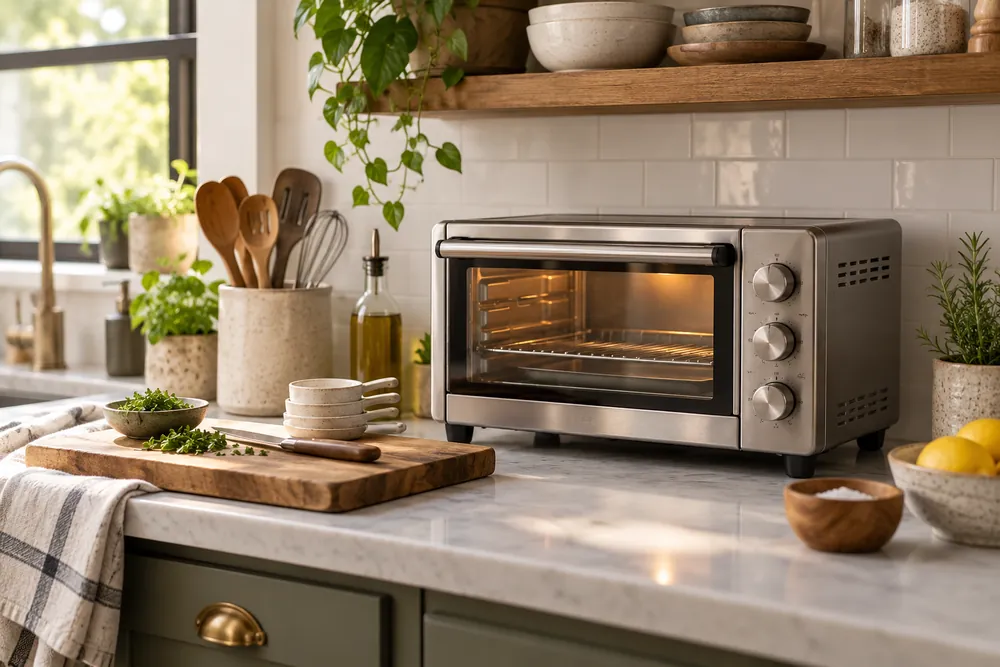
Measure Your Space Before You Shop
Counter depth, outlet location, and door clearance determine whether a toaster oven will fit. Compare the appliance’s published exterior dimensions with the usable space, not the full width of your countertop.
Measure the countertop from front to back, then check the distance between walls, cabinets, and appliances. Record the smallest measurement because counters, backsplashes, and trim can reduce the available footprint.
| Measurement | Typical category range | What to check |
|---|---|---|
| Width | 16–24 inches | Side-to-side counter space |
| Depth | 12–20 inches | Front overhang and backsplash clearance |
| Height | 9–14 inches | Upper cabinets and shelf clearance |
Do not plan around the oven’s listed dimensions alone. Manufacturers may require open space around the sides, back, or top for ventilation, and those requirements can exceed the appliance’s footprint.
Check the manual or product page for clearance instructions. A compact oven that fits between two objects may still be unsuitable if its ventilation path is blocked.
| Specification | Common category range | Space-planning trade-off |
|---|---|---|
| Recommended top clearance | 4–12 inches | More clearance may rule out a cabinet shelf |
| Cooking capacity | 9–30 quarts | Larger interiors usually need more counter depth |
| Power draw | 1,000–1,800 watts | Confirm the outlet and circuit can support the appliance |
Measure the open door path as the closed footprint. A front-hinged door can extend across a walkway, while a side-hinged design may need unobstructed space beside the oven.
- Keep the cord route clear of hot surfaces and sink areas.
- Leave room to remove the crumb tray and racks.
- Check that the oven can be lifted or slid forward for cleaning.
Write down your maximum width, depth, height, and clearance before shopping. Then compare those limits with each manufacturer’s published dimensions and installation guidance.
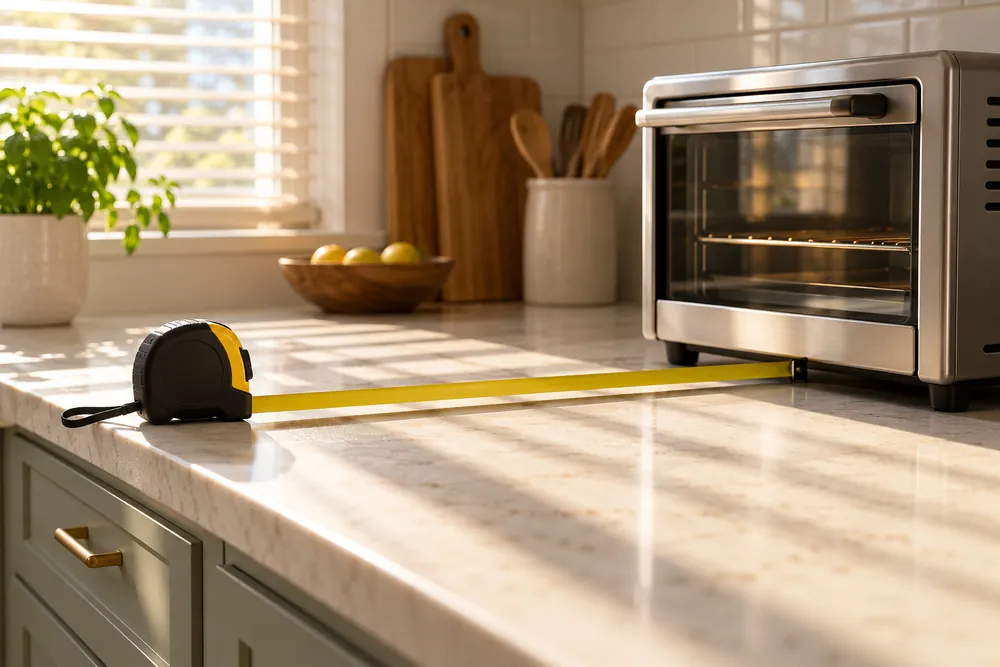
Compare Size, Capacity, and Clearances
Footprint, capacity, and ventilation determine whether a toaster oven suits your kitchen. Compare My Tako Cheena specifications with available space under cabinets, beside appliances, and around the oven.
Measure the location and check exterior dimensions. Rounded housing, rear cords, or protruding controls may require more space than the listed width suggests.
| Category | Typical published range | Best fit |
| Compact footprint | 12–16 inches wide; 10–14 inches deep | Single servings, dorms, narrow counters |
| Mid-size footprint | 16–20 inches wide; 13–17 inches deep | Daily reheating and small baking dishes |
| Large countertop footprint | 20–25 inches wide; 16–20 inches deep | Family portions and larger cookware |
| Interior capacity | 0.5–1.5 cubic feet | From snacks to multi-serving meals |
Check interior measurements, rack positions, and usable cooking area. A wide cavity may fit pizza or pans, while a taller cavity may better suit casserole dishes.
Compare required clearances with cabinets, walls, backsplashes, and storage. A compact oven may still be unsafe in an enclosed cubby.
| Planning factor | Common range | Why it matters |
| Side clearance | 2–6 inches | Allows heat dissipation and access |
| Top clearance | 4–12 inches | Protects cabinets and provides ventilation |
| Rear clearance | 2–6 inches | Accommodates heat, airflow, and the power cord |
| Standard counter depth | 24–26 inches | Leaves room for the oven and front access |
Use these ranges for screening only. My Tako Cheena’s instructions take priority because required clearances vary by design.
Match the oven to your cookware
- Check whether your preferred pan fits with the rack installed, including handles and door clearance.
- Choose a smaller cavity when storage matters more than batch size.
- Choose a larger cavity only when the counter can support its footprint and ventilation needs.
Record available width, depth, height, and open-air clearance before comparing listings. This helps distinguish a space-saving design from one that restricts safe operation.
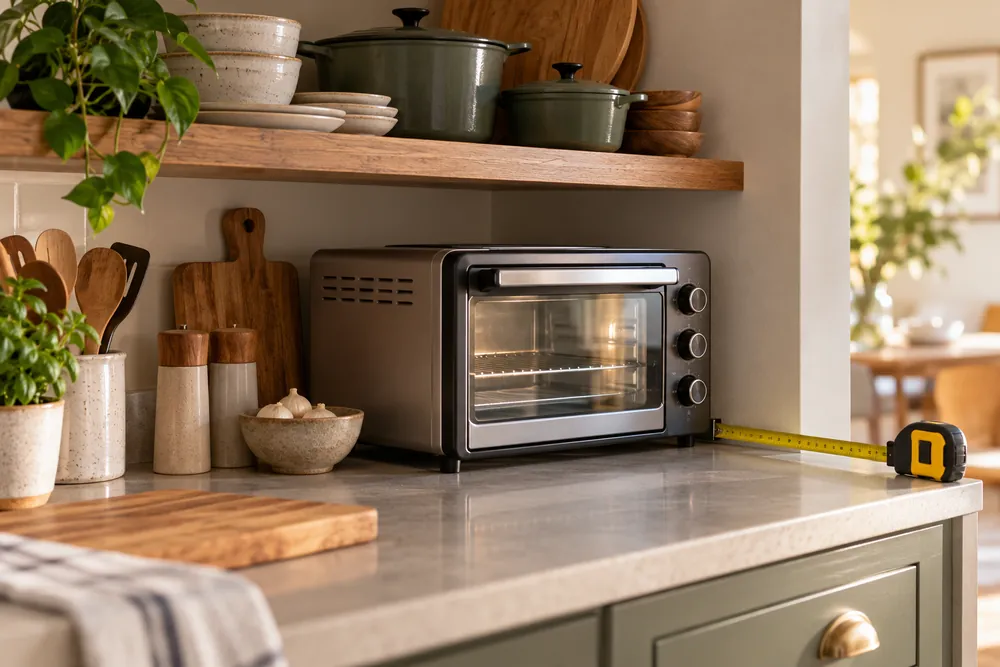
Choose the Cooking Functions You Need
Cooking functions determine whether a toaster oven earns counter space. Compare useful modes with controls, capacity, cleanup, and clearance.
Match Functions to Your Routine
Toast and bake handle daily tasks; broil browns food, while convection improves circulation and roasting consistency.
- Toast: Choose adjustable browning controls and separate settings for lighter or darker results.
- Bake: Look for a broad temperature range if you prepare casseroles, frozen foods, or small batches of baked goods.
- Broil: Check whether the rack can move close enough to the upper element for effective browning.
- Convection: Consider this mode for roasting vegetables, crisping food, and reducing hot spots.
- Air-fry: Confirm that the oven includes suitable airflow space and a tray or basket that is easy to clean.
| Function | Typical category range | Main trade-off |
| Keep warm | About 150–250°F | Useful for holding food, but not full cooking |
| Bake or roast | About 200–450°F | Versatile, with longer cooking times for dense foods |
| Broil | About 400–500°F | Fast browning, requiring close supervision |
Check Space Before Choosing Extra Modes
Extra functions may require larger interiors or housings. Measure counter space and ventilation clearance; compact labels do not guarantee small footprints.
| Capacity band | Best suited for | Space consideration |
| About 0.5–0.8 cubic feet | Toast, reheating, and small portions | Usually easier to fit in tight kitchens |
| About 0.8–1.2 cubic feet | Small casseroles, roasting, and air-frying | Needs more counter depth and ventilation |
| About 1.2–1.8 cubic feet | Family-size portions and broader cookware | Greater versatility, but less convenient storage |
Prioritize useful presets, manual temperature control, a removable crumb tray, and accessible rack positions.
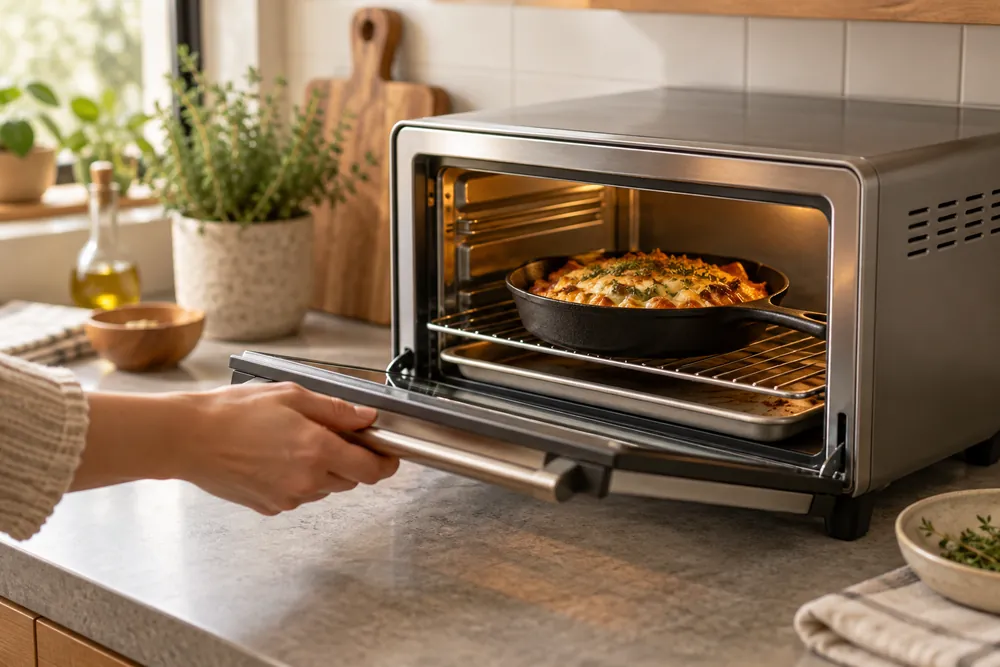
Check Controls, Visibility, and Cleanup
Compare controls, door design, lighting, and removable parts.
Choose controls you can read quickly
Large knobs provide tactile feedback, while push-button panels may hide programs in small labels or menus.
- Look for separate controls for temperature, cooking function, and time.
- Prefer clearly marked settings for baking, broiling, toasting, and reheating.
- Check whether the timer has an automatic shutoff rather than sounding only an alert.
- Confirm that display text remains readable from the counter’s normal standing position.
Compare useful specification ranges
| Specification | Common range | What it affects |
| Cooking temperature | 150–500°F | Low-temperature warming and high-heat baking or broiling |
| Power draw | 1,200–1,800 watts | Heating speed and circuit demand |
| Interior capacity | 0.5–1.5 cubic feet | Pan size, food quantity, and counter footprint |
| Rear and side clearance | 2–6 inches | Ventilation and safe placement near cabinets |
Use these ranges for comparison, then follow the manufacturer’s installation instructions.
Prioritize visibility
A wide window and interior light help monitor food without opening the door.
- Check whether the glass spans enough of the door to show the food clearly.
- Look for an interior light that can be switched on without starting a cycle.
- Confirm that the rack and tray positions remain visible through the door.
Plan for cleanup
Removable crumb trays and nonstick interiors simplify maintenance; exposed coils and narrow corners complicate it.
Check the manual before using a dishwasher. Let the oven cool before removing parts.
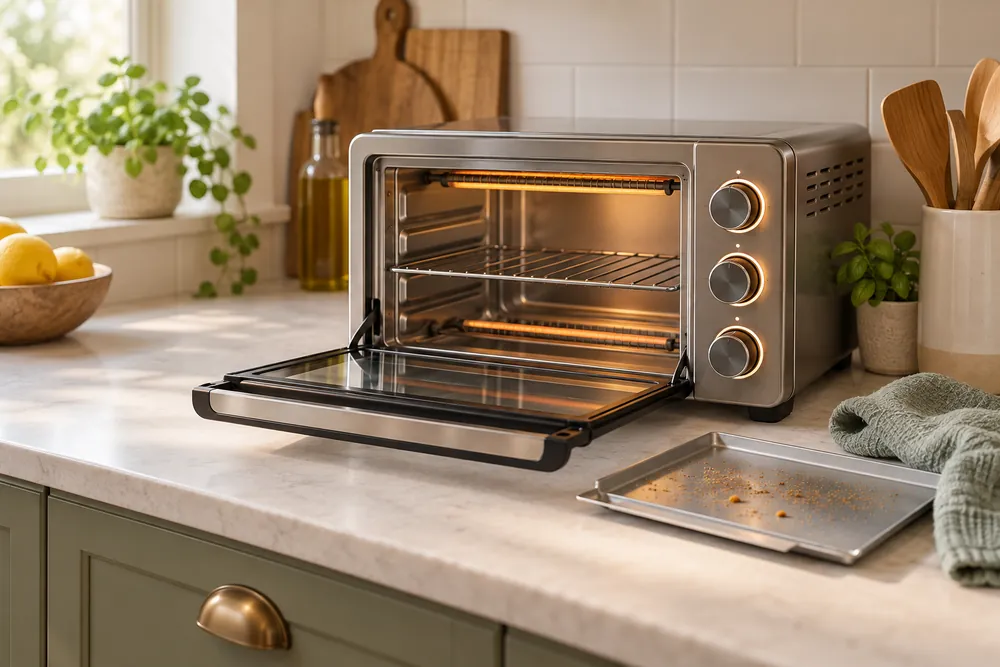
Evaluate Safety, Energy Use, and Published Specifications
Published specifications reveal whether a toaster oven suits a compact kitchen, but they do not replace measurement.
Compare electrical demand, usable capacity, temperature control, ventilation guidance, and safety features before choosing a My Tako Cheena appliance or a competing model.
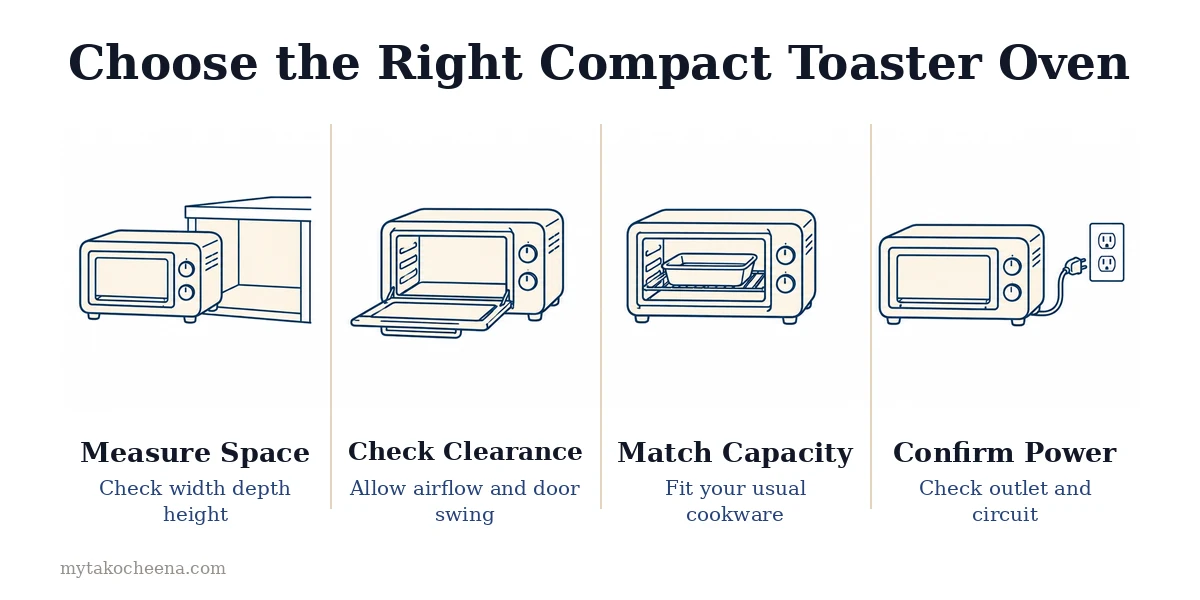
Start with the installation information, not the exterior width. Confirm the clearance around the cabinet, the door’s swing path, and whether the manual permits operation beneath cabinets or beside heat-sensitive surfaces.
| Specification | Typical category range | Why it matters |
| Rated power | 1,000–1,800 watts | Higher demand can shorten cooking time but may challenge a shared circuit. |
| Interior capacity | 0.5–1.2 cubic feet | Capacity affects pan compatibility and counter footprint. |
| Cooking temperature | 200–500°F | A wider range supports gentle warming and higher-heat baking. |
| Rear and side clearance | 2–6 inches | Space helps heat escape and protects nearby surfaces. |
Check whether the listed wattage describes the maximum draw rather than average consumption. Energy use depends on cooking time, thermostat cycling, insulation, and whether the appliance heats all elements continuously.
Safety specifications deserve attention. Look for an automatic shutoff, an insulated or cool-touch handle, nonslip feet, a grounded plug, a removable crumb tray, and warnings about extension cords and blocked vents.
- Verify that the plug and circuit match the manufacturer’s electrical requirements.
- Choose controls that make the selected function and temperature easy to confirm.
- Prefer manuals that explain rack positions, cookware limits, cleaning, and ventilation.
- Read owner reports for recurring concerns such as hot exteriors, uneven browning, or difficult controls.
Compare like with like: interior dimensions are more useful than marketing capacity, while listed temperatures may describe settings rather than verified chamber temperature.
Treat missing measurements, vague safety language, or unavailable manuals as reasons to investigate before purchase.
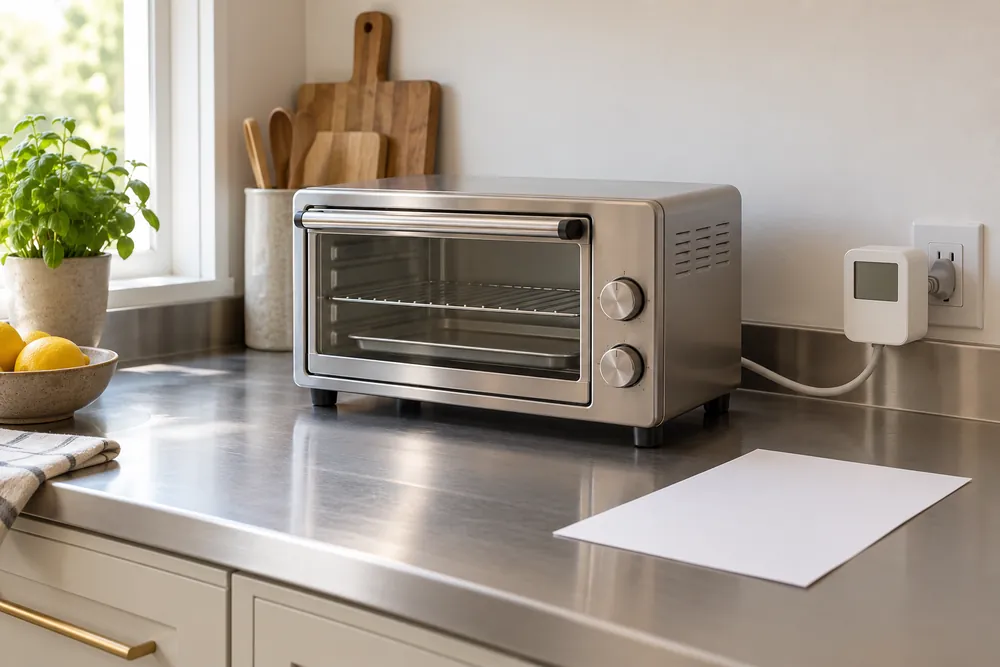
How These Hold Up After a Year
Owner reports repeatedly identify a long-term nuisance: crumb buildup around the door, lower heating elements, and hard-to-reach corners.
Manufacturer care instructions treat regular crumb removal as essential because residue can affect heating and create smoke.
What generally holds up is the basic heating function, metal rack, and removable crumb tray.
Owners report these parts remain serviceable when the appliance is emptied and wiped regularly, although finishes can discolor and control markings may fade with frequent cleaning.
Recurring owner complaints
- Crumbs and grease: Narrow gaps around the door can collect debris that is difficult to remove without turning or carefully lifting the appliance.
- Door hardware: Some owners report loose hinges, noisy springs, or a door that no longer closes as smoothly after repeated use.
- Controls: Mechanical dials tend to remain usable, while electronic buttons and displays are more often mentioned in complaints about intermittent operation.
- Exterior heat: Manufacturer documentation commonly warns that surrounding surfaces may become hot, making ventilation and clearance important in a compact kitchen.
| Specification | Typical range | Long-term trade-off |
|---|---|---|
| Cooking temperature | 150–450°F | Broader ranges improve versatility but may increase control complexity |
| Power draw | 1,200–1,800 watts | Higher output can shorten cooking times but demands a suitable circuit |
| Counter clearance | 2–6 inches | More space helps ventilation but reduces usable storage |
Manufacturer documentation recommends hand-washing removable accessories, avoiding abrasive cleaners, and keeping vents unobstructed.
Owners support those practices, particularly for preserving the tray coating and preventing smoke from baked-on grease.
For a small-space buyer, the best durability signal is maintainability rather than a long feature list.
Choose a toaster oven with an accessible tray, clear care instructions, sturdy door hardware, and enough surrounding clearance for safe ventilation.
Frequently Asked Questions
Compare footprint, cooking area, temperature range, controls, and clearance needs. Specifications confirm fit; owner feedback reveals heat, cleaning, and access trade-offs.
What size toaster oven fits a small kitchen?
Measure available width, depth, and height. Allow door-opening space and manufacturer-recommended ventilation clearance.
| Specification | Typical category range |
| Exterior width | 15–22 inches |
| Exterior depth | 11–18 inches |
| Recommended ventilation clearance | 2–6 inches |
What temperature range should a toaster oven have?
Compare minimum and maximum settings, useful increments, and broil or high-heat modes for baking, roasting, reheating, and broiling.
| Use | Common category range |
| Low-temperature warming | 150–250°F |
| General baking and roasting | 300–450°F |
| High-heat broiling | 450–500°F |
How much food can a small toaster oven hold?
Check interior dimensions, rack positions, and cookware compatibility. Compact models suit toast and snacks; wider cavities hold larger dishes.
Is a toaster oven safe to use under kitchen cabinets?
Follow the manual’s top, side, rear, and front clearance requirements. Heat and steam can damage cabinets.
What wattage is best for a small toaster oven?
Higher wattage may improve heating but draws more power. Compare wattage with outlet and circuit capacity.
| Category | Typical range |
| Compact appliance | 800–1,200 watts |
| Mid-size countertop appliance | 1,200–1,800 watts |
Are toaster oven controls easy to use in a small kitchen?
Choose readable labels, smooth dials, and a clear timer. Digital controls offer precision; mechanical controls are often quicker to understand.
What should I check before buying a toaster oven for a rental?
Prioritize a manageable footprint, grounded plug, removable crumb tray, easy-clean finishes, return terms, and warranty coverage.