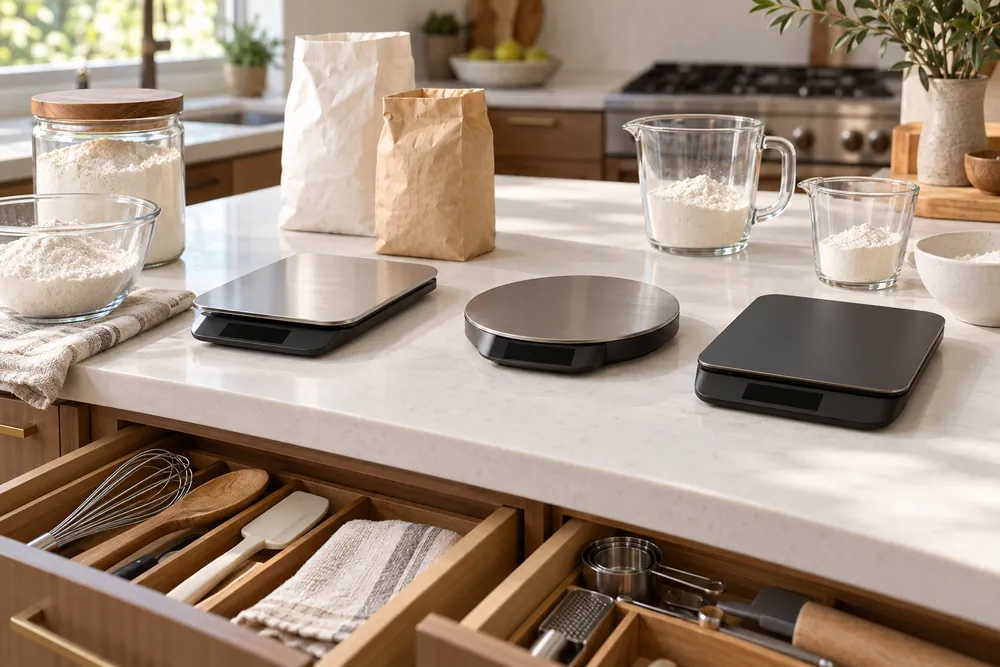
In short: A kitchen scale for baking is a compact digital device that weighs ingredients instead of relying only on volume measurements.
The best choice has a stable platform, clear readings in grams and ounces, reliable tare controls, enough capacity for your bowl and dough, and a display that remains visible while you add ingredients.
These features improve consistency and simplify recipe scaling.
Why Baking Needs a Kitchen Scale
Baking depends on ingredient ratios, so small changes can affect texture, spread, rise, and moisture.
A kitchen scale replaces variable scoops and cups with a repeatable weight, making recipes easier to reproduce and problems easier to diagnose.
Flour illustrates the difference clearly. A cup can contain different amounts depending on whether flour is spooned lightly, scooped directly, or compressed in the container.
Weighing creates a more dependable starting point, especially for cakes, cookies, pastry, and bread dough.
Weight improves recipe consistency
Weight also simplifies recipe adjustments. Increasing a batch, reducing it, or dividing dough into equal portions is more straightforward with grams than with fractions of cups.
Consistent portions can bake at similar rates, reducing underbaked centers and overbrowned edges.
| Specification | Typical category range | Why it matters |
|---|---|---|
| Maximum capacity | 11 lb to 22 lb | Allows for bowls, ingredients, and heavier doughs |
| Smallest displayed increment | 0.1 g to 1 g | Supports more controlled measuring of yeast, salt, and spices |
| Platform width | 5 in to 8 in | Determines how securely bowls sit on the surface |
Capacity includes the container, not only the ingredients. A scale that handles a bag of flour may feel restrictive after adding a substantial bowl, water, butter, and dough.
Higher capacity can mean a larger footprint or higher cost, so match the range to your usual batch size.
Resolution presents a different trade-off. Broad increments are usually adequate for flour and sugar, while finer increments provide better control over small quantities of salt, leavening, spices, and yeast.
Very sensitive readings can also fluctuate, so a stable platform and clear controls remain important.
Features that reduce measuring work
- Tare: Zeros the bowl so ingredients can be added one at a time without separate measuring vessels.
- Readable display: Keeps the weight visible beside or below a mixing bowl.
- Unit switching: Supports recipes written in grams, ounces, or other common kitchen units.
- Stable platform: Helps prevent shifting bowls and inconsistent readings during use.
Display placement deserves attention because a wide bowl can hide a front-facing readout.
Published dimensions and owner photos can reveal whether the screen remains visible during real preparation, while reported usability can show how easily the tare and unit buttons work.
Choose capacity for your bowls and doughs, resolution for your smallest ingredients, and platform size for your mixing equipment.
A kitchen scale cannot correct a flawed formula, but it removes a major source of variation from an otherwise repeatable baking process.
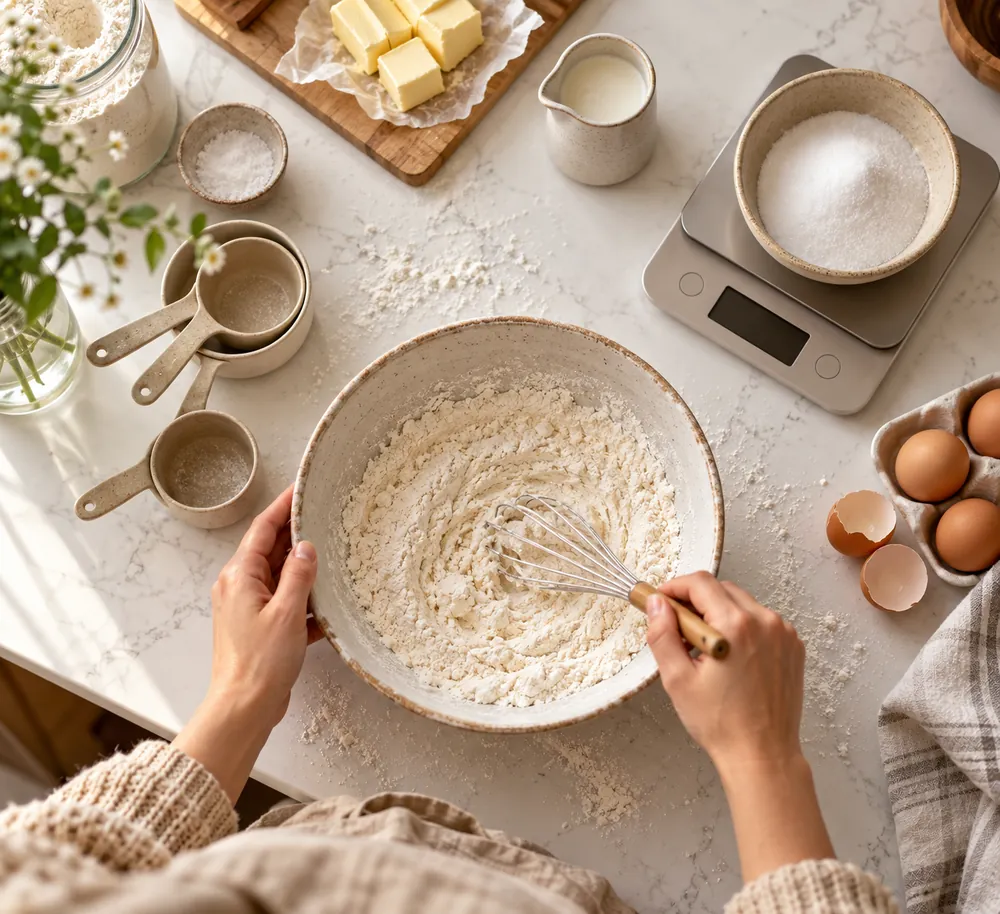
Accuracy, Readability, and Measurement Units
Accuracy, readable increments, and flexible measurement units determine how useful a kitchen scale becomes during baking.
A scale should show small changes clearly, remain stable under a bowl, and let you weigh ingredients without repeatedly converting measurements.
Published specifications provide a starting point, but owner reports can reveal whether the display stays visible, the buttons respond consistently, and the tare function works smoothly during everyday preparation.
Match resolution to the ingredients
Resolution describes the smallest displayed change. A scale that measures in broad steps may handle flour and sugar adequately, but it can make small quantities of yeast, salt, baking powder, spices, or extracts less precise.
| Specification | Common range | Practical effect |
| Maximum capacity | 11 lb to 22 lb | Allows for bowls, ingredients, and heavier doughs |
| Displayed increment | 0.1 g to 1 g | Supports fine adjustments or general weighing |
| Platform width | 5 in to 8 in | Influences bowl stability and display visibility |
Capacity includes the container, not only its contents. A large glass bowl can consume much of the available limit before flour, water, or dough is added, so bread bakers and large-batch users benefit from more headroom.
Finer increments are not automatically better for every baker. They can improve control over small additions, while a simpler scale with adequate capacity may offer easier controls, a larger platform, or a clearer display.
Keep the reading visible
Display layout matters because a wide mixing bowl can hide a front-facing readout. Look for a display positioned near an open edge, strong contrast, and digits large enough to read without lifting or shifting the bowl.
A stable platform also supports accuracy. Feet that grip the counter and a body that does not flex under pressure help prevent changing readings while ingredients are poured or redistributed.
Choose useful measurement units
Grams provide a consistent basis for scaling recipes, dividing dough, and comparing ingredient ratios. Ounces can be convenient when following recipes written in imperial units, so switching between grams and ounces is useful.
- Grams: Best for repeatable baking ratios and small adjustments.
- Ounces: Helpful for recipes and ingredient packaging using imperial measurements.
- Tare: Lets you zero the bowl and add ingredients one at a time.
Prioritize clear increments, a visible readout, dependable tare operation, and suitable capacity. These features reduce measuring variation without adding unnecessary complexity to the baking process.
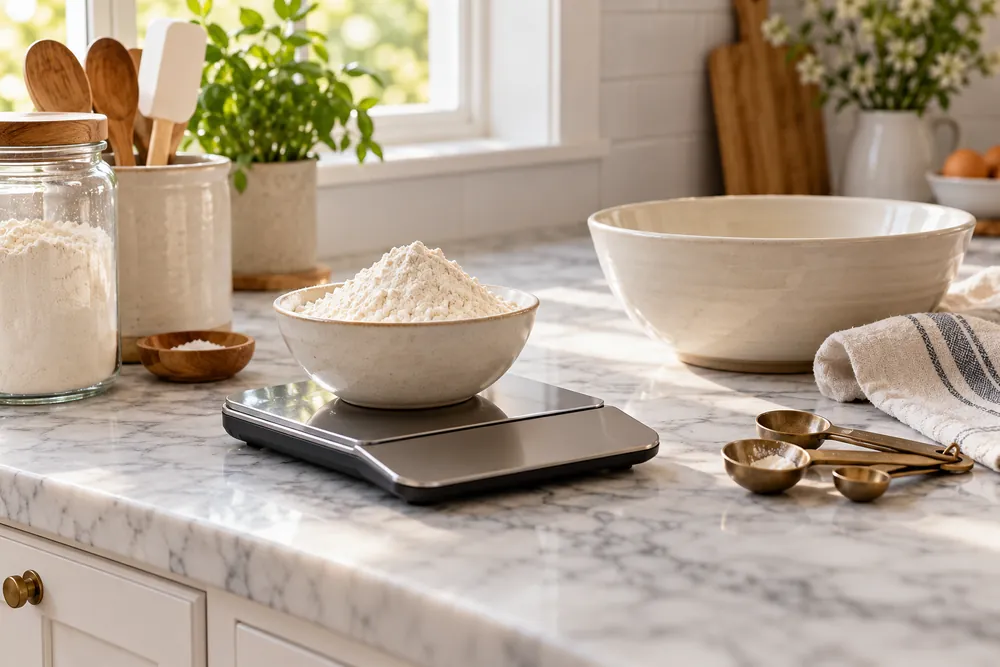
Platform Size, Bowl Clearance, and Counter Footprint
Platform dimensions determine whether a kitchen scale feels practical once a mixing bowl, ingredients, and your hands share the counter.
A broad weighing surface can improve stability, but a larger body may take more storage space and make the display harder to see.
Choose the scale around the bowls you use most often, not only the ingredients you plan to weigh.
A compact model may suit small baking batches, while a wider platform is easier to use with large glass bowls, dough containers, and sheet-style prep vessels.
Match the platform to your bowls
A useful platform should support the bowl without letting it wobble or overhang so far that it contacts the counter.
Overhang is not automatically a problem, but it can make the scale less stable and may interfere with buttons or the display.
| Category | Typical range | Practical trade-off |
| Platform width | 5 to 8 inches | Smaller platforms store easily; wider ones support broad bowls better. |
| Typical bowl diameter | 8 to 12 inches | Larger bowls may cover a front display on compact scales. |
| Useful weighing clearance | About 1 to 3 inches around the bowl base | Extra room improves stability and leaves access to controls. |
These ranges describe common category choices, not a guarantee for every product.
Compare the scale’s published platform dimensions with the outside diameter of your preferred mixing bowl, including any handles, pouring lips, or wide rims.
Protect display visibility
A readable display matters more during ingredient-by-ingredient weighing than it may seem. A tall bowl can block a front-facing readout, forcing you to lean over the rim or lift the bowl before confirming each measurement.
- Front display: Convenient for shallow bowls, but more vulnerable to obstruction from tall containers.
- Side or elevated display: Easier to view around some bowls, though the larger layout may increase the footprint.
- Removable bowl: Useful when the included container is shaped to preserve visibility, but it may not suit every recipe or cleanup routine.
Consider storage and counter space
Measure the shelf, drawer, or cabinet where the scale will live before choosing a broad platform. A scale that remains on the counter needs enough surrounding space for a bowl, ingredient containers, and comfortable button access.
Look for a low-profile body if you store the scale beneath appliances or inside a shallow drawer. A heavier base can improve stability, but it may be less convenient to move after each use.
Owner photos and reports can clarify whether bowls hide the display, slide on the platform, or crowd the controls.
Prioritize platform fit and clear visibility over the largest surface available, then confirm the published dimensions before buying.
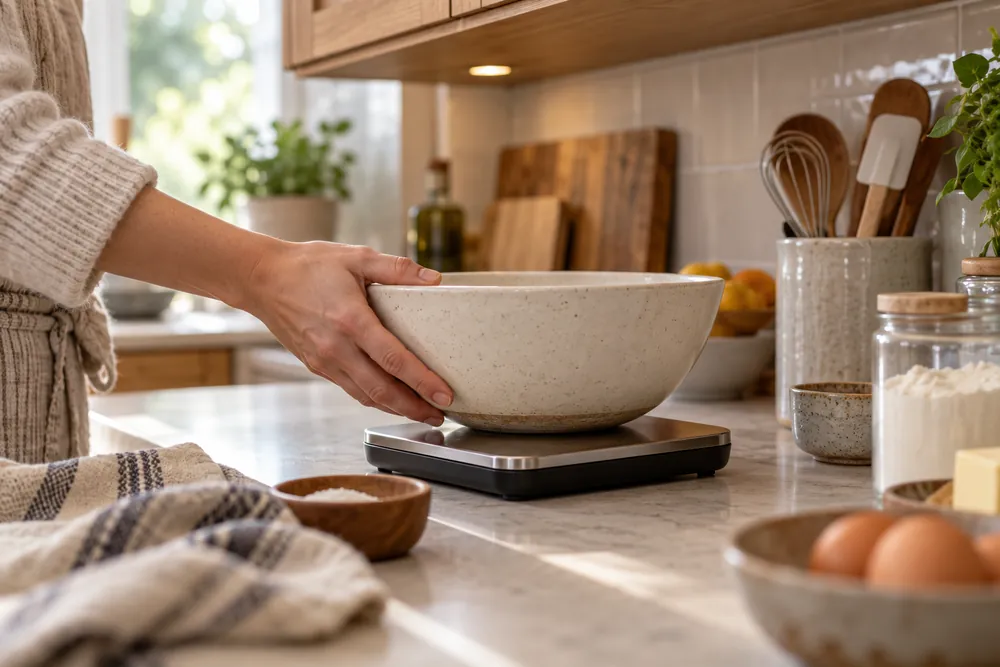
Controls, Display Placement, and Tare Function
Clear controls, an unobstructed display, and a dependable tare button determine how easily a scale fits into a baking workflow.
These details matter because weighing often happens while a bowl covers part of the platform and ingredients are added in several stages.
Look for controls that are distinct, responsive, and easy to operate with clean or lightly floured fingers.
A dedicated power button, unit button, and tare button reduce confusion, while touch controls can be convenient but less predictable around spills or residue.
| Feature | Common range or layout | Practical trade-off |
|---|---|---|
| Capacity | 11 lb to 22 lb | Higher capacity accommodates heavy bowls and bread dough. |
| Displayed increment | 0.1 g to 1 g | Finer increments help with yeast, salt, and small batches. |
| Platform width | 5 in to 8 in | Wider platforms support bowls but may take more storage space. |
Display placement can matter more than screen size. A front-facing readout may disappear behind a wide mixing bowl, whereas a raised, recessed, or separated display can remain visible as ingredients are added.
Check product dimensions and owner photos for evidence of real-use visibility.
Brightness, contrast, and stable digits also affect readability. A display that changes slowly or becomes difficult to read under a bowl can make small additions harder to control.
An automatic shutoff feature may conserve batteries, but a long pause during mixing can be inconvenient if the scale powers down before the next ingredient.
Tare should reset the current container weight to zero without requiring repeated button presses. After placing the bowl on the platform, press tare, add an ingredient, tare again, and continue building the mixture in one vessel.
- Choose a capacity suited to the bowl, dough, and ingredients together.
- Prefer finer increments for spices, leaveners, yeast, and salt.
- Confirm that the bowl will not hide the display from your usual viewing angle.
- Check owner reports for tare reliability and button responsiveness.
With a tape measure in hand, compare the scale’s actual footprint with the counter space where you prep. Leave room to place a bowl without pushing the scale against a wall, backsplash, utensil holder, or appliance.
Measure the bowl you use most often, then check whether its base fits comfortably on the platform.
A bowl that overhangs slightly may hide controls or shift when ingredients are poured, making the layout less practical than its advertised width suggests.
Also measure upward, not only across. A low shelf, cabinet, or pull-out drawer can prevent convenient storage, while a raised display may need extra clearance. Keep the scale where you can reach the controls without lifting the bowl.
The tare button deserves a simple kitchen check: imagine pressing it repeatedly between flour, liquid, and smaller ingredients.
It should be reachable from the side you normally work from, without requiring you to steady the bowl with the same hand.
Consider what happens when the scale is crowded. If a mixing bowl, ingredient container, and spoon occupy the surrounding counter, a small control area can become awkward to reach.
A slightly larger footprint may be worthwhile if it leaves the readout and tare control accessible.
Before buying, sketch the scale’s footprint on the counter with masking tape or paper. Place your usual bowl inside that outline, then stand where you bake and check the viewing angle.
This quick comparison often reveals whether the design suits your workspace.
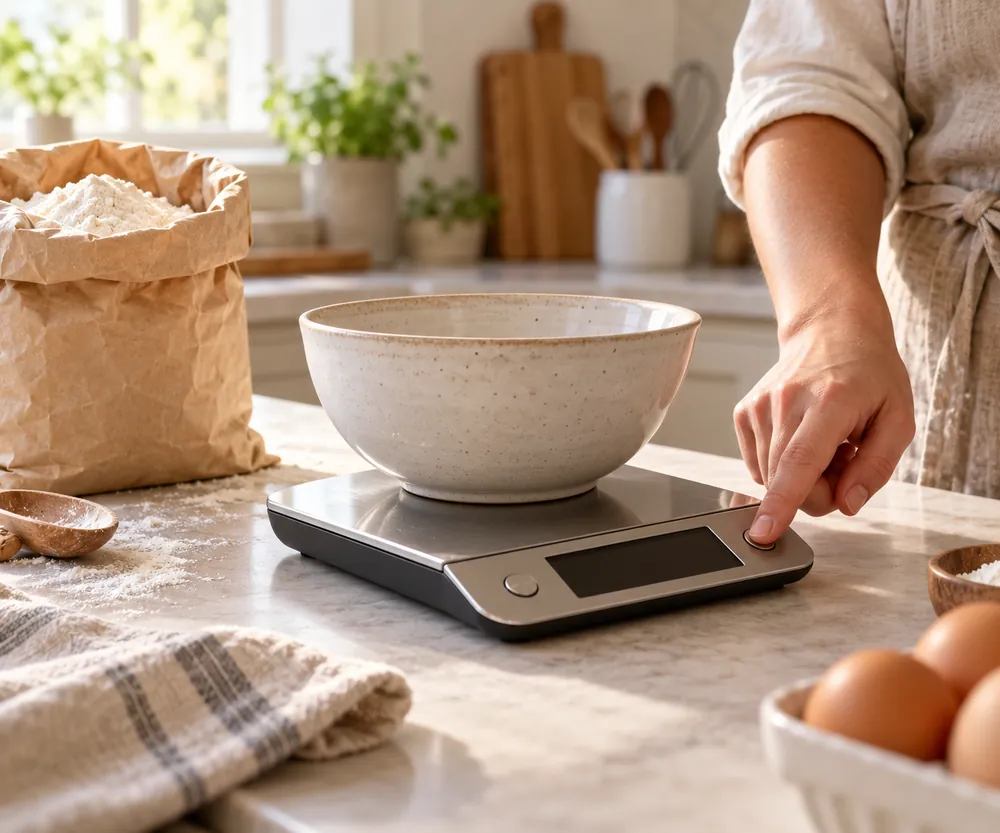
Power Source, Cleaning, and Storage
Power source, washable surfaces, and storage design affect whether a kitchen scale remains convenient after the novelty wears off.
A scale used for baking should be ready for repeated ingredient additions, easy to wipe after flour spills, and simple to store without damaging its controls or display.
Battery operation keeps the scale portable and avoids adding another cord to a crowded counter.
USB-rechargeable designs reduce disposable battery use, but they need a charging routine and may be inconvenient if the scale runs out of power during mixing.
Compare the power options
| Power source | Strength | Trade-off |
| Disposable batteries | Portable and quick to replace | Requires spare batteries and creates ongoing waste |
| Rechargeable battery | Convenient for frequent use | Needs charging and eventual battery replacement |
| USB or mains operation | Useful near a permanent workstation | A cable can crowd the counter or limit placement |
Check the published battery type, charging method, and auto-off behavior before buying. Auto-off can preserve power, but a short shutoff period may interrupt a recipe while ingredients are being prepared.
A manual-on design is useful when you want to weigh several bowls in succession.
Cleaning is easiest when the weighing platform has a smooth, sealed surface with few grooves around the buttons.
Removable platforms can simplify washing, but confirm whether the manufacturer permits rinsing or recommends only a damp cloth. Keep the scale itself away from running water unless its instructions specifically allow it.
Cleaning features to prioritize
- Sealed controls: Reduce the chance that flour, sugar, or liquid reaches the electronics.
- Wide platform: Gives bowls room without forcing ingredients against the display area.
- Clear surface: Makes sticky residue easier to spot and remove.
- Stable feet: Help prevent movement while wiping or adding ingredients.
Storage also requires practical clearance. A compact scale may fit a drawer, while a larger platform may need shelf space. Allow enough room to lift it out without scraping the display or pressing the buttons against other utensils.
| Storage situation | Typical category range | Reason |
| Drawer or shelf clearance | About 1.5 to 3 inches | Helps prevent pressure on controls and permits easy removal |
| Countertop space around the scale | About 2 to 4 inches | Leaves room for bowls, ingredients, and hand access |
Store the scale dry, level, and away from heat, steam, and heavy cookware.
Compare its power requirements, cleaning instructions, footprint, and storage clearance so daily baking remains straightforward rather than becoming another cleanup task.
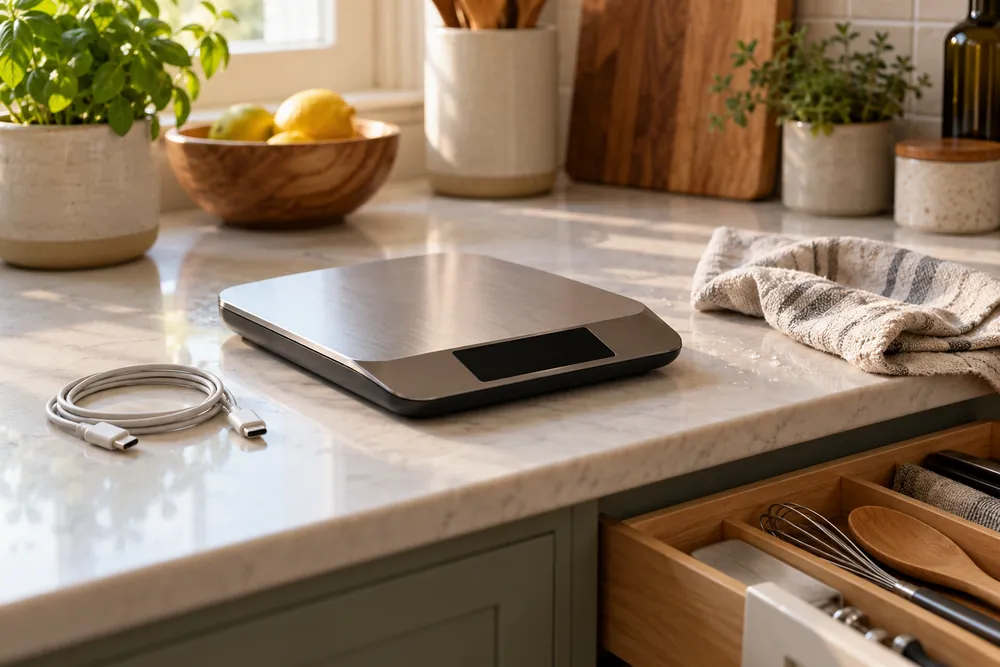
What Owners Wish They Had Checked First
Owner reports repeatedly point to three issues that are easy to miss in a product listing: a display hidden by the bowl, a tare button that responds poorly, and an auto-off setting that interrupts slow preparation.
Manufacturer documentation clarifies capacity and functions, but daily usability often appears only in long-term ownership comments.
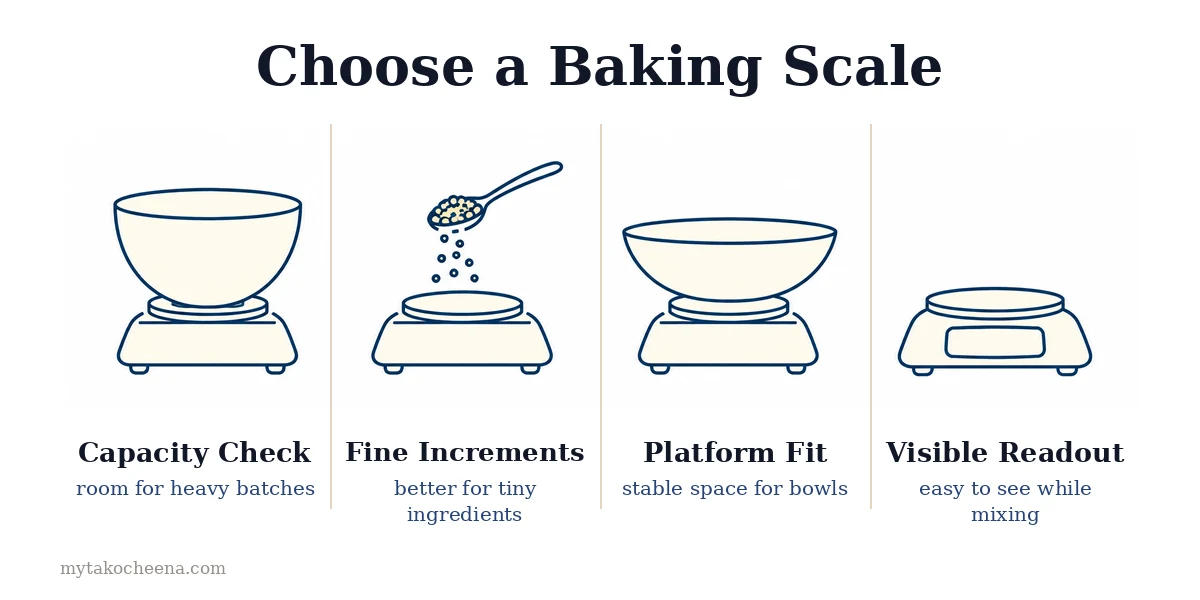
Capacity should include the bowl. Owners who bake bread or make large batches often wish they had added the bowl’s weight before comparing scales.
A compact platform may handle flour comfortably but feel cramped once a heavy glass bowl and wet dough are included.
| Specification | Common range | Practical trade-off |
| Maximum capacity | 11 lb to 22 lb | Higher capacity suits dough and heavy bowls but can mean a larger body. |
| Displayed increment | 0.1 g to 1 g | Finer increments help with yeast, salt, and spices; broader increments suit routine flour weighing. |
| Platform width | 5 in to 8 in | A wider platform steadies large bowls but may use more counter space. |
| Typical auto-off period | 1 minute to 5 minutes | Short intervals save power but can interrupt weighing between additions. |
Display placement holds up as a recurring complaint. Owner photos and comments often show that a large mixing bowl can cover a front-facing readout.
A backlit display, raised screen, or broad platform may cost more space, but it reduces leaning, lifting, and rechecking.
Tare behavior matters more than extra modes. Owners value a button that resets consistently after every addition.
Manufacturer instructions should explain whether the scale supports repeated tare operations, negative readings, unit changes, and weighing directly on the platform.
Reported early failures tend to involve controls, displays, unstable feet, or battery compartments rather than the basic weighing function.
Look for owners mentioning drifting readings, delayed response, moisture exposure, and buttons that become difficult to press.
- Check whether the bowl leaves the display visible.
- Compare capacity after accounting for bowl weight.
- Confirm the increment suits small ingredients.
- Read reports about tare response and auto-off behavior.
- Keep the scale dry unless manufacturer documentation permits washing.
A dependable baking scale does not need every available feature. Prioritize readable feedback, stable support, reliable tare operation, and specifications that match the bowls and batch sizes you actually use.
What Shoppers Ask Before Ordering
Kitchen-scale shoppers usually compare capacity, readability, tare performance, platform size, and unit options before ordering. The best choice depends on whether you measure delicate ingredients, large dough batches, or both.
Published specifications show what a scale is designed to do, while owner reports can reveal whether the display remains visible and the controls stay convenient during daily baking.
What capacity should a baking kitchen scale have?
A capacity around 11 to 22 pounds suits many home-baking tasks, including mixing bowls, flour, sugar, and bread dough. Remember that the bowl contributes to the total weight, so a scale should not operate close to its limit.
| Capacity range | Best suited to |
| 11–15 lb | Everyday cakes, cookies, and small doughs |
| 16–22 lb | Large bowls, bread dough, and batch baking |
Is 0.1 gram accuracy necessary for baking?
Fine increments are useful for yeast, salt, spices, baking powder, and small recipes. For flour and sugar, 1-gram increments are often practical, but a broader display can make tiny ingredient adjustments harder to repeat.
Choose resolution according to your recipes rather than assuming the smallest advertised increment is always better. Stability and consistent readings matter as much as fine display changes.
Will a large mixing bowl hide the scale display?
Display placement can determine whether a compact scale feels convenient. A platform around 5 to 8 inches wide is common, but a broad bowl may still cover a front-facing readout.
Check product dimensions, display position, and owner photos. A raised or separated display is easier to read while ingredients are added, especially when weighing directly into a deep bowl.
Do I need a tare button for baking?
Yes, tare is one of the most useful baking features. It lets you place the bowl on the platform, zero the weight, and add each ingredient without transferring ingredients between measuring containers.
This approach reduces washing and makes recipe adjustments easier. Confirm that the tare control is clearly labeled and responds reliably rather than requiring repeated presses.
Should I choose grams, ounces, or both?
A scale that switches between grams and ounces supports recipes from different sources. Grams are usually easier for precise scaling because they avoid awkward fractions and keep ingredient ratios consistent.
Check whether the unit button is easy to reach and whether the display clearly identifies the selected unit. Accidental unit changes can cause serious measurement errors.
What platform size works for bread dough?
A wider platform gives heavy or oversized bowls better support, while a compact body takes less storage space. Bread bakers may prefer more surface area, but should still confirm the maximum capacity.
- Choose a compact platform for limited counter or cabinet space.
- Choose a wider platform for large bowls and dough batches.
- Check that the bowl sits level without touching nearby controls.
How do I compare kitchen-scale owner reviews?
Look for repeated comments about readable displays, stable readings, responsive tare controls, cleaning convenience, and battery access. One isolated complaint is less useful than a pattern across many reported experiences.
Compare those reports with the published capacity, increment, platform dimensions, and unit options.
A scale that matches your usual bowl and recipe sizes is generally more useful than one with impressive specifications you rarely need.