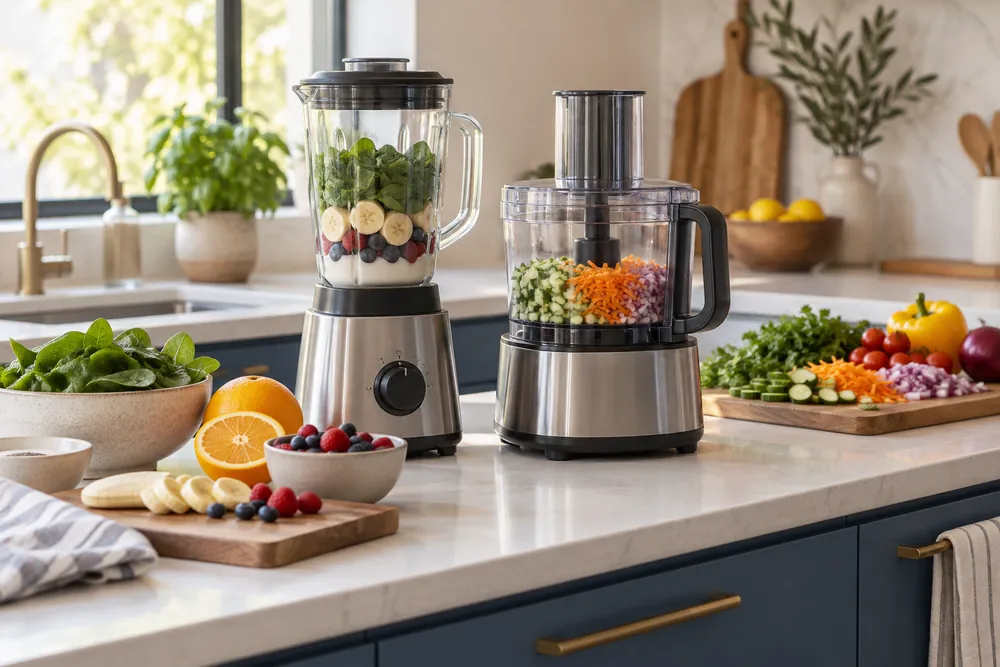
Quick Answer: A food processor handles solid-food preparation, while a blender handles liquids and smooth mixtures. Use a food processor for chopping, slicing, shredding, grating, kneading, and thick dips or doughs.
Use a blender for smoothies, soups, sauces, frozen drinks, and finely puréed foods. Their jobs overlap, but each appliance is shaped for different textures and workloads.
Food Processor vs Blender: The Practical Difference
Blade geometry, container shape, and ingredient movement define the difference. A processor spreads food across a wide bowl for controlled cutting, while a blender circulates liquid through a tall jar for smooth results.
A processor works with little or no added liquid. A blender usually needs enough moisture to keep ingredients moving through its blades.
| Specification | Food processor | Blender |
| Common full-size capacity | About 7–14 cups | About 48–72 ounces |
| Usual motor range | About 450–1,200 watts | About 500–1,500 watts |
| Typical assembled height | About 14–18 inches | About 15–20 inches |
| Best working texture | Dry, chunky, sticky, or lightly moist | Liquid, loose, icy, or fully smooth |
What a Food Processor Does Better
The broad bowl gives ingredients room to spread, tumble, and repeatedly contact the blade. It suits chopping onions, shredding cabbage, slicing potatoes, grating cheese, making breadcrumbs, and cutting butter into flour.
Interchangeable attachments expand its role. Slicing and shredding discs create even pieces, while a dough blade handles heavier mixtures without requiring a pourable consistency.
- Choose a processor for: salsa with texture, pesto, hummus, nut mixtures, pie dough, shredded vegetables, and grated ingredients.
- Expect better control: short pulses preserve chunks instead of forcing every ingredient toward a uniform purée.
What a Blender Does Better
A blender’s tapered jar encourages circulation: ingredients move toward the blades, break apart, and travel upward along the sides. This produces smooth smoothies, milkshakes, sauces, soups, and frozen drinks.
Thick mixtures can stall or form an air pocket without enough liquid. Scraping, stopping, or adding moisture may help, but a processor suits dense or textured mixtures better.
Some recipes need both appliances. Chop vegetables or aromatics in a processor, then transfer them to a blender for a silky result. Compare capacity, storage height, attachments, cleanup, and your usual texture before choosing.
When a Food Processor Is the Better Tool
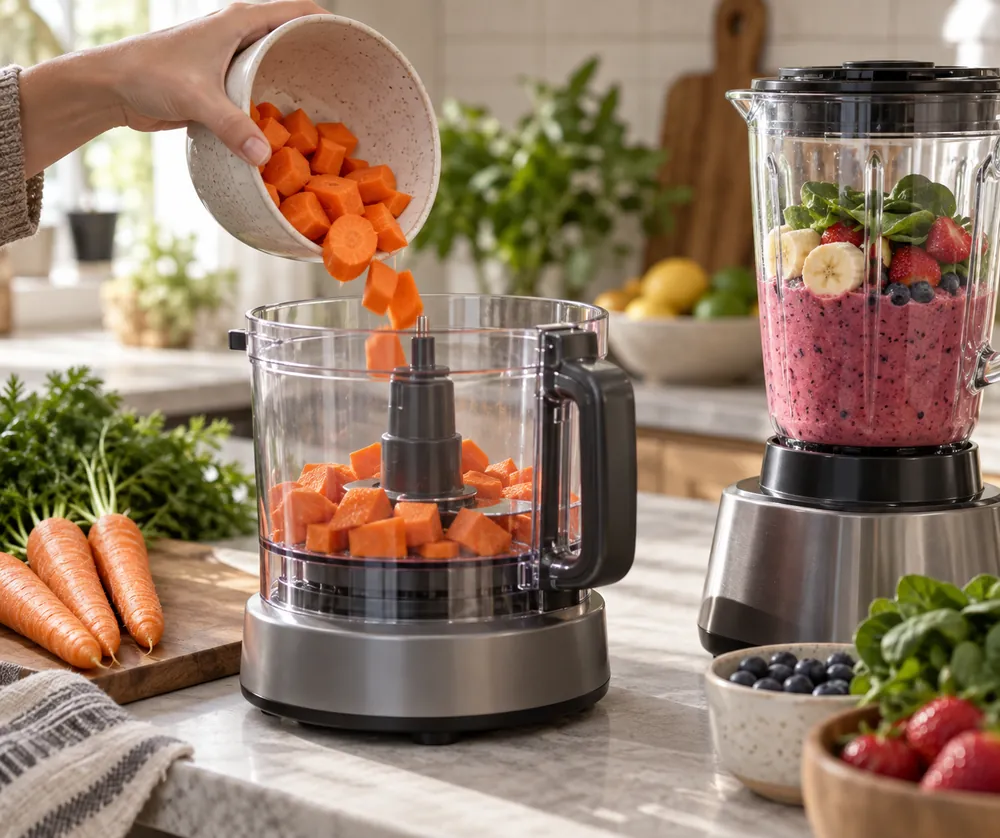
Chopping, slicing, shredding, grating, kneading, and mixing thick ingredients are jobs a food processor handles naturally.
Its wide bowl gives food room to spread around the blade, so ingredients can be cut evenly without enough liquid to make them runny.
That design suits dry and semi-moist preparation. A processor can turn vegetables into controlled pieces, grate cheese, or combine pastry ingredients while preserving the texture a recipe needs.
Choose a food processor for controlled cutting
The main blade chops onions, herbs, nuts, cooked vegetables, and meat. It also works for breadcrumbs, pesto, hummus, salsa, and mixtures that should be cohesive but not completely smooth.
Interchangeable discs expand the processor’s role beyond chopping.
A slicing disc creates consistent potato, cucumber, or apple pieces, while a shredding disc handles cabbage, carrots, hard vegetables, and cheese faster than hand preparation.
- Chopping: Breaks ingredients into pieces without forcing them into a liquid texture.
- Slicing and shredding: Produces repeatable cuts for salads, slaws, gratins, and toppings.
- Grating: Processes cheese, firm vegetables, and similar ingredients in larger batches.
- Kneading: Brings many bread, pizza, and pastry doughs together quickly.
- Thick mixing: Combines dips, spreads, nut mixtures, and fillings with limited added liquid.
Capacity and storage trade-offs
Full-size food processors commonly provide more horizontal working space than personal prep appliances. A larger bowl reduces repeated batches, although very small quantities may move inefficiently around it.
| Specification | Common category range | Practical implication |
|---|---|---|
| Full-size bowl capacity | About 7–14 cups | Useful for batch chopping and shredding |
| Typical motor rating | About 450–1,200 watts | Supports loads from light prep to stiff mixtures |
| Assembled storage height | About 14–18 inches | Check cabinet clearance before buying |
Motor wattage does not determine suitability by itself. Bowl width, blade design, disc quality, feed-tube size, and ingredient redistribution can matter more for consistent preparation than a larger published motor figure.
Recognize the limits
A food processor is less suitable for smoothies, thin drinks, and soups needing a uniformly silky finish. Its broad bowl does not create the circulation of a blender jar, so liquids may spread instead of forming a strong vortex.
Use a processor when food should remain cut, chunky, thick, sticky, or lightly moist. Select a blender for pourable textures, or combine both appliances when chopped ingredients must become a smooth purée.
When a Blender Is the Better Tool
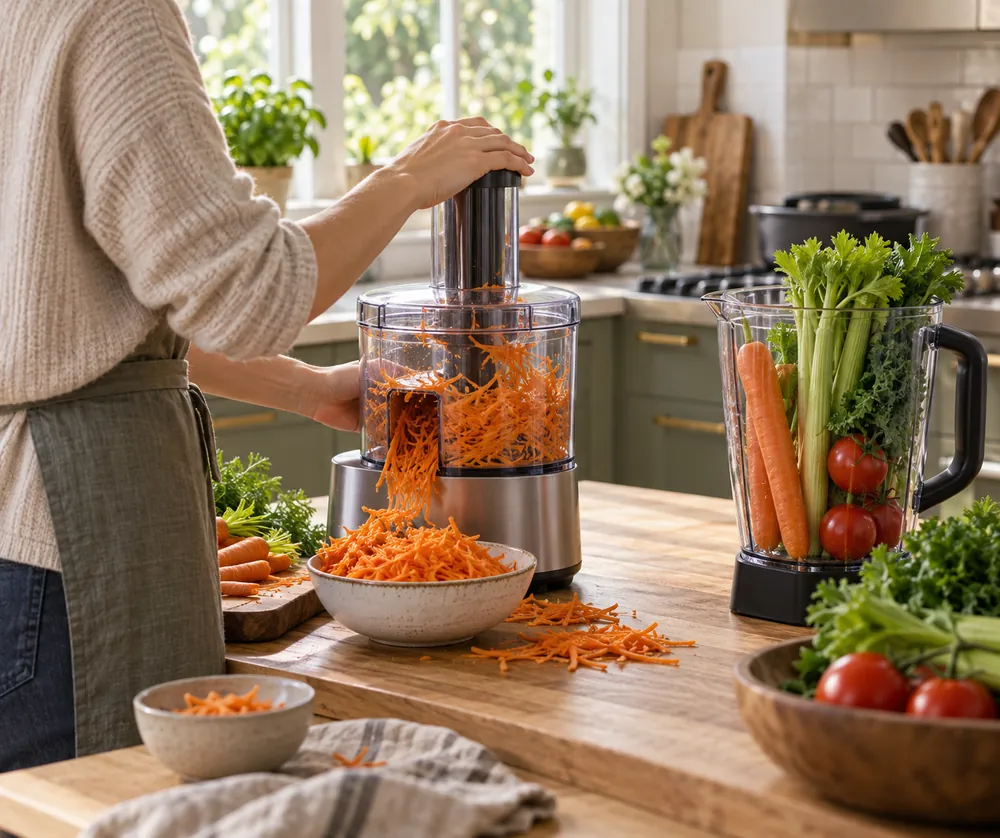
Blenders excel when ingredients need to become fluid, finely puréed, or smooth. Their tall jars and angled blades create circulation, pulling food into the blade path while liquid helps maintain a steady vortex.
Choose a blender when texture matters more than controlled cutting. Smoothies, milkshakes, blended drinks, puréed soups, pourable sauces, and emulsified dressings are natural blender tasks.
Tasks a Blender Handles Best
- Smoothies: Liquid and soft produce circulate efficiently, while ice and frozen fruit break down into a consistent drink.
- Soups: Cooked vegetables and stock can become silky without the coarse texture a food processor may leave behind.
- Sauces and dressings: High-speed blending combines oil, water-based ingredients, herbs, and seasonings into a uniform emulsion.
- Frozen drinks: The jar and blade assembly are designed to move ice through liquid rather than chop dry ingredients across a wide bowl.
Blender performance depends on enough liquid to keep ingredients moving. Thick hummus, nut butter, dough, and dense vegetable mixtures can stall or form an air pocket around the blades, especially when overfilled.
| Specification | Typical category range |
|---|---|
| Jar capacity | About 48–72 oz |
| Motor rating | About 500–1,500 watts |
| Assembled storage height | About 15–20 inches |
Capacity affects batch size, but a larger jar does not automatically improve small portions. A narrow, tapered container may circulate modest amounts more effectively, while a wider jar handles larger batches with less overflow risk.
A blender is also useful after food-processor preparation. Chopped roasted vegetables, herbs, or nuts can move into a blender with stock, oil, or water when the recipe needs a silky consistency rather than visible pieces.
For a buyer with a tape measure, jar height is the first clearance check. Measure from the counter to the underside of the cabinet, then allow room to lift the jar or remove its lid.
A blender that fits only when pushed forward may become inconvenient every day.
Measure the counter depth as well. Leave space behind the blender for its cord and in front for controls, pouring, and placing a glass.
If the appliance must be stored elsewhere, check whether its jar, lid, and tamper can travel together without occupying a second shelf.
Think about the ingredients you make most often. A blender suits liquid recipes and smooth textures, but it is less convenient when you regularly process dry, chunky, or very thick mixtures.
In that case, a food processor may earn its counter space more often.
Finally, look beyond the motor housing. A removable jar, accessible blade area, simple controls, and dishwasher-safe parts can matter more than maximum power.
The best choice is the appliance that fits the kitchen, matches the usual texture, and can be cleaned without becoming a chore.
Where Their Jobs Overlap
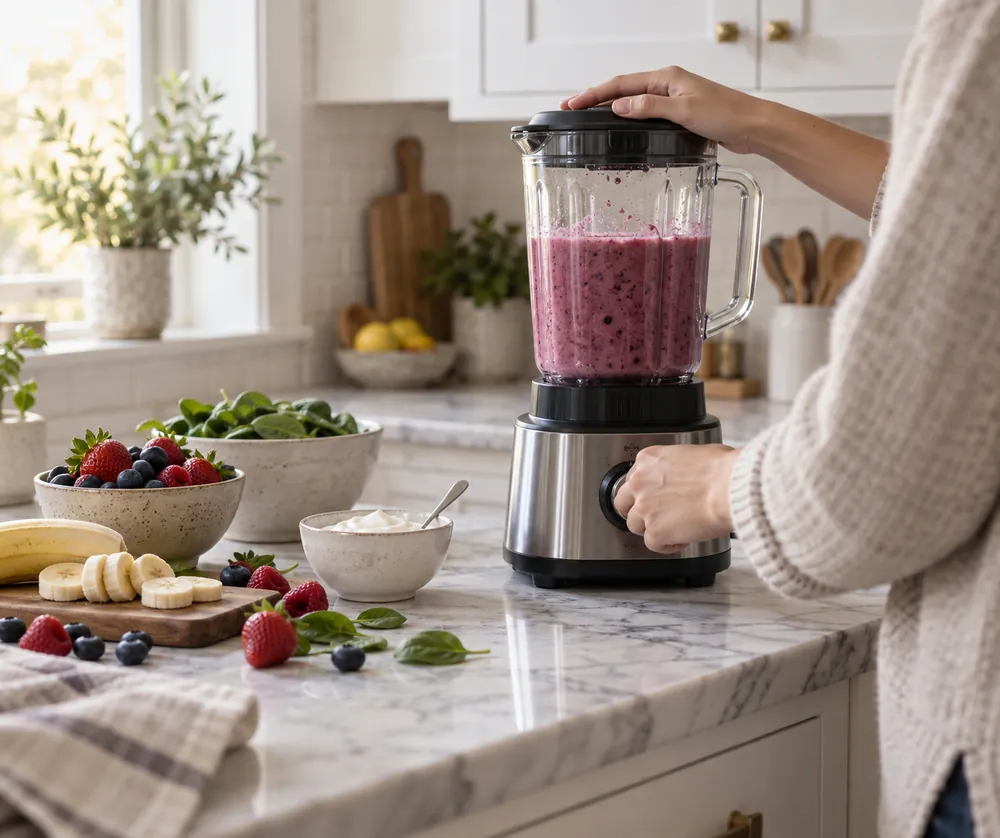
Chopping, blending, and puréeing may seem interchangeable, but texture reveals which appliance fits. A food processor offers more control over size and thickness, while a blender produces a uniform, pourable result.
Salsa shows the difference. A processor creates a chunky mixture with visible onion, pepper, and tomato pieces; a blender makes a smoother dip but may need liquid for proper circulation.
| Comparison | Food processor | Blender |
|---|---|---|
| Common capacity band | About 7-14 cups | About 48-72 ounces |
| Typical motor range | About 450-1,200 watts | About 500-1,500 watts |
| Typical assembled storage height | About 14-18 inches | About 15-20 inches |
Both handle soft vegetables, herbs, nuts, cooked beans, and sauces. Their abilities overlap, but the bowl or jar determines how ingredients move around the blade.
Tasks that suit either appliance
- Salsa: Use a processor for a coarse, spoonable texture or a blender for a smoother sauce.
- Pesto: Either appliance works, though a processor usually makes it easier to keep some texture.
- Hummus: A processor handles thick chickpea mixtures with less added liquid, while a blender can produce a silkier result when the recipe is loose enough.
- Nut butter: Both can break down nuts, but the mixture may need scraping, pauses, or added oil depending on its thickness.
A blender depends on circulation. Its tall jar pulls liquid and softened ingredients downward, so thick mixtures can stall or trap air around the blades.
A processor depends on distribution. Its broad bowl lets ingredients spread, allowing the blade to chop, pulse, and redistribute solids without excess liquid.
Choose the processor for controlled pieces, shredded ingredients, thick spreads, and dough. Choose the blender for smoothies, puréed soups, dressings, frozen drinks, and pourable sauces.
Some recipes benefit from both. Chop roasted vegetables, aromatics, or nuts in the processor, then blend them with stock, oil, or another suitable liquid for a smoother finish.
Attachments affect the overlap. Slicing and shredding discs cover preparation jobs a blender cannot reproduce, while a tamper or variable speed can help with thicker mixtures.
Compare the texture you make most often, not only the motor claim. Choose the appliance whose container and blade design match your recipes.
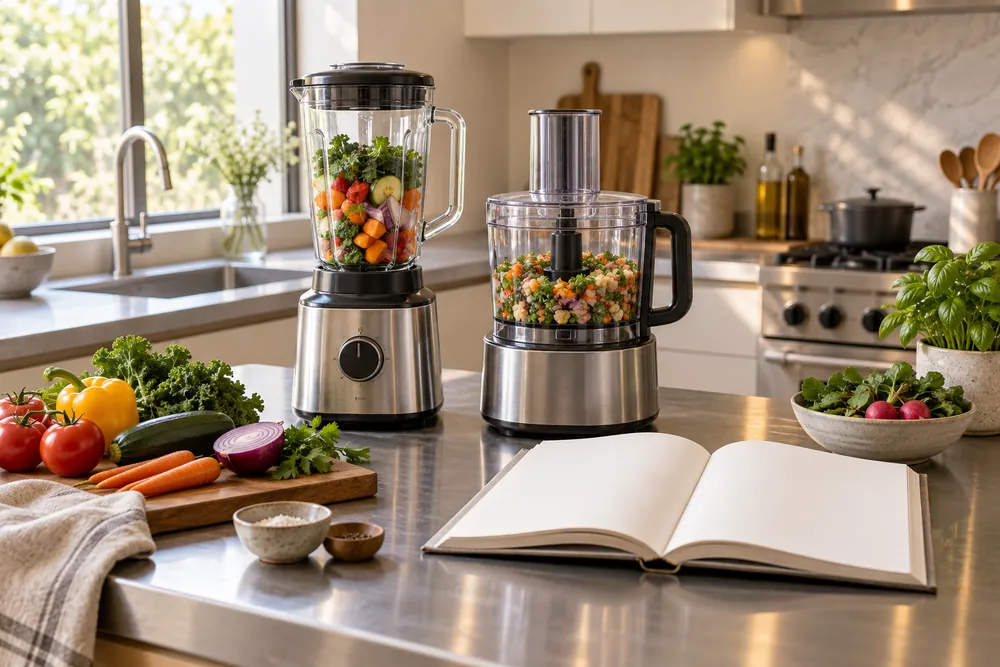
What Owners Report After Six Months
Owner reports after six months usually focus on workflow, cleanup, and storage rather than motor power.
Manufacturer documentation supports this distinction: processors are designed for controlled cutting and mixing, while blenders depend on liquid circulation for smooth results.
The recurring complaint is cleanup
Owners repeatedly mention washing bowls, lids, feed tubes, gaskets, and separate blades after small jobs.
A blender is often quicker to rinse because its jar stays assembled, although thick smoothies, nut butter, and dried sauces can leave residue beneath the blade assembly.
Storage creates another practical complaint. Full-size food processors commonly need about 14–18 inches of vertical space assembled, while full-size blenders often need about 15–20 inches.
Processor discs and pushers also require cabinet or drawer space.
| Appliance | Typical capacity | Common motor range | Frequent storage concern |
|---|---|---|---|
| Food processor | About 7–14 cups | About 450–1,200 watts | Wide base and loose accessories |
| Blender | About 48–72 ounces | About 500–1,500 watts | Tall jar and cabinet clearance |
What tends to hold up
Owners generally report lasting value from a processor used for vegetables, cheese, crumbs, dough, and thick dips.
Its broad bowl reduces added liquid, while manufacturer instructions emphasize pulsing, batch limits, and correct attachment placement to protect texture and reduce strain.
Blenders tend to satisfy owners who regularly make smoothies, puréed soups, dressings, and frozen drinks.
Reports are less favorable when blending dry ingredients or thick mixtures without enough liquid, because ingredients can stall below the blades.
What can fail early
- Food processor complaints often involve cracked work bowls, worn drive components, dull discs, or lost small accessories.
- Blender complaints often involve leaking seals, damaged jar couplings, overheating during thick blends, or containers that become cloudy from abrasive cleaning.
The practical takeaway is consistent: choose the appliance that matches repeated tasks, not the highest advertised wattage.
Manufacturer guidance and owner reports favor smaller batches, proper loading, prompt cleaning, and avoiding jobs that oppose the appliance’s design.
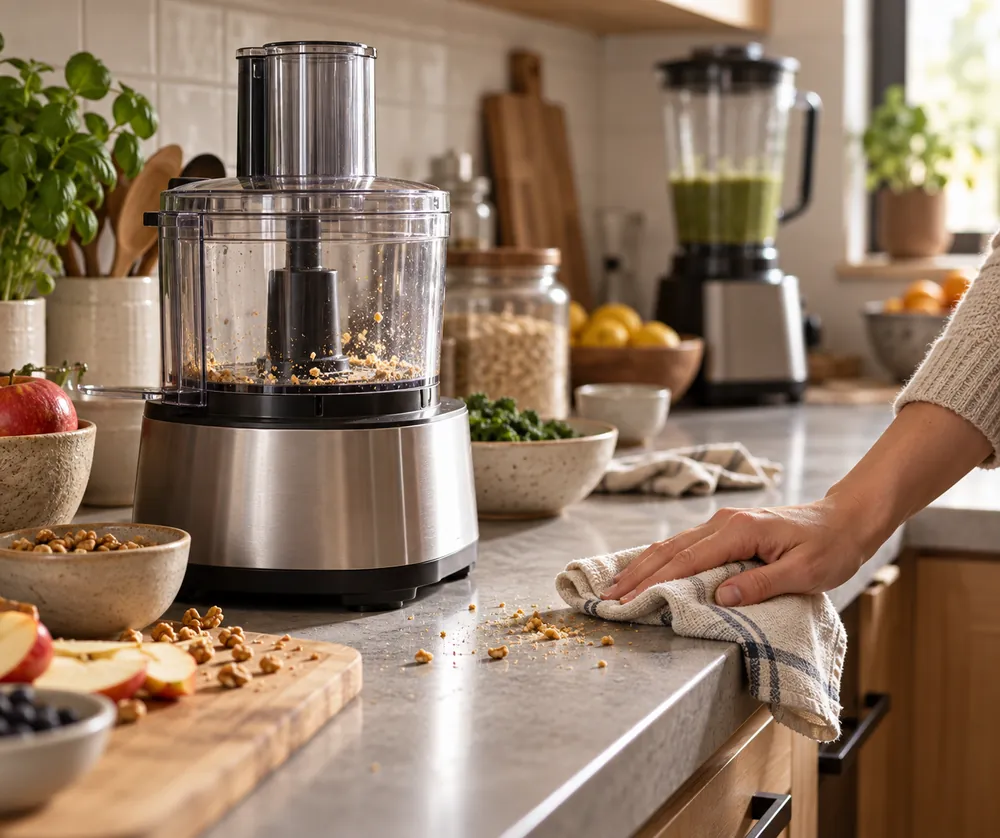
How to Choose Based on What You Cook
Your usual recipes determine whether you need a food processor, a blender, or both. Choose a food processor for controlled cutting; choose a blender when ingredients must circulate into a smooth, pourable mixture.
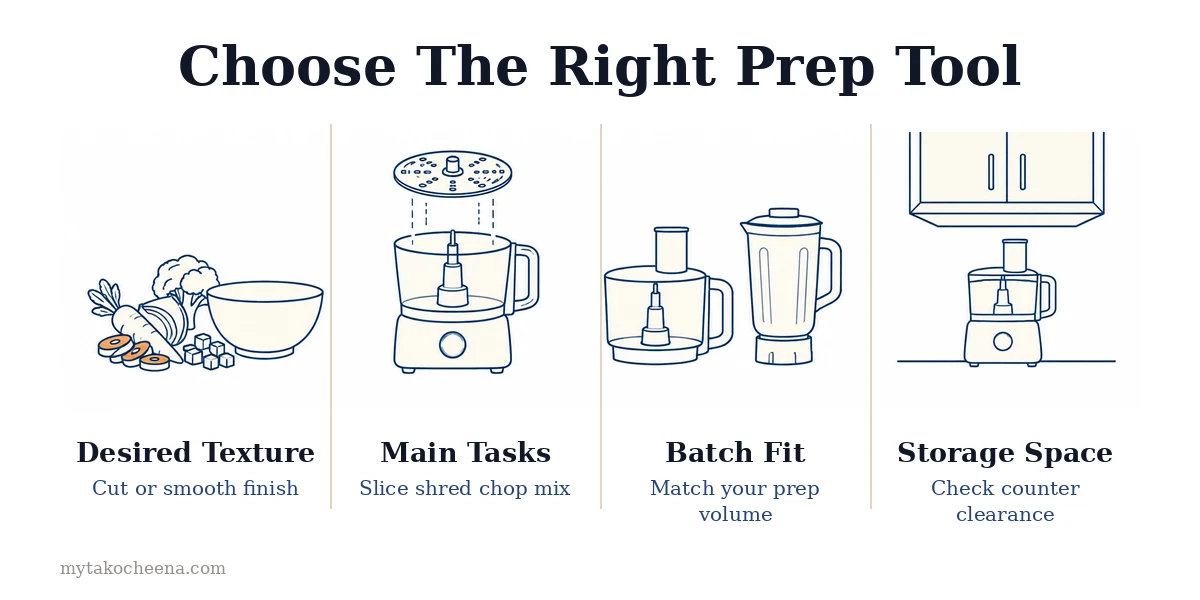
Food processors spread ingredients across a wide bowl, giving blades and discs room to chop, slice, shred, grate, and mix. They handle dry, chunky, sticky, or moderately moist foods that may struggle to move in a blender jar.
Blenders depend on circulation. Their tall jars draw liquid toward the blades and return the mixture through the vortex. Without enough liquid, thick mixtures may stall, require scraping, or turn out unevenly.
| Consideration | Food processor | Blender |
| Common full-size capacity | About 7–14 cups | About 48–72 ounces |
| Typical motor range | About 450–1,200 watts | About 500–1,500 watts |
| Usual assembled height | About 14–18 inches | About 15–20 inches |
Match the appliance to the texture
- Choose a food processor for salsa, mirepoix, sliced potatoes, shredded cabbage, grated cheese, breadcrumbs, pesto, hummus, nut mixtures, and pie or bread dough.
- Choose a blender for smoothies, milkshakes, puréed soups, frozen drinks, emulsified dressings, and sauces that should be completely smooth.
- Choose both for recipes that begin with solid preparation and finish with liquid blending, such as roasted vegetable soup or cashew cream.
Motor wattage is useful but not decisive. Blade shape, bowl width, jar taper, attachments, and ingredient moisture may matter more than published power.
Storage can settle the decision. A processor needs space for discs, blades, and a feed pusher, while a blender is easier to leave assembled but may exceed cabinet clearance.
Buy for your dominant texture: cut, grated, and controlled favors a food processor; fluid, silky, and drinkable favors a blender.
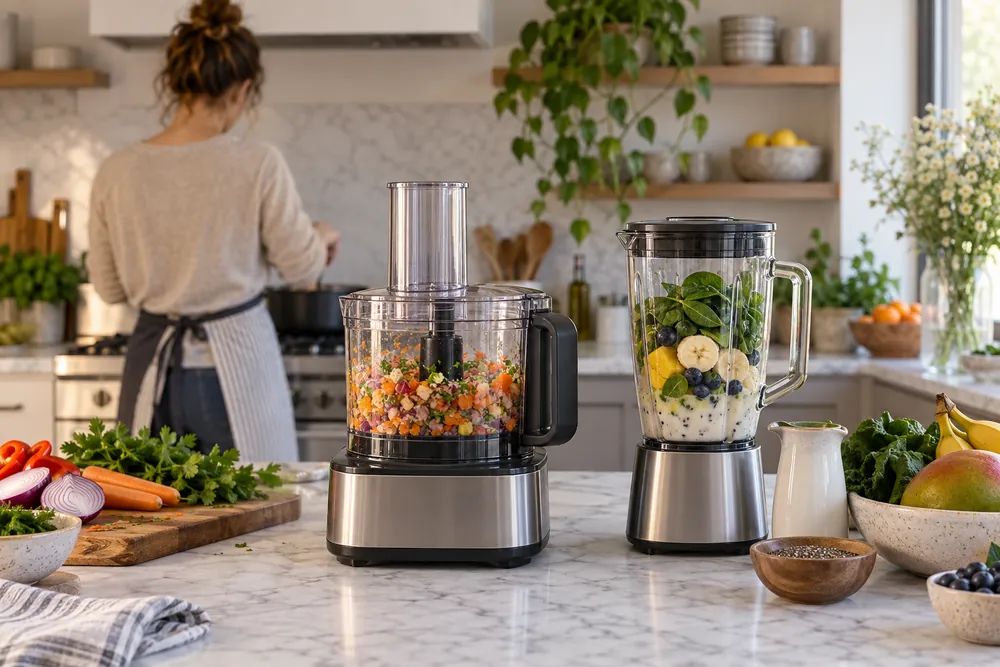
Frequently Asked Questions
Food processors chop, slice, shred, and mix thick ingredients. Blenders create smooth, pourable results.
These answers compare common US countertop categories and trade-offs.
Which is better for everyday cooking, a food processor or blender?
Choose a food processor for vegetables, cheese, nuts, breadcrumbs, dough, and chunky sauces.
Choose a blender for smoothies, soups, dressings, milkshakes, frozen drinks, and silky sauces.
Can a blender replace a food processor?
A blender handles purées, liquid sauces, and soft mixtures but may chop dry ingredients unevenly.
Use a food processor for consistent slices, shreds, crumbs, chopped pieces, or thick dough.
Can a food processor make smoothies?
A food processor can blend soft fruit with yogurt, milk, or juice, but its wide bowl may produce uneven results.
For smooth drinks, use a blender with enough liquid to keep ingredients moving.
What can you make in a food processor that a blender cannot?
A food processor is better for dry or semi-dry preparation. Common jobs include:
- Slicing potatoes, cucumbers, and onions
- Shredding cabbage, carrots, and cheese
- Making pie dough, breadcrumbs, and nut mixtures
- Chopping vegetables for salsa, mirepoix, and relishes
A blender usually needs more liquid and offers less control over piece size.
What size food processor or blender should I buy?
| Appliance | Typical capacity range |
| Food processor | About 7–14 cups |
| Blender | About 48–72 ounces |
Choose capacity based on batch size, storage space, and cleanup. Larger bowls suit meal prep; smaller jars suit individual drinks.
How much counter or cabinet space does each appliance need?
| Appliance | Common height range |
| Food processor | About 14–18 inches |
| Blender | About 15–20 inches |
Measure each appliance assembled, including jar, lid, feed tube, and pusher. Blenders are taller; processors need room for discs and accessories.
Is blender wattage more important than food processor wattage?
Wattage matters but does not determine performance alone. Blenders need power for dense mixtures; processors depend on blades, bowl width, and attachments.
Compare motor claims with your tasks. A modest processor may slice effectively, while a powerful blender can struggle without liquid.
Should I buy both a food processor and a blender?
Buy both for regular chopped ingredients and smooth liquids. Use the processor for pesto, hummus, dough, shredded vegetables, and chunky salsa; use the blender for soups, smoothies, and emulsified sauces.
With limited space or budget, choose a processor for controlled texture or a blender for smooth, drinkable results.