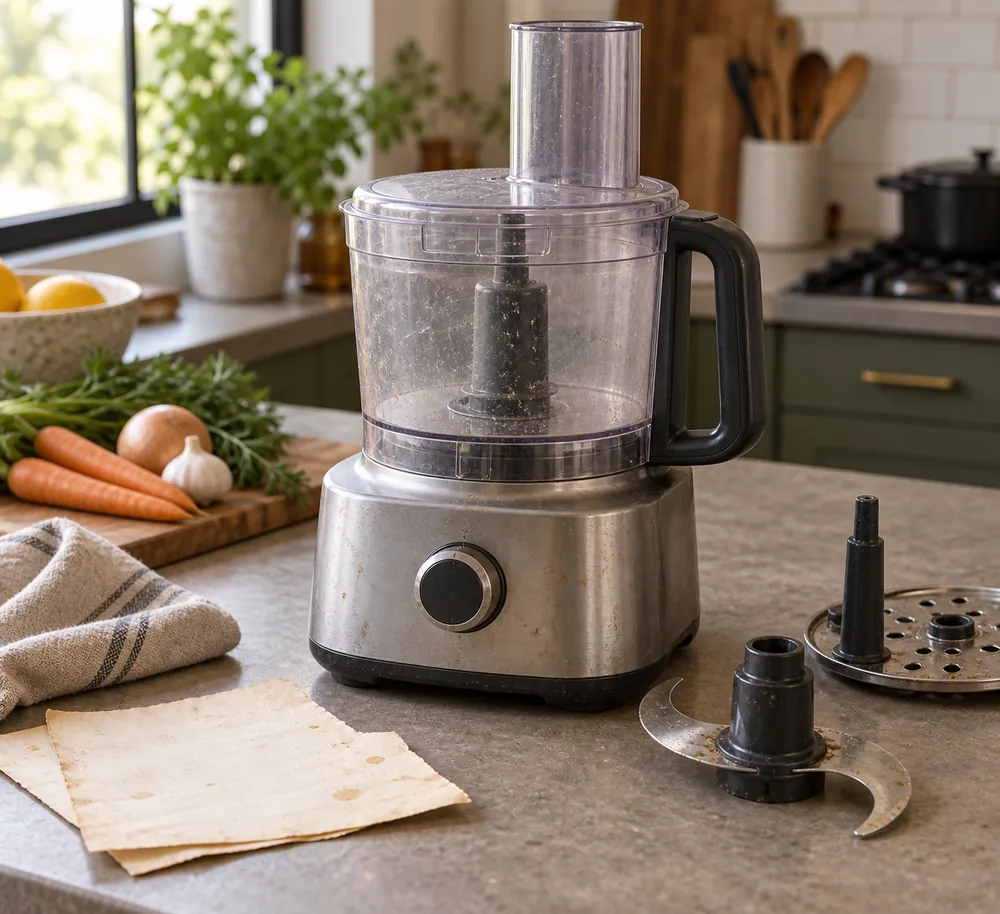
Straight answer: Most home cooks need a food processor in the midrange wattage category for everyday chopping, slicing, shredding, pureeing, and family meal prep.
Lower wattage suits small batches and soft ingredients, while higher wattage provides more headroom for dough, dense vegetables, nut butters, and frequent large batches. Bowl size, blade design, controls, and owner reports also matter.
What Wattage Food Processor Do You Need
Food processor wattage describes the motor’s electrical power draw, not the complete quality of its results. The right rating depends on your hardest regular task, batch size, and processing frequency.
Compare wattage with bowl capacity, blade design, controls, warranty coverage, and owner reports about stalling.
Match wattage to the work
Lower-powered processors suit light preparation such as herbs, garlic, onions, soft produce, dips, pesto, and baby food. They can be practical for occasional use, but dense mixtures and hard vegetables leave less motor headroom.
| Wattage range | Best fit | Trade-off |
| 250–450 watts | Small chopping, sauces, soft produce, occasional prep | Less capacity for dough, hard vegetables, and long runs |
| 500–750 watts | Daily slicing, shredding, puréeing, and family meal prep | Usually a larger base and more parts to clean |
| 800–1,200 watts | Frequent heavy prep, dense mixtures, dough, and large batches | Greater cost, weight, noise, and storage demand |
A midrange motor is usually the flexible choice for a primary kitchen processor.
It provides better reserve power for carrots, cheese, cooked meat, thick hummus, and repeated chopping without requiring the size and weight of a heavy-duty appliance.
Check bowl capacity alongside motor power
A powerful motor cannot increase a small bowl’s batch volume. Conversely, a large bowl paired with a weak motor may struggle when filled near its working limit. Capacity and wattage should therefore be considered as a matched system.
| Bowl capacity | Typical role | Wattage priority |
| 3–5 cups | Mini prep, condiments, and small households | Moderate power is generally sufficient |
| 7–9 cups | Everyday vegetables, sauces, shredding, and meal prep | Midrange power offers broader flexibility |
| 11–14 cups | Batch cooking, dough, large salads, and entertaining | Higher power matters more under load |
Look beyond the wattage label
Motor efficiency, gearing, blade sharpness, bowl shape, and overload protection can make similarly rated machines perform differently. Owner reviews are useful for identifying bogging with pizza dough, carrots, cheese, or nut mixtures.
- Choose lower wattage for small portions and soft ingredients.
- Choose midrange wattage for regular slicing, shredding, chopping, and puréeing.
- Choose higher wattage for dense foods, dough, large batches, and frequent use.
Account for noise, base weight, cord storage, and cabinet clearance before buying.
The practical choice for many US kitchens is a full-size, midrange processor unless a stand mixer handles dough or a mini chopper covers nearly every task.
Buy enough power for the hardest task you perform regularly, not the largest number on the package.
How Much Wattage Do You Need for Common Food Processor Tasks
Food processor wattage indicates motor draw, not guaranteed cutting quality or speed. Match the motor to your hardest regular task, then check bowl capacity, blade design, controls, warranty coverage, and owner reports about stalling.
Light preparation rarely needs maximum power.
Dense dough, hard vegetables, large batches, and repeated cycles place more resistance on the motor, so additional wattage provides useful headroom rather than automatically producing better results.
Match wattage to the task
| Wattage range | Suitable tasks | Trade-off |
| 250–450 watts | Herbs, garlic, onions, soft fruit, dips, salsa, and small sauces | Less reserve for dough, hard roots, nuts, and long runs |
| 500–750 watts | Regular chopping, slicing, shredding, puréeing, and family meal preparation | Usually a larger base with more parts to clean and store |
| 800–1,200 watts | Frequent dough work, dense vegetables, nut mixtures, and substantial batches | Greater cost, weight, noise, and storage demand |
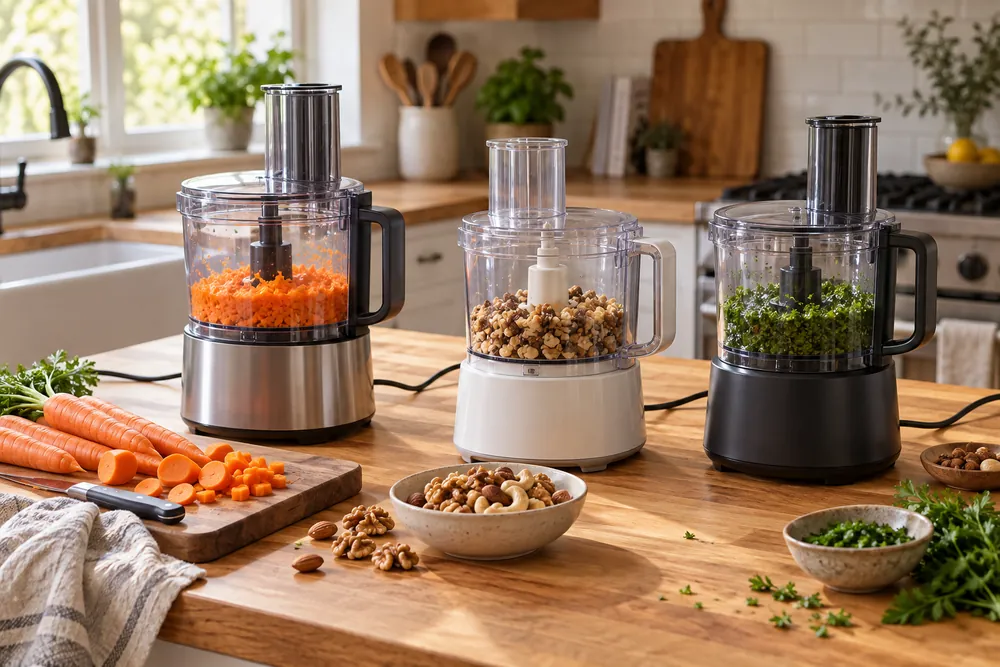
A mini processor in the lower range suits pesto, baby food, chopped herbs, quick dressings, and small quantities of vegetables.
It can be convenient because the bowl fills efficiently, but its smaller motor and working area may struggle with sticky mixtures or repeated processing.
A midrange motor is the practical choice for a main household processor.
It generally offers enough reserve for slicing carrots, shredding cheese, chopping vegetables, blending sauces, and preparing moderate dough batches without requiring the highest-power base.
Higher wattage becomes more valuable when the processor regularly handles stiff pizza dough, dense pastry, hard cheese, large quantities of carrots, or nut butter.
Power cannot prevent every stall, however; overloaded bowls, dull blades, poor gearing, and insufficient liquid can still reduce performance.
Consider bowl capacity with motor power
| Bowl capacity | Typical use | Power priority |
| 3–5 cups | Condiments, small households, herbs, and quick prep | Moderate power is usually sufficient |
| 7–9 cups | Daily vegetables, sauces, shredding, and general meal preparation | Midrange power improves flexibility |
| 11–14 cups | Batch cooking, large salads, entertaining, and dough | Higher power matters more under load |
Capacity and wattage should work together. A powerful motor in a small bowl may process dense ingredients effectively but cannot increase batch size.
A large bowl paired with a weak motor can appear versatile while slowing down or stalling near its working limit.
Brand wattage labels are not perfectly comparable. Motor efficiency, transmission design, blade sharpness, pulse control, and overload protection can make similarly rated machines behave differently.
Owner reports are especially useful for recurring complaints involving dough, carrots, cheese, or overheating.
Account for the kitchen, not only the motor
More powerful processors often have heavier bases, wider bowls, taller feed tubes, and louder operation.
Check the appliance height against available cabinet clearance, and confirm whether the bowl, discs, and blades store inside the unit or require separate space.
Choose the lowest wattage that comfortably handles your hardest regular task.
For many US kitchens, that means a midrange full-size processor; a mini unit works for occasional small prep, while a higher-power machine earns its space through frequent dense or large-batch work.
What Changes the Wattage You Need
A food processor’s wattage indicates the motor’s electrical power consumption, rather than the finished result’s overall quality or speed.
Choose enough capacity for your hardest regular task, then compare the motor with bowl size, blade design, controls, warranty coverage, and owner reports about stalling.
Match wattage to the work
A mini processor used for herbs, garlic, onions, dips, and soft produce rarely needs the same motor strength as a full-size machine handling dough, hard vegetables, or dense cheese.
Higher wattage creates more headroom under load, but it can also mean a heavier base, more noise, and greater storage demands.
| Wattage range | Best suited to | Trade-off |
| 250–450 watts | Small chopping, sauces, dips, and occasional prep | Less reserve for dough, hard vegetables, and long runs |
| 500–750 watts | Regular slicing, shredding, puréeing, and family meals | Usually requires more counter and cabinet space |
| 800–1,200 watts | Frequent heavy prep, dense mixtures, nut butter, and dough | Higher weight, noise, cost, and storage needs |
Bowl capacity changes how much motor power is useful. A powerful motor in a small bowl can process compact mixtures effectively, but it cannot replace batch space.
Conversely, a large bowl paired with a weak motor may slow, stall, or require frequent pauses when filled with heavy ingredients.
| Bowl capacity | Typical role | Wattage priority |
| 3–5 cups | Condiments, small households, and quick prep | Moderate power is usually sufficient |
| 7–9 cups | Daily vegetables, sauces, shredding, and chopping | Midrange power improves flexibility |
| 11–14 cups | Batch cooking, dough, large salads, and entertaining | Higher power matters more under load |
Look beyond the label
Wattage comparisons are imperfect because motor efficiency, gearing, blade sharpness, bowl shape, and overload protection affect real performance.
Two processors with similar ratings can feel different, so owner reports about carrots, pizza dough, cheese, and repeated batches can reveal problems that specifications cannot.
- Choose lower wattage for salsa, pesto, chopped onions, baby food, and small weekly tasks.
- Choose midrange power for a primary processor that slices, shreds, chops, and purées regularly.
- Choose higher power for dense vegetables, dough, large batches, and frequent processing with fewer cooldown pauses.
Check the feed tube, blade design, pulse control, and overload protection alongside motor wattage.
Also measure cabinet clearance and storage space, because larger processors often have taller feed tubes, wider bowls, heavier bases, and accessories that do not fit inside the work bowl.
For many US kitchens, a midrange full-size processor offers the broadest balance unless a stand mixer handles dough or a mini chopper covers nearly every task.
Buy the lowest wattage that comfortably handles your hardest regular job, rather than paying for a number you will not use.
How to Compare Food Processors Beyond Wattage
Wattage describes the electrical power a food processor is designed to draw, not the quality of its finished results. Use it as an initial filter, then compare the bowl, blade system, controls, feed tube, warranty, and owner reports.
The best choice has enough reserve for your hardest regular task without adding unnecessary size, noise, or storage demands.
Match wattage to the work
A mini processor may handle herbs, garlic, onions, soft fruit, dips, and quick sauces efficiently.
Dense dough, hard vegetables, cheese, nuts, and repeated batches place more demand on the motor, especially when the bowl is filled near its working limit.
| Wattage range | Typical work | Trade-off |
|---|---|---|
| 250–450 watts | Small chopping, dips, soft produce, occasional prep | Less reserve for dough and dense ingredients |
| 500–750 watts | Daily slicing, shredding, sauces, and family meal prep | Usually more counter and storage space |
| 800–1,200 watts | Frequent heavy prep, dough, nut mixtures, and large batches | Greater weight, noise, cost, and cleanup demands |
Capacity changes how useful that motor feels.
A powerful motor in a small bowl can process firm ingredients effectively but cannot prepare a large salad or dough batch at once; a large bowl paired with limited power may slow or stall under a heavy load.
| Capacity range | Best fit | Power priority |
|---|---|---|
| 3–5 cups | Mini prep, condiments, and small households | Moderate power is generally sufficient |
| 7–9 cups | Vegetables, sauces, shredding, and everyday cooking | Midrange power improves flexibility |
| 11–14 cups | Batch cooking, dough, large salads, and entertaining | Higher power matters more under load |
Inspect the parts that transfer motor power
Motor efficiency, gearing, blade sharpness, and overload protection can make similarly labeled machines perform differently.
A sturdy work bowl, secure lid, wide feed tube, and stable base also reduce interruptions during longer processing sessions.
- Blade design: Check whether the main blade reaches the ingredients evenly and whether slicing or shredding discs match your usual cuts.
- Controls: Pulse functions help control texture, while simple switches are easier to use with wet or messy hands.
- Cleaning: Removable parts and dishwasher-safe components can matter more than a small wattage increase.
Owner reports are useful for finding recurring complaints about stalling, overheating, leaks, difficult assembly, or weak shredding.
Give more weight to repeated reports involving pizza dough, carrots, cheese, or other ingredients that resemble your regular workload.
Account for the space around the processor
Higher-power machines often have heavier bases, wider bowls, taller feed tubes, and more accessories.
Check the appliance height against your cabinet clearance, and confirm whether discs and blades store inside the bowl or require a separate drawer.
For many US kitchens, a midrange full-size processor offers the best balance for chopping, slicing, shredding, and puréeing.
Choose the lowest wattage that comfortably handles your hardest frequent task, then verify capacity, storage, warranty coverage, and reported reliability before buying.
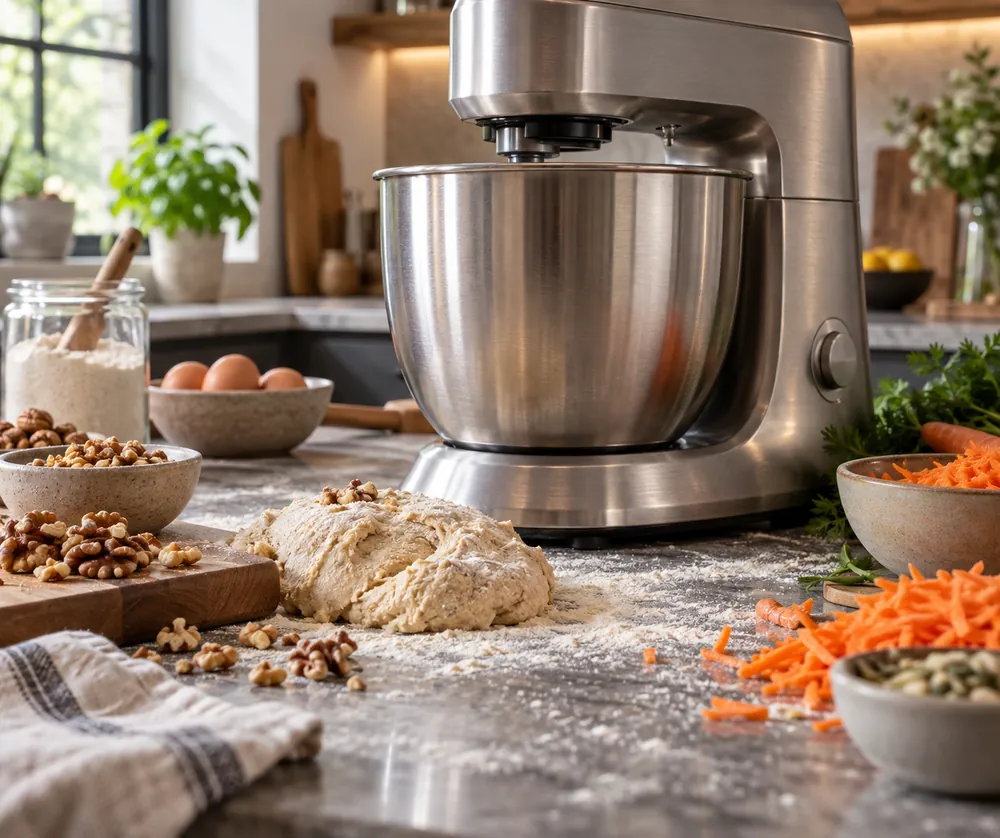
What Owners Change After the First Month
After several weeks, owners usually change how they judge a food processor.
Owner reports and manufacturer documentation show that wattage matters under load, but daily satisfaction depends just as much on setup time, bowl capacity, cleanup, storage, and whether the machine stalls during the hardest recurring task.
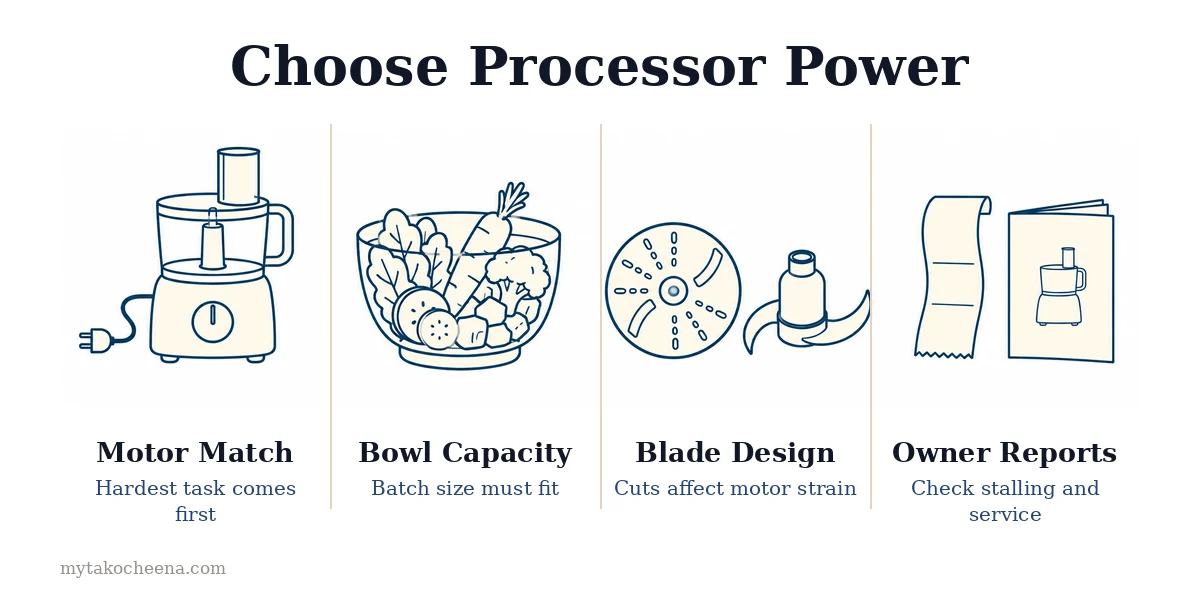
The complaint that returns most often is poor performance with dense mixtures.
Reports commonly mention dough climbing the blade, cheese collecting instead of shredding, carrots requiring repeated pulses, or the motor slowing near a full bowl.
These problems are more noticeable when buyers selected wattage for occasional chopping but use the processor for heavier work.
| Wattage range | Owner-reported fit | Typical limitation |
| 250–450 watts | Herbs, onions, dips, soft produce | Less reserve for dough and hard vegetables |
| 500–750 watts | Routine slicing, shredding, sauces, purees | More parts, weight, and counter space |
| 800–1,200 watts | Dense mixtures, larger batches, frequent prep | Higher storage and cleanup demands |
What holds up best is usually simple mechanical design. Owners tend to value sharp reversible discs, a secure bowl, a wide feed tube, controls that respond consistently, and parts that remain easy to wash.
Manufacturer documentation should confirm whether bowls, lids, seals, and discs are dishwasher-safe and whether replacement parts remain available.
Capacity becomes more important after the novelty fades. A small bowl can be quick for garlic or dressing, while a large bowl reduces repeated batches for family meals.
However, filling a bowl beyond the recommended line can worsen results regardless of the advertised motor rating.
| Capacity range | Practical use | Likely adjustment |
| 3–5 cups | Small households and condiments | Process fewer ingredients per batch |
| 7–9 cups | Daily vegetables, sauces, moderate shredding | Use the feed tube and pulse carefully |
| 11–14 cups | Batch cooking, salads, and dough | Plan more storage and counter clearance |
Early failures reported by owners often involve cracked plastic tabs, leaking seals, noisy bearings, difficult-to-lock lids, or controls that become unreliable.
Warranty language matters because coverage may exclude normal wear, overloaded use, accessories, or damage caused by improper assembly.
After the first month, buyers often prefer the lowest wattage that handles their hardest regular task without stalling.
Before choosing, compare owner reports for that task, confirm the recommended fill level, and check cabinet clearance and accessory storage.
available separately, fit the same revision, and can go through the dishwasher if that matters to your routine. A powerful motor does not compensate for a lid that is awkward to align or a disc that needs hand washing after every use.
For a buyer standing in the kitchen, start with the space around the appliance rather than the number on the box.
Measure the shelf, cabinet opening, and counter depth, then leave room to lift the lid, add ingredients, and remove the bowl without scraping nearby walls.
Check the height with the feed tube and pusher in place. A processor may fit under a cabinet when stored but become impractical if the lid must be removed vertically.
If it will live in a cupboard, measure the full opening, not only the shelf surface.
Width affects more than storage. A broad base may feel steadier during dense work, while a narrow footprint can fit a crowded counter more easily.
Compare the appliance’s widest point with the space beside the sink, hob, and other frequently used tools.
Also measure the route between storage and preparation areas. A heavier machine that stays on a high shelf may be used less often than a lighter one kept within reach.
Owners often revise their priorities after discovering that convenience controls frequency of use.
Consider where wet parts will dry. A bowl, lid, pusher, spindle, and disc can occupy more space than expected when spread beside the sink.
Look for a clear drying area before choosing a larger processor for work performed only occasionally.
The hardest recurring recipe should determine the useful reserve, but batch size still needs context.
A larger bowl can reduce repeated processing, yet it may be excessive for small portions and less convenient when ingredients need to be gathered from the bottom.
Noise and movement deserve a practical check through documentation and owner reports.
A machine that shifts, rattles, or demands firm hand placement can become frustrating during longer tasks, even when its motor handles the mixture without an obvious slowdown.
Before buying, verify what the stated wattage represents and whether the maker describes performance under load.
Electrical input is not a guarantee of cutting results, and attachments, blade condition, ingredient size, and processing technique all influence the finished texture.
The strongest choice is therefore the one that fits the kitchen’s physical limits and the owner’s repeated habits.
If the machine can be stored accessibly, cleaned without delay, and matched to the heaviest regular task, its wattage is more likely to feel sufficient.
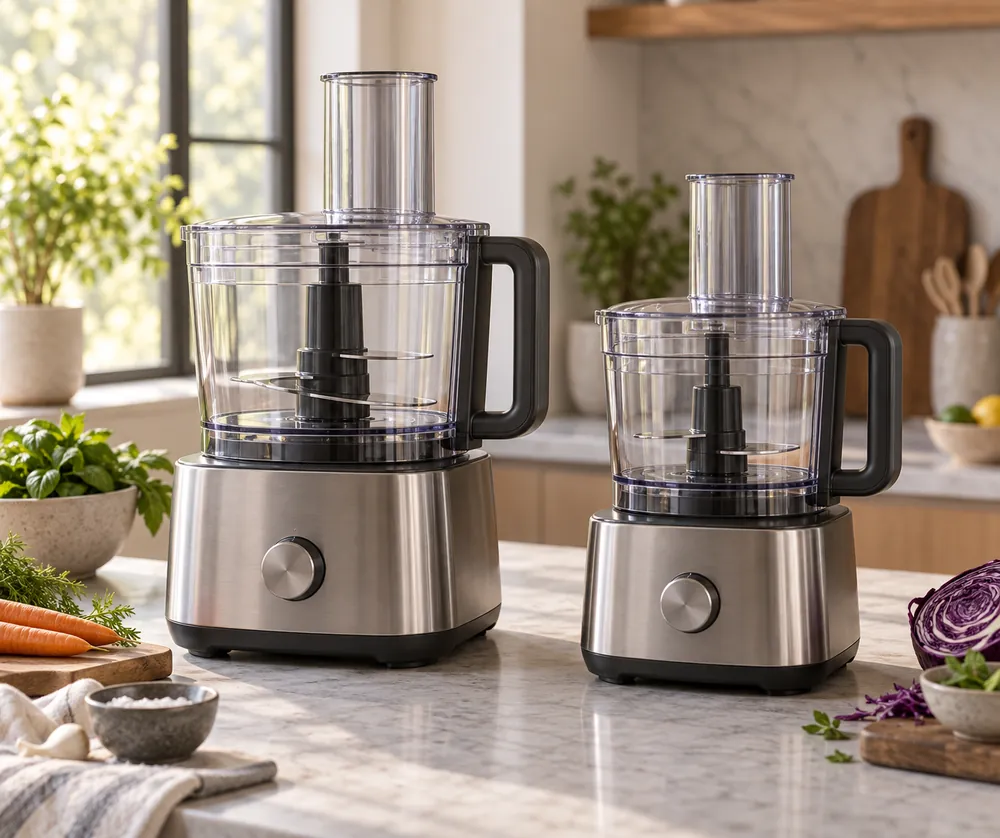
Asked and Answered
Food processor wattage indicates the motor’s electrical demand, but it does not guarantee faster chopping or smoother results.
Match the motor to your hardest regular task, then compare bowl capacity, blade design, controls, warranty coverage, and owner reports about stalling.
These answers explain how to compare specifications without treating the highest wattage as automatically best for every US kitchen.
What wattage food processor is best for everyday cooking?
A midrange motor usually suits regular chopping, slicing, shredding, puréeing, and sauce preparation. It provides more working headroom than a small chopper without adding the cost, weight, and storage demands of a heavy-duty machine.
| Wattage range | Best fit | Trade-off |
| 250–450 watts | Herbs, dips, soft produce, occasional prep | Less headroom for dough and hard vegetables |
| 500–750 watts | Daily slicing, shredding, sauces, family meals | More parts, weight, and counter space |
| 800–1,200 watts | Dense batches, dough, frequent heavy preparation | Higher cost and greater storage demand |
Is higher wattage always better in a food processor?
Higher wattage can help with dense dough, firm vegetables, large batches, and repeated processing. It cannot compensate for a dull blade, inefficient gearing, poor bowl design, or an unsuitable batch size.
Buy the lowest wattage that comfortably handles your hardest regular task. Extra power is less useful if you mainly prepare salsa, pesto, chopped onions, baby food, or small portions.
What wattage do I need for a mini food processor?
A mini processor generally needs moderate power for garlic, herbs, nuts, dressings, dips, and small quantities of vegetables. Its smaller bowl limits batch size, so a stronger motor does not make it equivalent to a full-size machine.
What bowl size matches food processor wattage?
Capacity and motor strength should make sense together. A large bowl paired with a weak motor may struggle near its limit, while a powerful motor in a small bowl offers little benefit for batch cooking.
| Capacity range | Typical role | Wattage priority |
| 3–5 cups | Condiments, mini prep, small households | Moderate |
| 7–9 cups | Daily vegetables, sauces, moderate shredding | Midrange |
| 11–14 cups | Batch cooking, dough, large salads | Higher |
How many watts does a food processor need for dough?
Dough places more strain on a motor than soft produce or thin slicing. Choose a higher-power processor with a sturdy dough blade, stable base, and overload protection if pizza, bread, or pastry dough is a frequent task.
Does food processor wattage affect noise and storage?
It can. Larger motors often come with heavier bases, wider bowls, taller feed tubes, and more accessories.
Measure cabinet clearance before buying, and check whether discs and blades store inside the bowl. A machine that fits the wattage requirement but remains difficult to lift or store may become inconvenient.
How should I compare food processor wattage between brands?
Use published wattage as a first filter, not a complete ranking.
Compare motor efficiency, gearing, blade sharpness, pulse control, bowl capacity, feed-tube design, warranty language, and owner reports describing carrots, cheese, dough, or stalling.
For many US kitchens, a midrange full-size processor offers the best balance. Choose a mini model for small weekly prep, or a stronger machine when dense ingredients and large batches are routine.