The gist: An air fryer is a compact convection oven designed to circulate hot air quickly around small food portions, while a convection oven offers a larger cavity, broader pan options, and more batch capacity.
Air fryers usually excel at crisping fries, wings, and leftovers. Convection ovens better suit sheet-pan meals, baking, roasting, and family-size cooking.
What Actually Changes Between an Air Fryer and a Convection Oven
Both circulate heated air, but an air fryer concentrates it in a smaller cavity. A convection oven spreads airflow across a broader chamber.
Air fryers quickly crisp small portions. Convection ovens offer more surface area, rack flexibility, and support for pans and dishes.
Capacity changes how you cook
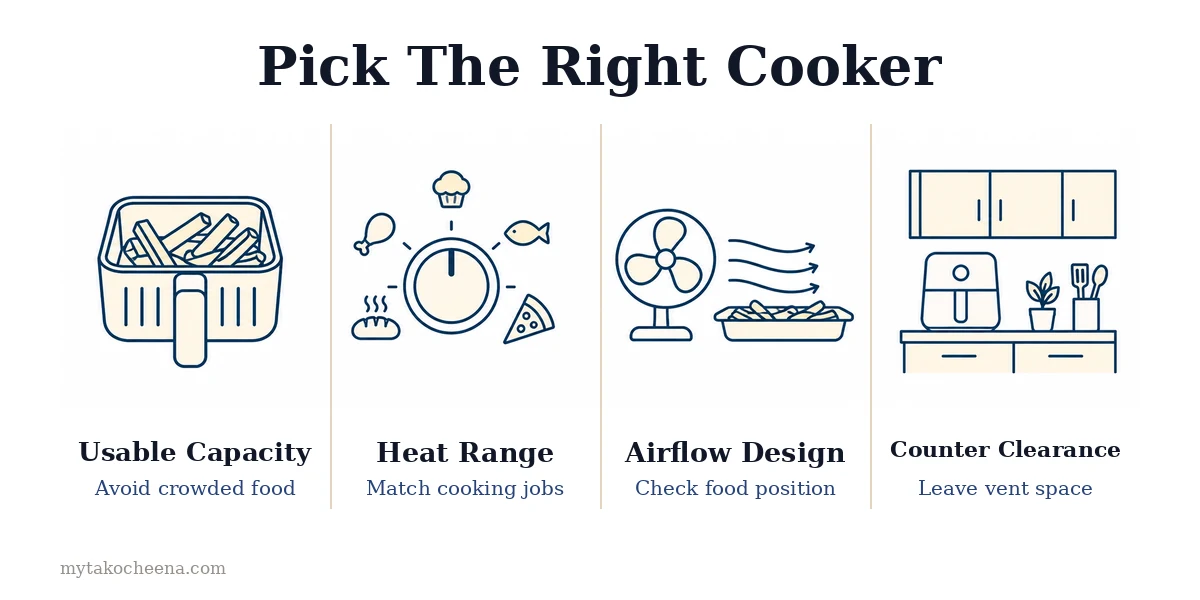
Air fryers use quarts; countertop convection ovens use cubic feet. Neither measurement shows how much food fits in one layer.
| Specification | Air fryer | Countertop convection oven |
| Common capacity band | About 2 to 10 quarts | About 0.5 to 1.5 cubic feet |
| Common cooking temperature range | About 180°F to 400°F | About 150°F to 500°F |
| Usual countertop wattage band | About 1,200 to 1,800 watts | About 1,200 to 1,800 watts |
| Typical manual clearance guidance | About 4 to 6 inches | About 4 to 6 inches |
Air fryer baskets can hold substantial food, but crowding limits airflow and browning. Oven trays provide flatter space for vegetables, pizza, cookies, and larger portions.
Food position affects the result
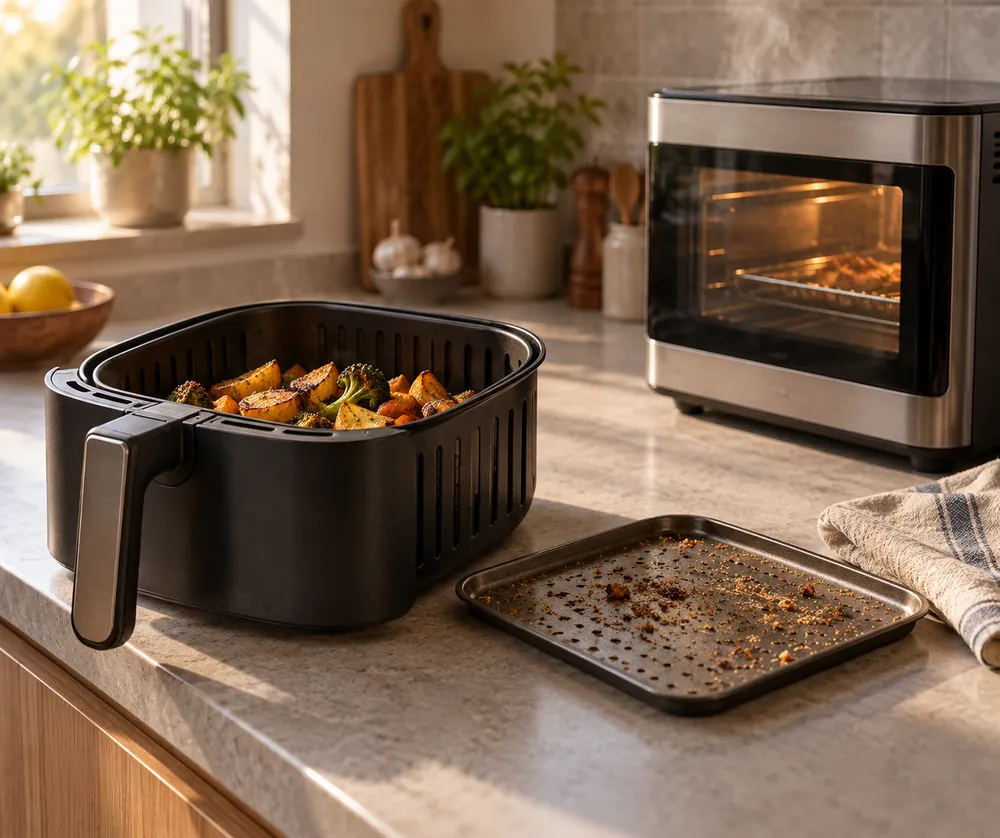
- Air fryer: Food usually rests in a perforated basket or on a crisper plate close to the heating element and fan. Loose pieces receive strong airflow, so fries, wings, and reheated leftovers develop browned edges quickly.
- Convection oven: Food can sit on a rack, sheet pan, baking dish, or oven-safe container. That flexibility suits casseroles, saucy foods, delicate fish, toast, and baked goods that should remain still.
Shaking may help an air fryer; convection ovens depend more on rack position, pan material, and spacing.
Counter space and controls matter
Measure counter depth and check outlet placement. Both appliances need clearance around their vents.
Choose an air fryer for crisp small batches and reheating. Choose a convection oven for pan compatibility, baking, and larger portions.
Start with the counter, not the appliance category. Measure the available width and depth, then mark the appliance footprint with removable tape.
Include space for controls, handles, and any rear overhang rather than measuring only the main body.
Check the height beneath cabinets as well. An air fryer may need room above its top for heat to escape, while a convection oven may require clearance around a side-hinged or drop-down door.
Follow the manufacturer’s clearance instructions for the specific model.
Door movement can matter more than exterior depth. Open the door fully and confirm that it will not strike a backsplash, cabinet edge, faucet, or another appliance.
Leave enough standing room to pull out a hot basket, rack, or tray safely.
Measure the path to the counter before buying. Record the narrowest doorway, hallway, and turn, especially if the appliance will arrive boxed.
A unit that fits the final location may still be awkward to carry through a tight kitchen entrance.
Also consider where accessories will live. Baskets, trays, racks, and removable crisper plates need a dry storage spot when they are not in use.
If the appliance occupies a frequently used work surface, account for the counter space it removes during preparation.
Electrical access belongs in the same check. Choose a location where the cord can reach an appropriate outlet without crossing a sink, cooktop, walkway, or hot surface.
Avoid relying on an extension cord unless the manufacturer specifically permits it.
The best choice is therefore the format that fits your routine and your room.
A compact footprint may suit frequent small batches, while a wider oven-style layout can simplify larger meals if the door, ventilation, and storage needs work in your kitchen.
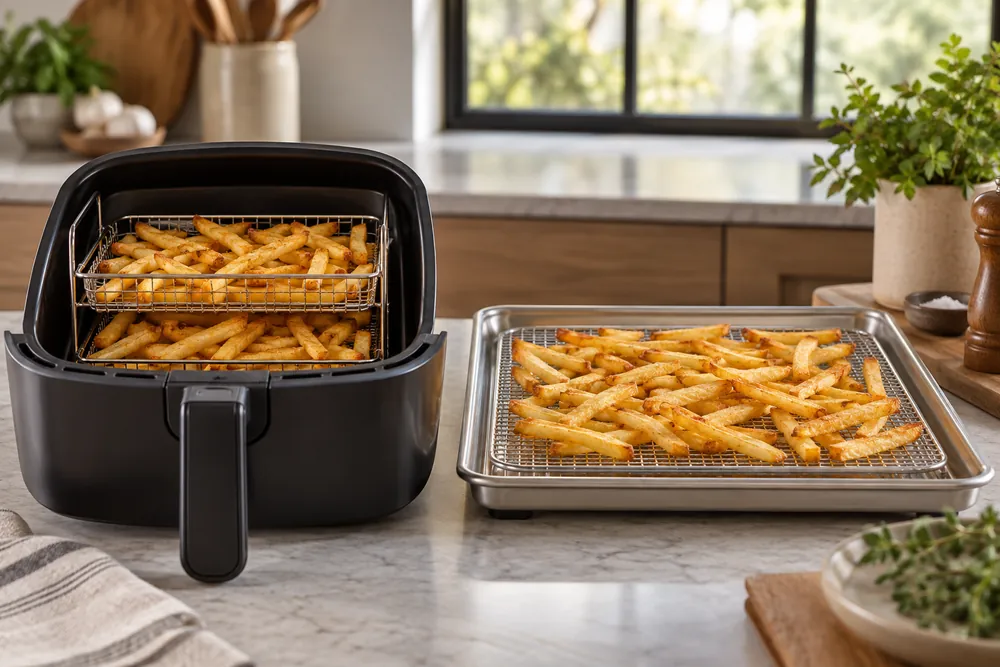
Cooking Speed, Crisping, and Browning Compared
Air fryers usually cook small portions faster because their compact cavities push hot air closely around the food. Convection ovens trade some speed for pan flexibility and the ability to cook larger portions without crowding.
Why air fryers often finish sooner
An air fryer concentrates heat around a basket or crisper plate, so exposed surfaces receive strong airflow.
That circulation helps remove surface moisture, which supports crisping on fries, wings, breaded vegetables, and reheated leftovers.
A convection oven also uses a fan, but its larger cavity must heat more air and often leaves greater distance between the food and the heating element.
Preheating and cooking can take longer, especially when the oven contains a heavy tray, a deep pan, or several portions.
| Factor | Air fryer | Countertop convection oven |
|---|---|---|
| Typical capacity band | About 2 to 10 quarts | About 0.5 to 1.5 cubic feet |
| Common temperature range | About 180°F to 400°F | About 150°F to 500°F |
| Typical clearance guidance | About 4 to 6 inches | About 4 to 6 inches |
Crisping depends on spacing
A loose single layer gives an air fryer its strongest advantage. Air can reach more of each piece, while excess moisture escapes through the basket.
A crowded basket produces softer results because overlapping food steams instead of browning.
Convection ovens provide more flat cooking area, but a solid baking sheet can restrict airflow beneath the food.
A perforated tray or wire rack may improve circulation, while a deep casserole or sauced dish benefits from the oven’s greater pan compatibility.
- For crisp edges: use a shallow layer, leave gaps, and turn or shake food when needed.
- For even browning: avoid stacking and keep the rack or basket position consistent.
- For moist foods: choose a pan that contains juices instead of relying on an open basket.
Where convection ovens catch up
A convection oven can be faster overall for family-size meals because it accommodates a full sheet pan, multiple pieces of toast, or several servings at once.
Cooking individual portions may take longer, but its larger batch capacity can reduce repeated cycles.
Air fryers suit rapid sides, frozen snacks, wings, and reheating. Convection ovens suit sheet-pan dinners, cookies, roasted vegetables, pizza, and foods that need a pan or multiple rack positions.
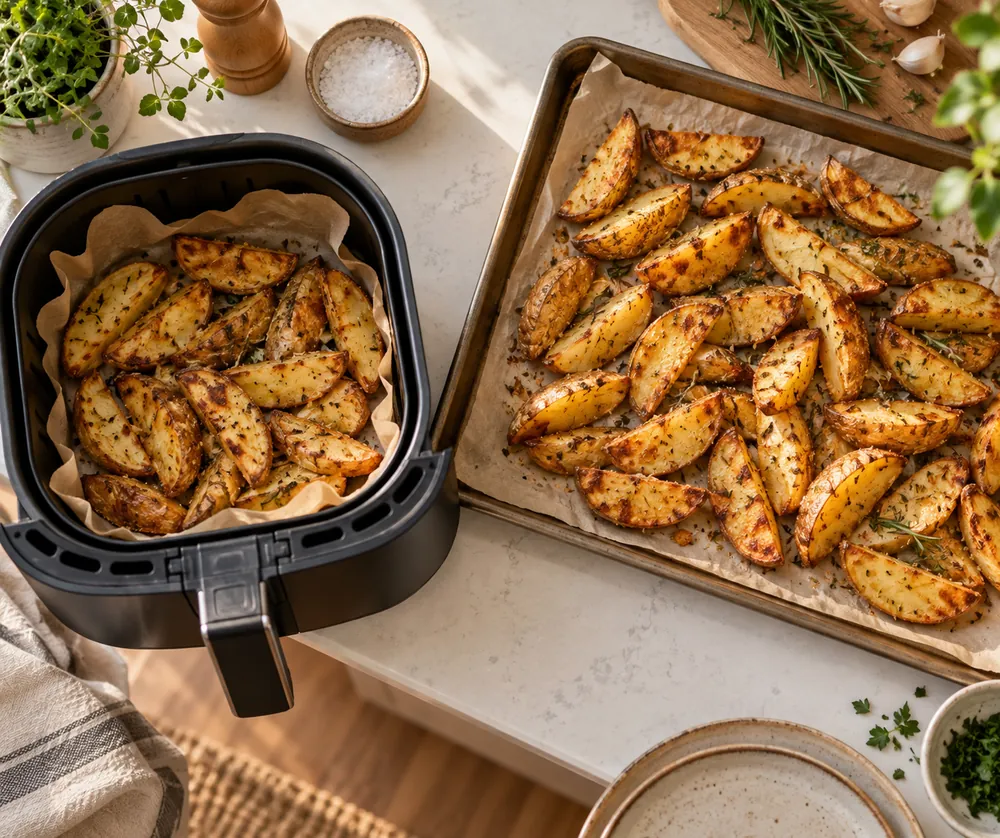
Counter Space, Capacity, and Batch Cooking
Counter space, usable cooking area, and batch size distinguish an air fryer from a convection oven. An air fryer concentrates heat in a compact cavity, while a convection oven offers more surface, rack positions, and pan options.
Advertised capacity does not equal usable batch size. Basket shape, tray depth, rack spacing, and ventilation clearance affect how much food fits comfortably.
| Specification | Air fryer | Countertop convection oven |
| Typical capacity band | About 2 to 10 quarts | About 0.5 to 1.5 cubic feet |
| Common cooking temperature range | About 180°F to 400°F | About 150°F to 500°F |
| Usual countertop wattage band | About 1,200 to 1,800 watts | About 1,200 to 1,800 watts |
| Typical manual clearance guidance | About 4 to 6 inches | About 4 to 6 inches |
Counter space is more than footprint
An air fryer may use less front-to-back space, but its pull-out basket needs front clearance. A convection oven may be wider or taller, yet its door and racks make loading large pans easier.
Measure the surface, overhead opening, and outlet route. Keep vents clear according to the manual; walls or cabinets can restrict exhaust.
Capacity depends on food layout
Air-fryer capacity is measured in quarts, while convection-oven capacity uses cubic feet. These measurements are not interchangeable: a tall basket may hold volume but provide limited space for an even layer.
A crowded basket restricts airflow. Fries, wings, vegetables, and breaded foods brown more evenly when spread loosely, so a larger basket may still require multiple batches.
Convection ovens provide flatter surfaces for sheet pans, cookies, pizza, and casseroles. Multiple racks support broad batches but may brown unevenly and require rotation.
Choose the batch pattern you actually cook
- Air fryer: Best for crisp portions, quick sides, reheating, and foods that benefit from vigorous circulation.
- Convection oven: Better for family-size portions, sheet-pan meals, baking, roasting, and foods that need a pan or casserole dish.
- Limited counter space: Favor the appliance that handles your most frequent batch without repeated loading, not simply the appliance with the smaller footprint.
A compact air fryer saves time for small meals, but several batches erase that advantage. A convection oven uses more counter space while reducing batch count, which can matter more for shared meals.
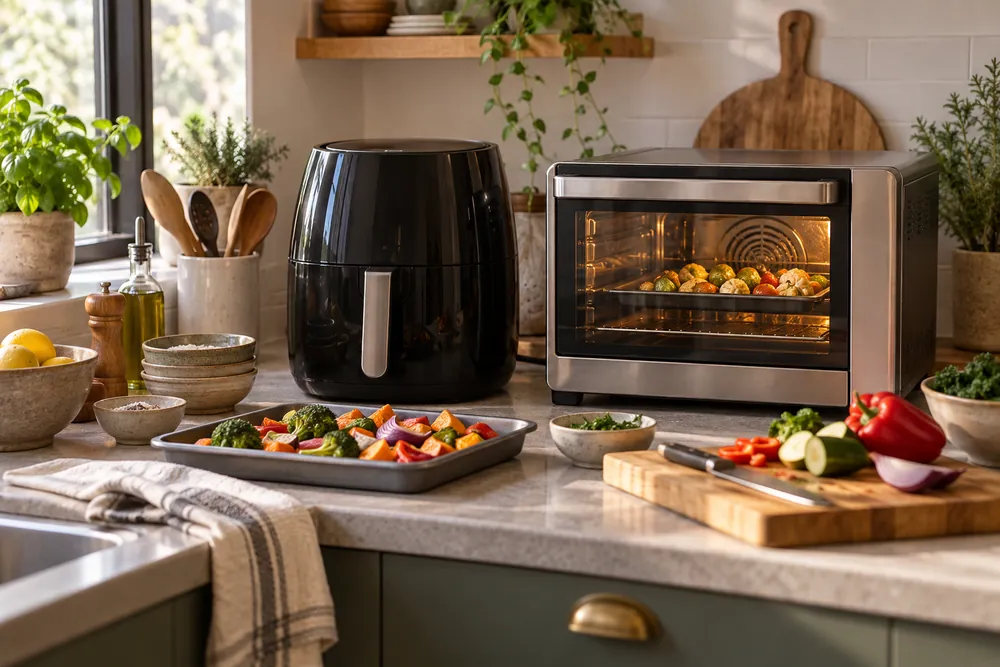
Energy Use, Preheating, and Everyday Convenience
Energy use depends less on the appliance label than on how much food you cook and how much space you heat.
An air fryer usually reaches cooking temperature faster because its compact cavity concentrates heat and airflow, while a convection oven is more efficient when one cycle replaces several smaller batches.
Category specifications show the practical difference. Air fryers commonly use 1,200 to 1,800 watts and hold 2 to 10 quarts, while countertop convection ovens use similar wattage and offer 0.5 to 1.5 cubic feet.
| Feature | Air fryer | Countertop convection oven |
|---|---|---|
| Typical cooking temperature range | About 180°F to 400°F | About 150°F to 500°F |
| Typical preheat experience | Often about 2 to 5 minutes | Often about 5 to 15 minutes |
| Common capacity band | About 2 to 10 quarts | About 0.5 to 1.5 cubic feet |
| Typical required clearance | About 4 to 6 inches | About 4 to 6 inches |
Preheating is where the smaller cavity saves time. Many air fryers need little warm-up for frozen snacks, wings, vegetables, and reheating, although following the package or recipe remains more reliable than relying on a preset.
A convection oven takes longer to heat, but its larger surface can cook a sheet-pan meal, several portions of vegetables, or a full batch of cookies in one cycle.
That can reduce energy use compared with repeated air-fryer batches for a family-size meal.
Convenience depends on the task
- Choose an air fryer for fast small batches, crisp leftovers, fries, wings, and foods that benefit from shaking or turning.
- Choose a convection oven for casseroles, toast, baking, roasting, saucy foods, and pans that cannot fit comfortably in a basket.
- Check the counter location before buying. Both appliances need open vent space, a suitable outlet, and clearance from cabinets and walls.
Presets, shake reminders, removable baskets, racks, and dishwasher-safe parts can matter as much as heating performance. The most efficient choice matches the usual portion size without extra batches or unnecessary preheating.
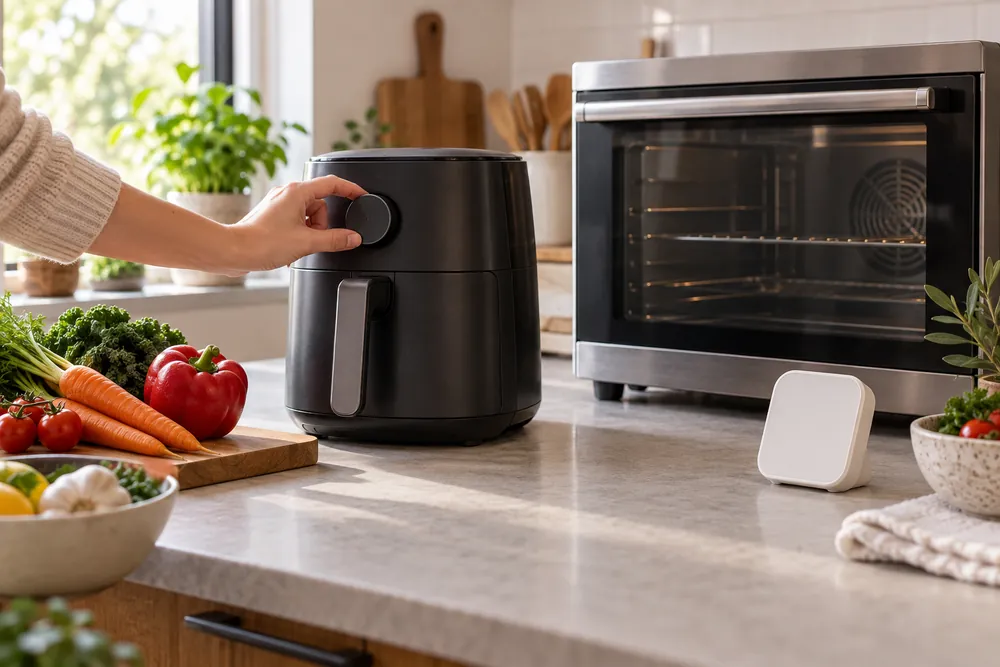
Cleaning, Noise, and Kitchen Smell
Cleaning, sound, and odor matter when an appliance stays on the counter. Air fryers contain mess in a removable basket, while convection ovens expose more space to grease and crumbs.
The easier choice depends on cooking habits, dishwasher-safe parts, and kitchen ventilation.
Cleaning workload
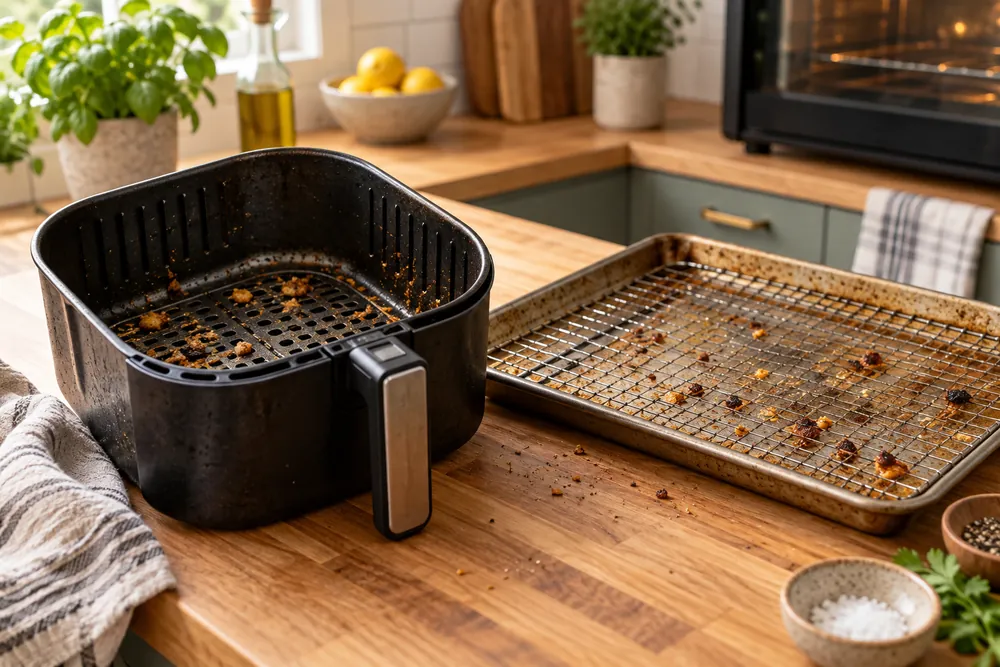
Air fryer cleanup is usually quick after fries, vegetables, or reheated snacks. Let the basket and crisper plate cool, then wash away oil and crumbs before residue hardens.
Splatter can collect near the heating element and fan guard. Do not soak the main unit or use abrasive cleaners that can damage nonstick surfaces.
Convection ovens accommodate larger or saucy dishes but have more surfaces to wipe, including walls, door glass, racks, crumb trays, and the fan area.
| Appliance | Common capacity band | Typical cleaning focus |
| Air fryer | About 2 to 10 quarts | Basket, crisper plate, interior splatter |
| Countertop convection oven | About 0.5 to 1.5 cubic feet | Racks, trays, door glass, crumb area, interior walls |
Noise and ventilation
Air fryers commonly produce a noticeable whir as their fan moves hot air through a compact chamber.
Convection ovens also use fans, and noise varies by design, so specifications and owner reports are more reliable than category assumptions.
Both release heat, odors, and moisture. Follow the manual’s clearance requirements, keep vents unobstructed, and use a range hood or open window for greasy foods.
| Consideration | Typical category-level range | Why it matters |
| Side and rear clearance | About 4 to 6 inches | Protects nearby surfaces and keeps vents unobstructed |
| Usual countertop wattage | About 1,200 to 1,800 watts | May affect outlet loading and simultaneous appliance use |
Choose an air fryer for compact, dry batches and simpler cleanup. Choose a convection oven for covered dishes, larger pans, and easier rack access.
How These Hold Up After a Year
Owner reports often share one complaint: advertised capacity feels smaller when food must sit in a loose, single layer.
Manufacturer documentation supports that limitation, since both appliance types require airflow around food and open space around vents.
The basic division of labor holds up best.
Air fryers remain convenient for crisp snacks, reheating, wings, and small portions, while convection ovens earn their counter space through sheet-pan meals, baking, roasting, and broader pan compatibility.
What owners complain about most
Air-fryer owners commonly mention basket crowding, peeling nonstick surfaces, noisy fans, and grease or crumbs beneath the cooking plate.
These issues do not affect every appliance, but they make basket shape, coating quality, and removable-part design important buying considerations.
Convection-oven owners more often describe longer preheating, uneven browning between rack positions, and awkward cleaning around the door or heating elements.
Manufacturer instructions warn that crowded pans, incorrect rack placement, and blocked vents can reduce circulation.
| Specification | Air fryer | Countertop convection oven |
|---|---|---|
| Typical countertop capacity | About 2 to 10 quarts | About 0.5 to 1.5 cubic feet |
| Common cooking temperature range | About 180°F to 400°F | About 150°F to 500°F |
| Typical clearance requested in manuals | About 4 to 6 inches | About 4 to 6 inches |
What tends to last
Simple controls, sturdy baskets or racks, accessible crumb trays, and replacement parts matter more over time than a long preset menu.
Owner reports treat presets as convenience features rather than guarantees, because portion size and food arrangement determine results.
Air fryers usually hold up when the basket is not overloaded and is washed according to the manual. Convection ovens benefit from careful pan placement, regular crumb removal, and clear ventilation space.
- Choose an air fryer for frequent small batches, quick reheating, and crisp surfaces.
- Choose a convection oven for flatter trays, delicate foods, baking, and family-size portions.
- Check before buying whether the cooking basket, tray, rack, and door seal are replaceable or easy to clean.
Common Questions Before You Buy
Air fryers and convection ovens differ in size, airflow, and cooking surfaces. Choose based on batch size, counter space, and whether you prioritize crisping or broader oven functionality.
Is an air fryer faster than a convection oven?
An air fryer often cooks small portions faster because its compact cavity concentrates hot air and usually needs less preheating.
What is the difference in capacity between an air fryer and convection oven?
| Appliance | Typical capacity |
| Air fryer | About 2 to 10 quarts |
| Countertop convection oven | About 0.5 to 1.5 cubic feet |
These units use different measurements. An air fryer usually has a smaller cooking area, while a convection oven offers flat space for trays, pans, casseroles, or multiple portions.
Does an air fryer make food crispier than a convection oven?
An air fryer can brown fries, wings, breaded foods, and vegetables more strongly through concentrated airflow. Results also depend on spacing and tray position.
Can a convection oven replace an air fryer?
Sometimes. A convection oven can cook air-fryer-style foods with a shallow or perforated tray, but it may heat more slowly.
An air fryer is less suitable for sheet-pan meals, covered dishes, delicate baked goods, or full-size pans. Choose based on the foods you cook most.
Which appliance is better for family-size meals?
A countertop convection oven generally offers more surface area for family-size portions, including sheet-pan dinners, pizza, vegetables, cookies, and casseroles.
An air fryer suits smaller batches, but crowding reduces airflow and may require multiple batches.
What temperature range should I look for?
| Appliance | Published temperature range often seen |
| Air fryer | About 180°F to 400°F |
| Countertop convection oven | About 150°F to 500°F |
A wider range gives a convection oven more flexibility for low-temperature cooking, baking, roasting, and broiling. Check the manual for usable ranges.
How much counter space and clearance do these appliances need?
Both need a stable, heat-resistant surface and unobstructed ventilation. Follow the manufacturer’s clearance instructions.
Measure depth, door or basket swing, outlet location, and storage path before buying.