Quick Answer: A countertop ice maker is a compact appliance that produces ice without a built-in freezer connection.
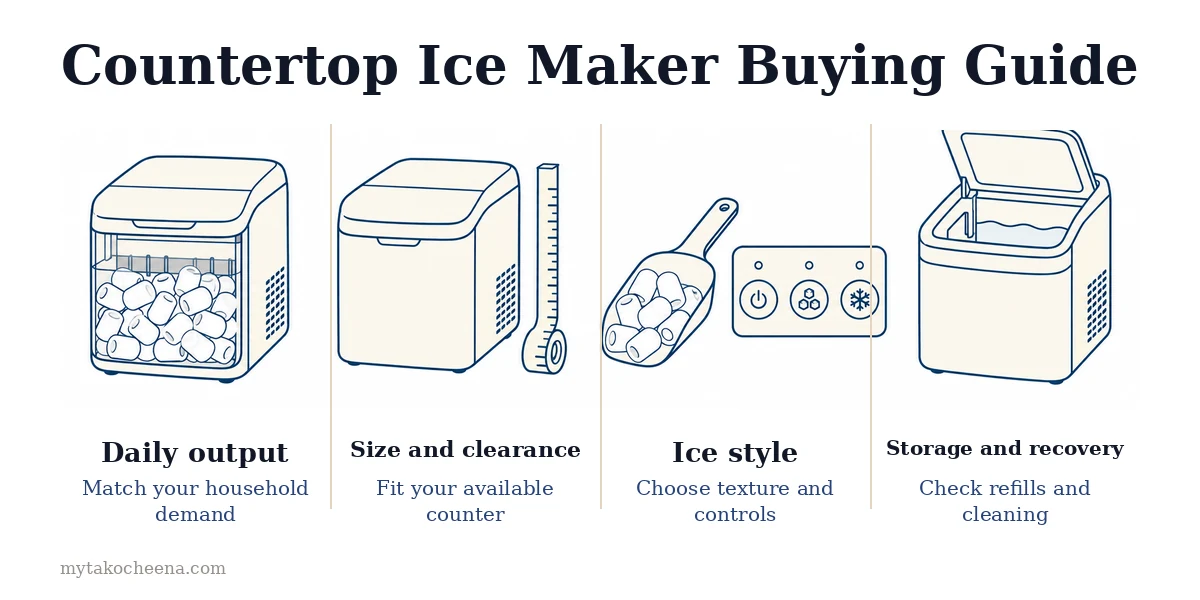
Choose one by matching its ice shape, daily production, storage basket, dimensions, water-filling method, noise level, cleaning needs, and price to your routine.
Prioritize dependable operation and easy maintenance over settings or output you will rarely use.
What to Look for in a Countertop Ice Maker
Daily ice needs, preferred ice texture, available counter space, and cleaning habits should guide your choice.
A suitable countertop ice maker should keep pace with your household without creating extra work or crowding the area around your sink.
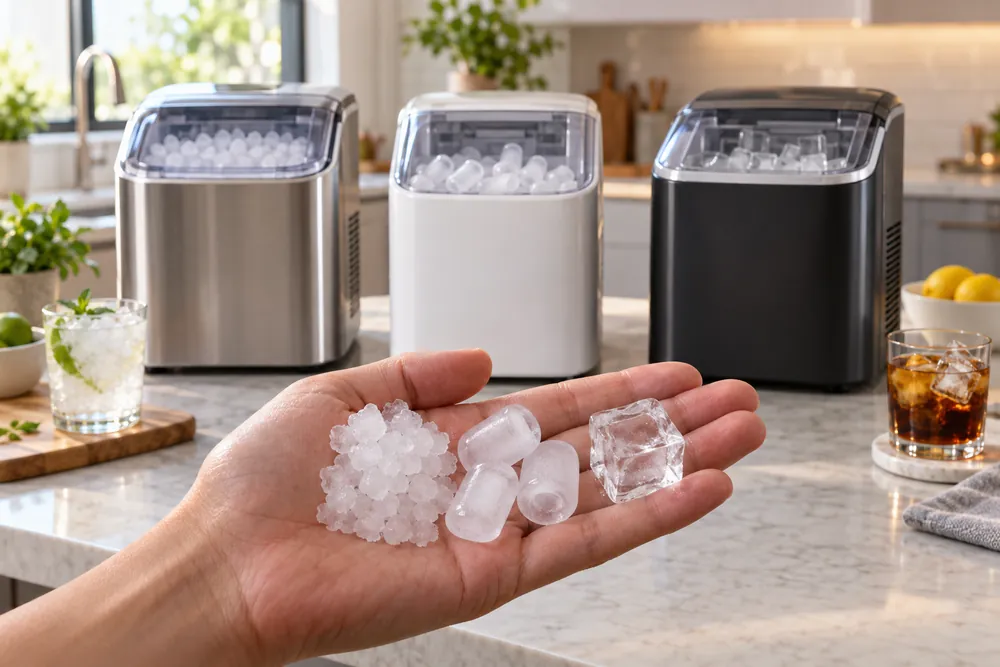
Start with the ice itself. Chewable nugget-style ice suits soft drinks, smoothies, and casual snacking, while bullet-shaped ice cools drinks quickly and is common in compact machines.
Clear cubes can melt more slowly, but machines designed to produce them may require more involved cleaning.
Match Production to Your Routine
Compare the advertised daily output with the internal basket size. Production describes how much a machine can make over time, whereas the basket shows how much ice is available before it must be emptied.
| Category | Typical range | Best suited to |
| Compact | 1.5–2.5 pounds per day | Occasional drinks and small kitchens |
| Standard | 2.5–3.5 pounds per day | Regular household use |
| High-output | 3.5–5 pounds per day | Entertaining and frequent refills |
Remember that countertop units generally make ice in batches. Their insulated baskets slow melting but do not replace a freezer, so frequent use may matter more than the highest advertised output.
Check Space, Clearance, and Controls
Measure the intended surface, including room above the lid and beside the machine. Keep enough space for ventilation, basket removal, water filling, and access to the drain without shifting the appliance.
| Measurement | Common range | Why it matters |
| Overall width | 9–15 inches | Determines counter space used |
| Overall depth | 12–18 inches | Affects placement near walls |
| Ventilation clearance | 2–6 inches | Allows airflow around the unit |
Choose controls that clearly show water, ice-full, and cleaning status. A transparent lid helps monitor supply, while a removable basket, scoop, and accessible drain simplify daily handling.
Prioritize Maintenance and Reliability
Look for a dedicated cleaning cycle, but treat it as a convenience rather than a complete maintenance plan. Regular descaling, fresh water, surface wiping, and occasional emptying help limit buildup and stale odors.
- Compare operating noise if the machine will sit near conversation areas or bedrooms.
- Review the warranty, return window, and availability of replacement parts.
- Favor simple controls and reachable surfaces over settings you are unlikely to use.
A compact, easy-to-maintain machine is often more satisfying than a higher-output model with awkward controls or difficult-to-reach components.
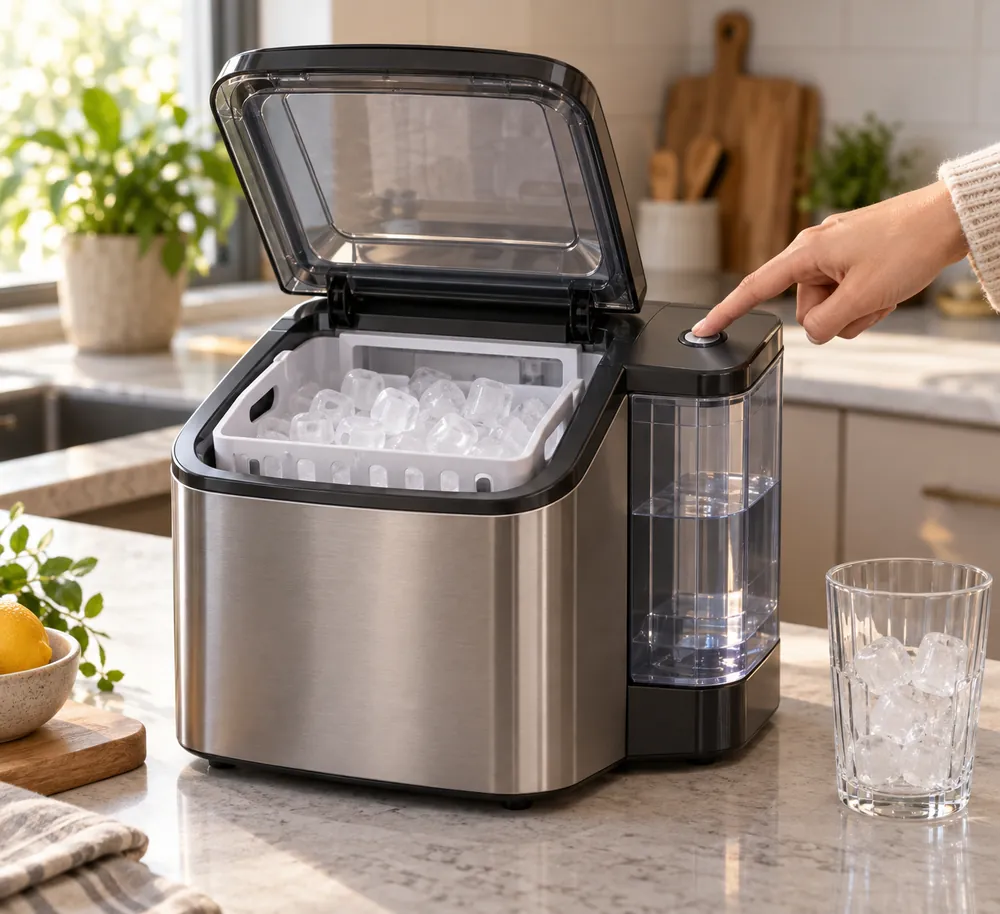
Choose the Best Ice Type for Your Drinks
Ice shape affects more than appearance. It changes how quickly a drink cools, how fast it dilutes, how pleasant it is to chew, and whether the machine suits your daily routine.
Choose the ice style that matches your usual drinks first, then compare production, basket capacity, cleaning, and counter space. A fast machine is less useful if its ice melts quickly or its texture does not suit your household.
Match Ice Texture to the Drink
- Bullet-shaped ice: Common in compact machines, this rounded ice cools beverages quickly and is usually easier to chew than traditional freezer cubes. It works well for water, iced tea, mixed drinks, and occasional entertaining.
- Nugget-style ice: Soft, porous pieces absorb flavor and feel satisfying to chew. Choose this style for soda, smoothies, specialty drinks, and households where people snack on ice.
- Clear cube ice: Dense, transparent cubes melt more slowly and preserve the flavor of spirits or carefully prepared cocktails. Machines that make clear ice often need more time, water management, and cleaning attention.
| Category | Typical daily output | Best suited to |
| Compact | 1.5–2.5 pounds | Occasional drinks and small kitchens |
| Standard | 2.5–3.5 pounds | Daily household use |
| High-output | 3.5–5 pounds | Frequent refills and entertaining |
Output ratings describe how much a machine can make over a day, not how long the ice will remain frozen.
Countertop models commonly keep finished ice in an insulated basket rather than a freezer, so plan to transfer extra ice when serving drinks over an extended period.
Consider how much ice you use at once. A smaller unit may suit one or two people, while a higher-output model reduces waiting during gatherings but may occupy more space and require more frequent water changes.
Check Controls and Maintenance
Look for clear indicators for low water, a full basket, and cleaning. A removable basket and scoop simplify serving, while a drain plug makes it easier to empty old water before storage.
Prioritize texture, predictable output, and easy cleaning over extra ice settings. The best choice produces the style your drinks need without creating maintenance work you will avoid.

Match Ice Production and Storage to Your Needs
Daily ice demand, basket capacity, and refill frequency should guide your countertop ice maker choice.
A suitable machine keeps pace with your household without occupying more counter space, using more water, or requiring more maintenance than your routine justifies.
Compare the advertised daily output with the amount of ice you need at one time.
Production ratings describe what a machine may make over a full day, while the internal basket shows how much ice is available before you need to transfer or use it.
| Category | Typical daily output | Suitable for |
| Compact | 1.5–2.5 pounds | Occasional drinks and small kitchens |
| Standard | 2.5–3.5 pounds | Regular household use |
| High-output | 3.5–5 pounds | Frequent refills and entertaining |
Plan Around Real Storage Needs
A larger production figure does not guarantee a larger supply. Countertop machines commonly make ice in batches, and their insulated baskets usually slow melting rather than provide long-term frozen storage.
Check basket size, refill speed, and whether the machine alerts you when the basket is full.
Choose a compact unit for occasional beverages, but consider higher output when several people regularly use ice for water bottles, mixed drinks, smoothies, or coolers.
A machine with modest output may still be practical when you can refill it throughout the day.
Reserve Space for Operation
Measure the countertop, including room above the lid and beside the appliance. Leave enough clearance for ventilation, removing the basket, adding water, and draining the reservoir without shifting the machine.
| Measurement | Common range | Why it matters |
| Width | 9–15 inches | Determines counter space used |
| Depth | 12–18 inches | Affects placement near walls |
| Ventilation clearance | 2–6 inches | Supports airflow and cooling |
Balance Output With Convenience
Higher-capacity machines can reduce refilling but may be noisier, heavier, and harder to clean. Prioritize accessible surfaces, a removable basket, a drain plug, and clear water and ice-full indicators over settings you rarely use.
For frequent use, select a model whose production, storage, footprint, and cleaning routine match your habits. Reliable operation and simple maintenance usually matter more than maximum output alone.
For a machine such as My Tako Cheena, start with the space it will occupy when the lid is open, not only the footprint listed by the seller. Measure the counter’s width and depth, then leave room to lift the lid and remove the basket.
Check the distance between the countertop and any cabinets above it. A compact ice maker can fit beneath a cabinet while still becoming awkward to refill if the lid cannot open fully.
Measure that vertical clearance before deciding where it will live.
Leave access around the sides and back as well. The machine needs room for its power cord, water reservoir, and ventilation. A tight fit may force you to pull it forward each time you add water or empty the basket.
Use masking tape to mark the proposed footprint on the counter. Keep the taped outline in place while opening nearby cabinet doors, operating the sink, and preparing drinks.
This reveals whether the ice maker competes with the space you use every day.
Think about the route from the machine to the freezer, cooler, or serving area. If you expect to transfer ice often, a location near those destinations saves repeated trips.
If the best spot is near the sink, confirm that filling and draining will be convenient.
Basket size also affects how you use the appliance between batches. A smaller basket may suit drinks made one or two at a time, while frequent entertaining can make repeated transfers inconvenient.
Decide whether you prefer steady refills or larger handoffs.
Consider who will handle the ice. A full basket can be harder to lift, especially when it must clear nearby cabinets or appliances. Leave enough open counter space to set the basket down without balancing it beside a sink or cooktop.
Water access matters more than it first appears. If the reservoir requires a pitcher, measure the space needed to pour without striking an upper cabinet.
If you plan to use bottled or filtered water, store that supply within easy reach.
Before buying, compare the maker’s stated dimensions with the actual usable area, including clearance for the lid and cord.
A machine that fits on paper may still be impractical if it blocks outlets, cabinet handles, or your main food-preparation zone.
The best match is therefore the machine that fits your physical routine, not merely the one with the largest production claim.
For My Tako Cheena or any alternative, tape out the space first, then choose the output and basket arrangement you can comfortably maintain.
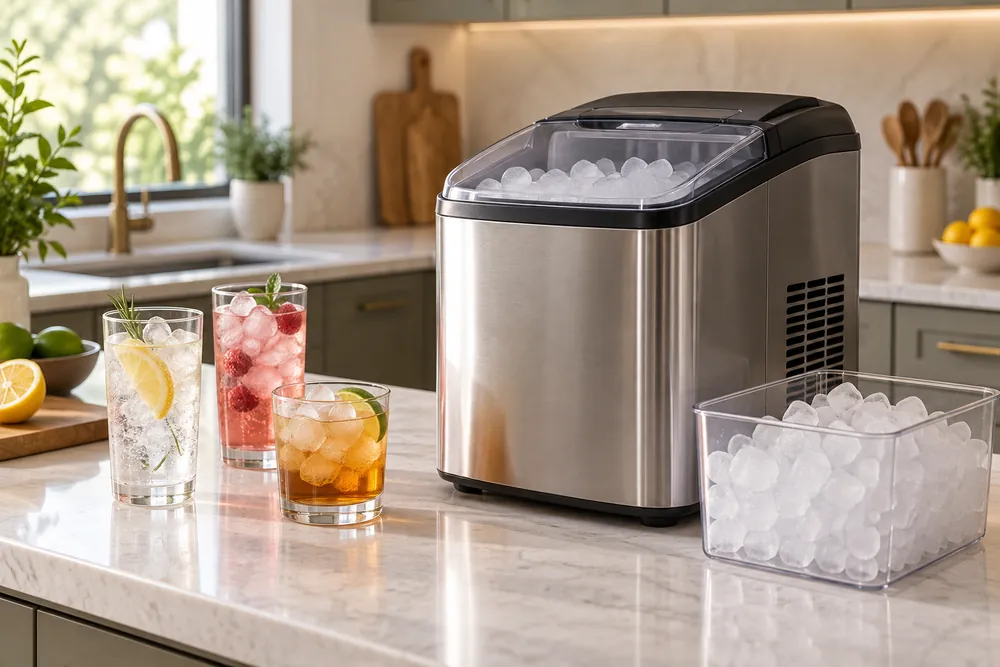
Check Size, Water Supply, and Countertop Fit
Counter space, reservoir access, and ventilation determine whether an ice maker feels convenient or constantly gets in the way.
Measure the intended location before comparing production claims, because a machine that fits its footprint may still need extra room for airflow, lid movement, and water filling.
Start with the available width and depth, then check the height beneath cabinets or shelves.
Keep the unit on a level, water-resistant surface near an outlet, but avoid placing it directly beside a stove, sink splash zone, or heat-producing appliance.
| Measurement | Common range | Why it matters |
| Overall width | 9–15 inches | Shows how much usable counter space the unit occupies |
| Overall depth | 12–18 inches | Determines whether it can sit comfortably near a wall |
| Ventilation clearance | 2–6 inches | Allows heat to escape and air to circulate |
Leave room for everyday movement
A countertop ice maker needs more space than its listed dimensions suggest. Leave clearance around the ventilation openings and make sure the lid can open fully without hitting a cabinet.
The basket should also slide out without forcing you to move the appliance.
Think through the complete refill routine. You need space to pour water into the reservoir, lift a pitcher or container above the opening, and drain old water without spilling it across nearby appliances.
- Confirm that the lid, basket, scoop, and drain plug remain accessible after placement.
- Keep ventilation openings clear of walls, backsplashes, paper towels, and other appliances.
- Use a stable surface that can support the filled machine without rocking or sliding.
- Check whether the cord reaches the outlet without an extension cord crossing the work area.
Compare reservoir and water-supply options
Portable countertop models commonly use a built-in reservoir that you fill by hand. This arrangement avoids plumbing, but it requires regular refills and fresh water changes, especially during gatherings or warm weather.
A larger reservoir can reduce interruptions, while a smaller one may make the appliance lighter and easier to empty.
Match the reservoir to your routine rather than choosing the largest available option, since standing water can develop odors when cleaning is neglected.
| Category | Typical daily output | Typical storage capacity |
| Compact | 1.5–2.5 pounds per day | 1–1.5 pounds |
| Standard | 2.5–3.5 pounds per day | 1.5–2 pounds |
| High-output | 3.5–5 pounds per day | 2–3 pounds |
Match capacity to available space
Production ratings describe ice made over a period, not necessarily the amount available at once.
Countertop baskets are usually insulated rather than freezer-powered, so ice can melt back into the reservoir if it is not transferred promptly.
Choose a compact design for occasional drinks and limited counters, or select a higher-output category when frequent refills matter more than workspace.
Confirm the return policy and measure again before ordering, especially for a tight kitchen layout.
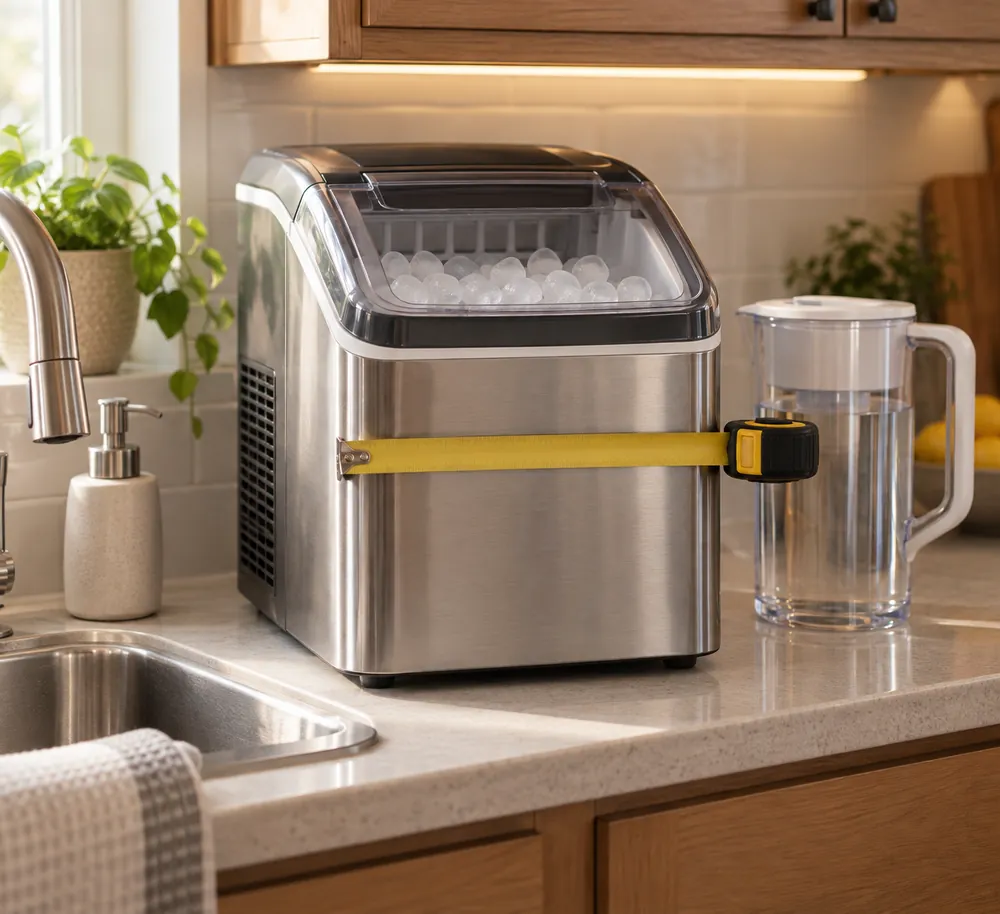
Compare Speed, Noise, and Energy Use
Production speed, operating noise, and energy use determine how well a countertop ice maker fits daily routines.
Compare these factors together because a fast machine may run more often, while a quieter or more efficient model may produce ice more gradually.
Daily output describes how much ice a machine can make over a full day, not how quickly it fills the basket.
Batch timing matters more during parties or busy meal periods, so check whether the specifications explain production per cycle as well as the daily estimate.
| Production category | Typical daily output | Best suited to |
| Compact | 1.5–2.5 pounds | Occasional drinks and smaller households |
| Standard | 2.5–3.5 pounds | Regular daily use |
| High-output | 3.5–5 pounds | Frequent refills and entertaining |
A full ice basket usually pauses production, and countertop storage is not the same as freezer storage. Meltwater may return to the reservoir in some designs, but the ice can still become wet or clump together.
Plan to transfer excess ice if you need it to remain solid.
Evaluate operating noise
Fans, pumps, compressors, and the ice-release cycle all contribute to sound.
Specifications may list a decibel range, but owner reports can reveal whether the noise is steady, intermittent, or especially noticeable when the machine starts a new cycle.
| Sound range | How it may feel in use | Placement guidance |
| About 40–50 dB | Low background sound | Suitable for open kitchens and nearby work areas |
| About 50–60 dB | Clearly audible during operation | Keep away from quiet rooms and sleeping areas |
Energy use depends on compressor design, room temperature, cycle frequency, and how often the lid is opened.
Common countertop units often fall within roughly 100–200 watts while operating, but the machine may cycle rather than draw that amount continuously.
Compare efficiency by considering output alongside power demand. A lower-wattage unit that produces ice slowly may operate for longer, while a faster model may finish sooner but use more electricity during active cycles.
- Choose higher output for gatherings, frequent cold drinks, or limited freezer space.
- Choose quieter operation for open-plan kitchens, offices, and studio apartments.
- Choose lower energy demand when the machine will run for many hours each day.
- Check ventilation clearance, commonly about 2–6 inches, because restricted airflow can reduce performance.
Prioritize the combination that matches your routine rather than selecting the largest production claim.
A moderately fast machine with manageable noise, sensible energy use, and adequate ventilation can be more practical than a louder high-output model.
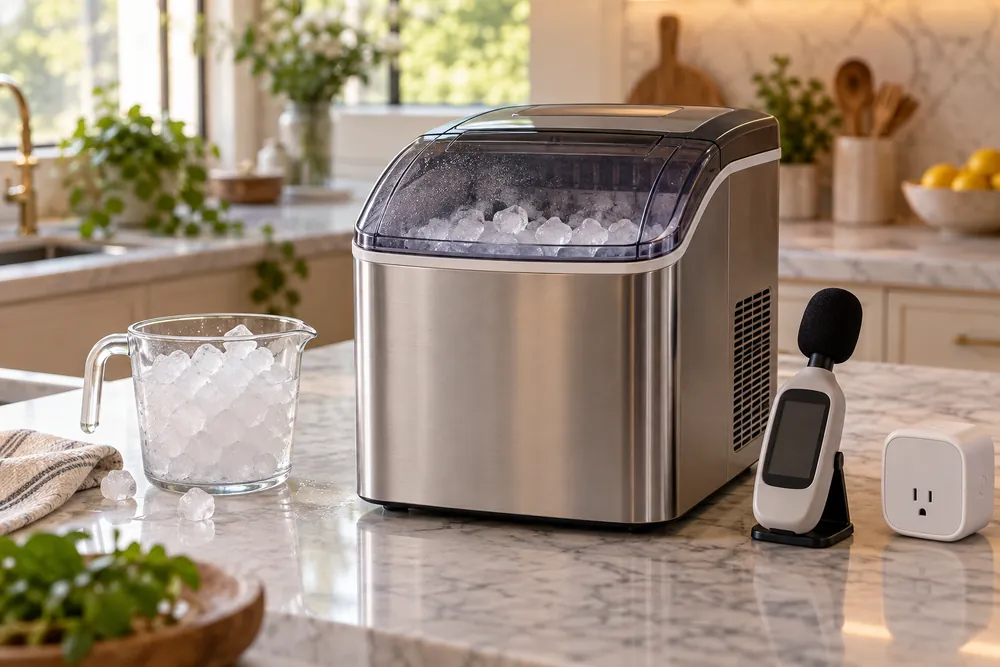
Evaluate Cleaning, Maintenance, and Durability
Cleaning access, water handling, and construction quality determine whether a countertop ice maker remains convenient after the novelty fades.
Compare removable parts, reachable interior surfaces, drainage, and owner-reported reliability before choosing a machine with extra settings or a larger output claim.
Check the Cleaning Design
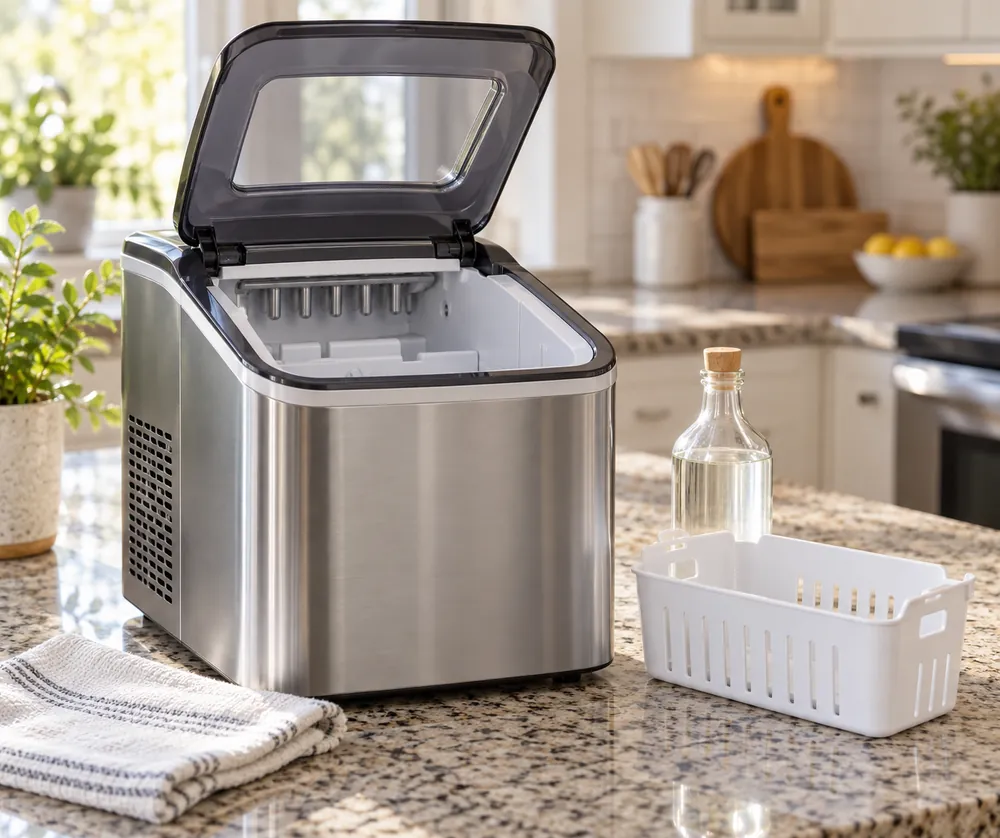
A removable ice basket and scoop should lift out without forcing the lid or spilling meltwater. Smooth plastic surfaces are easier to wipe than deep seams, exposed fasteners, or narrow channels that can trap residue.
Look for a drain plug or drain hose positioned where you can empty the reservoir without moving the appliance.
A wide opening also makes it easier to pour out old water, rinse the tank, and inspect the bottom for slime or mineral buildup.
- Choose a clearly labeled cleaning cycle, but treat it as a supplement to manual washing.
- Confirm that the basket, scoop, and other removable parts can be rinsed without special tools.
- Check whether the water reservoir is accessible enough for a cloth or soft brush.
- Prefer controls that show cleaning, low-water, and full-basket conditions clearly.
Plan for Water Quality and Descaling
Hard water can leave scale on sensors, cooling surfaces, and water lines, while stagnant water can develop odors.
Empty the reservoir regularly, wipe the interior dry between extended uses, and follow the manufacturer’s guidance for food-safe descaling.
Filter quality may affect taste and mineral deposits, but it does not eliminate cleaning. A machine with a simple reservoir and accessible water path can be easier to maintain than a more elaborate design with hidden tubing.
| Condition | What to inspect | Practical trade-off |
| Soft or filtered water | Odor, film, and residue | Less scale, but regular emptying still matters |
| Hard water | White deposits and sensor buildup | More frequent descaling may be needed |
Assess Durability and Long-Term Value
Sturdy hinges, a firm lid, stable feet, and a basket that does not flex under normal handling suggest better everyday durability.
Avoid treating metal-looking panels as proof of stronger internal components; examine warranty terms and reported failure patterns instead.
Countertop ventilation also affects service life. Leave the manufacturer’s recommended space around the unit, with common guidance falling within the range below, and keep vents free of dust and grease.
| Placement factor | Common category range | Why it matters |
| Side or rear clearance | About 2–6 inches | Supports airflow and heat release |
| Daily production category | About 1.5–5 pounds | Higher output can increase cleaning and water demands |
Prioritize accessible maintenance, dependable drainage, and clear warranty support over decorative features. The easiest machine to clean is often the one that stays in regular use and produces better-tasting ice over time.
Common Questions Before You Buy
Ice shape, production rate, storage, countertop clearance, noise, and cleaning determine whether a countertop ice maker fits your routine.
Compare these practical details before paying for extra settings, because reliable daily operation matters more than a long feature list.
How much ice can a countertop ice maker make?
Match the production rating to your usual demand, not to occasional entertaining.
Batch-making appliances may need several cycles before filling the basket, and the listed daily output assumes regular water refills and suitable operating conditions.
| Category | Typical daily output | Best suited to |
| Compact | 1.5–2.5 pounds | Occasional drinks and small kitchens |
| Standard | 2.5–3.5 pounds | Daily household use |
| High-output | 3.5–5 pounds | Frequent refills and entertaining |
What size countertop ice maker should I buy?
Measure the available counter, then account for the lid, basket, water reservoir, and power cord. Depth matters near a backsplash, while width determines whether the appliance competes with a coffee maker, toaster, or prep area.
| Measurement | Common range | Why it matters |
| Overall width | 9–15 inches | Counter space used |
| Overall depth | 12–18 inches | Placement near a wall |
| Ventilation clearance | 2–6 inches | Airflow around the unit |
Which ice shape is best for drinks?
Bullet-shaped ice cools drinks quickly and is widely available.
Nugget-style ice is softer and easier to chew, making it popular for sodas and smoothies, while clear cubes generally suit slow-sipping drinks but can require more involved maintenance.
Does a countertop ice maker keep ice frozen?
Many countertop machines insulate the basket but do not function as freezers. Meltwater may return to the reservoir for another cycle, so transfer unused ice to a freezer when you need longer storage.
Are countertop ice makers loud?
Noise varies with the compressor, fan, harvest cycle, and surrounding surface. Check manufacturer specifications and owner reports, especially if the machine will operate beside a television, at a work desk, or in an open-plan kitchen.
How difficult is a countertop ice maker to clean?
Choose a removable basket, accessible reservoir, drain plug, and dedicated cleaning cycle.
These features reduce effort, but they do not replace emptying old water, wiping interior surfaces, rinsing the scoop, and following the recommended descaling schedule.
What features are worth paying for in an ice maker?
Prioritize clear water, ice-full, and cleaning indicators, plus controls that are easy to understand.
A transparent lid, dependable shutoff, and straightforward warranty can be more useful than app controls or several rarely used operating modes.