Straight answer: Food processor wattage is a motor-power rating, not a complete measure of performance.
Most home cooks need enough power for their usual chopping, slicing, shredding, mixing, and dough tasks, while tougher or larger batches benefit from a stronger motor.
Compare wattage with bowl size, blade design, controls, warranty coverage, and owner reports before choosing.
What Wattage Food Processor Do You Need
Motor wattage tells you how much electrical power the food processor is designed to draw, not how perfectly it will chop. Use it as a first filter, then compare bowl size, blade design, feed tube, warranty language,
and owner reports about stalling.
Published wattage helps separate light prep machines from processors built for dense or frequent work.
A small chopper handles herbs, garlic, nuts, and quick sauces, while a full-size processor needs more power for dough, cheese, and long slicing sessions.
| Wattage range | Best fit | Trade-off to expect |
| 250-450 watts | Small chopping, dips, soft produce, occasional prep | Less headroom for dough, hard vegetables, and long runs |
| 500-750 watts | Everyday slicing, shredding, puree, family meal prep | Usually larger footprint and more parts to wash |
| 800-1,200 watts | Frequent heavy prep, nut butters, dough, dense batches | Higher cost, weight, and storage demand |
Capacity should rise with wattage. A high-watt motor in a tiny bowl helps compact power, but not batch volume. A large bowl with a weak motor may look versatile yet struggle near its limit.
| Capacity range | Typical role | Wattage priority |
| 3-5 cups | Mini prep, condiments, small households | Moderate power is usually enough |
| 7-9 cups | Daily cooking, vegetables, sauces, moderate shredding | Midrange wattage gives better flexibility |
| 11-14 cups | Batch cooking, dough, large salads, entertaining | Higher wattage matters more under load |
Do not compare wattage alone across brands. Motor efficiency, gearing, blade sharpness, and overload protection can make similar labels feel different.
Owner reviews reveal whether a machine bogs down with pizza dough, carrots, or cheese.
- Choose lower wattage for salsa, pesto, chopped onions, baby food, and small weekly prep.
- Choose midrange wattage for a main kitchen processor that slices, shreds, chops, and purees regularly.
- Choose higher wattage for dough, dense vegetables, big batches, and repeated processing without long cooldowns.
Noise and storage matter too. Larger motors often come with heavier bases, wider bowls, and taller feed tubes.
Compare the published height against your cabinet clearance and check whether accessories store inside the bowl or need separate space.
For many US kitchens, the practical target is a midrange full-size processor unless you own a stand mixer or only need a mini chopper. Buy the lowest wattage that matches your hardest regular task, not the highest number on the shelf.
How Much Wattage Do You Need for Common Food Processor Tasks
Wattage indicates motor power draw, not guaranteed performance. Consider it alongside bowl size, blade design, feed tube size, and owner reports.
Common wattage bands by task
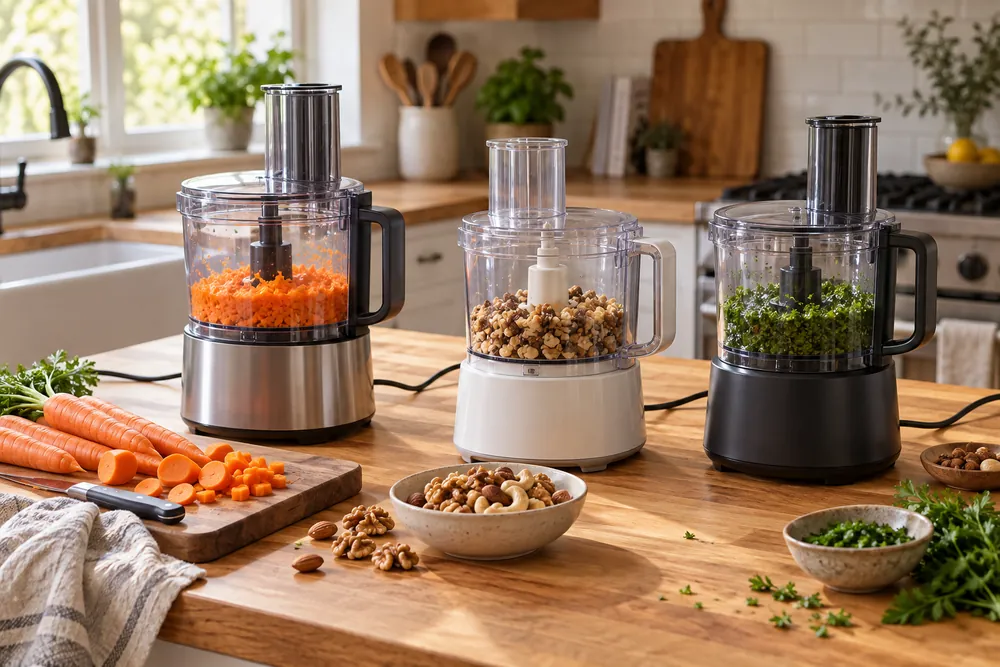
Light prep needs less power than dough or dense shredding. Small choppers suit herbs and sauces; full-size processors provide more headroom.
| Task category | Usual published wattage band | Best fit |
| Herbs, garlic, dips, soft sauces | About 200-400 watts | Mini choppers and compact prep bowls |
| Chopping onions, carrots, nuts, crumbs | About 400-700 watts | Everyday family prep |
| Slicing, shredding cheese, thicker vegetables | About 600-900 watts | Regular meal prep and larger batches |
| Nut butters, stiff mixtures, occasional dough | About 800-1,200 watts | Heavy-duty full-size processors |
These are shopping ranges, not guarantees. Blade sharpness, gearing, bowl locking, and disc design also affect performance.
Match wattage to bowl capacity
Capacity affects motor load. A compact bowl filled near the top can bog down faster than a larger bowl processing the same ingredients.
| Capacity category | Common bowl size range | Typical wattage expectation |
| Mini chopper | About 2-4 cups | Lower wattage is usually acceptable for small soft batches |
| Compact processor | About 5-8 cups | Midrange wattage suits weekly chopping and sauces |
| Full-size processor | About 9-14 cups | Higher wattage helps with shredding, slicing, and repeat batches |
| Large-capacity processor | About 14 cups and up | Stronger motors are useful for dense loads and volume prep |
Compare capacity and wattage together. Large bowls with modest motors may handle salads and salsa but struggle with dense cheese, dough, or nut mixtures.
What tasks actually stress the motor
Hard cheese, thick bean purees, dough, nut butter, frozen fruit mixtures, and long runs with thick pastes create more resistance and heat.
- Low-stress tasks: herbs, bread crumbs, cooked vegetables, mayonnaise, salsa, and soft dips.
- Medium-stress tasks: raw carrots, cabbage, onions, pie crust, firm cheese, and larger batches of slaw.
- High-stress tasks: dense dough, nut butter, frozen fruit mixtures, and long runs with thick pastes.
Published wattage does not show duty cycle. Check manual run-time guidance before assuming a high watt number supports unlimited heavy use.
Buying takeaway
Choose the lowest range covering your hardest regular task. Dips and small chopping need compact power; shredded cheese, batch cooking, and dough call for full-size power.
Then compare capacity, discs, replacement parts, warranty terms, and owner experience with the foods you make.
Motor Wattage vs. Real-World Performance
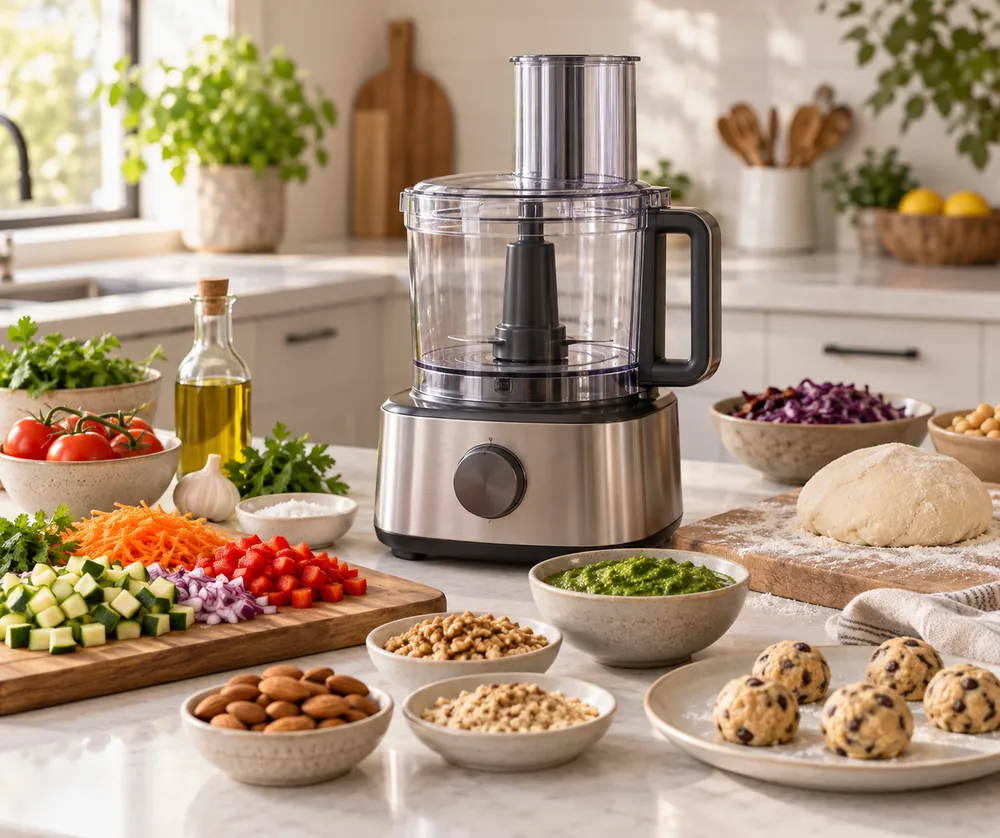
A food processor’s motor wattage shows its rated electrical power draw, not how effectively it chops onions or kneads dough. Results also depend on bowl shape, blade geometry, gearing, and run time under load.
Published specs are useful because they set expectations. A low-watt unit may handle salsa and breadcrumbs well, while a higher-watt machine is usually better for dense dough, nut butters, and repeated batch prep.
| Category | Usual motor wattage band | Common bowl capacity band | Best-fit use |
| Mini chopper | 100-300 watts | 1-4 cups | Garlic, herbs, dips, small sauces |
| Compact processor | 300-600 watts | 5-8 cups | Vegetables, cheese, crumbs, light prep |
| Full-size processor | 600-1,200 watts | 9-14 cups | Batch prep, shredding, slicing, heavier mixes |
Higher wattage can help, but it is not a guarantee. Two processors in the same wattage band can feel different because one may use sturdier gears, sharper blades, or a tighter-fitting work bowl.
Why specs do not tell the whole story
Owner reports reveal the difference between convenience and sustained strength. A processor may pulse nuts well, then struggle with thick dough because heat buildup, blade drag, or bowl flex becomes the limiting factor.
- Blade design: A sharp, well-positioned blade can outperform a duller blade attached to a stronger motor.
- Feed tube and disc fit: Clean slicing depends on stable food contact, not wattage alone.
- Motor protection: Shutoff features can protect the appliance, but they may interrupt heavy jobs.
- Work bowl size: Overfilling reduces circulation and makes any motor work harder.
For comparison shopping, match wattage to the toughest expected task, then check capacity and owner feedback for that task.
A compact processor can suit weekly chopping, while a full-size unit fits dough, shredding cheese blocks, or meal-prep batches.
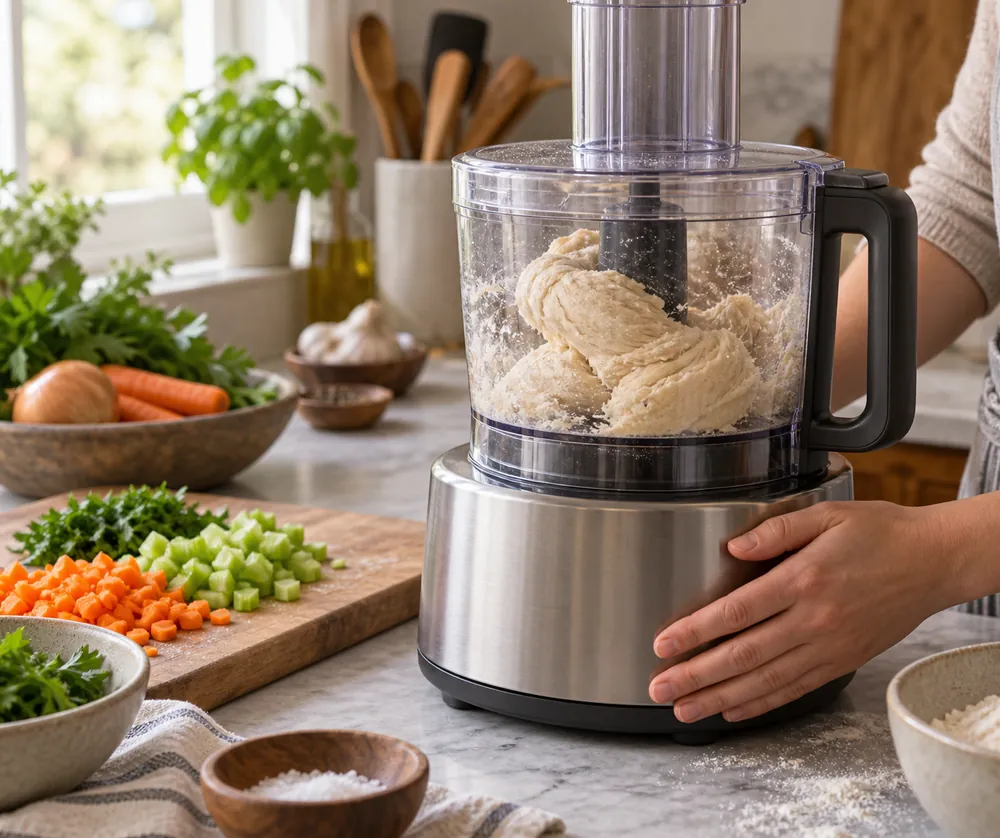
What Changes the Wattage You Need
Motor load changes with ingredient density, bowl size, blade design, and run time. Published wattage helps, but it only makes sense next to capacity, feed-tube size, and the jobs you expect it to handle.
A mini chopper can use a modest motor for herbs, garlic, nuts, or small sauces. A full-size food processor needs more headroom because dough, cheese, and thick vegetable batches resist the blade longer.
| Category | Usual published wattage range | Best-fit tasks |
| Mini choppers | 120-300 watts | Herbs, garlic, dips, small nut batches |
| Compact processors | 300-600 watts | Salsa, crumbs, shredded vegetables, small doughs |
| Full-size processors | 600-1,200 watts | Cheese, dense vegetables, larger batches, dough work |
Capacity changes motor demand
Capacity matters because a larger bowl invites larger loads. Common home capacity bands run about 3-5 cups for small units, 7-9 cups for compact machines, and 11-14 cups for full-size models.
More volume does not always mean better performance. A wide bowl with a weak motor may struggle with dense food, while a smaller machine may process evenly because ingredients stay close to the blade.
Dense ingredients need more headroom
Hard cheese, carrots, sweet potatoes, nuts, and dough strain a motor more than tomatoes or herbs. Look for higher wattage when these jobs are routine, especially if owner reports mention stalling, overheating, or uneven chopping.
Dough is the clearest warning sign. Bread or pizza dough can bog down lower-power processors, so check for listed dough use, a dough blade, or a maximum flour amount before comparing wattage alone.
Run time and speed control matter
Published wattage does not show how long a machine can work under load. Short pulse jobs need less sustained power than shredding cabbage, making nut butter, or kneading dough.
Pulse control can make a lower-wattage unit feel capable for chopping because it prevents overprocessing. Multiple speeds help with slicing and emulsifying, but they do not replace enough torque for heavy ingredients.
- Choose lower wattage for small batches, soft foods, sauces, herbs, and occasional chopping.
- Choose midrange wattage for weekly prep, shredded vegetables, breadcrumbs, salsa, and light dough.
- Choose higher wattage for frequent cheese shredding, dense vegetables, nut-heavy recipes, and dough.
Compare wattage only after matching processor size to your cooking pattern. The better buy is the model whose motor, bowl capacity, attachments, and owner-reported durability all point to the same workload.
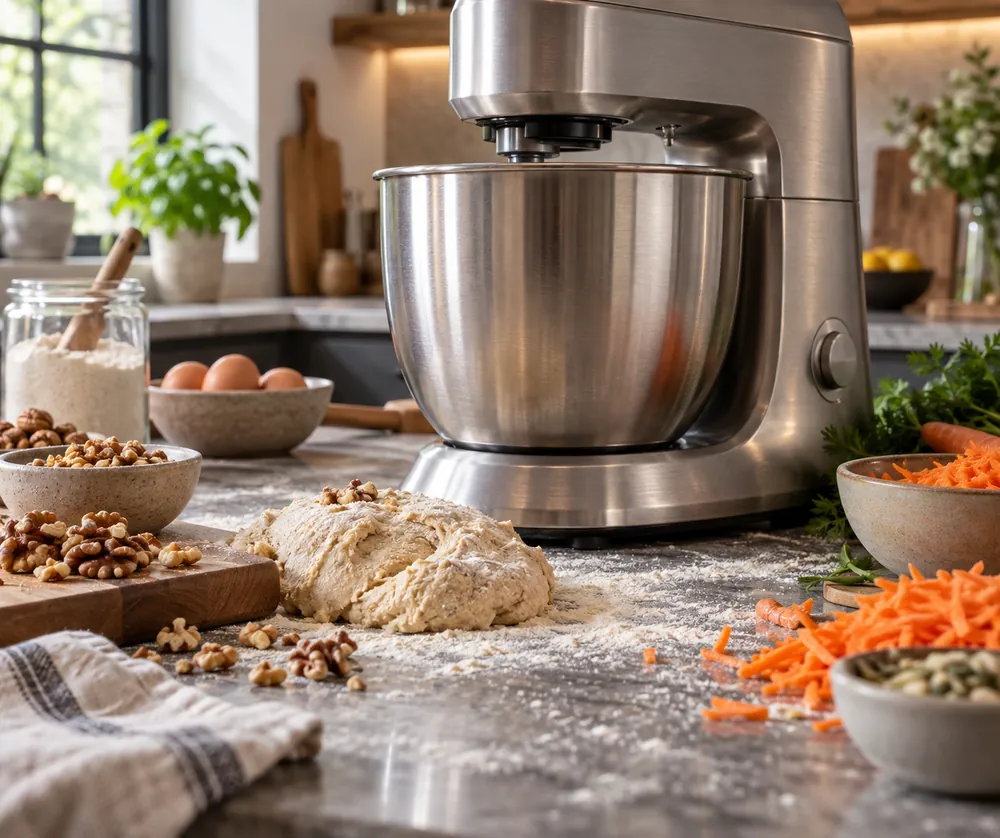
How to Compare Food Processors Beyond Wattage
Wattage shows motor draw, not overall performance. Compare bowl size, blades, controls, footprint, and parts support before assuming a higher number is better.
Bowl capacity and batch size
Capacity often matters more than motor size because it limits each batch. Small bowls store easily; larger bowls handle dough, slaws, and party prep with fewer rounds.
| Category | Typical published capacity range | Best fit |
| Mini chopper | 1.5 to 4 cups | Garlic, herbs, dips, small sauces |
| Compact processor | 5 to 8 cups | Small households and light prep |
| Full-size processor | 9 to 14 cups | Shredding, slicing, dough, meal prep |
| Large-capacity processor | 15 to 16 cups | Bulk prep and frequent entertaining |
Motor rating versus useful design
Higher wattage helps with dense dough or long shredding, but design still matters. Check overload protection, base stability, blade sharpness, and feed-tube shape.
| Processor type | Common published wattage range | Trade-off to check |
| Mini chopper | 150 to 300 watts | Convenient size, limited heavy prep |
| Compact processor | 350 to 600 watts | Good versatility, smaller batches |
| Full-size processor | 600 to 1,000 watts | More capability, more counter space |
| Heavy-duty home processor | 1,000 to 1,200 watts | Stronger motor, higher cost and weight |
Feed tube, discs, and controls
Feed-tube width affects trimming before slicing. Wider tubes save prep time; narrow pushers give better control for slim foods.
- Slicing disc: Check whether thickness is fixed or adjustable.
- Shredding disc: Look for fine and coarse options if you prep cheese or vegetables often.
- Dough blade: Useful only if the manual clearly supports dough mixing.
- Pulse control: Helps avoid overprocessing salsa, nuts, and pie dough.
Footprint, storage, and cleaning
Counter clearance can matter as much as bowl size. Compare listed height with your cabinet gap before buying.
Check whether accessories nest inside the bowl or need a separate case. Dishwasher-safe parts help, but owner reports may flag trapped water, gasket wear, or sharp discs better washed by hand.
What to read in the spec sheet
Specs should answer practical questions before brand preference takes over. Compare capacity, wattage band, dimensions, discs, warranty, and replacement-part availability together.
- Choose higher wattage for dough, hard vegetables, and frequent batch prep.
- Choose larger capacity when you cook for groups or prep ahead.
- Choose better storage when cabinet space is tight.
- Choose stronger accessory support when you want the machine to last longer.
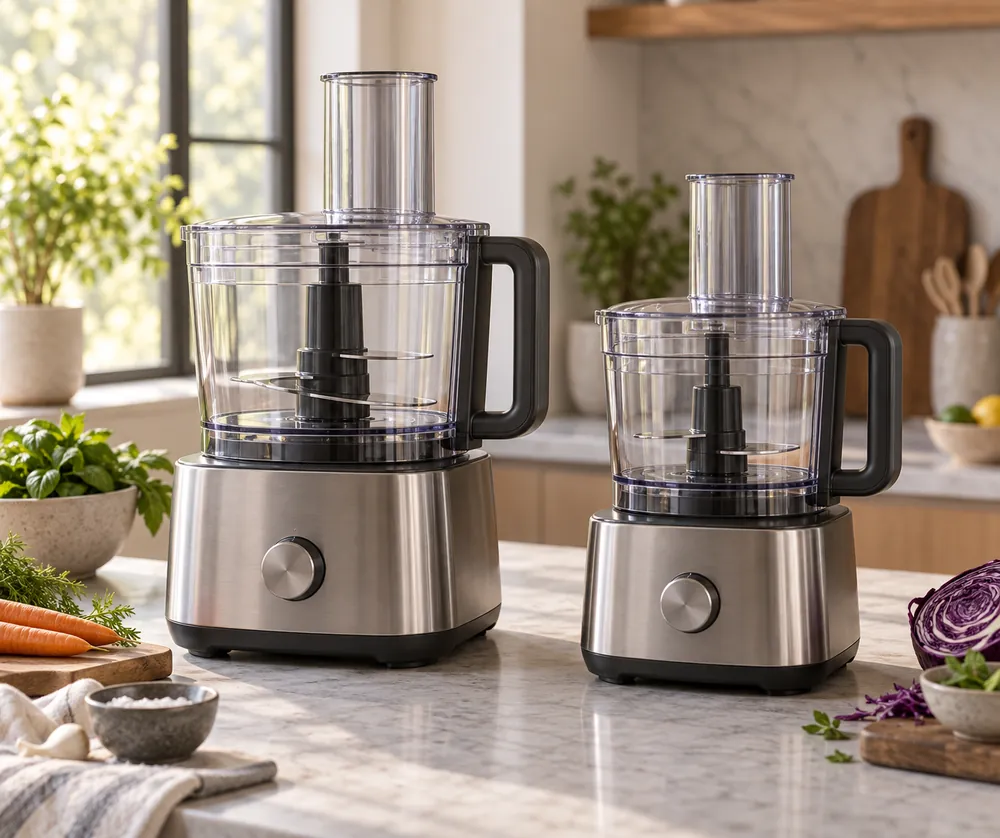
How These Hold Up After a Year
Owner reports point to one repeat complaint: food processors that sound powerful on paper can struggle with dense doughs, nut pastes, and long shredding sessions. Buyers should compare wattage, bowl size, and duty limits together.
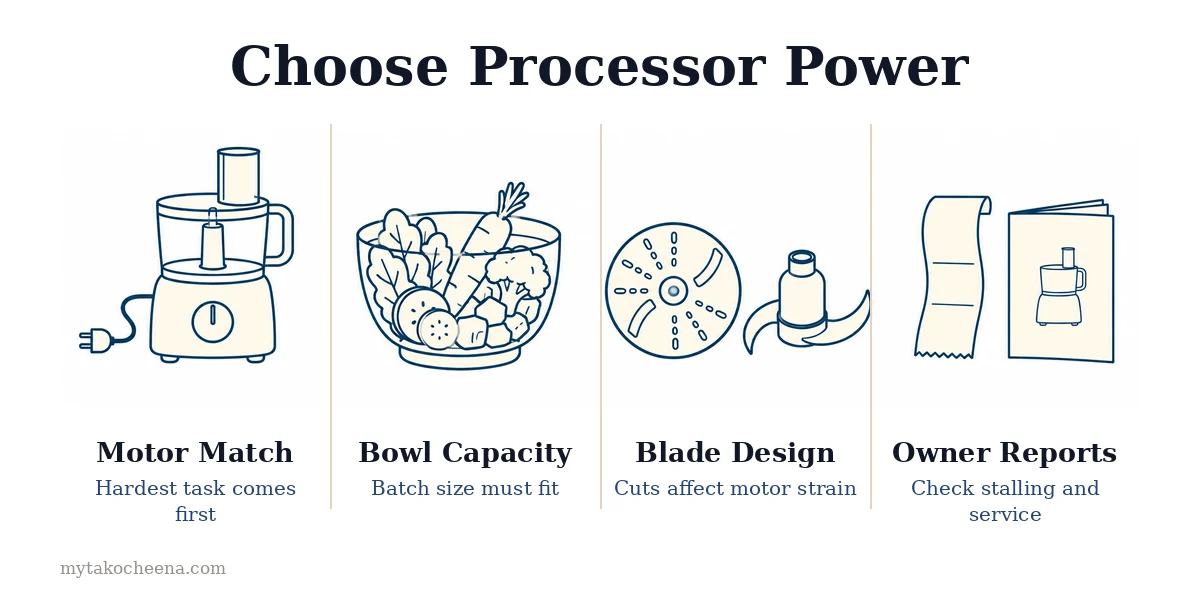
Published specifications help, but long-term satisfaction depends on matching workload to motor class.
Owners most often praise machines that stay stable, lock cleanly, and avoid overheating during normal chopping, slicing, and grating.
| Category | Typical published range | What owners tend to notice |
| Compact choppers | 250-450 watts | Good for onions, herbs, dips, and small batches; more complaints with hard cheese or dough. |
| Mid-size processors | 500-800 watts | Better balance for family prep, shredding, slicing, and thicker mixtures. |
| Heavy-duty processors | 900-1,200 watts | Fewer power complaints, but higher noise, weight, and storage concerns appear more often. |
What Holds Up Best
Owner reports repeatedly favor simple mechanical controls, wide feed tubes, and bowls with fewer narrow crevices. These parts affect cleanup and daily use more than motor wattage.
Manufacturer documentation can reveal durable design choices. Look for dishwasher-safe removable parts, clearly listed replacement bowls or lids, and safety interlocks described in the manual, not only on marketing pages.
| Capacity band | Typical bowl range | Common trade-off reported by owners |
| Small | 3-5 cups | Easy to store, but limiting for cabbage, dough, and meal prep. |
| Medium | 7-10 cups | Fits many households, but accessory storage starts to matter. |
| Large | 11-14 cups | Handles bulk prep better, but takes more counter or cabinet space. |
What Fails Early
The most common early complaints involve lids, locking tabs, feed-tube pushers, and plastic bowls cracking or becoming hard to latch. These failures are frustrating because the appliance may not run if the safety lock does not engage.
Reports also mention dull-feeling blades, stained bowls, and warped parts after high-heat dishwasher cycles.
Manufacturer care instructions often advise top-rack placement or hand-washing for some components, so warranty coverage may depend on following those limits.
- Recurring complaint: underpowered feel during dense or continuous jobs.
- Best long-term signs: available replacement parts, clear manuals, and simple latching systems.
- Early failure points: plastic tabs, lids, bowls, and accessory storage pieces.
For wattage, the safer choice is not always the biggest motor. Match the wattage band, bowl range, and care limits to the foods you prepare most often, then check owner reports for repeated failures in the same parts.
Questions Worth Answering First
Food processor wattage matters, but bowl size, blades, feed tube, warranty, and owner experience also shape the decision.
What wattage food processor do I need for everyday cooking?
For onions, salsa, cheese, and dips, midrange full-size models work well. Higher wattage helps with dough, hard vegetables, nut mixtures, and repeated batches.
| Use case | Usual published wattage range | Buyer trade-off |
| Mini choppers and small prep bowls | 200-350 watts | Compact storage, limited heavy-duty use |
| Everyday full-size processors | 450-750 watts | Good balance for routine chopping and slicing |
| Heavy-duty home processors | 800-1,200 watts | Better for dough, dense foods, and frequent batches |
Is higher wattage always better in a food processor?
No. Higher wattage helps under load, but bowl shape, blade sharpness, gearing, and overload protection also matter.
What size food processor bowl should I buy?
Match capacity to your cooking. Small bowls suit herbs and sauces; larger bowls reduce batches for slaws, dough, meal prep, and family recipes.
| Capacity band | Typical bowl range | Best fit |
| Mini | 2-4 cups | Small prep, sauces, herbs |
| Compact | 5-8 cups | Apartment kitchens and light cooking |
| Full-size | 9-14 cups | Family meals, shredding, slicing, dough prep |
| Extra-large | 15-16 cups | Large batches and frequent meal prep |
How much wattage do I need for dough?
Dough loads the motor continuously. Check dough support, blades, recipe limits, batch sizes, and warranty exclusions.
Does wattage affect slicing and shredding quality?
Wattage helps maintain speed, but disc design, feed tube stability, pusher fit, and attachments determine results.
How much counter and cabinet space does a food processor need?
Measure assembled height with lid and pusher, then compare it with cabinet and under-cabinet clearance.
| Size class | Usual height range | Common storage concern |
| Mini and compact | 8-13 inches | Fits more easily in cabinets |
| Full-size | 14-18 inches | May need counter storage or a tall shelf |
| Extra-large | 17-20 inches | Can conflict with upper cabinets |
What specs should I compare besides watts?
Compare features that affect daily use, cleaning, storage, and replacement costs.
- Bowl capacity: Match cup range to your usual batch size.
- Feed tube: Wider openings reduce pre-cutting.
- Blade and disc set: Confirm what is included, not optional.
- Dishwasher-safe parts: Check the manual, not only the product page.
- Warranty terms: Look for motor coverage and exclusions.
Should I buy a food processor or a blender for high-power jobs?
Choose a food processor for chopping, slicing, shredding, dough, and thick mixtures. Choose a blender for smoothies, soups, frozen drinks, and liquid-heavy recipes.