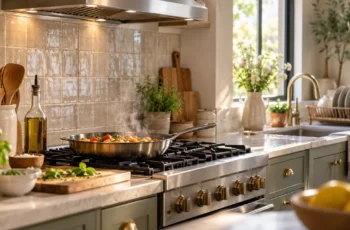
Straight answer: A good slow cooker size matches both your household and the foods you make most often. Smaller cookers suit dips, sides, and one or two people, while larger cookers handle roasts, batch meals, and family portions.
Shape matters too: round models save space, while oval models fit longer cuts of meat and whole poultry more easily.
Slow Cooker Size Basics for Everyday Cooking
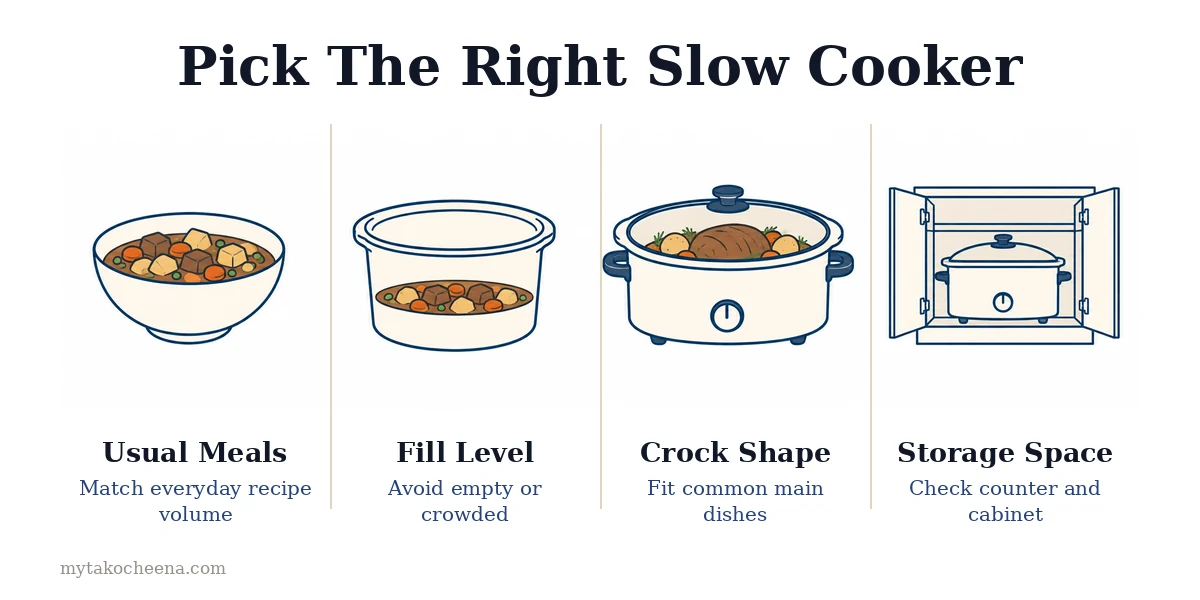
Slow cooker size starts with the food you cook most often, not the largest pot on the shelf. Shape, fill level, storage space, and serving style decide whether a cooker feels practical.
Capacity labels describe insert size, not the amount you should always cook. Recipes usually work best with the crock filled within a middle band, not nearly empty or packed to the rim.
| Capacity range | Best everyday use | Main trade-off |
| 1.5 to 3 quarts | Dips, sauces, oatmeal, side dishes, and small households | Limited room for roasts, whole poultry, or batch cooking |
| 4 to 5 quarts | Family dinners, soups, chili, shredded meat, and leftovers | May be tight for large cuts or meal prep portions |
| 6 to 8 quarts | Batch cooking, entertaining, meal prep, and larger cuts | Takes more cabinet space and may underperform with small recipes |
Round crocks suit soups, beans, dips, and saucy meals because food stacks deep. Oval crocks usually handle roasts, ribs, whole poultry, and longer vegetables better because the usable floor is wider.
Shape also affects storage. A wide oval cooker may fit meat better, while a round cooker can be easier to park in a crowded cabinet or on a narrow counter.
| Spec to check | Common range | Why it matters |
| Standard base cabinet opening | 12 to 24 inches wide | Helps predict whether the cooker stores upright without rearranging shelves |
| Counter clearance around appliance | 2 to 6 inches | Allows heat to vent and keeps nearby items away from warm surfaces |
| Usual slow cooker power draw | 150 to 400 watts | Shows general heating demand without comparing one named model to another |
| Typical low-to-high cooking range | 170 to 300 degrees Fahrenheit | Explains why slow cookers hold food gently rather than searing it |
Published capacity can still mislead. A tall crock with the same quart rating as a wider crock may bury ingredients deeper, affecting how vegetables soften and how meat fits.
Match size to normal recipe volume first, then choose shape around common proteins and storage limits. This avoids buying a large cooker that only works well for occasional holidays.
- Choose smaller for dips, sides, breakfast grains, and compact kitchens.
- Choose mid-size for regular family meals, soups, stews, and leftovers.
- Choose larger for freezer meals, parties, pulled pork, and bulky ingredients.
For everyday cooking, pick the smallest cooker that still fits your regular main dish comfortably. That gives better fill levels, easier cleanup, and less storage friction.
How Many Quarts You Need by Household Size
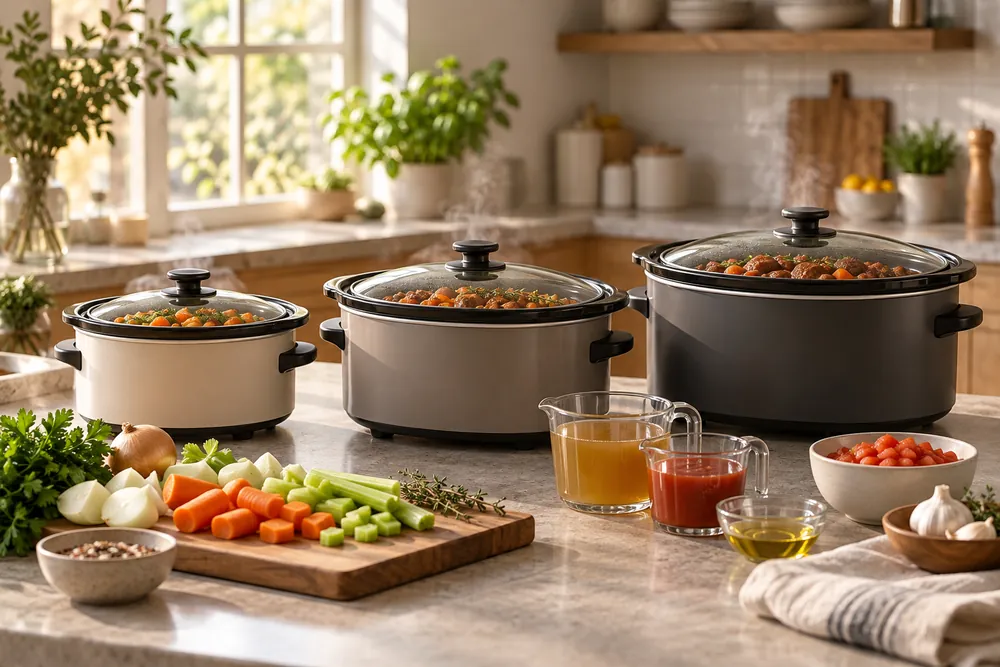
Quart size decides whether a slow cooker feels useful or annoying. Match the published capacity to how many people you feed, then adjust for leftovers, batch cooking, and storage space.
| Household or use | Capacity range to compare | Best fit |
| Solo meals or dips | 1.5 to 3 quarts | Small portions, sauces, warm appetizers |
| Two-person household | 3 to 4 quarts | Weeknight meals with limited leftovers |
| Three to four people | 4 to 6 quarts | Family dinners, soups, stews, shredded meat |
| Large household or meal prep | 6 to 8 quarts | Batch cooking, potlucks, larger cuts |
Published capacity is usually the crock’s full volume, not the practical cooking level. Many recipes work best when the insert is filled within a middle range, so buying too large can be as inconvenient as buying too small.
| Specification to compare | Typical range | Why it matters |
| Recommended fill level | One-half to two-thirds full | Helps food heat evenly without crowding or drying |
| Usual slow-cooker wattage band | 150 to 400 watts | Larger cookers often draw more power, but controls vary |
| Typical counter clearance to allow | 2 to 4 inches around the appliance | Supports ventilation and safer lid handling |
How to choose without oversizing
- Choose 1.5 to 3 quarts for dips, oatmeal, sides, or a single-person kitchen with minimal leftovers.
- Choose 3 to 4 quarts for two adults who cook standard dinners and do not want a crowded refrigerator.
- Choose 4 to 6 quarts for many family recipes, especially chili, soup, pulled chicken, and pot roast portions.
- Choose 6 to 8 quarts for batch cooking, entertaining, or recipes built around larger cuts of meat.
Shape matters after capacity. Round crocks save counter space, while oval crocks handle roasts, ribs, and whole poultry more easily.
Compare the usable recipe size, storage footprint, and lid height before choosing. A slow cooker that fits your cabinet and your usual meals will get used more often.
Round vs Oval Slow Cookers
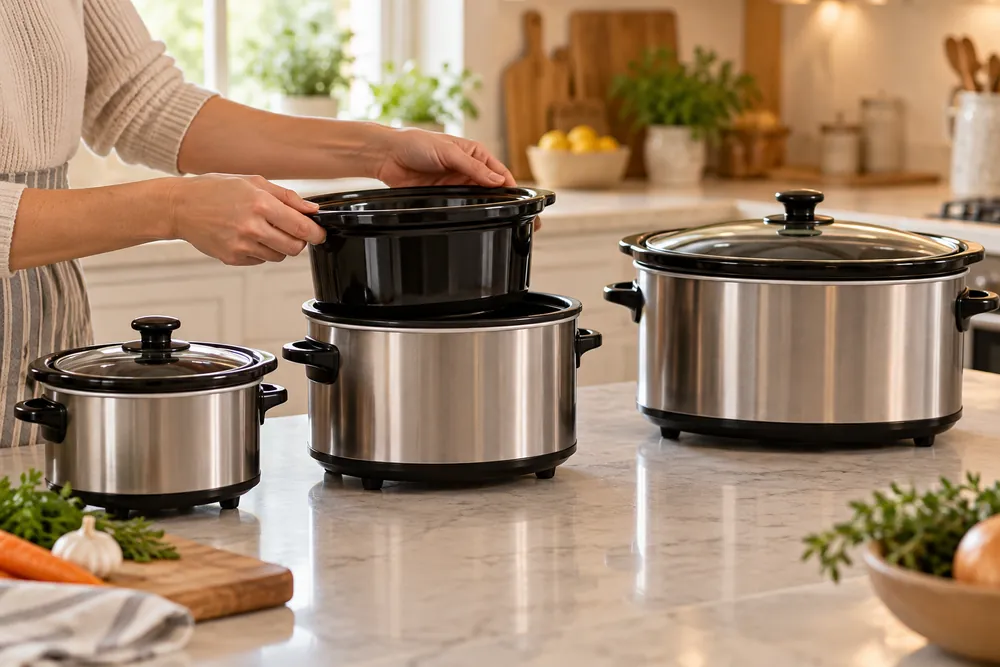
Round and oval slow cookers use similar heat technology, but shape changes food fit, storage, and handling.
Round cookers suit soups, beans, dips, oatmeal, chili, and smaller roasts. Their compact crock can store neatly in tight cabinets.
Oval cookers fit longer foods flat, including whole chickens, ribs, brisket pieces, pork loins, and layered casseroles.
| Category | Round slow cookers | Oval slow cookers |
| Common capacity bands | 1.5-4 quarts for dips, sides, and small meals | 4-8 quarts for family meals and larger cuts |
| Typical counter clearance to plan | 2-4 inches around the body for steam and handling | 2-4 inches around the body, with extra side room for longer handles |
| Usual wattage bands | 150-250 watts for smaller units; 250-400 watts for larger round units | 250-450 watts for common family-size units |
Capacity labels are not comfortable working volume. Leave headroom to reduce bubbling, uneven cooking, and difficult stirring.
Compare recipe volume with listed capacity, then choose the insert shape that fits your repeat meals.
Shape trade-offs to check before buying
- Choose round for compact storage, smaller households, dips, sauces, grains, and recipes that do not depend on food length.
- Choose oval for roasts, poultry, ribs, meal prep, and recipes where ingredients need to sit in a wider single layer.
- Check cabinet fit by comparing the listed width, depth, and height, not capacity alone.
- Check lid shape because oval glass lids can be harder to store than round lids.
Cabinet dimensions matter because shelves, hinges, and pull-outs can reduce usable space.
| Cooking need | Better shape to compare first | Reason |
| Dips, queso, oatmeal, beans | Round | Compact insert and easy stirring |
| Whole chicken, ribs, pork loin | Oval | Longer foods fit with less stacking |
| Small apartment storage | Round | Shorter side-to-side footprint in many specs |
| Family batch cooking | Oval | Larger capacity bands are more common |
Pick after matching capacity, storage, and frequent foods. Owner feedback can reveal awkward lids, heavy crocks, and cabinet fit problems.
Counter Space, Storage, and Portability
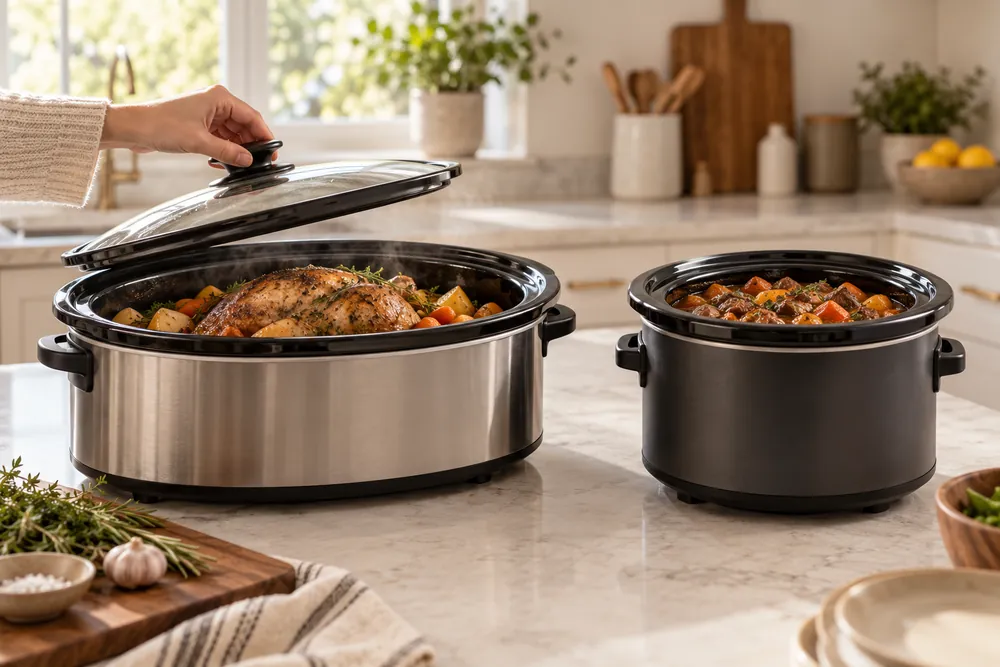
Counter space decides whether a slow cooker stays useful or gets buried. Compare the listed footprint, handle width, and lid height before choosing a shape, because published capacity alone does not tell you how it will fit.
Round cookers usually take less width, while oval cookers fit roasts, ribs, and longer vegetables better.
Rectangular multi-cookers can be harder to store because their handles, control panels, or locking lids add bulk beyond the pot size.
| Category | Typical published range | Fit trade-off |
| Small and dip-size cookers | 1 to 3 quarts | Easy to store, but limited for full meals |
| Everyday family cookers | 4 to 6 quarts | Balanced capacity, moderate counter demand |
| Large batch cookers | 7 to 10 quarts | Good for entertaining, harder to lift and store |
Cabinet fit matters as much as counter fit. Many US base and wall cabinets use openings in broad bands, so check the appliance height with the lid and handles included.
| Storage spot | Common opening range | What to verify |
| Wall cabinet shelf | 10 to 14 inches tall | Body height, lid knob, and cord position |
| Base cabinet shelf | 12 to 18 inches tall | Handle width and lift-out clearance |
| Counter under upper cabinets | 15 to 18 inches clear | Lid opening space and steam clearance |
Portability details that matter
Portability is not only weight. A cooker used for potlucks, tailgates, or office meals needs secure handles, a stable base, and a lid system that resists spills during short trips.
- Locking lid: Useful for transport, but it should not be locked during cooking unless the manual allows it.
- Side handles: Wider handles improve grip, but they increase shelf width.
- Removable crock: Easier to serve and wash, but heavier when full.
- Cord storage: A wrap or clip helps prevent snagging in crowded cabinets.
Choose the smallest shape that fits your usual recipe, not the largest capacity that fits your budget. Published dimensions reveal the daily cost: counter space, storage space, and how often you will want to move it.
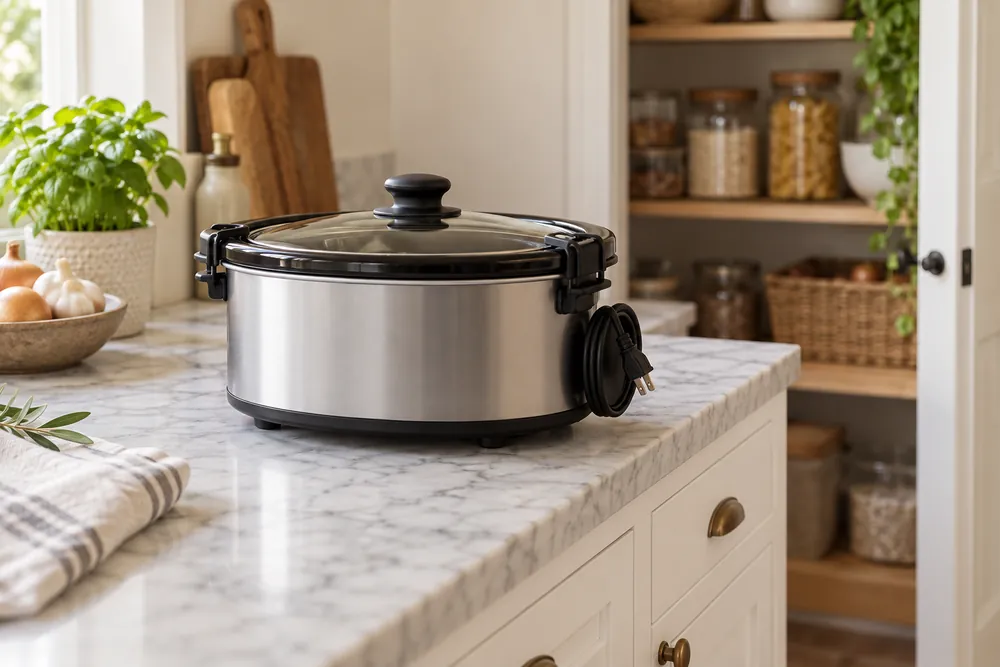
Matching Size to the Foods You Cook Most
Soup, beans, roasts, and dips point to different slow cooker sizes because volume changes how full the insert should be. Published capacity specs help, but shape matters as much as quart range.
A slow cooker usually performs best when the food fills a practical middle range, not the very bottom or brim. Compare the foods you repeat often, then choose the smallest size that still handles your largest normal meal.
| Food you cook often | Useful capacity range | Shape to consider |
| Dips, oatmeal, small sides | 1.5-3 quarts | Round or compact oval |
| Soups, beans, chili, meal prep | 4-6 quarts | Round or oval |
| Whole poultry, roasts, large batches | 6-8 quarts | Oval |
Round crocks suit liquids because the footprint is compact and stirring is easy. Oval crocks give longer foods more room, so they are better for roasts, ribs, and poultry listed in many owner reports.
Storage also affects the right match. A big oval insert may cook your favorite roast well, but it can be awkward if your cabinets or counter depth are tight.
| Spec to check | Common category range | Why it matters |
| Undercabinet clearance | 15-18 inches | Helps confirm lid removal space |
| Base width on mid-size to large units | 10-17 inches | Affects counter and shelf fit |
| Typical slow cooker power draw | 120-400 watts | Shows the general load on an outlet |
Quick matching rules
- Choose smaller for sauces and dips: shallow food in a large crock can cook unevenly and dry around the edges.
- Choose mid-size for flexible dinners: soups, stews, and beans usually fit well without dominating storage space.
- Choose oval for long cuts: shape can matter more than total capacity for roasts and poultry.
Published dimensions and owner feedback are the safest way to compare candidates. Match the foods first, then confirm capacity, shape, lid clearance, and storage fit before buying.
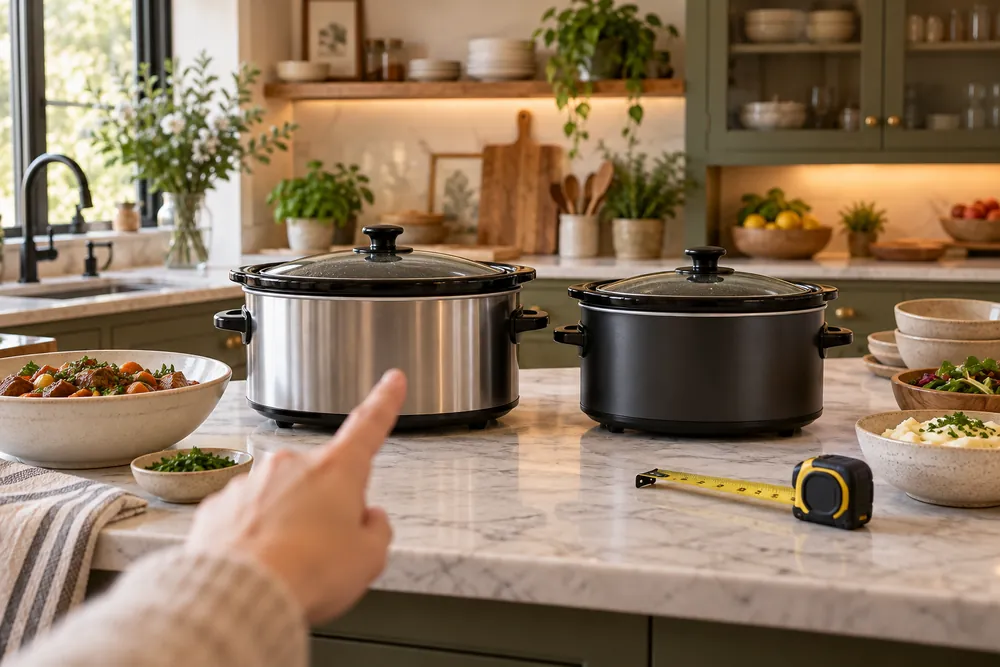
In practice, the tape measure decides whether the right capacity is livable. Measure the counter spot with the lid tilted up, then measure the shelf or cabinet where the cooker will rest between uses.
A size that fits only while closed can become annoying fast.
Also check the shape against your usual serving dish or cutting board space. A round cooker may leave more room beside it for prep, while an oval body may need a wider landing zone.
That matters in small kitchens where every inch becomes working space.
If two sizes both handle your common meals, choose the one that fits your storage and cleaning routine better. The best match is not the largest insert you can justify.
It is the cooker you can pull out, fill properly, and put away without rearranging the kitchen.
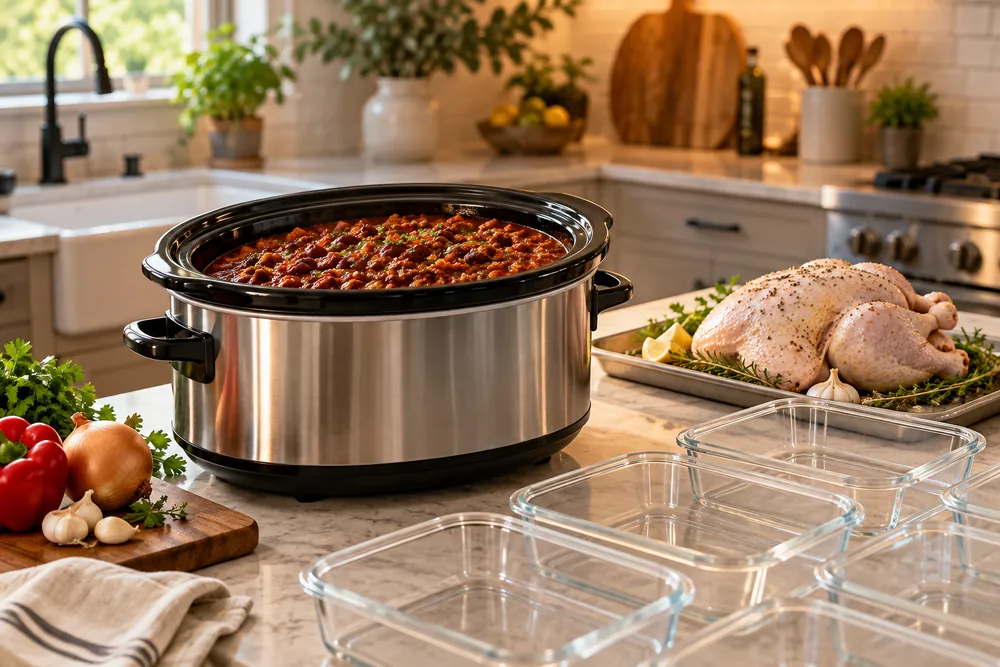
Lid Fit, Insert Weight, and Cleaning Practicality
Lid fit affects steam retention and how safely the pot moves without sloshing. Insert weight affects daily handling, especially when the crock is full, hot, or washed by hand.
Specifications rarely say “easy to clean,” so compare the parts that create work: lid type, insert material, handle shape, dishwasher claims, and whether the crock has sharp corners or a smooth oval interior.
Check the lid before comparing extras
A slow cooker lid should sit evenly on the rim without excessive rocking. Some movement is normal because slow cookers vent steam, but a loose lid can increase evaporation during long cooking.
Glass lids let you check food without lifting the cover. Locking lids help with transport, but usually are not meant to clamp during cooking unless the manual says so.
| Category | Typical published range | Practical trade-off |
| Small round cookers | 1.5-3 quarts | Easy to store, limited for roasts or meal prep |
| Family-size oval cookers | 4-7 quarts | Better for whole cuts, heavier insert when full |
| Large entertaining cookers | 8-10 quarts | More capacity, harder sink and cabinet fit |
Insert weight matters after dinner
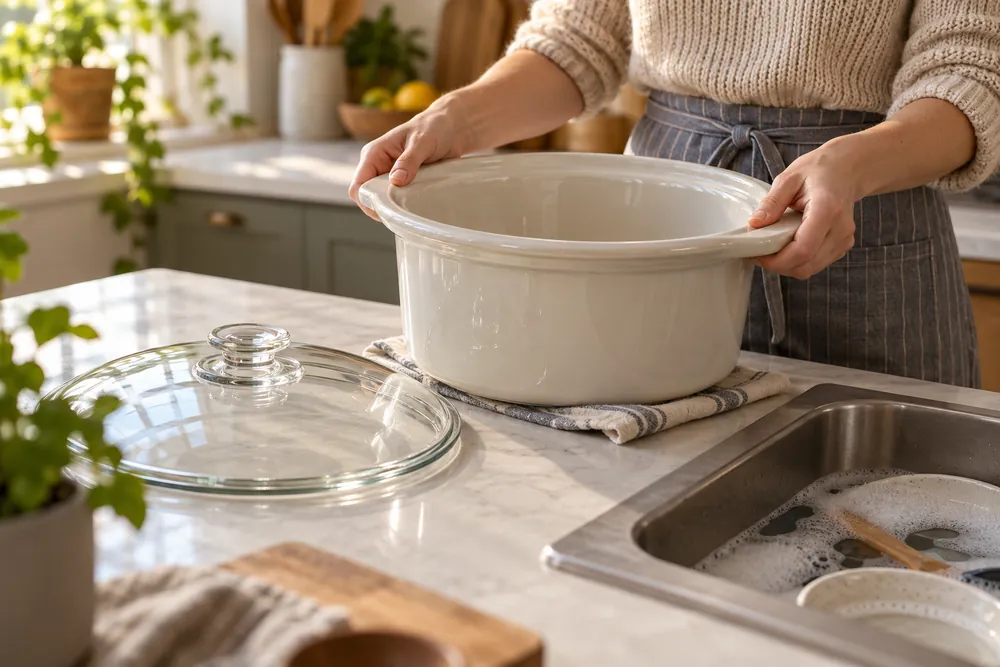
Ceramic inserts hold heat well and feel stable, but become awkward when filled. Aluminum or nonstick metal inserts may be lighter, though coating care and utensil limits matter.
Compare empty insert weight if published. If not, owner comments about lifting, washing, and cabinet storage are useful signals, especially for larger oval crocks.
- Wide handles: Easier to grip with potholders, especially on heavier ceramic inserts.
- Removable insert: Simpler serving and cleaning than fixed-crock designs.
- Rounded interior corners: Easier to wipe than squared corners where sauce can collect.
- Dishwasher-safe claims: Helpful, but check whether the lid, insert, or both are included.
| Home or appliance constraint | Common range to verify | Why it matters |
| Base cabinet openings | 12-24 inches wide | Large oval cookers may need sideways storage |
| Upper cabinet clearance | 15-18 inches above counter | Tall lids can make counter storage awkward |
| Sink bowl width | 14-18 inches | Large inserts may be difficult to wash flat |
Cleaning practicality depends on shape, not only dishwasher labeling. Oval inserts fit roasts better, while round inserts may rotate more easily in a sink and stack in a cabinet.
Treat lid fit, insert weight, and cleanability as daily-use features. Capacity matters, but a cooker that is easy to lift, wash, and store is more likely to stay in regular use.
What Buyers Notice Once It Is Installed
Counter space becomes the first practical issue owners mention after setup. Owner reports often praise set-and-forget cooking, but manufacturer documentation makes clear that clearance, cord reach, and storage footprint still matter.
Recurring complaints usually center on lid fit, hot exterior surfaces, and inserts that feel heavier than expected once full.
Buyers also report that oval shapes store less neatly, while round crocks can feel limiting for roasts and longer cuts.
| Category detail | Typical published range | What owners tend to notice |
| Capacity bands | 3- to 4-quart, 5- to 7-quart, and 8-quart-plus classes | Small units store easily; larger units handle gatherings but feel bulky. |
| Counter clearance | About 4 to 6 inches around sides and back | Tight corners can trap heat and steam near cabinets. |
| Usual wattage bands | About 150 to 400 watts for many household models | Higher-capacity cookers may draw more power and run hotter externally. |
What holds up best is usually the ceramic or stoneware insert, according to long-term owner comments. Manufacturer care guides often emphasize avoiding thermal shock, which matches reports of cracks after sudden temperature changes.
What fails early is more often a small part than the main heating base. Owners repeatedly cite loose handles, worn lid knobs, fading control markings, or digital panels that become unreliable before the crock itself wears out.
- Round cookers: easier to store, often better for soups, beans, dips, and smaller households.
- Oval cookers: better for poultry, ribs, and roasts, but wider on the counter and shelf.
- Manual controls: simpler and easier to understand, but require more attention to timing.
- Programmable controls: more convenient, but owner reports mention display and button issues more often.
Manufacturer documentation usually frames warm settings as holding functions, not cooking settings. Owner reports echo that distinction: meals may stay serving-hot, but texture can decline if food sits too long after the cooking cycle.
Buyers comparing specifications should treat shape as seriously as capacity. A larger slow cooker that does not fit the cabinet, outlet location, or usual meal size becomes the complaint that repeats after the first few uses.
What Shoppers Ask Before Ordering
Compare capacity, shape, lid style, and storage space, then read owner comments for fit issues, hot spots, and everyday usable volume.
What slow cooker size should I buy for two people?
For two adults, a small round cooker usually makes sense unless you want leftovers. Larger crocks can work, but many recipes cook best when partly filled.
| Capacity range | Typical use |
| 1.5 to 3 quarts | Dips, sides, meals for one or two |
| 4 to 5 quarts | Small families, soups, weekly leftovers |
| 6 to 8 quarts | Batch cooking, roasts, larger households |
Is an oval slow cooker better than a round one?
Oval shapes fit longer cuts and poultry. Round cookers store neatly and suit beans, stews, dips, and smaller spaces.
How much counter clearance does a slow cooker need?
Published dimensions can exclude working space. Leave room for handles, steam, and lifting the lid.
| Space to check | Practical range |
| Side clearance around handles | 1 to 3 inches |
| Vertical room to lift lid | 4 to 8 inches |
| Common upper cabinet opening | 15 to 18 inches high |
What wattage range is normal for slow cookers?
Higher capacity often means higher wattage, but controls, insulation, and crock mass also affect performance.
| Category | Usual listed range |
| Small slow cookers | 70 to 200 watts |
| Standard family sizes | 180 to 320 watts |
| Large programmable units | 250 to 450 watts |
Should I choose manual or programmable controls?
Manual knobs are simple and cheaper to replace. Programmable controls add timers and automatic warming when dinner timing changes.
Compare the display, button labels, and warm mode. Owner reports can reveal readability and beep volume.
Does the lid type matter for travel?
Yes. A locking lid helps during transport, but it is usually meant for carrying, not pressure cooking.
- For potlucks: look for gasketed or clip-style lids.
- For home use: a basic glass lid is easier to clean.
- For storage: note whether clips add width.
How full should a slow cooker be?
Many recipes work best when the crock is neither shallow nor packed tight. Match capacity to your normal batch size.
| Fill level | Practical result |
| One-half to two-thirds full | Common target for steady cooking |
| Under one-half full | May cook faster or dry at edges |
| Over two-thirds full | May heat slowly or risk bubbling over |
What specs should I compare before clicking buy?
Compare capacity, dimensions, insert material, lid style, cord length, controls, and dishwasher-safe claims. Scan owner feedback for weight, cleaning, lid fit, and footprint.