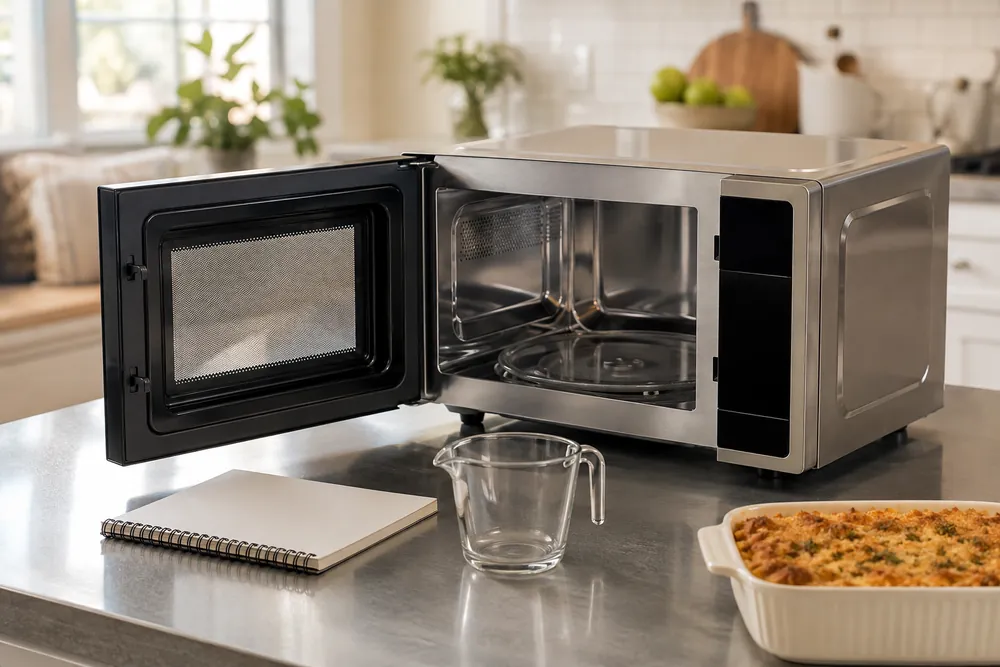
In short: A convection microwave combines microwave heating with a fan and heating element that circulate hot air for browning and baking.
It suits kitchens that need one appliance for reheating, crisping, and small oven tasks, but it costs counter space and adds cleaning, preheating, and control complexity. Buy one when those extra cooking abilities match your routine.
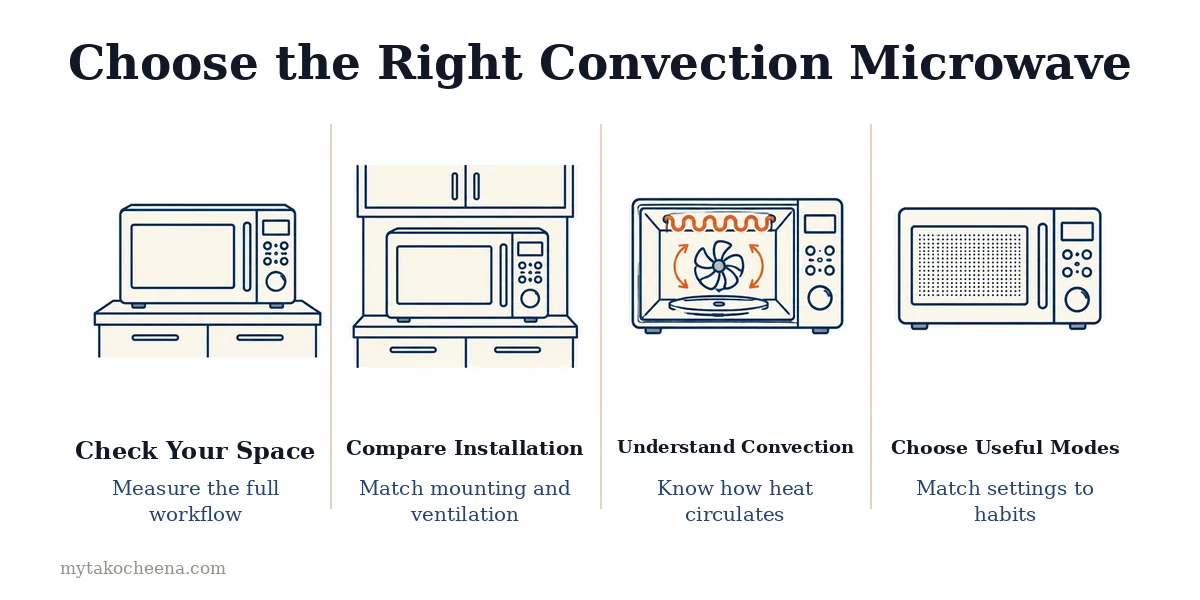
Start With The Space You Really Have
Counter space, cabinet height, door clearance, and a safe landing spot for hot cookware determine whether a convection microwave will improve your kitchen or create a daily obstruction.
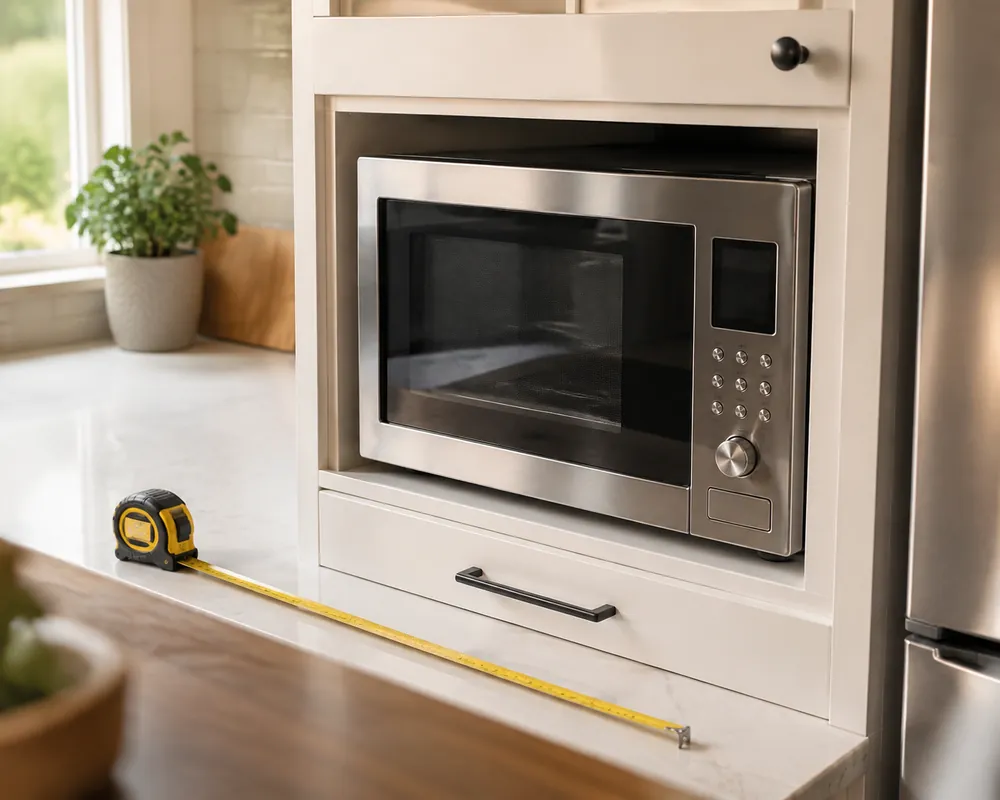
Measure the complete workflow, not just the rectangle where the appliance might sit. A unit that fits on paper can still block food preparation, collide with a cabinet, or leave nowhere to place a hot tray.
Measure the appliance and its breathing room
Record the available width, depth, and height, then compare those measurements with the manufacturer’s installation diagram.
Include the handle and door swing, the route for the power cord, and the space needed to load a casserole without twisting it around nearby cabinets.
| Measurement | Common range | Why it matters |
| Rear or side ventilation space | Two to four inches | Clearance requirements vary and restricted airflow can affect safe operation. |
| Countertop convection capacity | One to two cubic feet | Interior volume affects plate, pan, and casserole options, while exterior depth still consumes workspace. |
| Typical cooking temperature range | Two hundred to four hundred fifty degrees Fahrenheit | A wider range supports more baking and roasting tasks, provided the controls are easy to use. |
Interior capacity does not tell the whole story. A turntable may favor round cookware, while a flatbed may accept broader dishes but distribute heat differently.
Check the usable cooking surface, rack positions, and maximum dish dimensions rather than relying only on the advertised cavity size.
Choose the installation style carefully
Countertop models usually offer the simplest setup and replacement, but they occupy visible preparation space.
Over-the-range models recover counter area while demanding suitable cabinet dimensions, electrical access, mounting support, and effective venting.
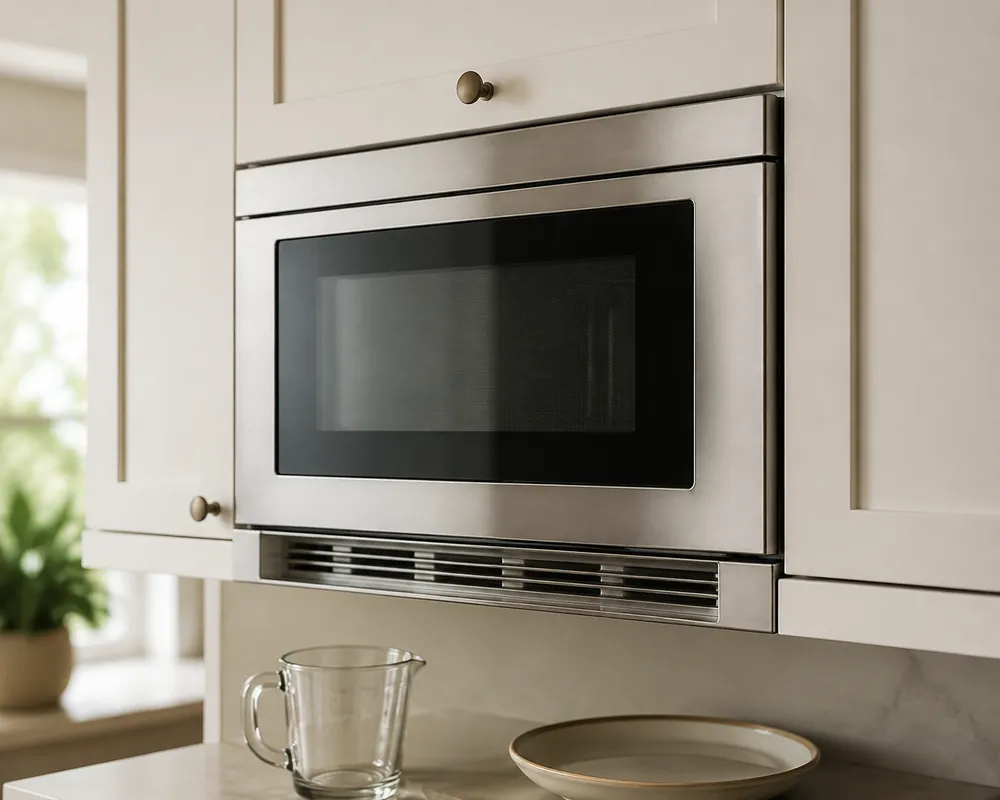
Built-in designs can produce a cleaner appearance, yet trim kits and specified airflow paths may add cost and installation work.
Confirm that the surrounding cabinetry supports the installation instead of assuming a standard opening will fit every appliance.
- Map the door swing and handle clearance before comparing features.
- Reserve a stable surface for removing hot racks and dishes.
- Prioritize a smaller unit you will use comfortably over a larger one that disrupts meal preparation.
Space also shapes convenience. A convection microwave earns its footprint when it handles reheating, crisping, and small baking jobs without slowing down the rest of the kitchen.
Know What Convection Actually Adds
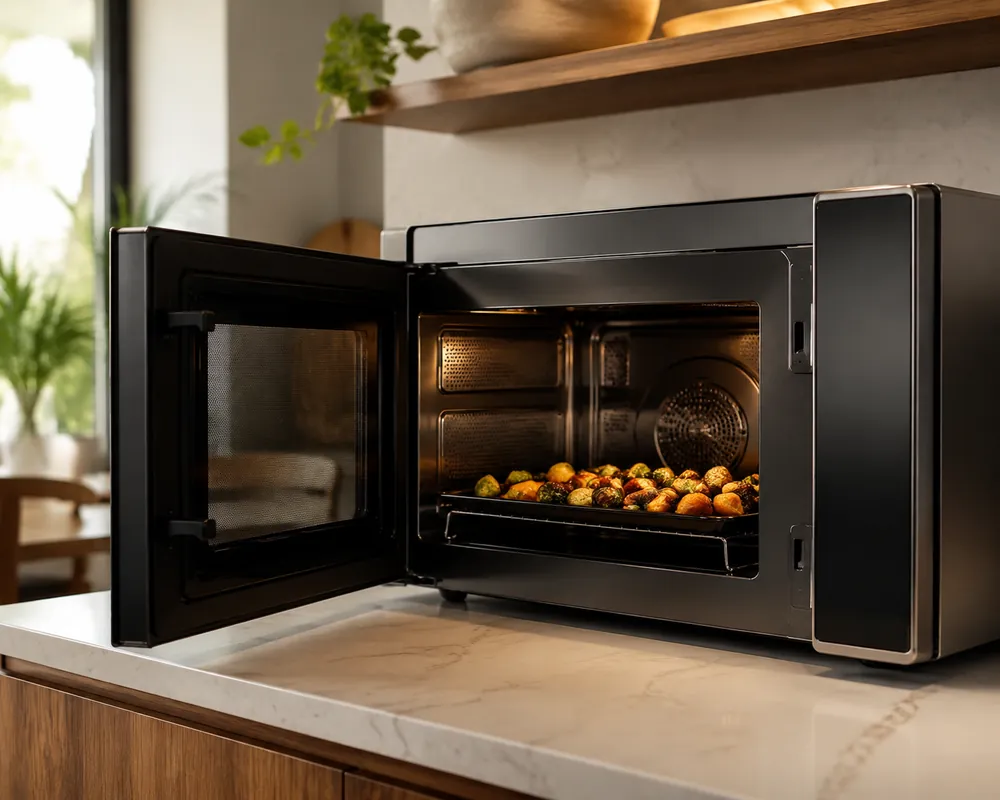
Convection adds a heating element and fan to the microwave cavity, turning the appliance into a compact oven as well as a fast reheater.
That extra airflow can brown, roast, crisp, and bake food more effectively, but it also adds preheating, hot cookware, cleanup, and controls to your routine.
Microwave mode remains best for soup, drinks, steamed vegetables, and quick reheating.
Convection mode suits foods that need dry heat and surface color, such as biscuits, small casseroles, roasted vegetables, and pizza that should regain some crispness.
| Mode | Best use | Main trade-off |
|---|---|---|
| Microwave | Fast heating and defrosting | Limited browning and crispness |
| Convection | Baking, roasting, and browning | Preheating and longer cooking time |
| Combination | Faster cooking with surface color | More adjustment and monitoring |
Check the appliance’s temperature range before assuming it can replace an oven.
Category specifications commonly span roughly the range shown below, but usable results depend on insulation, fan strength, cookware, and how evenly heat reaches the food.
| Category | Typical range | What it supports |
|---|---|---|
| Lower-temperature convection | Approximately 200–400°F | Reheating, gentle baking, and small roasts |
| Broader-temperature convection | Approximately 200–450°F | More baking and browning flexibility |
Racks matter because they position food closer to the heating element and improve airflow.
Confirm which accessories are safe in each mode; metal may be suitable for convection but unsafe during microwave operation, while tall cookware can interfere with the fan or door.
Convection makes the most sense when counter space is limited and you want an additional oven for small portions.
It adds less value when your routine is almost entirely reheating, or when you already own a toaster oven that handles browning more simply.
Match The Cooking Modes To Your Habits
Cooking modes should match the meals you make repeatedly, not the feature list printed on the control panel.
Choose a convection microwave for the combination of microwave speed and oven-style browning only when both functions solve a real kitchen problem.
Start with the tasks you perform most often. Microwave mode handles soup, drinks, vegetables, and leftovers quickly, while convection suits pizza, roasted vegetables, pastries, and foods that need a drier, browned surface.
Combination mode can shorten cooking time while adding more texture, but it may require trial and adjustment.
| Specification | Typical category range | Why it matters |
| Interior capacity | 0.7–1.5 cubic feet | Determines whether plates, pans, or baking dishes fit comfortably |
| Microwave power | 700–1,200 watts | Influences heating speed and defrosting consistency |
| Convection temperature | 200–450°F | Shows whether the oven mode suits gentle baking or higher-heat roasting |
Look for clearly labeled microwave, convection, broil or grill, defrost, and combination settings.
Controls that separate these functions are easier to understand than menus requiring several button presses, especially when you are reheating food in a hurry.
Broil or grill mode is useful for melting cheese and finishing browned tops, but it does not replace full oven capacity.
Check whether the included rack is safe for the selected mode and whether the turntable, tray, or flatbed accommodates the cookware you already own.
Automatic programs can help with common foods, yet manual time and temperature controls matter more for flexibility.
Favor a unit whose modes fit your weekly routine; unused programs add cleaning, preheating, and control complexity without adding value.
Check Controls, Cleaning, And Daily Friction
Controls, cleanup, and handling determine whether a convection microwave becomes a useful second oven or an appliance you avoid.
A strong design makes common tasks obvious, keeps spills contained, and reduces the steps between pressing Start and serving food.
Look for dedicated buttons or clearly labeled sequences for microwave, convection, broil or grill, defrost, and combination cooking.
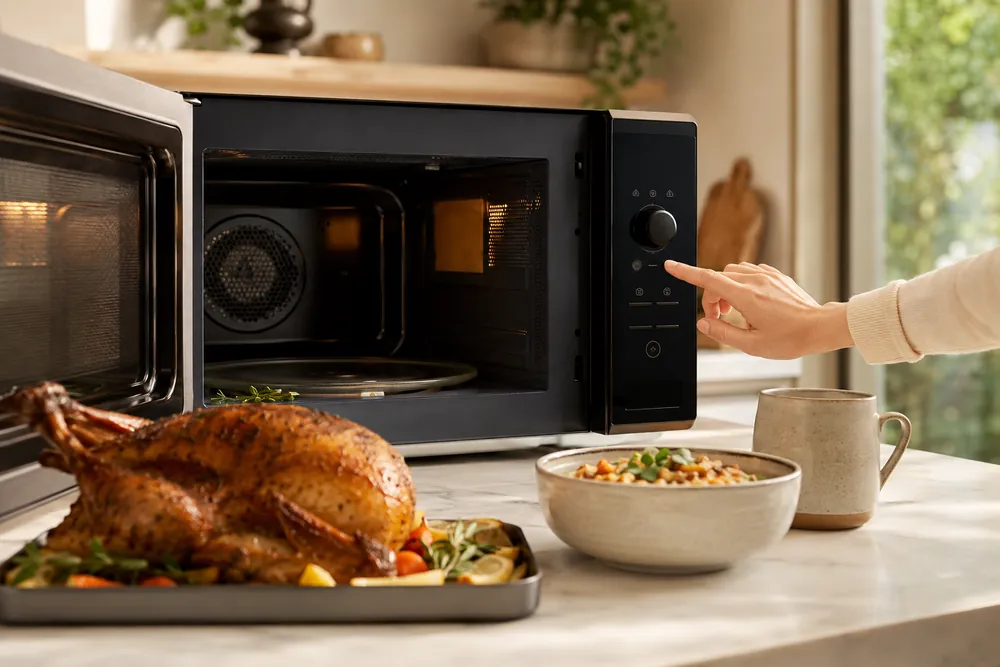
A dial can be faster than a crowded keypad, while touch controls are easier to wipe but may require more menu navigation.
Judge The Control Panel By Routine Tasks
Try to follow the control flow for reheating leftovers, defrosting meat, and baking a small dish. You should not need the manual every time you switch from microwave power to convection temperature or combination mode.
- Choose controls with readable labels and useful one-touch options.
- Check whether power level, cook time, temperature, and preheat status are visible at once.
- Look for a quiet, easy-to-cancel alert if beeps would disturb your household.
- Confirm that the interior light and window let you monitor browning without opening the door.
Plan For Heat, Steam, And Spills
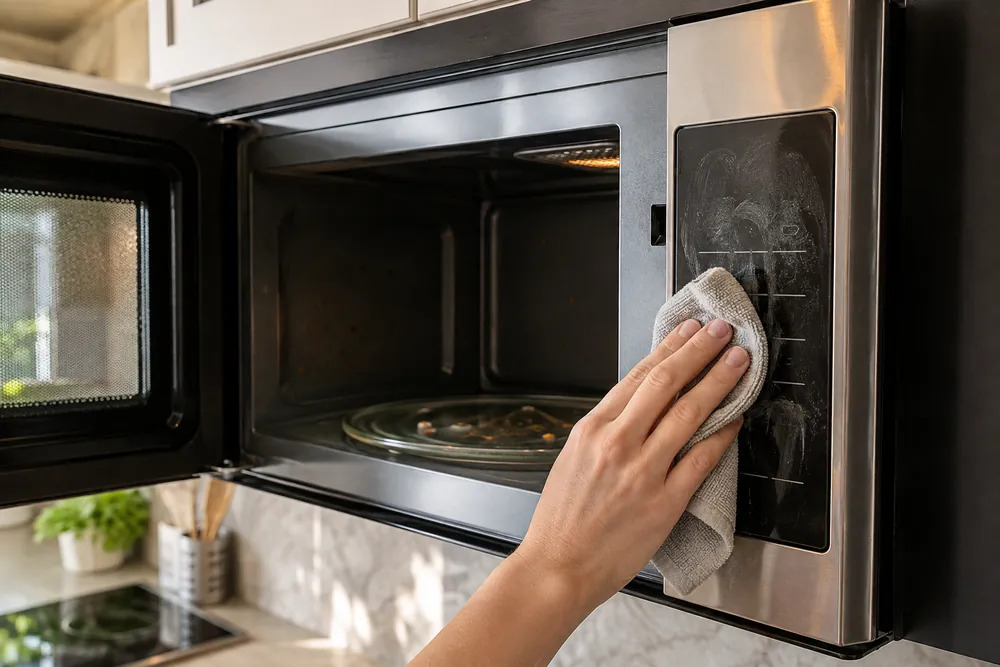
Convection cooking creates grease, crumbs, and baked-on residue that ordinary microwave reheating may not. A smooth interior, removable turntable, accessible rack, and wipeable door reduce the effort after cooking.
| Specification | Useful range or consideration |
| Typical surrounding clearance | About 2–4 inches, depending on the manufacturer’s instructions |
| Common convection temperature range | About 200–450°F, with lower and upper limits varying by unit |
Confirm the required clearance in the manual rather than assuming every countertop unit vents the same way.
Also check whether the rack, crisping tray, and turntable are dishwasher-safe; hand-washing awkward accessories can erase the convenience of combination cooking.
Finally, consider daily friction: door weight, handle comfort, interior height, preheat delay, and how easily you can remove a hot dish.
A feature-rich unit earns its counter space only when its routine feels simpler than using separate appliances.
Think About Power, Capacity, And Venting As Trade-Offs
Power, interior capacity, and venting determine whether a convection microwave feels like a useful second oven or an oversized appliance with limited flexibility.
Compare these specifications together, because gaining cooking strength or space can also increase heat, noise, electrical demand, and installation difficulty.
More Power Can Mean Faster Cooking
Higher microwave wattage can shorten reheating and cooking times, but it may also demand a more suitable circuit and make timing less forgiving.
Convection performance depends on the heating element, fan, insulation, and airflow as well as microwave output, so wattage alone does not predict baking results.
| Category | Typical range | Trade-off |
| Microwave output | 900–1,200 watts | Faster heating can require more careful timing |
| Interior capacity | 0.7–1.5 cubic feet | More room usually means a larger, heavier appliance |
| Counter clearance | 2–6 inches around vents | Better airflow costs usable workspace |
Capacity should match the cookware you actually use. A smaller cavity may handle plates, mugs, and frozen meals efficiently, while a larger one can accept a casserole dish or baking pan but may leave less room for food preparation.
Check Capacity Beyond The Advertised Cavity
Measure the turntable, rack position, and usable height instead of relying only on the stated cubic-foot figure.
A cavity can look generous on paper yet reject your favorite dish because the door, rack, or rotating tray limits its shape.
Venting creates another trade-off. Countertop units need open space around intake and exhaust areas, while over-the-range models may connect to outside ducting or recirculate filtered air.
Confirm the manufacturer’s clearance and duct requirements before treating an installation as interchangeable.
- Countertop: Easier to place and replace, but it consumes prep space.
- Over-the-range: Frees the counter, but cabinet height, electrical access, and ventilation affect the fit.
- Built-in: Looks integrated, but trim kits and airflow planning add complexity.
Choose the smallest capacity that fits your regular cookware, then verify power and venting requirements. That approach keeps the appliance useful without paying in counter space, installation work, or daily frustration.
Decide If It Replaces Another Appliance
A convection microwave earns its counter space only when it can replace a task handled by another appliance. Compare the jobs you cook repeatedly, not the number of buttons on the control panel.
Start with the appliance you hope to remove or use less often.
A convection microwave may cover microwave reheating, toaster-oven crisping, and some small-oven work, but it will not automatically replace a full-size oven, air fryer, or dedicated toaster.
Match the appliance to the job
- Replacing a basic microwave: Choose convection only if browning, crisping, or small baking jobs matter. Otherwise, the extra fan, heater, racks, and controls add cost and cleaning without improving everyday reheats.
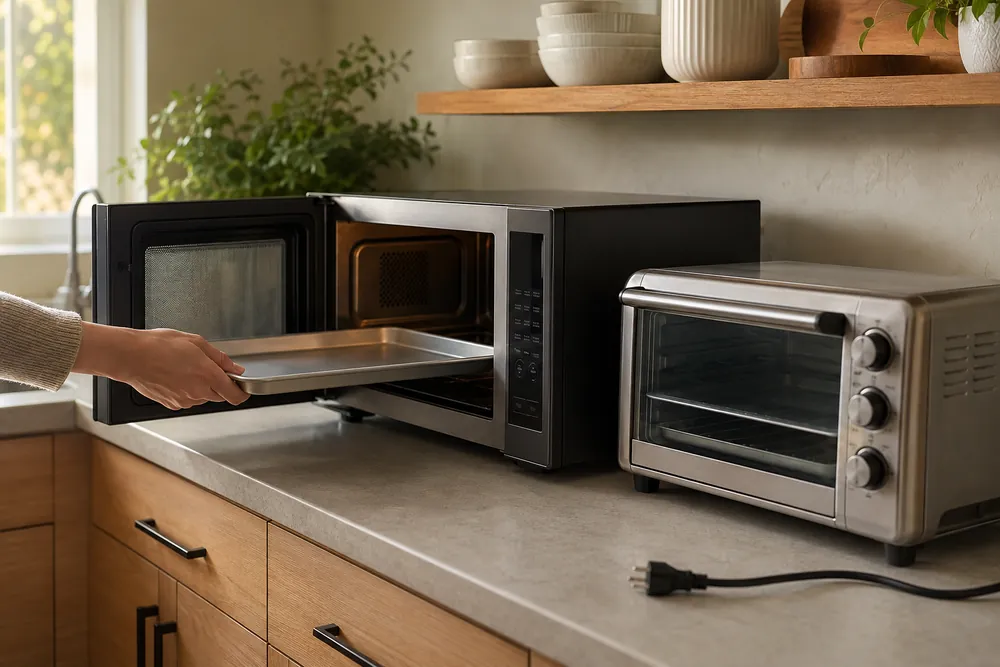
- Replacing a toaster oven: Check whether the cavity accepts your usual toast, open sandwiches, or small baking dishes. A microwave-safe turntable may not suit flat, wide foods as well as a toaster-oven tray.
- Replacing an air fryer: Combination cooking can crisp some foods, but a separate air fryer may circulate air more aggressively and offer a basket that is easier to shake and wash.
- Replacing a full-size oven: Expect a useful supplement rather than a complete substitute. A countertop cavity handles smaller portions, while larger roasts, multiple dishes, and wide baking sheets still need an oven.
Check space and electrical trade-offs
Measure the complete setup, including door swing, ventilation space, cord access, and a safe landing place for hot cookware.
Countertop convection microwaves commonly occupy deeper footprints than basic microwaves, so a unit that fits the width may still block preparation space.
| Specification | Common range | Why it matters |
|---|---|---|
| Countertop clearance | 2–6 inches | Allows airflow around the housing; follow the manual first |
| Usual countertop capacity | 0.9–1.5 cubic feet | Helps indicate whether plates, pans, or casseroles will fit |
| Typical microwave power | 900–1,200 watts | Affects reheating speed and electrical load |
Also compare cleanup and workflow. Preheating, changing racks, wiping grease from the fan area, and waiting for hot metal to cool can erase the convenience of replacing another appliance.
Choose the unit when it removes a real appliance or combines two jobs you perform often. Keep your existing oven or toaster oven when capacity, speed, or simpler controls matter more than saving one appliance footprint.
The Bottom Line Before You Buy
Fit, venting, cooking modes, and your real reheating habits should decide the purchase. A convection microwave earns its space only when it handles everyday food without making cooking slower, louder, or more complicated.
Start by measuring the complete workflow, not only the open counter area. Check the door swing, cord route, cabinet height, ventilation space, and a safe landing spot for hot cookware.
| Check | Common range | Why it matters |
| Countertop clearance | 2–4 inches | Allows airflow around many countertop designs |
| Countertop capacity | 0.9–1.5 cubic feet | Helps determine plate, pan, and casserole flexibility |
| Convection temperature | 200–450°F | Shows whether the oven suits baking, roasting, or crisping |
Exterior dimensions matter as much as interior capacity. A wide cavity may still feel restrictive if the turntable limits pan shapes, while a flatbed design can improve usable space but may change how evenly some foods cook.
Choose the installation style carefully. Countertop units are simpler to place and replace but consume prep space. Over-the-range models can preserve counter space, yet cabinet fit, electrical work, and venting become more important.
Built-in installations may look cleaner but can require trim kits and additional airflow planning.
Convection adds a fan and heating element to standard microwave cooking. That enables browning, roasting, and baking, but it also introduces preheating, racks, hot cookware, and extra cleanup.
Look for clearly labeled microwave, convection, broil or grill, defrost, and combination modes. Buy for the settings you will use on busy weeknights, not for the longest feature list.
A basic microwave remains the better choice for drinks, soup, vegetables, and routine leftovers.
Choose convection when you also need crisp reheats, frozen meals, toastier finishes, or small baking jobs; otherwise, the added controls may become expensive clutter.
What Owners Report After Six Months
Owner reports after six months tend to separate useful flexibility from daily irritation.
The recurring complaint is not usually microwave performance; it is noise, difficult cleaning, and controls that make a quick reheat feel slower than expected.
What Holds Up
Owners commonly say the microwave function remains dependable for leftovers, drinks, frozen meals, and defrosting.
Manufacturer documentation also supports using combination modes for faster cooking, while convection settings handle browning and small baking jobs.
Durability reports are more favorable when the cavity, turntable, racks, and door seal are cleaned regularly.
Stainless interiors and removable accessories generally make routine maintenance easier, although grease still collects around vents and the upper heating element.
| Specification | Typical category range |
|---|---|
| Countertop capacity | 0.8–1.5 cubic feet |
| Microwave power | 900–1,200 watts |
| Convection cooking temperature | 200–450°F |
What Becomes Annoying
Owner complaints repeatedly mention loud fans, hot exterior surfaces, and long cooling cycles after convection cooking.
Manufacturer instructions often require open space around the appliance, so cramped placement can make heat and noise more noticeable.
Some owners also report early problems with door switches, displays, turntables, or control panels.
These reports do not establish a universal failure pattern, but they make warranty length, service availability, and return terms worth checking before purchase.
Before buying, read recent owner reports for cleaning effort, fan noise, and control clarity rather than focusing only on capacity.
A unit that matches your available space and everyday meals is more likely to remain useful after the novelty fades.
Those reports matter most when matched to the space available. Measure the appliance footprint, then mark the required clearance around its sides, rear, and top.
A unit that technically fits may still feel crowded if nearby cabinets restrict airflow or make controls difficult to see.
Check the door swing before choosing a location. The hinge side, handle projection, and open-door depth can interfere with a wall, backsplash, cabinet, or adjacent appliance.
Leave enough room to remove a hot dish without twisting around the counter.
Counter depth also affects everyday access. A deeper oven may leave less usable workspace in front, while a lightweight shelf may flex when the door opens.
Confirm that the supporting surface is level, stable, and rated for the appliance and its contents.
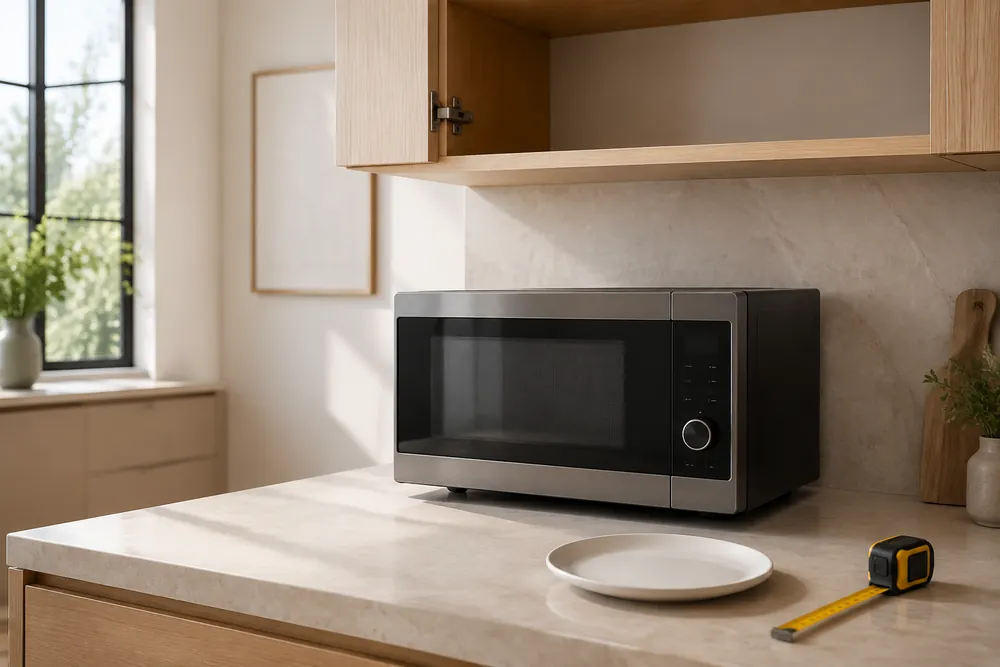
Use the tape measure for the interior as well as the exterior. Compare the turntable diameter and cavity shape with the plates, containers, and baking dishes you actually use.
Interior volume alone does not show whether a favorite dish will fit comfortably.
Finally, locate the outlet before carrying the oven home. Avoid relying on an extension cord, and check that the cord can reach without running across a hot surface.
These placement details often determine whether the added convection function feels useful or cumbersome.
What Shoppers Ask Before Ordering
Counter space, venting, cooking modes, and daily reheating habits determine whether a convection microwave earns its footprint.
These answers help separate useful oven flexibility from features that add controls, cleaning, and noise without improving your meals.
What size convection microwave should I buy?
Measure the appliance, door swing, cord route, cabinet height, and landing space for hot cookware. Interior capacity also matters because a wide plate may fit differently from a tall casserole.
| Capacity band | Best suited to |
| 0.7–1.0 cu. ft. | Single portions and compact kitchens |
| 1.1–1.5 cu. ft. | Family leftovers and standard dinner plates |
| 1.6–2.2 cu. ft. | Larger dishes and small baking jobs |
How much clearance does a convection microwave need?
Follow the manufacturer’s ventilation instructions rather than assuming every countertop unit uses the same spacing. A practical planning range is about 2–6 inches around ventilation areas, but the required clearance varies by design.
Is convection worth it for reheating leftovers?
Microwave mode remains fastest for soup, rice, and soft leftovers. Convection or combination mode helps pizza, roasted foods, pastries, and breaded items regain surface texture instead of becoming warm and limp.
What cooking modes should a convection microwave have?
Look for clearly labeled microwave, convection, combination, defrost, and broil or grill settings. Presets help only when they are easy to adjust; confusing controls can make a versatile appliance slower to use.
- Choose combination cooking for faster browning.
- Choose convection for baking and roasting.
- Choose microwave-only cooking for routine reheating.
Can a convection microwave replace a toaster oven?
It can cover many small baking, crisping, and roasting tasks while saving counter space. It may not match a dedicated toaster oven for repeated batches, long baking sessions, or easy access to a shallow tray.
What temperature range should convection cooking offer?
A useful category-level range is approximately 200–450°F, depending on the appliance. A wider range offers more flexibility, but usable controls, preheating behavior, and even airflow matter more than the highest setting.
Are countertop or over-the-range models better?
Countertop models simplify installation and replacement but consume prep space. Over-the-range models free the counter, yet cabinet fit, electrical work, mounting, and venting can make the project more expensive and restrictive.