The short answer: A suitable garbage disposal matches your cooking habits, sink, plumbing, and available cabinet space.
Most regularly used household kitchens benefit from a 3/4 HP model, while lighter use may require less power and heavy cooking may justify more.
Continuous feed models offer convenience, whereas batch feed units add a safety-focused operating step. Stainless steel parts, jam resistance, noise control, and warranty coverage also matter.
Start With Your Household Size and Cooking Habits
Household size matters, but cooking style is the stronger buying signal. A one-person home that prepares meals from scratch may need more grinding capacity than a larger household that mostly reheats food.
Match the disposal to your sink scraps, how often you run it, and the space beneath the drain. A stronger unit can reduce jams, while a compact model may preserve cabinet storage.
| Kitchen pattern | Common motor range | Typical waste |
| Light cooking or small household | 1/3–1/2 HP | Soft scraps and occasional plate cleanup |
| Regular family cooking | 1/2–3/4 HP | Daily preparation scraps and mixed leftovers |
| Heavy cooking or frequent entertaining | 3/4–1 HP | Tougher produce waste and repeated runs |
Match Capacity to Your Routine
Choose the lower category for occasional rinsing of soft food, such as cooked vegetables, fruit trimmings, and plate residue. Select a stronger category for daily chopping, frequent peeling, or cleaning several pans after meals.
Batch cooking deserves attention. Repeated short runs can strain a weak motor more than one occasional cleanup, particularly when fibrous scraps or dense leftovers enter the drain together.
- Light use: prioritize compact dimensions and adequate basic grinding.
- Daily cooking: favor stronger grinding and better jam resistance.
- Entertaining: consider sustained cleanup demands and noise control.
| Planning point | Typical range | Why it matters |
| Vertical clearance | 12–18 inches | Allows room for the unit and plumbing |
| Motor category for frequent cooking | 3/4–1 HP | Supports repeated mixed-scrap cleanup |
Measure the cabinet before choosing a taller disposal, especially with a shallow sink or crowded plumbing. Homes with septic systems should follow local guidance before increasing food waste through the drain.

Choose the Right Motor Power
Motor power determines how easily a garbage disposal breaks down food scraps. Match horsepower to cooking frequency, household workload, and the waste commonly rinsed into the sink.
| Motor range | Best suited to | Trade-off |
| 1/3–1/2 horsepower | Soft scraps and occasional use | Lower cost and smaller footprint, but less suitable for demanding loads |
| 1/2–3/4 horsepower | Routine family cooking and mixed scraps | Balanced grinding strength, capacity, and cabinet space |
| 3/4–1 horsepower | Frequent cooking, batch preparation, and tougher waste | More capability, with potentially greater size and noise |
| 1–1 1/4 horsepower | Heavy-use kitchens and repeated daily loads | Useful for demanding work, but may exceed a light-use kitchen’s needs |
Lower-power units handle soft produce ends, plate scrapings, and small leftovers. They may struggle with fibrous peels, dense food waste, or repeated loads.
A 1/2–3/4 horsepower category suits many households that cook regularly. Choose the stronger end for daily vegetable preparation, several pans, or fewer jams during short operating cycles.
Power does not replace correct use. Avoid grease, large bones, and stringy waste unless the manufacturer permits them.
Check dimensions, sink opening, plumbing alignment, and electrical requirements before prioritizing extra horsepower.
Start by measuring the space beneath the sink, not the cabinet exterior.
Record the clear height from the underside of the sink to the lowest obstruction, then measure available width and depth around the drain, trap, water lines, and cabinet walls.
Leave room to connect the discharge pipe without forcing it into a sharp bend.
A disposal that fits vertically may still create a plumbing conflict if its outlet sits too close to the existing drain line or leaves insufficient space for the trap.
Measure the sink opening as well, especially when replacing an older unit.
Most disposals use a standard opening, but a nonstandard sink, thick flange, or undermount installation can affect compatibility and may require an adapter or replacement mounting hardware.
Use the measurements to narrow the field before comparing features. If clearance is tight, prioritize a compact design and accessible connections.
If the cabinet has generous room, consider whether easier servicing, better sound insulation, or a more substantial mounting assembly matters more than the smallest footprint.
Also trace the electrical route. Confirm that the cord, switch, outlet, or air-switch arrangement can reach its connection without crossing plumbing or interfering with stored items.
Take photos and note each measurement before shopping, then compare them with the manufacturer’s installation dimensions.
Compare Continuous Feed and Batch Feed Models
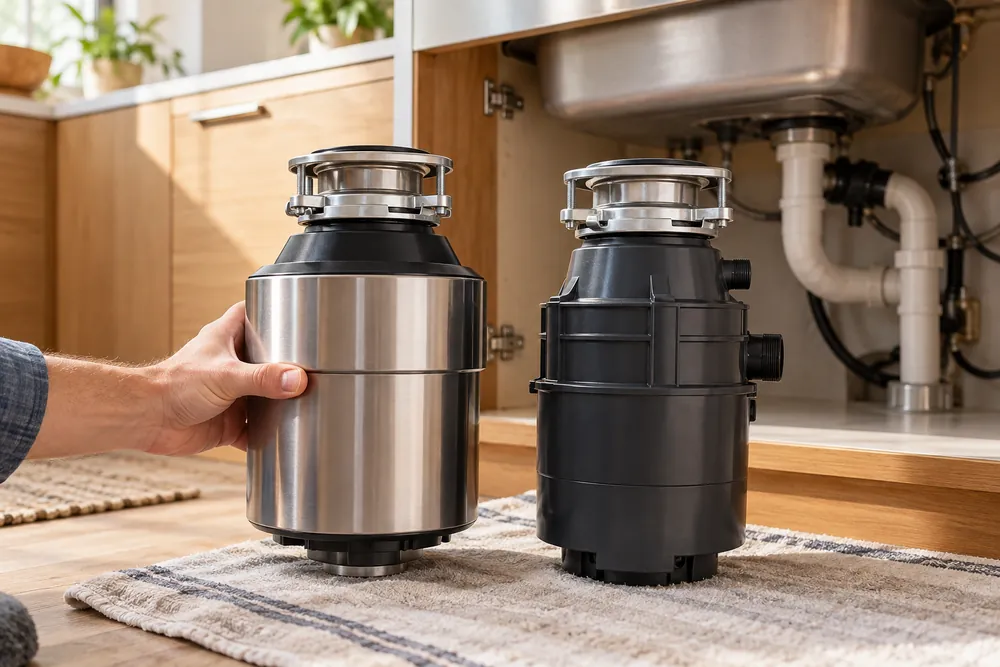
Feed style determines how you load scraps, control operation, and manage safety. Continuous feed models suit fast cleanup, while batch feed models suit households that prefer covered, step-by-step grinding.
Continuous feed: faster for active kitchens
A continuous feed disposal starts with a wall switch or air switch and runs while you add scraps. It suits meal preparation when trimmings and plate scrapings accumulate quickly.
The opening remains accessible while the motor runs. Keep utensils, hands, and loose objects away from the drain, and handle food scraps carefully.
Batch feed: controlled loading and added protection
A batch feed disposal operates only after you place a stopper or cover in the drain opening. Separate loads can reduce accidental access and suit families with children or households that prefer deliberate operation.
This control takes longer during large cleanups. Compare the cover design and usable grinding space rather than choosing by feed type alone.
| Feature | Continuous feed | Batch feed |
| Typical use | Frequent, fast cleanup | Controlled, smaller loads |
| Operation | Switch or air switch | Cover or stopper cycle |
| Safety emphasis | Requires careful handling | Covered opening during operation |
Check the installation footprint first. Common under-sink clearance needs range from 12 to 18 inches, and batch models may need room for their cover mechanism.
Choose continuous feed for speed or batch feed for controlled loading. Either style should include stainless steel grinding components, jam resistance, manageable noise, and compatible plumbing connections.
Check Sink, Plumbing, and Septic Compatibility
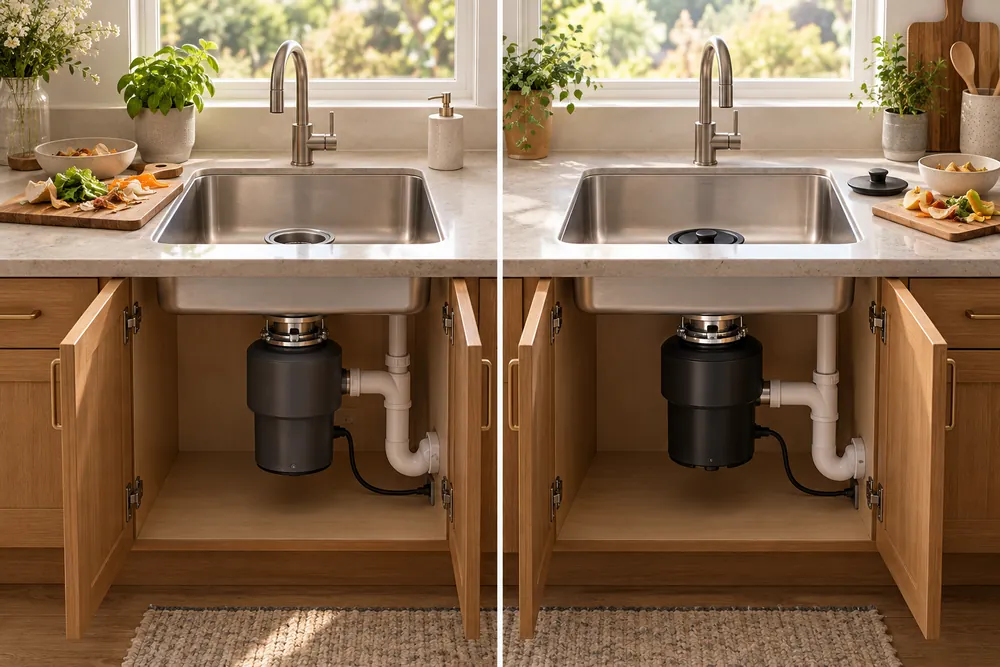
A garbage disposal must fit the sink opening, under-sink space, drain plumbing, electrical setup, and septic system. Confirm compatibility before comparing grinding power.
Measure the sink and cabinet
Most disposals fit standard sink flanges, but some require a mounting ring or adapter. Measure the drain opening and space for the disposal, elbow, trap, wiring, and shelves.
| Measurement | Common category range | Why it matters |
| Vertical cabinet clearance | 12–18 inches | Allows room for the disposal body and plumbing |
| Drain connection position | Several inches below the sink outlet | Affects trap alignment and drainage slope |
Check outlet alignment with the drainpipe. A different unit size may require a new trap, extension tube, or cabinet adjustment. Do not force connections, which can cause leaks.
Review plumbing and electrical requirements
- Confirm the dishwasher inlet can connect to the disposal, and remove its internal knockout before attaching the hose.
- Check that the circuit, switch, grounding, and required protection meet local electrical rules.
- Leave service access around the reset button and avoid blocking shutoff valves or stored cleaning supplies.
Confirm septic compatibility
Septic systems receive disposal waste, so ask the installer whether one is appropriate and whether added maintenance or treatment is needed.
Use cold water, avoid grease and fibrous waste, and run the unit long enough to clear the line.
Look at Grinding Stages and Jam Resistance
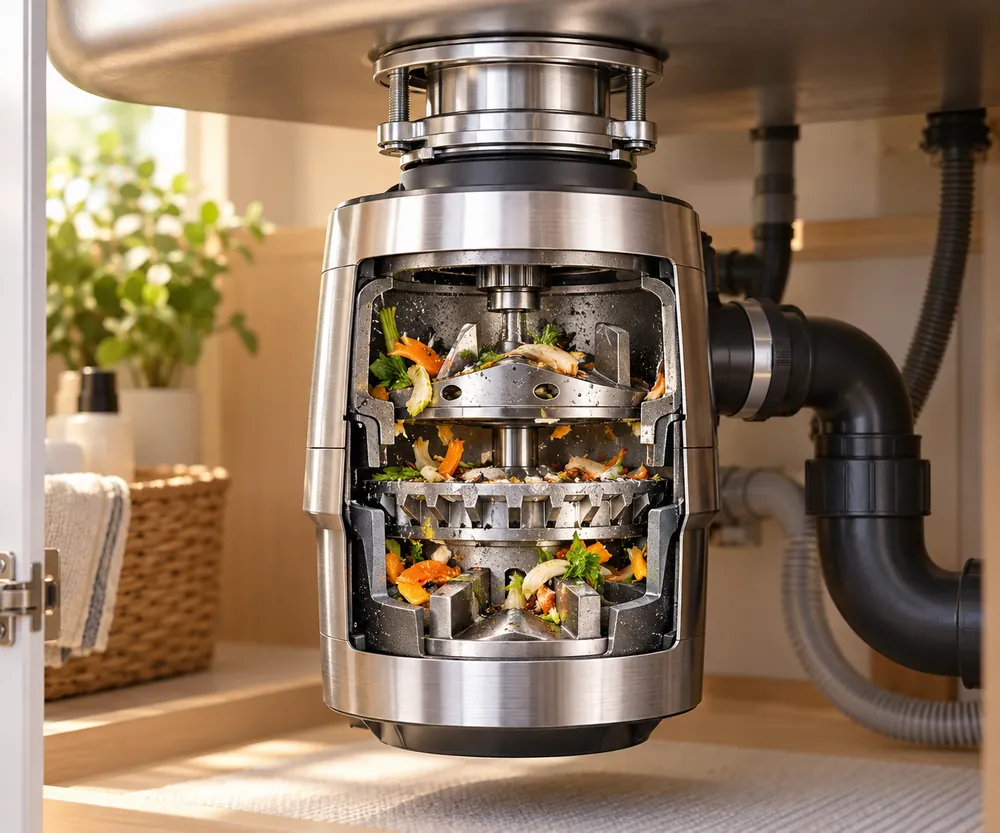
Grinding stages determine how finely a disposal breaks food waste, while jam resistance affects how reliably it handles uneven or fibrous scraps.
Compare both features with motor strength, sink habits, and plumbing needs rather than assuming more stages mean better performance.
Match grinding stages to your waste
A single grinding stage suits soft scraps and ordinary plate rinsing. Multiple stages produce finer particles, which may help waste move through narrow or older drain lines, but they can add cost and increase the unit’s size.
Fine grinding does not make a disposal suitable for every material. Avoid glass, metal, grease, large bones, and stringy waste. Fibrous scraps can wrap around moving parts instead of breaking apart cleanly.
| Motor category | Typical fit | Grinding-stage consideration |
| 1/3–1/2 HP | Light use and soft scraps | Basic grinding is often adequate |
| 1/2–3/4 HP | Routine family cooking | Choose finer grinding for mixed daily waste |
| 3/4–1-1/4 HP | Heavy preparation and repeated use | Prioritize robust components and jam recovery |
Check how the unit handles jams
Jam resistance comes from torque, cutting geometry, corrosion-resistant components, and a safe way to free the grinding mechanism.
Look for overload protection and a manual reset, then confirm the button remains reachable after installation.
Some disposals reverse or loosen the grinding mechanism to clear jams. This reduces the need to reach beneath the sink with a tool, but it does not replace careful loading or safe shutoff procedures.
| Space category | Typical range | What to check |
| Vertical clearance | 12–18 inches | Housing, trap, wiring, and service access |
| Motor housing depth | Compact to extended | Cabinet back wall and adjacent plumbing |
Choose the finest grinding system that fits your budget, plumbing, and cabinet space. In a busy kitchen, prioritize jam recovery and durable grinding parts over features unrelated to your typical scraps.
Consider Noise Level and Insulation
Noise control matters when the sink sits near a dining area, home office, or open living space. Compare sound ratings, insulation, and mounting design rather than assuming a larger motor is louder.
Compare reported sound levels
Manufacturers use decibel ratings, sound-reduction claims, or terms such as “quiet.” Treat them as starting points because installation, cabinet construction, water flow, and food scraps affect the sound you hear.
| Category | Typical reported range | Trade-off |
|---|---|---|
| Basic compact units | 60–70 dB | Lower cost and smaller housing, but more noticeable operation |
| Insulated household units | 50–60 dB | Quieter operation with additional housing and insulation |
| Premium quiet-focused units | 45–55 dB | Better sound control, often with greater size or cost |
Look beyond the motor
Layered housing, insulated motor compartments, tighter grinding chambers, and vibration control can reduce hum and rattling. They cannot eliminate sharper sounds from hard scraps contacting the grinding components.
- Insulated shell: Helps contain motor and grinding noise inside the disposal body.
- Vibration control: Reduces rattling through the sink, flange, cabinet, and connected plumbing.
- Anti-splash baffle: Can limit splash and some high-frequency noise around the sink opening.
- Rigid mounting: A secure, correctly fitted mount prevents movement that can amplify sound.
Allow space for sound-control features
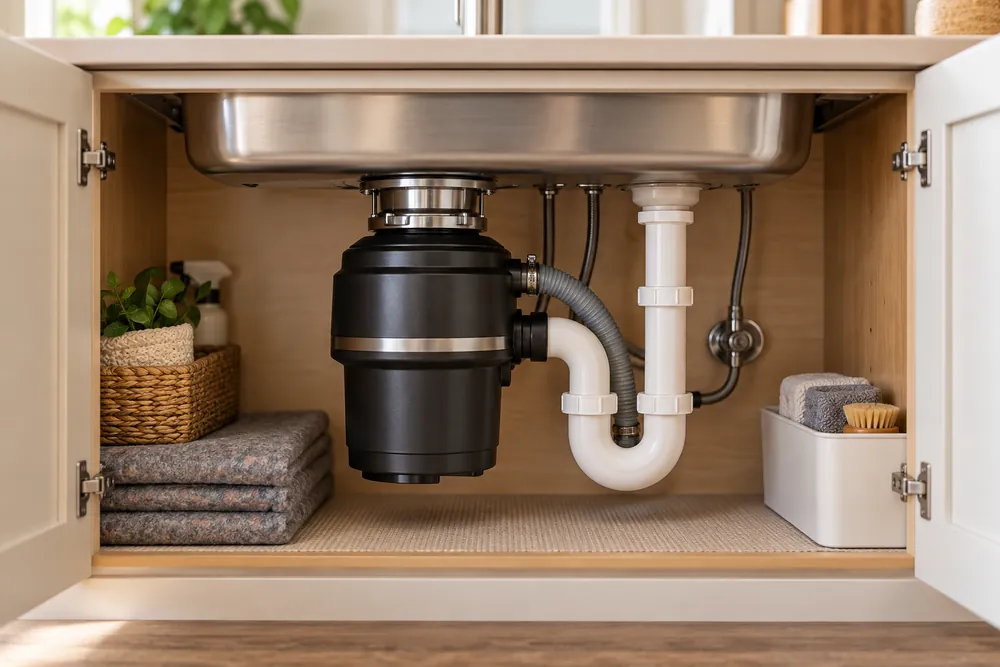
Quiet models may have larger housings. Measure from the drain opening to the cabinet floor, then account for the trap, dishwasher hose, electrical connection, and stored items.
| Space below the drain | Suitable planning approach |
|---|---|
| 12–14 inches | Favor compact units and verify every dimension carefully |
| 15–18 inches | Allows more flexibility for insulated household models |
For an open-plan kitchen, prioritize verified sound specifications and insulation over a small increase in motor power. Owner reports can reveal rattling and vibration that headline ratings miss.
Review Installation Requirements and Mounting Style
Sink compatibility, cabinet clearance, drain alignment, and mounting style determine whether a garbage disposal installs easily or creates plumbing problems. Confirm these details before comparing motor power, insulation, or features.
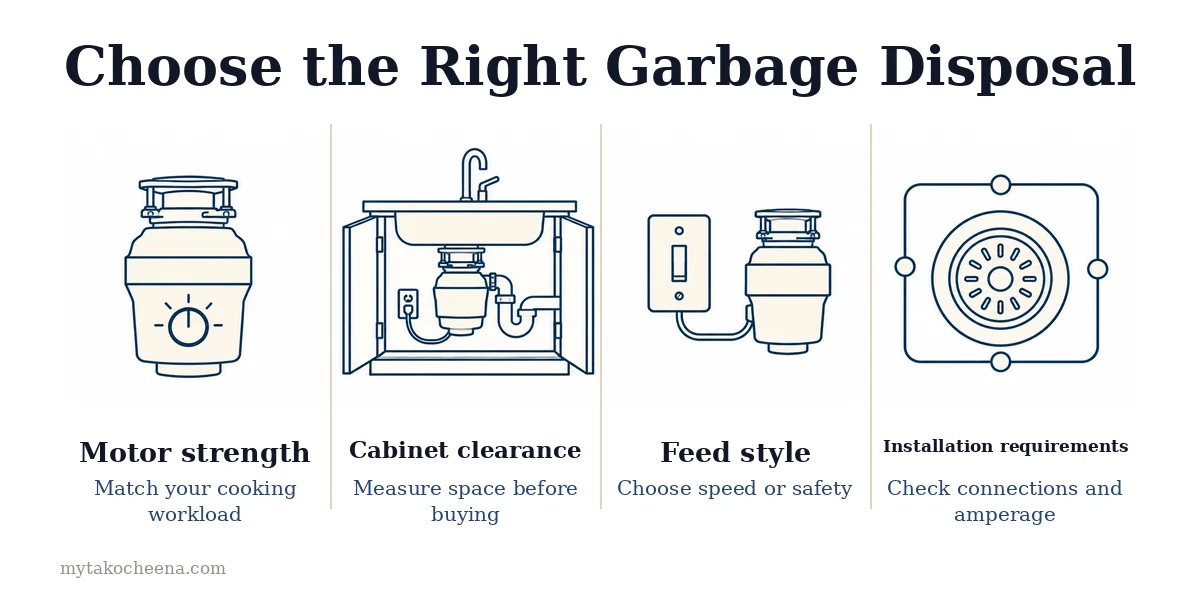
Measure the sink opening and space below it, including the drain trap and dishwasher hose. Standard openings commonly measure about 3.5–4.5 inches, while under-sink clearance typically requires roughly 12–18 inches.
| Measurement | Common category range | Why it matters |
| Sink opening | About 3.5–4.5 inches | Confirms flange compatibility |
| Vertical cabinet clearance | About 12–18 inches | Allows room for the unit and plumbing |
| Dishwasher hose length | About 4–8 feet | Supports a practical connection route |
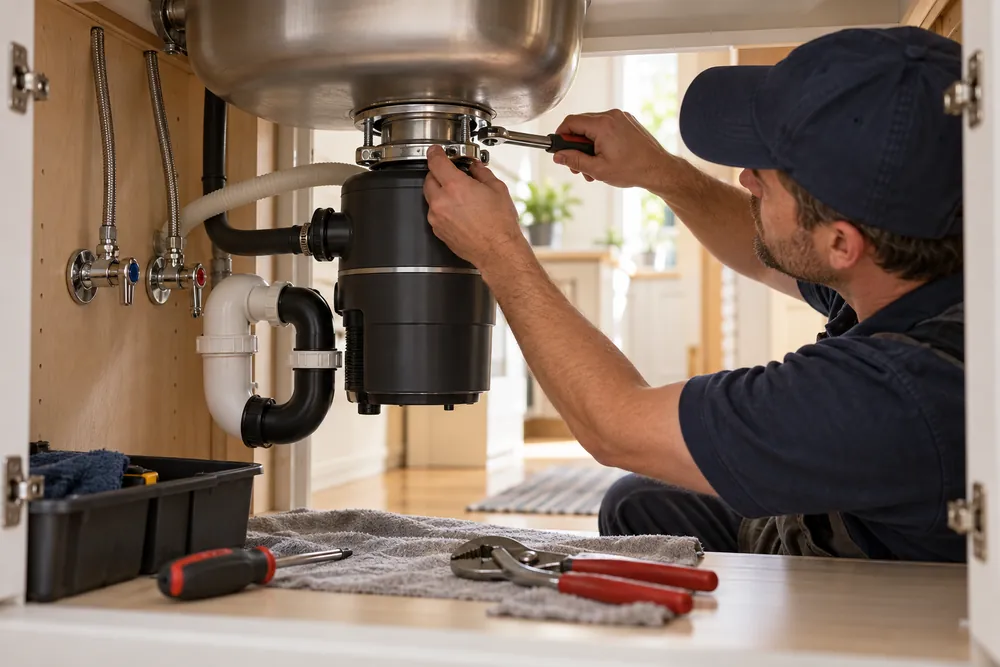
Most replacement units use a twist-lock, three-bolt sink flange, but mounting hardware is not automatically interchangeable.
A new disposal may require its own flange, gasket, or mounting ring, especially when replacing another brand or an older installation.
Compare mounting and plumbing needs
- Standard flange mounting: Suitable for many common sink installations and usually simplifies replacement.
- Compact housing: Preserves cabinet storage but may leave less room for the drain elbow and trap.
- Dishwasher connection: Verify that the unit has an inlet and that its knockout plug is removed before connecting the hose.
- Septic systems: Check local recommendations and installation instructions before adding more food waste.
Account for outlet access, switch wiring, and drain direction as well as the disposal body. Choose a model that leaves service space around the reset button and plumbing connections, then confirm the manufacturer’s instructions.
Factor In Durability, Warranty, and Materials
Durability depends on the grinding chamber, corrosion resistance, jam protection, and usage frequency.
Compare construction details and warranty coverage alongside motor power, because a stronger unit is not always the better long-term choice.
Stainless steel grinding components generally resist rust better than coated or galvanized parts under frequent exposure to water and acidic food residue.
Overall durability also depends on seals, bearings, splash guards, and motor design.
Compare Materials and Protection
| Component | Preferred feature | Why it matters |
| Grinding parts | Stainless steel | Better resistance to corrosion and repeated moisture exposure |
| Grinding chamber | Stainless or corrosion-resistant construction | Helps protect the interior from food residue and standing water |
| Motor protection | Overload reset and jam assistance | Reduces strain during blockages and repeated use |
| Sound insulation | Layered insulation and sealed housing | Can reduce vibration and harsh operating noise |
Warranty length provides a useful durability signal, but check the conditions. A longer warranty may cover the motor while excluding labor, installation, misuse, or plumbing problems.
| Warranty range | Common positioning | What to verify |
| 2–5 years | Basic or value-focused coverage | Parts, labor, and corrosion exclusions |
| 5–10 years | Higher-durability positioning | Whether coverage is limited or full replacement |
Choose coverage that matches your expected workload. Keep the receipt, register the unit when required, and confirm whether professional installation is necessary to preserve protection.
For a busy kitchen, prioritize stainless steel internals, reliable overload protection, and a clear warranty. For light use, a simpler disposal may provide sufficient service while saving cabinet space and money.
Asked and Answered
Garbage disposal selection depends on motor strength, sink compatibility, feeding method, grinding materials, noise control, and warranty coverage. Choose a unit suited to your cooking routine and cabinet space.
What horsepower garbage disposal do I need?
Match motor power to cooking frequency and food texture. Stronger motors handle repeated loads and tougher scraps with fewer jams.
| Motor range | Best suited for |
| 1/3–1/2 HP | Light cooking and soft scraps |
| 1/2–3/4 HP | Regular family meal preparation |
| 3/4–1 HP | Frequent cooking and tougher waste |
Is a 3/4 HP garbage disposal enough for a family?
A 3/4 HP model suits households that cook most nights, offering useful grinding strength without heavier-duty size, cost, and energy demands.
How do I know whether a garbage disposal will fit my sink?
Measure the sink drain opening, cabinet width, vertical clearance, and drain connection. Confirm the mounting flange matches your sink.
| Space category | Common range |
| Vertical cabinet clearance | 12–18 inches |
| Drain opening | 3.5–4 inches |
Is continuous feed or batch feed better?
Continuous feed models run while switched on, making preparation convenient. Batch feed models require a stopper or cover, adding safety for homes with children.
What grinding materials should a garbage disposal have?
Choose stainless steel grinding components for corrosion resistance and durability. Do not put grease, glass, metal, or large bones in any disposal.
How can I choose a quieter garbage disposal?
Look for insulated housing, vibration control, and sound-reducing mounting features. Quieter construction may increase size or cost.
What garbage disposal warranty should I look for?
Compare warranty length, covered components, labor terms, and installation requirements. Confirm coverage includes leaks, motor failure, and defective parts.