The short answer: Hamilton Beach food processor parts are model-specific replacement components, including bowls, lids, pushers, blades, discs, and adapters.
Confirm the exact model number and match the part’s tabs, locking points, feed chute, hub, and dimensions before comparing sellers.
Replacing one damaged part often makes sense when the motor remains reliable, but several failures can justify buying a new processor.
- Model number: Confirm the model number exactly before buying, because small suffixes or letters can change compatibility.
- Broken bowl: Replace a cracked work bowl when damage reaches tabs, handles, center posts, or liquid lines.
- Seller claims: Avoid vague listings that say parts fit most Hamilton Beach processors without matching your model number.
- Used parts: Inspect discontinued-model parts for cloudy plastic, stress cracks, worn tabs, warped lids, or blade corrosion.
- Repair value: Compare all needed parts plus shipping against a new processor when several pieces are broken.
Confirm the Part Before You Compare Sellers
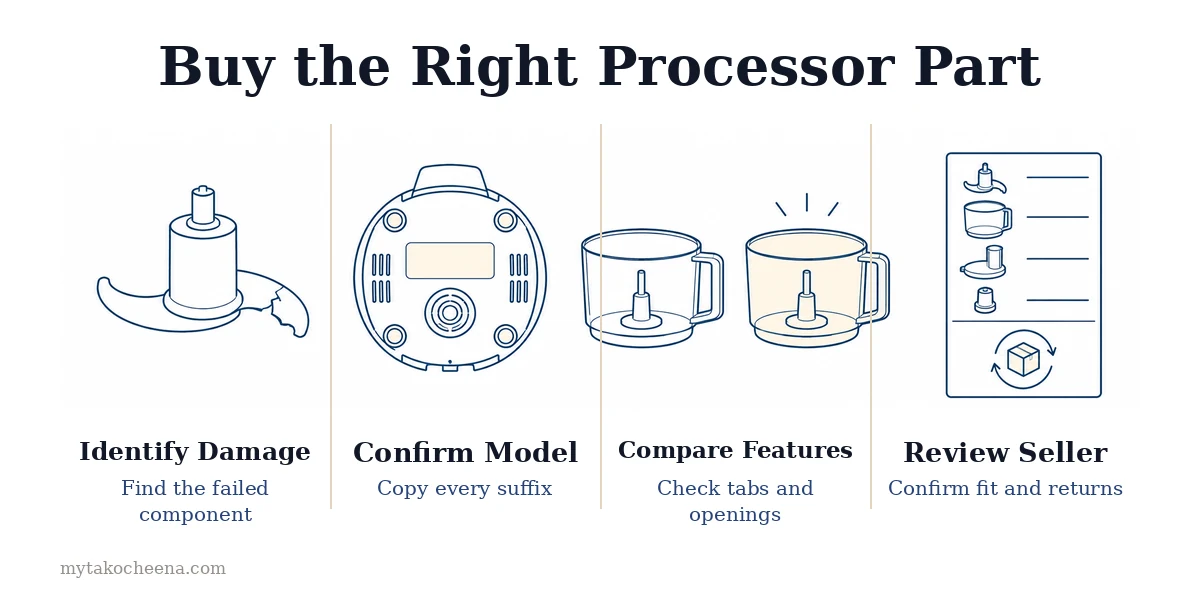
Start with the failed part, then confirm the exact food processor model before comparing sellers. A matching bowl, lid, pusher, blade, disc, or adapter is safer and often less wasteful than replacing a motor base that still works.
Find the model number on the base, rating label, or cord area, and copy every letter and suffix. Unplug the processor before turning it over, especially when the bowl or blade remains attached.
Do not rely on the product name or a seller’s claim that a part fits “most” Hamilton Beach processors. Similar clear bowls can have different tabs, locking points, center posts, handles, or feed-chute shapes.
Match the Part by Function
- Work bowl: Check the locking tabs, handle position, center post, and liquid line. Replace cracked plastic when damage reaches any load-bearing area.
- Lid and pusher: Confirm the safety-lock shape, feed tube, and pusher diameter. Do not substitute fingers, utensils, or improvised plungers.
- Blade, disc, or adapter: Match the attachment type and hub opening rather than choosing by diameter or appearance alone.
| Specification | Common range |
|---|---|
| Food processor bowl capacity | 3–14 cups |
| Typical motor wattage bands | 300–1,000 watts |
For used or discontinued parts, inspect for cloudy plastic, stress cracks, warped lids, worn tabs, and blade corrosion.
Check the manual for the manufacturer’s part name, then compare every required part and shipping cost with a new processor before ordering several replacements.
Use the tape measure to record the part’s outside dimensions, opening diameter, thickness, and the distance between tabs or posts. Measure the original only if it is safe to handle, and note whether the rim is straight or stepped.
Treat those numbers as a screening tool, not proof of compatibility. Compare them with the seller’s complete dimensions and photographs, checking the underside, locking features, and hub area.
A part that looks close may still fail to seat securely.
Before ordering, ask for any missing measurements and confirm the return policy for fit-related problems.
Keep the old part until the replacement arrives, then compare both pieces side by side before installing or operating the processor.

Parts Worth Replacing on a Hamilton Beach Processor
A cracked work bowl, broken lid, missing pusher, worn blade, or damaged disc is often worth replacing while the motor base still runs smoothly.
Start with the failed part, then confirm the exact model number before comparing sellers, because similar-looking Hamilton Beach components may use different tabs, locks, or attachment points.
Work bowls deserve priority when cracks reach a handle, locking tab, center post, or liquid line. Damage in these areas can spread and may prevent the bowl from seating safely.
Compare the bowl’s handle position, base shape, tabs, and approximate capacity rather than relying on a product photograph.
| Specification | Common category range | Why it matters |
| Processor bowl capacity | 3–14 cups | Helps separate compact and full-size bowl families |
| Motor power | 300–1,000 watts | Provides context when comparing repair value |
A replacement lid is practical when its locking tab or feed chute is damaged. A failed safety interlock can stop an otherwise healthy motor from operating.
The pusher should also be replaced rather than substituted with fingers, utensils, or improvised objects near the blade.
Replace S-blades, dough blades, slicing discs, shredding discs, and stem adapters when they are bent, corroded, loose, or missing.
Confirm the attachment type and center fitting; discs that look alike may require different adapters or sit at different heights.
- Check the model number on the base or rating label.
- Inspect used parts for cloudy plastic, warped lids, stress cracks, worn tabs, and blade corrosion.
- Compare every required part and shipping cost with a new processor before ordering several components.

Where to Buy Without Getting the Wrong Fit
Buy the replacement part by exact model compatibility, not by appearance or a broad product title.
Confirm the failed part first, then compare the manufacturer, an authorized parts seller, and reputable used-part listings so the bowl, lid, pusher, blade, or disc locks into place safely.
Start With the Model Number
Find the model number on the base, rating label, or cord-storage area. Unplug the processor before turning it over, especially if the bowl or blade remains attached.
Copy every letter and suffix exactly. Hamilton Beach product families can share similar names while using different locking tabs, center posts, feed chutes, safety switches, or drive adapters.
A listing that says it fits “most” processors is not enough.
Compare the Part, Not Just the Photograph
Keep the original part beside you while shopping. Check the handle location, bowl tabs, lid notches, feed-tube opening, blade hub, disc stem, and attachment points against the seller’s description and photographs.
- Work bowl: Replace one with cracks near the handle, locking tab, center post, or liquid line.
- Lid and pusher: Confirm the pusher slides fully into the feed tube and that the lid activates the safety interlock.
- Blade and discs: Match the hub or adapter, cutting function, and mounting shape rather than choosing by diameter alone.
Use Specifications to Narrow the Search
| Specification | Common range or trade-off |
|---|---|
| Food processor bowl capacity | About 3–14 cups; larger bowls may use different lids and drive parts |
| Countertop appliance motor rating | About 250–1,000 watts; higher ratings do not guarantee part compatibility |
Check the Seller Before Checkout
Manufacturer stores and authorized parts distributors usually provide the clearest compatibility information.
Marketplace sellers can help with discontinued processors, but inspect used plastic for cloudiness, stress cracks, warped lids, worn tabs, and blade corrosion.
Confirm the return policy, shipping cost, and whether the part is new, refurbished, or salvaged. Add the cost of every required component before deciding whether repair remains more practical than replacing the processor.

Compatibility Checks That Prevent Returns
The failed part should guide your search, but the food processor’s exact model number must confirm the purchase.
Check both before comparing sellers, because similar-looking Hamilton Beach bowls, lids, blades, and discs can use different tabs, locking points, or feed-tube shapes.
Match the Part to the Model
Find the model number on the motor base, rating label, underside, or cord area. Unplug the processor before turning it over, then copy every letter, digit, and suffix exactly; a small variation can identify a different part family.
Use the correct part name rather than a broad search term. A work bowl, lid, pusher, S-blade, slicing disc, shredding disc, dough blade, and stem adapter perform different jobs and are not interchangeable.
- Compare bowl tabs, handle placement, center posts, and locking grooves.
- Compare lid tabs, safety-switch contact points, and feed-chute shape.
- Compare blade or disc openings with the original stem adapter.
- Check the owner’s manual for the manufacturer’s part terminology.
Use Dimensions as a Secondary Check
Capacity can narrow a search, but it cannot replace model verification.
These broad category ranges help identify an obviously mismatched listing; measure your original component where practical and confirm the seller’s compatibility statement.
| Check | Common range | What it helps reveal |
| Food processor bowl capacity | 3–14 cups | Whether the replacement is in the same size class |
| Typical countertop clearance | 12–18 inches | Whether a taller lid or feed tube may create storage problems |
Inspect Condition and Repair Value
Replace a cracked bowl when damage reaches a tab, handle, center post, or liquid line.
Replace a lid with a broken locking tab rather than bypassing the safety mechanism, and never substitute fingers or improvised tools for a missing pusher.
For discontinued models, inspect used parts for cloudy plastic, stress cracks, warped lids, worn tabs, and blade corrosion. Add shipping costs for every required component, then compare the total with a new processor before checkout.

When a New Processor Makes More Sense
A replacement part makes sense when the motor base still runs reliably and the damage is limited to a bowl, lid, pusher, blade, disc, or adapter.
A new processor deserves consideration when several essential pieces are missing, the base has electrical or mechanical problems, or compatible parts are difficult to verify.
Start by pricing every required component, including shipping and any seller fees.
A replacement bowl and lid may be reasonable alone, but adding a blade, disc stem, and pusher can bring the repair close to the cost of a complete appliance.
| Category | Common range | Why it matters |
| Compact work-bowl capacity | 3–6 cups | Suitable for smaller batches |
| Full-size work-bowl capacity | 7–14 cups | Better for family-size preparation |
| Typical motor rating | 250–1,000 watts | Helps indicate intended workload |
Compare the replacement total with a new appliance that offers a similar capacity and motor class.
A lower-cost new unit may still be a poor trade if its bowl is smaller, its feed tube is narrower, or its discs do not support the preparation tasks you regularly perform.
Replacement value also depends on the failure. A cracked bowl with damaged locking tabs, a warped lid, or a broken safety-switch actuator should not be used temporarily.
These parts control stability and safe operation, so improvised repairs can create leakage, movement, or exposure to the blade.
- Keep the processor: The base runs smoothly, and one replaceable part is damaged.
- Compare carefully: Several attachments are broken, discontinued, or available only from uncertain sellers.
- Replace the appliance: The motor smells hot, cuts out, makes grinding sounds, or shows cord or housing damage.
Before choosing a new processor, measure available storage and countertop space.
Allow roughly 4–8 inches of working clearance around the feed tube and controls, then confirm that the replacement includes the blade and discs you actually need.

Small Details That Matter After the Part Arrives
A replacement part is not ready for use simply because it matches the listing photo. Inspect it beside the original, test the fit without forcing it, and check every locking point before adding food.
Small differences in tabs, seals, stems, or feed-chute openings can affect safety and performance.
Wash removable plastic parts with mild dish soap, then dry them completely before assembly.
Check the owner’s manual for dishwasher guidance, because heat can warp lids, bowls, and pushers that appear dishwasher-safe but require a specific rack or cycle.
| Part or area | Check before regular use |
|---|---|
| Work bowl | Look for cracks, cloudy stress marks, warped edges, and a secure base fit |
| Lid and pusher | Confirm the lid locks and the pusher moves freely through the chute |
| Blade or disc | Check for corrosion, bent metal, loose hubs, and correct seating on the stem |
| Storage space | Allow roughly 2–4 inches of clearance around stored attachments |
Run the processor empty for a brief inspection only after the bowl, lid, and safety interlock engage correctly. Stop immediately if the part wobbles, scrapes, rattles, leaks, or leaves unusual gaps around the shaft.
Capacity also affects whether a replacement feels practical. Common household food processor bowls fall into broad bands of about 3–7 cups, while smaller choppers may use bowls around 1–3 cups.
Keep the receipt, packaging, and seller messages until the part has passed inspection and a short food-free fit check.
Photograph any mismatch before returning it, and describe the model number, failed feature, and incompatible measurement clearly.

The Bottom Line for Spending Smart
A failed bowl, lid, pusher, blade, or disc should be identified before you compare sellers.
Confirm the exact Hamilton Beach model number first, because similar-looking parts can use different tabs, locking points, feed chutes, or center posts.
Replacing one damaged part is often the lower-waste choice when the motor base still works.
Compare the Part With the Machine
Start with the part that failed, then inspect the matching area on the processor. A cracked bowl deserves replacement when damage reaches a handle, locking tab, center post, or liquid line.
A lid with a broken safety tab can stop an otherwise healthy motor from operating.
Use the model number from the bottom of the base, rating label, or cord area rather than relying on the product name. Unplug the processor before turning it over, and copy every letter or suffix exactly.
A listing that says a part fits “most” Hamilton Beach processors is not enough evidence.
| Specification | Common category range | Why it matters |
| Food processor bowl capacity | 3–14 cups | Confirms that a replacement bowl suits the intended batch size |
| Typical motor power band | 300–1,000 watts | Helps judge whether an older base is worth preserving |
Buy in the Right Order
For many owners, the practical order is bowl, lid, pusher, blade, disc, then specialty accessories.
Keep the broken part beside you while shopping and compare handle placement, notches, feed-tube shape, attachment points, and locking geometry instead of trusting photographs alone.
Used or discontinued parts can save money, but inspect them for cloudy plastic, stress cracks, warped lids, worn tabs, and blade corrosion. Do not use fingers, utensils, or improvised plungers in place of a proper pusher.
Finally, total every required part and shipping charge before checkout.
One replacement is usually sensible; several broken pieces may cost enough to justify a new processor, especially when the base shows wear or the replacement is difficult to verify.

Where Owner Feedback Agrees and Where It Splits
Cracked bowls, broken lid tabs, and missing pushers generate the most consistent owner complaints.
Owner reports and Hamilton Beach documentation agree that compatibility depends on the exact model family, while opinions split over whether replacing several worn parts is worthwhile.
Complaints that recur
Owners repeatedly mention bowls that develop cracks around handles, locking tabs, or center posts. Lids also fail early when a safety-lock tab breaks, and a processor may appear inoperative even though the motor remains functional.
Pushers are commonly lost rather than worn out.
Reports also flag cloudy used plastic, warped lids, loose tabs, and blade corrosion, especially when sellers describe a part as fitting “most” Hamilton Beach processors without naming compatible models.
What tends to hold up
Owner feedback is more favorable toward intact motor bases, stainless cutting blades, and discs stored separately from the bowl.
Manufacturer documentation supports replacing removable components instead of treating a sound base as disposable.
Capacity and power vary across Hamilton Beach product families, so buyers should compare the ranges shown in official specifications rather than assume that a larger-looking bowl fits.
| Specification | Common range |
|---|---|
| Food processor bowl capacity | 3–14 cups |
| Motor wattage bands | 250–1,000 watts |
| Typical replacement-part clearance for tabs and posts | 1/8–1/4 inch |
Where opinions split
Replacing one bowl, lid, or pusher is often viewed as sensible when the motor runs smoothly.
Owners disagree once several components need replacement, because shipping, discontinued inventory, and uncertain used-part condition can narrow the savings.
- Match the model number before comparing photos.
- Check tabs, locking points, feed-chute shape, and center posts.
- Compare the complete parts total with a replacement appliance.
- Compare how the part locks, drives, and clears nearby pieces
- Check bowl handle position, base tabs, center post, and locking shape
- Match lid feed chute, latch shape, hinge points, and safety-switch tab
- Compare blade center hubs before trusting a listing photo
- Check whether discs mount directly or require a stem
- Review return rules before opening special-order replacement parts
Questions Buyers Ask Most
Start with the failed Hamilton Beach food processor part, then confirm the exact model number. A matching bowl, lid, or blade can extend a working motor base’s life and improve safe operation.
Compare the model label, part shape, attachment points, and seller compatibility information. Similar parts may have different tabs, handles, or feed chutes.
How do I find my Hamilton Beach food processor model number?
Check the bottom of the motor base, rating label, or area near the cord. Unplug the processor before turning it over.
Record every letter, digit, and suffix because small variations can change compatibility.
Which Hamilton Beach food processor parts should I replace first?
Start with the bowl, lid, pusher, blade, disc, and specialty accessories. Replace the failed part instead of the complete machine when the motor base still runs properly.
- Work bowls and lids commonly fail through cracks or broken locking tabs.
- Pushers are easy to lose and should not be replaced with improvised objects.
- Blades, discs, and adapters need the correct mounting points.
How can I tell whether a replacement bowl will fit?
Compare the locking tabs, handle position, center post, base shape, liquid line, feed-chute opening, and lid connection with your original bowl.
A similar-looking bowl may belong to another model family. Buy only when the seller identifies your exact model or compatible family.
What food processor capacity should I compare when buying parts?
Capacity narrows the search but does not prove compatibility. Use the original bowl and model label as the final authority.
| Category | Typical bowl capacity | Typical storage clearance |
| Compact | 3–4 cups | 4–8 inches |
| Mid-size | 7–10 cups | 6–10 inches |
| Large | 11–14 cups | 8–12 inches |
Is a cracked Hamilton Beach work bowl safe to keep using?
Replace a bowl when a crack reaches a locking tab, handle, center post, or liquid line. Do not use sharp edges, spreading cracks, or a loose fit.
A replacement is practical when the motor base and controls still work.
Are used Hamilton Beach food processor parts worth buying?
Used parts can help with discontinued processors, but avoid cloudy plastic, stress cracks, warped lids, worn tabs, damaged feed chutes, and corroded blades.
Ask for photos of the underside, locking points, and attachment surfaces. Confirm the return policy because fit may be difficult to verify.
Should I buy parts or replace the whole food processor?
Compare required parts, shipping, and missing accessories with a replacement processor. One bowl or pusher may justify repair; several damaged pieces can reduce its value.
Keep the machine when the motor runs smoothly and the part is clearly compatible. Replace it when safety-related parts, multiple attachments, and the base need attention.