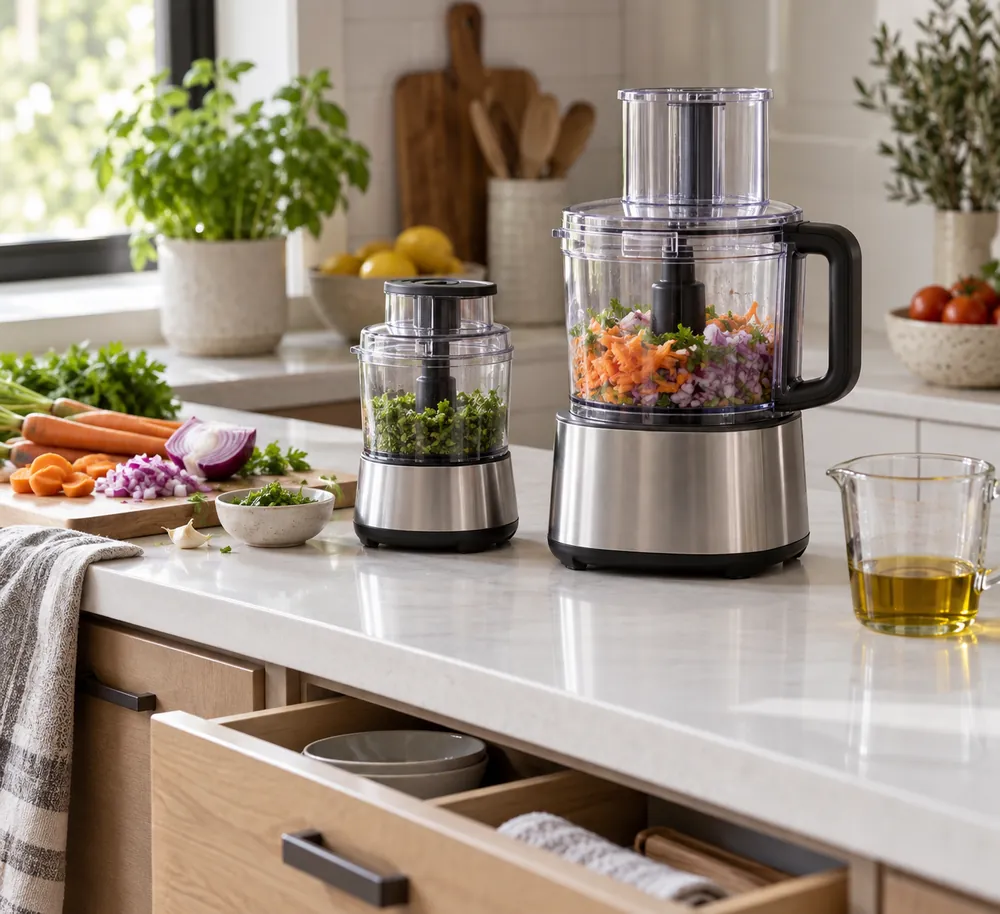
TL;DR: A mini food processor is a compact prep tool for small chopping, mixing, and sauce tasks, while a full-size food processor handles larger batches and more varied prep.
Choose mini if you cook for one or two, have limited storage, or mostly make small portions. Choose full-size if you batch cook, prep vegetables often, or want more versatility.
Mini Food Processor vs Full Size: The Core Difference
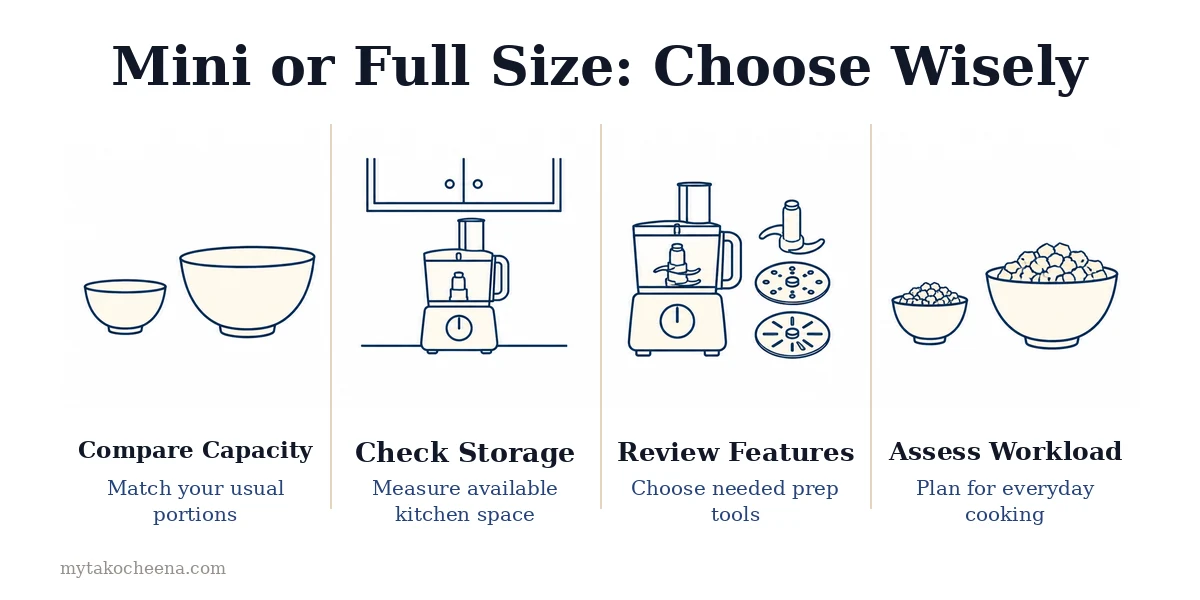
Bowl size drives the real split between a mini food processor and a full-size food processor. Published specs usually show a small work bowl for quick prep versus a larger bowl designed for batch work.
That difference changes storage, cleaning, motor expectations, and the kinds of recipes that feel practical. A mini model is not simply a cheaper full-size unit; it is a different tool for a different prep load.
Capacity is the first spec to compare
Mini food processors usually sit in the small-batch range. Full-size food processors usually start where mini bowls become cramped, especially for dough, shredded vegetables, or large sauce batches.
| Category | Common published bowl capacity range | Best fit |
| Mini food processor | About 1.5 to 5 cups | Garlic, herbs, small dips, baby food, nuts, single-meal prep |
| Full-size food processor | About 7 to 14 cups | Slaw, pastry, dough, shredded cheese, family-size chopping |
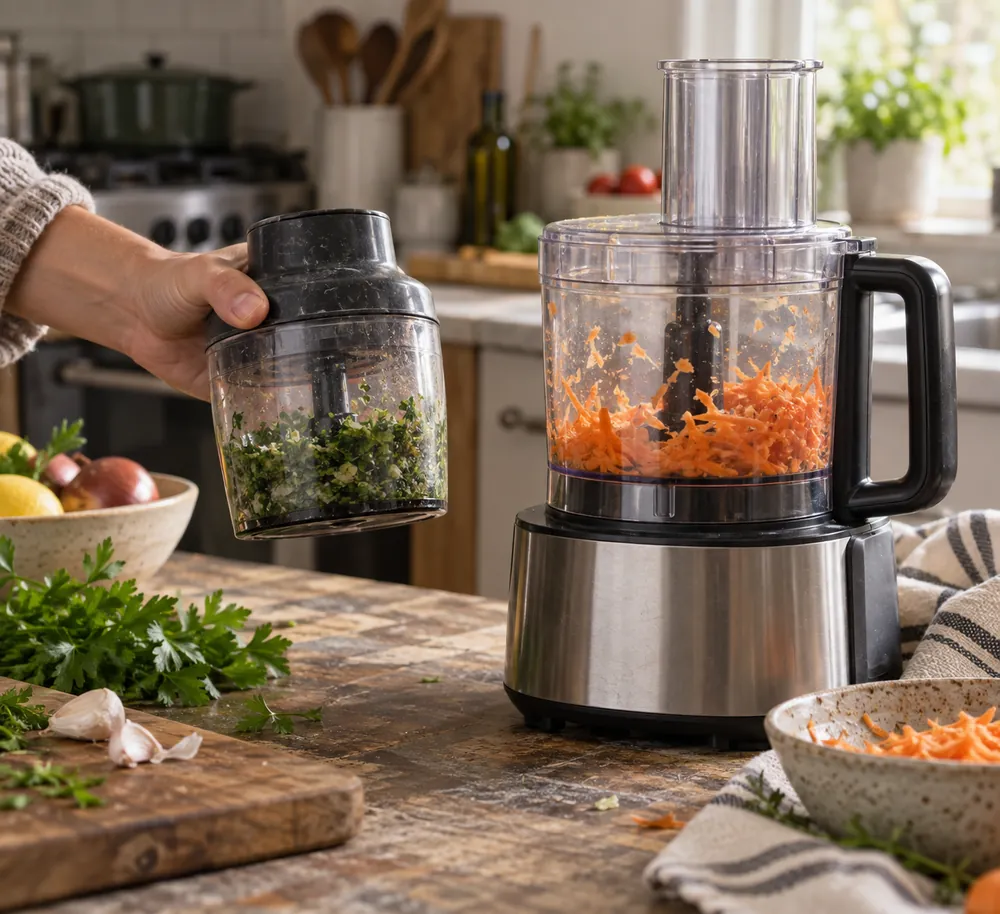
A mini bowl can process small amounts more evenly because food stays close to the blade. In a large bowl, the same tablespoon of herbs may scatter around the base and require more scraping.
A full-size bowl wins when volume matters. Larger feed tubes, wider bowls, and accessory discs can reduce repeated loading when slicing potatoes, shredding cabbage, or prepping vegetables for several meals.
Power and footprint change the trade-off
Published wattage is not a perfect performance score, but it helps separate light chopping from heavier processing. Blade shape, gearing, and bowl design also matter, so compare wattage as one clue, not the final verdict.
| Category | Usual wattage band | Typical counter footprint range |
| Mini food processor | About 100 to 350 watts | About 5 to 8 inches wide |
| Full-size food processor | About 450 to 1,200 watts | About 7 to 11 inches wide |
Mini units are easier to leave on the counter, move with one hand, and rinse quickly. They also fit better in apartments, dorm-style kitchens, and cabinets crowded with small appliances.
Full-size units ask for more space, especially with lids, pushers, discs, and blades. Under-cabinet clearance can matter because many countertop cabinets leave roughly 15 to 18 inches between counter and upper cabinet bottom.
Function is different, not just smaller
Mini processors usually focus on chopping, mixing, pureeing, and simple emulsions. They are convenient for pesto, salsa, dressings, breadcrumbs, and quick aromatics.
Full-size processors often support more attachments and wider prep jobs. Depending on the product line, published accessories may include slicing discs, shredding discs, dough blades, and adjustable thickness controls.
- Choose mini for small quantities, fast cleanup, tight storage, and frequent everyday prep.
- Choose full-size for batch cooking, slicing and shredding, dough tasks, and larger households.
- Consider both if you cook often and want a small chopper for daily use plus a larger machine for weekend prep.
The core difference is workload. A mini food processor handles quick, low-volume tasks with less hassle, while a full-size food processor handles bigger prep with more capacity, accessories, and counter-space commitment.
When a Mini Food Processor Makes More Sense
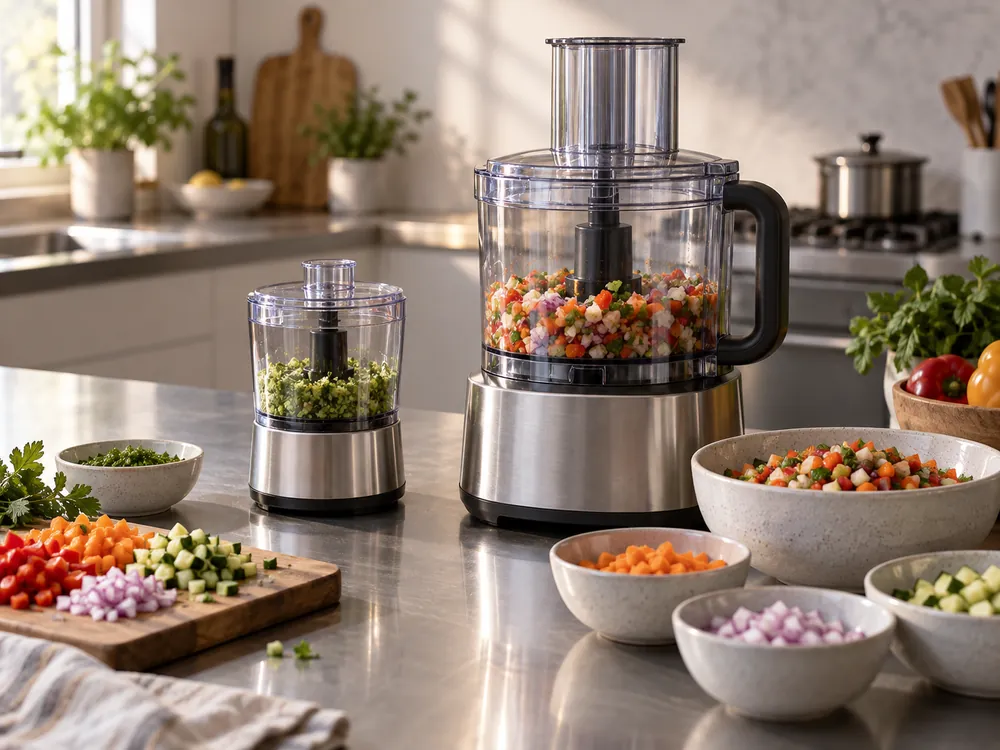
Small prep jobs are where a mini food processor earns its counter space. It is usually the better fit when your cooking is about sauces, dips, aromatics, small batches, and quick cleanup instead of bulk shredding or dough work.
Published specifications make the trade-off clear. Mini models usually give up bowl volume and motor headroom, but they are easier to store, lighter to move, and less annoying to wash after a small task.
| Category | Mini food processor | Full-size food processor |
| Typical bowl capacity band | About 1.5 to 5 cups | About 7 to 14 cups |
| Usual motor range | About 120 to 300 watts | About 450 to 1,200 watts |
| Common storage fit | Often fits in standard upper cabinets with about 10 to 12 inches of usable shelf height | Often needs deeper pantry space or lower cabinet storage with about 15 to 18 inches of usable height |
Small batches do not need a large bowl
A mini bowl is helpful when a full-size work bowl is too wide for a small volume of food.
Garlic, herbs, nuts, dressing bases, salsa, pesto, and baby food can circulate better when the ingredients are not spread thinly across a large base.
This matters because food processors depend on contact with the blade. A bigger machine can still chop small amounts, but it may leave more ingredients stuck to the sides, which means more stopping and scraping.
Storage space is part of the decision
Apartment kitchens, galley kitchens, and shared kitchens often make storage the deciding factor. A mini processor is more likely to stay within reach, which means it is more likely to be used for weekday prep.
| Kitchen situation | Why a mini model can make sense | Possible downside |
| Limited counter space | Smaller footprint and easier daily access | Less useful for large vegetables or batch cooking |
| Upper-cabinet storage | Shorter bodies often fit where tall appliances do not | Some lids and attachments still need separate space |
| Frequent small prep | Faster setup and cleanup for quick chopping | More batches needed for meal prep quantities |
Choose mini when convenience beats capacity
A mini food processor makes sense when you mainly want speed, not maximum versatility. It can replace knife work for small aromatics, sauces, spreads, and garnishes without committing you to a bulky appliance.
- Good fit: dips, dressings, chopped herbs, nuts, small salsa batches, and quick weeknight prep.
- Less ideal: slicing stacks of vegetables, shredding cheese in volume, kneading dough, or prepping for a crowd.
- Best buying signal: you value low cleanup and easy storage more than attachment variety.
For My Tako Cheena readers comparing US appliance specs, the practical question is not which size is stronger. It is whether your normal batch size matches the bowl, storage space, and cleanup effort you will tolerate every week.
When a Full-Size Food Processor Is Worth It
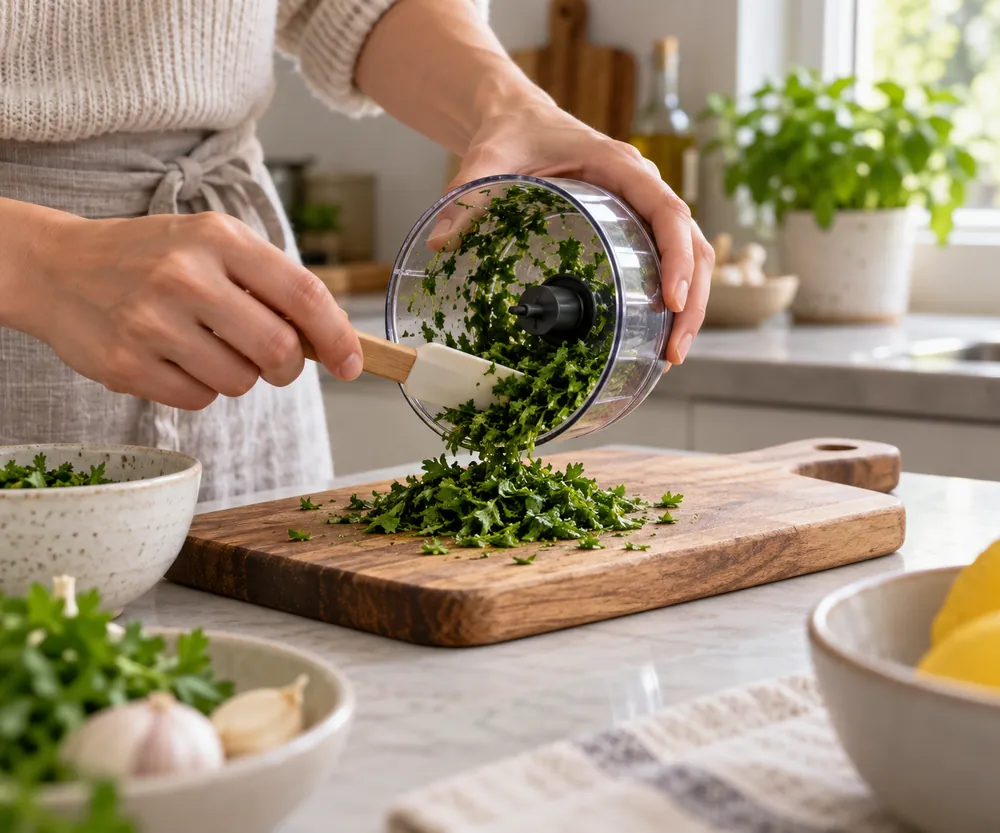
Batch size, repeated prep, and attachment flexibility make a full-size food processor worth considering.
It earns its counter space when a mini processor would require several rounds, leave ingredients unevenly processed, or limit the recipes you can prepare.
Choose capacity for the way you cook
A larger bowl handles vegetables, dough, shredded cheese, and blended mixtures with more room for ingredients to circulate.
That extra space can improve consistency and reduce the need to stop, scrape the sides, and restart the machine.
| Category | Typical work-bowl capacity | Best fit |
| Mini processor | About 1–5 cups | Small chopping, sauces, herbs, and single servings |
| Full-size processor | About 7–16 cups | Family batches, meal prep, shredding, slicing, and dough |
Capacity labels are not perfectly interchangeable. Some brands list the bowl’s total volume, while others emphasize usable capacity, so compare the manufacturer’s operating guidance rather than relying on the cup number alone.
Look beyond chopping
Full-size machines typically support a broader attachment system. Depending on the package, that can include reversible shredding and slicing discs, a dough blade, an emulsifying accessory, or a wider feed tube.
- Shredding and slicing: useful for vegetables, cheese, potatoes, and slaws when hand preparation would take longer.
- Dough preparation: valuable for households that make pizza, biscuits, or pastry in substantial batches.
- Uniform prep: a wider bowl and feed tube can reduce crowding and produce more consistent pieces.
- Workflow flexibility: one appliance can cover tasks that would otherwise require a mini processor, box grater, mandoline, or mixing bowl.
Motor specifications also help explain the difference, although wattage does not guarantee performance. Blade design, bowl shape, controls, and overload protection matter alongside the published motor rating.
| Category | Common published motor range | Typical trade-off |
| Mini processor | About 100–400 watts | Compact and efficient, but less suited to dense or repeated batches |
| Full-size processor | About 500–1,200 watts | More capacity and power potential, with greater size and storage demands |
Account for storage and cleanup
A full-size processor is not automatically the better choice for a small kitchen. The bowl, lid, discs, blades, and pusher may need dedicated cabinet space, and the base can remain inconvenient if you must move it for every use.
Check published dimensions for the assembled appliance and compare them with your available shelf or cabinet opening. Also confirm whether accessories nest inside the bowl, fit in a storage case, or require separate drawers.
- Worth the space: choose full-size capacity when you regularly prepare large batches or use slicing and shredding attachments.
- Less compelling: stay with a mini model when portions are small and most tasks involve herbs, aromatics, dips, or quick sauces.
- Best compromise: consider a full-size unit only if its capacity and attachments replace several tools you already use.
Reported owner experience often highlights the same practical divide: full-size processors save time during substantial prep but take longer to assemble, wash, and put away.
Published dishwasher-safety guidance can make that trade-off easier to manage.
Choose full-size when capacity, attachment range, and repeated batch work outweigh storage and cleanup costs. Choose mini when compactness and quick small-portion prep are the priorities.
Key Buying Factors: Capacity, Storage, Cleanup, and Prep Style
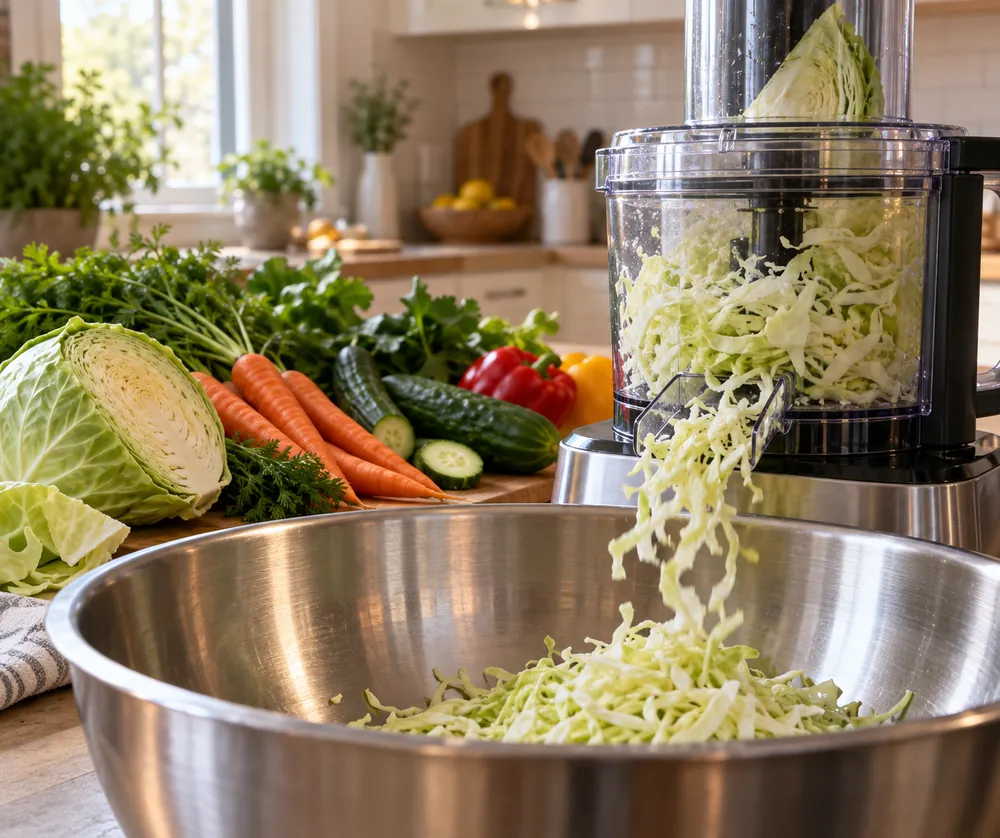
Capacity drives the mini food processor vs full size decision more than blade shape or button layout.
Compare published bowl size, footprint, dishwasher-safe parts, and feed tube design before matching either appliance to your prep style.
Capacity and batch size
Mini processors work best for small, wet, or aromatic jobs: salsa, pesto, dressings, garlic, nuts, and baby food portions. Full-size processors suit bulk chopping, slicing, shredding, dough, and repeated meal-prep batches.
| Category | Typical published bowl range | Best fit |
| Mini food processor | 1.5 to 5 cups | Small sauces, herbs, aromatics, single-meal prep |
| Full-size food processor | 7 to 14 cups | Family prep, shredding, slicing, dough, batch cooking |
Published capacity is not the same as practical working volume. Liquids, cabbage, onions, and dough need headroom, so choose a larger bowl if you regularly fill containers near the top.
Storage and counter clearance
Storage matters because a processor used often must be easy to reach. A compact unit can stay on the counter, while a larger machine may need a cabinet shelf with room for discs, lid, and pusher.
| Storage factor | Typical range | Why it matters |
| Upper cabinet opening height | 15 to 18 inches | Limits whether a processor fits assembled on the counter |
| Common counter depth | 24 to 25 inches | Affects usable workspace in front of the appliance |
| Typical motor power band | 250 to 1,200 watts | Higher bands often pair with larger bowls and heavier bases |
Cleanup and parts
Cleanup is where mini processors often win. Fewer parts, smaller bowls, and lighter lids make them easier to rinse after quick chopping jobs.
Full-size processors create more cleanup, especially with slicing discs, shredding discs, and large feed tubes.
Check whether the bowl, lid, pusher, and blades are listed as dishwasher-safe, then confirm rack-placement guidance in the manual.
Prep style and final choice
- Choose mini if you prep small amounts, cook for one or two, or want fast cleanup after sauces and aromatics.
- Choose full size if you shred blocks of cheese, slice vegetables, make dough, or batch-prep for several meals.
- Consider both if you cook often and dislike washing a large bowl for a few cloves of garlic.
Final decision should follow your highest-frequency task, not the largest possible recipe. Specifications show the capacity and footprint; owner reports help reveal whether cleanup and storage feel manageable over time.
What Long-Term Owners Say
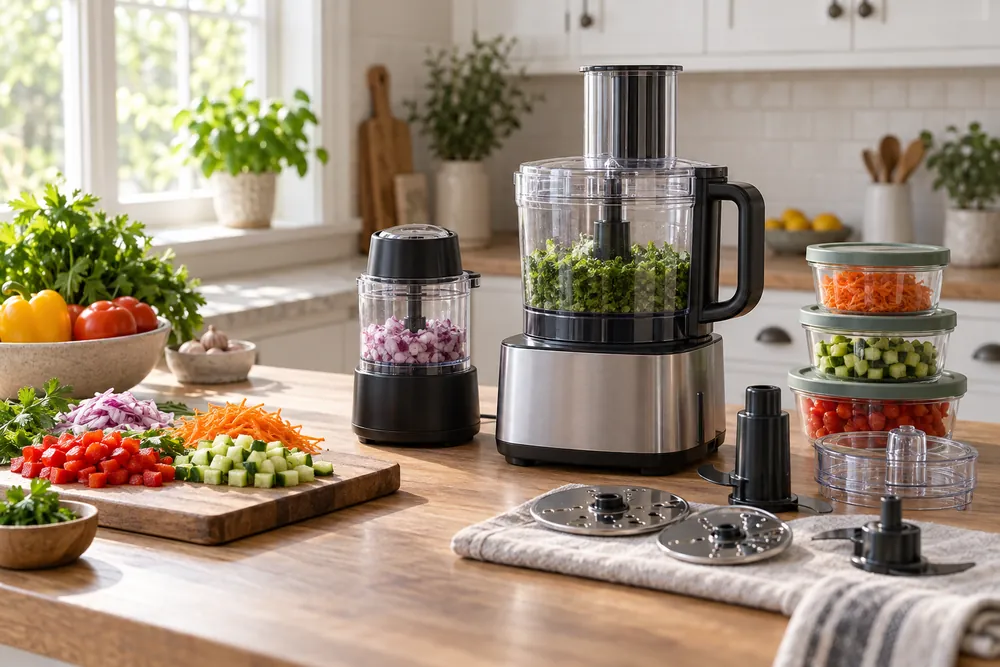
Owner reports tend to split mini food processors and full-size processors by frustration type.
Mini units draw more complaints about limited batch size, while full-size units draw more complaints about storage, cleaning, and setup effort.
Manufacturer documentation supports that divide.
Published specs usually show mini processors in smaller capacity bands, with lighter accessory sets, while full-size processors occupy larger capacity bands and often include feed tubes, slicing discs, and dough-capable attachments.
| Category | Typical capacity range | Usual motor range |
| Mini food processor | 1.5 to 5 cups | 150 to 350 watts |
| Full-size food processor | 7 to 14 cups | 450 to 1,200 watts |
The complaint that recurs most
Capacity mismatch is the repeat complaint in owner reviews. Buyers who choose a mini processor often like the footprint, then complain when salsa, slaw, hummus, or pie dough must be made in several batches.
Full-size owners report the opposite problem. They say the machine can handle larger prep jobs, but the bowl, lid, pusher, and blades can feel excessive for garlic, herbs, nuts, or a quick sauce.
- Mini processor complaint: too many batch cycles for family-size prep.
- Full-size processor complaint: too much cleanup for small jobs.
- Shared complaint: food can trap around lid channels, blade posts, and gasket-like crevices.
What tends to hold up
Owners most often praise simple controls, sealed touchpads, and bowls that lock in without forcing.
Manufacturer documentation commonly emphasizes dishwasher-safe removable parts, but owners still report longer life when lids and blades are hand-washed.
Motors in both categories receive better long-term comments when buyers stay within documented use limits. Chopping, pulsing, and soft mixing draw fewer complaints than heavy dough, frozen fruit, or dense nut butter runs.
What fails early
Early failures in owner reports usually involve plastic parts, not the advertised motor rating. Cracked lids, broken locking tabs, loose bowl handles, and worn blade hubs appear more often than complete motor failure.
Full-size processors add another weak point: accessories. Owners mention misplaced discs, cracked storage cases, and feed-tube parts that make the appliance less convenient even when the base still works.
For a US kitchen, the long-term decision is less about maximum power and more about honest workload.
Choose mini for frequent small prep, full-size for batch cooking, and avoid either category if its documented capacity range does not match your usual recipes.
Common Questions Before You Buy
Capacity, storage space, and cleanup drive the mini food processor versus full-size decision.
Published specs help narrow the choice, but the better pick depends on how often you prep, how much counter space you can spare, and whether you need slicing or shredding discs.
What size food processor do I need for everyday cooking?
Choose by batch size first. Mini food processors suit small chopping, sauces, and single-meal prep, while full-size models handle dough, family-size vegetables, and larger ingredient loads without repeated batches.
| Category | Typical published capacity range | Best fit |
| Mini food processor | 1.5-4 cups | Garlic, herbs, nuts, dips, small sauces |
| Compact food processor | 5-8 cups | Small households, moderate chopping, occasional shredding |
| Full-size food processor | 9-14 cups | Meal prep, dough, slicing, larger recipes |
Is a mini food processor powerful enough?
For soft vegetables, herbs, nuts, breadcrumbs, and small sauce batches, a mini can be enough. Published wattage is only part of the story; blade shape, bowl size, and pulse control also affect performance.
| Category | Common wattage range | Practical takeaway |
| Mini food processor | 100-350 watts | Good for short pulses and light chopping |
| Compact food processor | 350-600 watts | Better for thicker mixtures and frequent use |
| Full-size food processor | 600-1,200 watts | Better suited to dough, dense foods, and larger loads |
Can a mini food processor replace a full-size food processor?
A mini can replace a full-size unit only for small tasks. It usually will not match the capacity, feed tube width, or accessory range of a larger machine.
Buy mini for speed and storage. Buy full-size when you regularly slice potatoes, shred cheese, knead dough, or prep several servings at once.
How much counter or cabinet space does a food processor need?
Mini models are easier to leave on the counter or tuck into a cabinet. Full-size units need more vertical clearance, especially with the bowl, lid, pusher, and accessory case stored together.
| Category | Common height range | Storage note |
| Mini food processor | 7-11 inches | Often fits under standard wall cabinets |
| Full-size food processor | 14-18 inches | May need a taller shelf or pantry space |
Which is easier to clean after quick prep?
Mini processors usually win for cleanup because they have fewer parts and a smaller bowl. That matters when you are chopping one onion, making a quick dressing, or mincing herbs.
Full-size models take longer to wash but reduce repeated batches. Check whether the bowl, lid, blade, and discs are listed as dishwasher-safe in the published specifications.
Do I need slicing and shredding discs?
Choose a full-size or compact processor if slicing and shredding are routine tasks. Minis usually focus on chopping and pureeing, so they rarely offer the same disc selection.
- Choose discs for coleslaw, grated cheese, potatoes, carrots, and cucumber slices.
- Skip discs if you mainly make salsa, pesto, baby food, dressings, or chopped nuts.
Which food processor is better for small kitchens?
A mini is usually the safer small-kitchen choice because it stores easily and encourages frequent use. A full-size model makes sense in a small kitchen only when it replaces several tools or supports regular batch cooking.
Compare published dimensions before buying. Also check cord storage, accessory storage, and whether replacement bowls or blades are available from the brand.