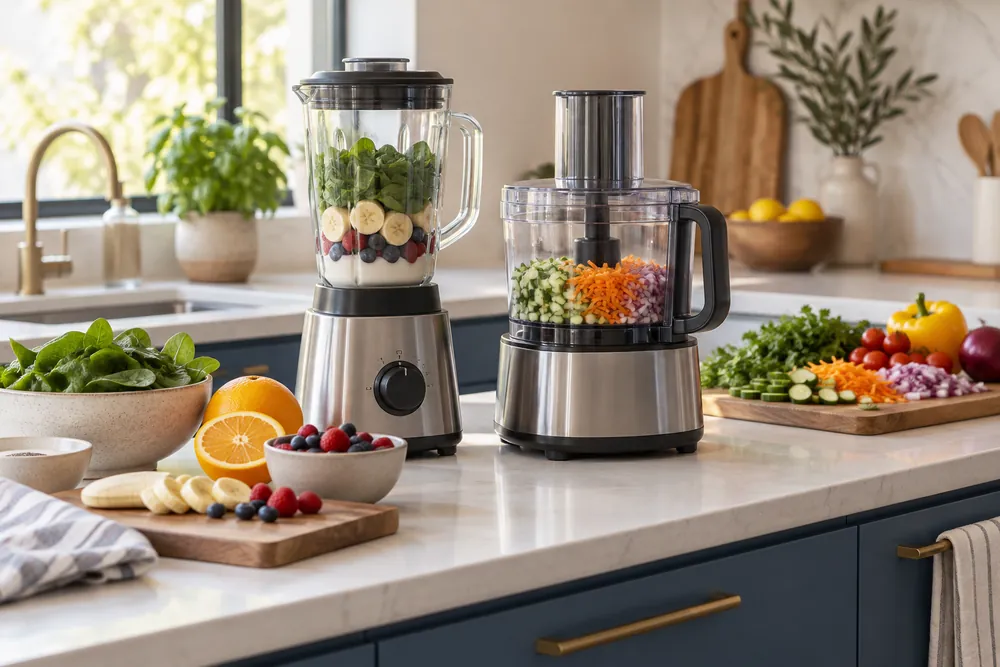
Quick Answer: A food processor is built for prep work, while a blender is built for liquids and smooth textures. Use a food processor for chopping, slicing, shredding, kneading, and thick mixtures.
Use a blender for smoothies, soups, sauces, and drinks. Some tasks overlap, but the bowl shape, blade position, and motor load make each appliance better at different jobs.
Food Processor vs Blender: The Practical Difference
Blade geometry separates a food processor from a blender more than motor size does.
A processor uses a broad bowl and interchangeable blades for dry or semi-dry prep, while a blender uses a tall jar that pulls liquid ingredients into a fast vortex.
That design difference changes what each appliance does well. Food processors favor chopping, slicing, shredding, grating, and dough mixing.
Blenders favor smoothies, soups, sauces, frozen drinks, and anything that needs a pourable texture.
| Specification | Food processor | Blender |
| Common capacity band | About 7-14 cups for full-size bowls | About 48-72 oz for full-size jars |
| Usual motor range | About 450-1,200 watts | About 500-1,500 watts |
| Typical storage height | About 14-18 inches assembled | About 15-20 inches assembled |
| Best working texture | Dry, chunky, sticky, or lightly moist | Liquid, loose, icy, or fully smooth |
A food processor gives you surface area. Ingredients spread across the bowl, so the blade can cut, toss, and redistribute pieces without needing much liquid.
That is why it handles cabbage, cheese, pie dough, nuts, and mirepoix better than a blender.
A blender gives you circulation. The narrow base and tall jar are designed to pull food downward, shear it, then push it back up. Without enough liquid, thick mixtures can stall, cavitate, or need frequent scraping.
- Use a food processor for salsa, shredded vegetables, sliced potatoes, grated cheese, nut mixtures, breadcrumbs, pesto, hummus, and doughs that should stay textured.
- Use a blender for smoothies, milkshakes, puréed soups, emulsified dressings, frozen cocktails, and sauces where a smooth pour matters.
- Use both when a recipe starts with chopped solids but finishes as a silky liquid, such as roasted vegetable soup or cashew cream.
Published specifications can make blenders look stronger because wattage is prominent. That number matters, but it does not replace blade shape, jar taper, bowl width, or included discs.
A lower-watt processor can still slice evenly because it is using the right attachment.
Counter space also matters. A processor usually stores with separate discs, blades, and feed-pusher parts. A blender is simpler to keep assembled, but taller jars can conflict with upper cabinets.
Choose by task, not by the biggest motor claim. Buy the appliance that matches your usual texture: cut and controlled for a food processor, fluid and smooth for a blender.
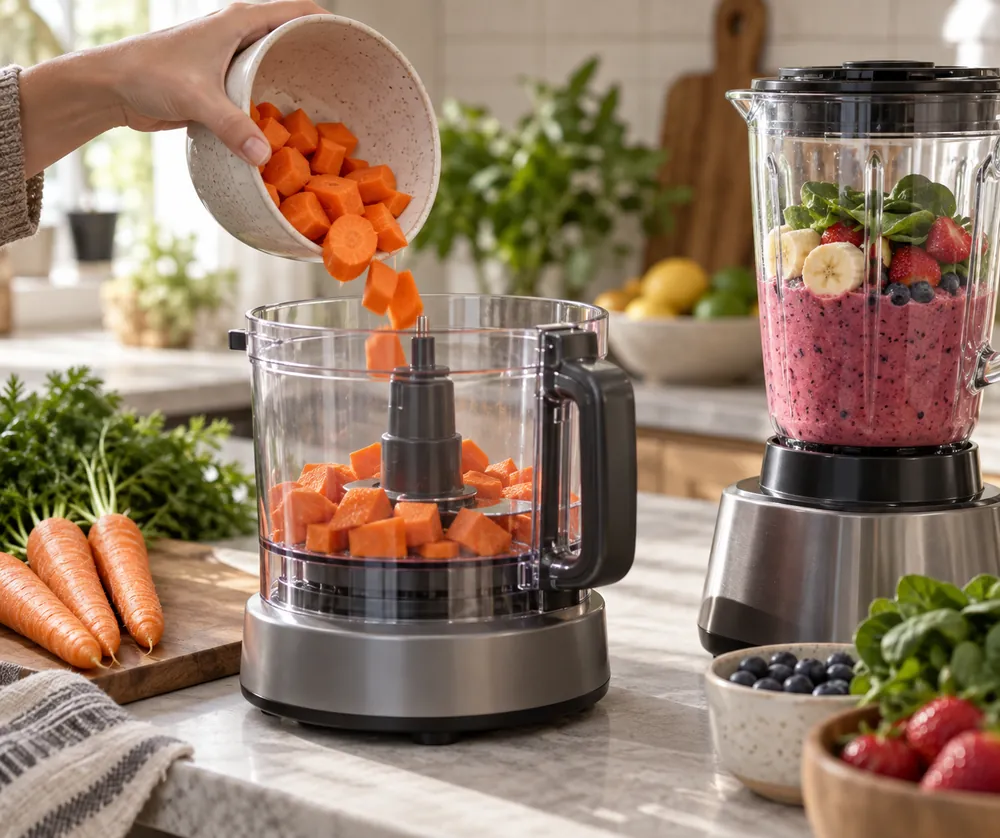
When a Food Processor Is the Better Tool
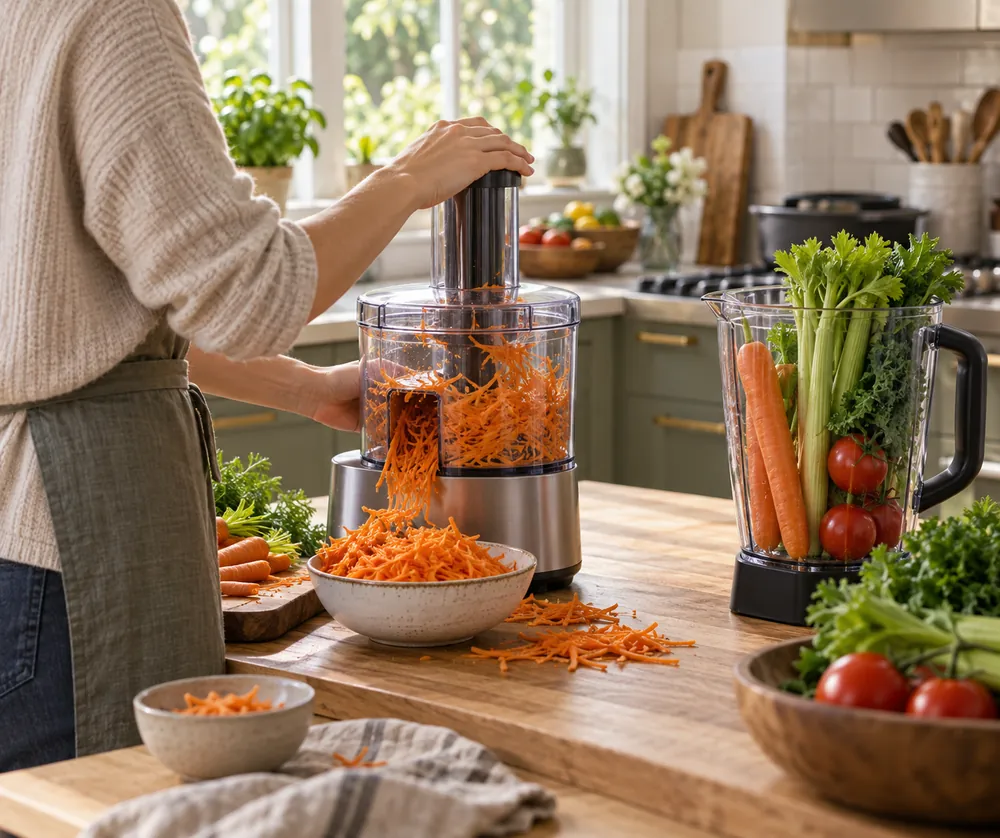
Chopped vegetables, shredded cheese, sliced potatoes, and pie dough point toward a food processor. A blender is built around liquid movement, while a food processor is built around contact with a blade or disc across a wider work bowl.
Use a food processor when the job depends on shape, texture, or repeated knife work. Published specifications usually show wider bowls, feed tubes, and accessory discs, which matter more than peak blending speed for these tasks.
| Specification | Typical category range | Why it matters |
| Work bowl capacity | 3 to 16 cups | Small bowls suit dips and herbs; larger bowls suit cabbage, dough, and batch prep. |
| Motor power band | 250 to 1,200 watts | Higher ranges generally support denser loads, though blade design and gearing still matter. |
| Under-cabinet clearance | 15 to 18 inches | Taller lids and feed tubes can affect storage on a counter below wall cabinets. |
A processor is better for slicing because food moves through a feed tube against a disc.
That gives more consistent pieces than pulsing vegetables in a blender jar, where ingredients bounce, fall unevenly, and can turn wet at the bottom.
- Shredding: choose it for cheese, carrots, cabbage, potatoes, and firm vegetables.
- Slicing: choose it for cucumbers, onions, potatoes, zucchini, and apples.
- Chopping: choose it for salsa, mirepoix, nuts, herbs, and coarse vegetable prep.
- Dough: choose it for short mixing jobs, especially pastry and some pizza or flatbread doughs.
Food processors also handle thicker mixtures with less liquid. Hummus, pesto, nut-based sauces, date bars, and crumb crusts usually need scraping and folding more than vortex action, so the lower, wider bowl is an advantage.
| Food texture | Food processor advantage | Blender limitation |
| Dry to slightly moist | Chops, crumbles, slices, and shreds without requiring much added liquid. | May leave chunks above the blade or overprocess the bottom layer. |
| Thick paste | Allows scraping and pulsing for coarse or smooth textures. | Often needs added liquid to keep the vortex moving. |
| Firm pieces | Feed tube and discs control contact with the cutting surface. | Jar shape makes controlled slices and shreds impractical. |
Capacity is another reason to pick the processor. Common full-size bowls cover more prep volume than many blender jars, and the shape makes it easier to stop before ingredients become puree.
Pay attention to the accessories listed in the published specs. A chopping blade alone is useful, but reversible shredding discs, slicing discs, dough blades, and small-bowl inserts expand what the machine can do.
Skip the processor for hot soups, thin smoothies, and pourable sauces. Many food processor bowls are not designed for hot liquids, and their lids can leak when the contents are fluid and close to the fill line.
Choose a food processor when the result should look cut, shredded, sliced, crumbled, or folded together. Choose a blender when the result should pour, sip, or emulsify into a continuous liquid.
When a Blender Is the Better Tool
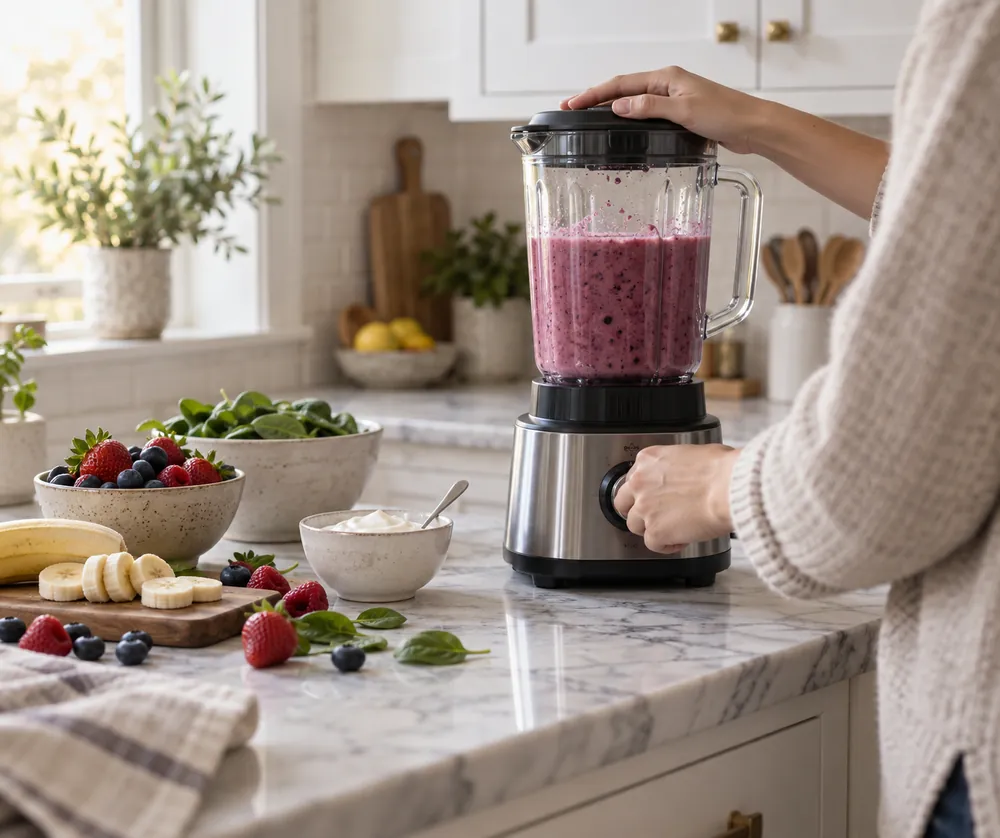
Smooth liquids, crushed ice, and pourable mixtures are where a blender earns its counter space. Its tall jar and fast blade pull ingredients into a vortex, which suits drinks, soups, sauces, and emulsions better than chopped prep work.
A blender is the stronger choice when the finished texture should be fluid, creamy, or drinkable.
Published specs usually emphasize motor power, jar capacity, blade design, and speed settings because those features affect circulation and consistency.
| Spec area | Typical range | Why it matters |
| Countertop blender capacity | 48-72 oz | Better for smoothies, frozen drinks, and soup batches. |
| Personal blender capacity | 14-32 oz | Fits single servings and smaller storage needs. |
| Common power band | 500-1,500 watts | Higher ranges usually handle ice and frozen fruit more confidently. |
Choose a blender over a food processor for smoothies, milkshakes, puréed soups, vinaigrettes, and thin sauces. A food processor can mix these, but its wider bowl often leaves more splatter and less consistent circulation.
- Frozen drinks: Blenders usually move ice and liquid together more efficiently.
- Hot soup purées: Venting lids and tall jars help manage steam, though manual instructions still matter.
- Nut-based sauces: High-speed blending can make cashew cream, pesto-style sauces, and dressings smoother.
- Protein shakes: Personal jars reduce cleanup and double as travel cups on many systems.
| Kitchen check | Typical range | Buying note |
| Under-cabinet clearance | 15-18 inches | Measure assembled height with the jar and lid attached. |
| Base width | 6-9 inches | Wider bases can feel steadier but take more counter space. |
A blender is not ideal for slicing onions, shredding cheese, kneading dough, or making uniform vegetable cuts. Those jobs favor a food processor because the bowl, feed tube, and discs are designed for controlled prep.
Use the blender when flow is the goal. Use the food processor when shape, size, or structure matters more than a perfectly smooth finish.
Where Their Jobs Overlap
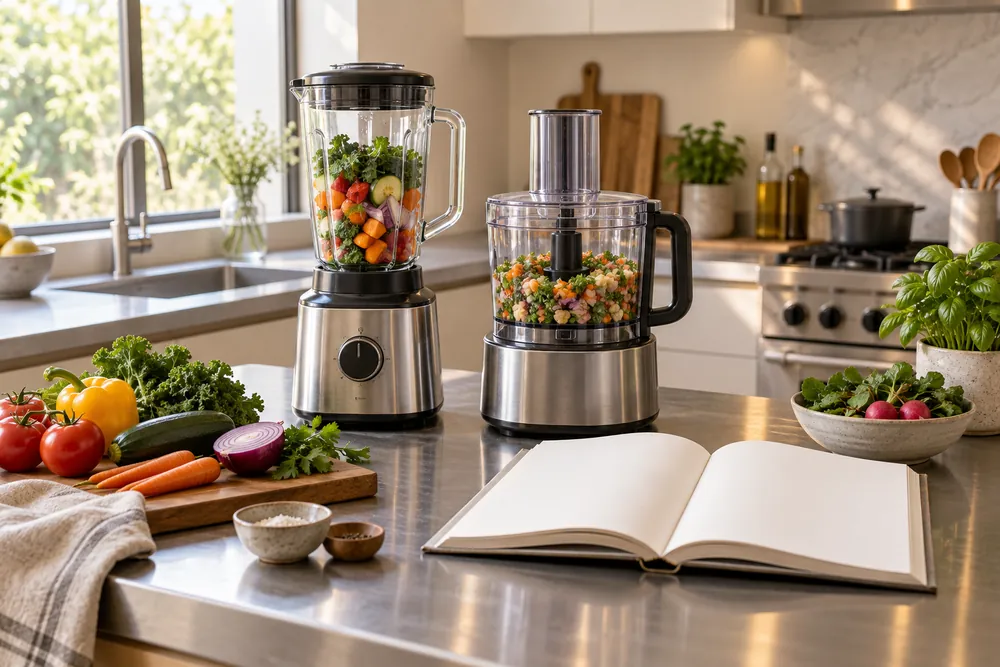
Chopping, blending, emulsifying, and pureeing can fall within either appliance’s job description.
The better choice depends on the texture you want, the batch size, and whether the recipe needs a wide work bowl or a narrow container that keeps ingredients moving.
Both machines can turn cooked vegetables into soup, combine ingredients for sauces, and process soft foods for dips.
A blender generally favors smooth results, while a food processor offers more control over chopped, grated, sliced, or coarsely pureed textures.
Shared tasks, different finishes
- Soups and sauces: A blender usually creates the silkiest finish, especially with enough liquid. A food processor can handle thicker mixtures but may leave more texture.
- Dips and spreads: Either appliance works for hummus, pesto, salsa, and bean dips. The processor’s broad bowl often makes scraping and adding ingredients easier.
- Frozen mixtures: Both can process frozen fruit, but performance depends on blade design, motor capability, liquid, and the manufacturer’s instructions.
- Small prep jobs: A personal-size blender may suit a single smoothie, while a processor’s attachments make it more useful for vegetables, cheese, and dough.
Published specifications also reveal a practical overlap in capacity. Category ranges vary by design, but these bands help frame whether an appliance is intended for a single serving, a family recipe, or larger batch preparation.
| Category | Typical capacity range | Best fit |
| Personal blender | 12–24 fluid ounces | Single drinks and small portions |
| Countertop blender | 48–72 fluid ounces | Drinks, soups, and sauces |
| Compact food processor | 3–7 cups | Small prep and dips |
| Full-size food processor | 9–14 cups | Family batches and prep work |
Power and workflow matter
Wattage is not a complete performance rating, but published ranges offer a useful starting point. Blade shape, speed control, torque, container geometry, and pulse functions can matter as much as the headline power figure.
| Appliance category | Common published wattage range | Typical advantage |
| Personal blender | 300–900 watts | Fast single-portion blending |
| Countertop blender | 500–1,500 watts | Smooth liquids and frozen mixtures |
| Food processor | 400–1,200 watts | Chopping, slicing, shredding, and thick mixtures |
Choose the blender when smoothness and pourable consistency are the priority. Choose the food processor when ingredient texture, batch preparation, or interchangeable discs matters more than completely uniform blending.
For a kitchen that uses both, avoid buying two appliances with identical strengths. Pair a blender suited to liquids with a processor that adds slicing, shredding, chopping, or dough capability.
What Buyers Notice Once It Is Installed
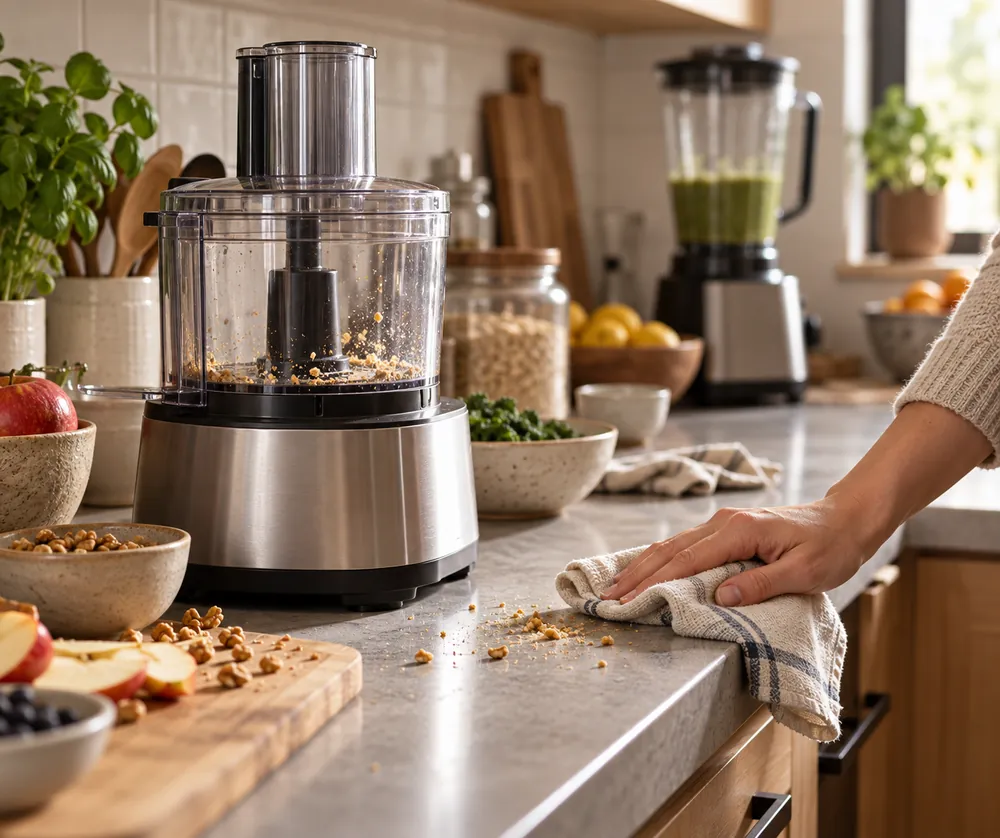
Counter space becomes the first everyday difference buyers mention after setup. Owner reports often praise blenders for staying ready near the outlet, while food processors draw more comments about bowl, lid, blade, and disc storage.
Manufacturer documentation also shows why the two feel different after purchase.
Blenders usually center on liquid capacity and motor base footprint, while food processors add more removable parts that need organized cabinet or drawer space.
| Appliance | Common capacity band | Usual wattage band | Typical clearance concern |
| Food processor | 7-14 cups | 450-1,200 watts | About 15-18 inches under upper cabinets |
| Blender | 48-72 ounces | 500-1,500 watts | About 17-20 inches with jar and lid |
The complaint that recurs most is cleaning. Owners commonly say blender jars rinse quickly after smoothies, but sticky nut butters, thick sauces, and gasket areas take more effort.
Food processor complaints are more often about crevices, feed tubes, locking tabs, and sharp discs.
Manufacturer manuals usually require careful hand placement and warn against handling blades casually, which matches owner comments about cleanup feeling slower than expected.
- What holds up: motor bases, simple controls, and sealed buttons receive the most durable-owner praise when used within the documented duty limits.
- What fails early: plastic lids, locking mechanisms, gaskets, and small accessory parts draw more frequent complaints than the motors.
- What disappoints: buyers often expect one appliance to replace the other, then find texture and batch size limit that idea.
Blenders earn better owner feedback for daily drinks, soups, and emulsions because the jar shape pulls liquids into the blades.
Food processors earn stronger comments for chopping, slicing, shredding, and dough work because the wide bowl reduces overprocessing.
Noise is another repeated post-installation issue, though published specifications rarely make it easy to compare.
Owner reports describe both as loud, with high-power blenders feeling sharper during frozen drinks and processors sounding rougher during dense chopping.
Long-term satisfaction usually follows the job match. Buyers who choose a blender for liquids and a food processor for prep report fewer regrets than buyers trying to make one machine cover every task.
How to Choose Based on What You Cook
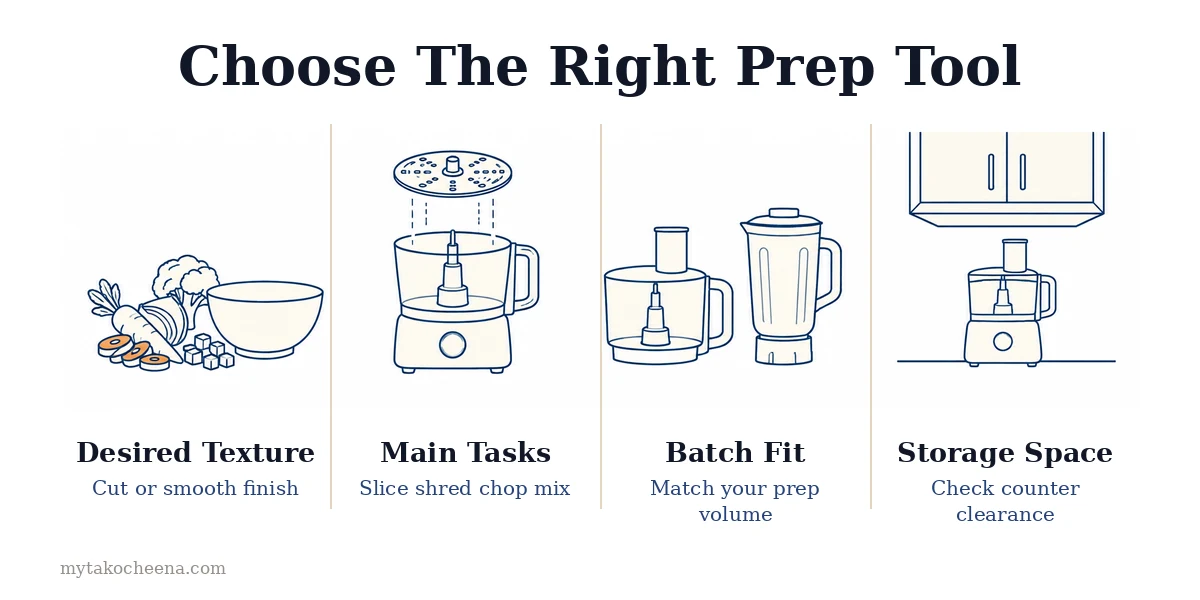
Recipes should drive the choice, not counter appeal. A food processor handles prep that starts dry, firm, or chunky, while a blender handles mixtures that need liquid movement and a smooth pour.
Match the machine to the texture
Choose a food processor for chopping, slicing, shredding, grating, kneading, and coarse mixing. Its wide bowl gives ingredients room to move without needing much liquid.
Choose a blender for smoothies, soups, sauces, frozen drinks, and emulsions. Its tall jar and blade vortex work best when liquid can circulate from top to bottom.
| Category | Typical capacity band | Usual wattage band |
| Food processor | 7-14 cups | 400-1,200 watts |
| Countertop blender | 48-72 ounces | 500-1,500 watts |
Use your weekly menu as the filter
- Meal prep: Pick a food processor for cabbage, onions, carrots, cheese, pie dough, hummus, and batch chopping.
- Breakfast drinks: Pick a blender for smoothies, protein shakes, frozen fruit, nut milk, and ice-based drinks.
- Family dinners: Pick a food processor for slaws, salsa, shredded vegetables, breadcrumbs, and dough starters.
- Silky textures: Pick a blender for creamy soups, thin sauces, dressings, and purées that need a pourable finish.
Storage also matters because both appliances compete for cabinet and counter space. Published dimensions vary, so compare height against the space under your upper cabinets before buying.
| Fit factor | Common range | Why it matters |
| Under-cabinet clearance | 15-18 inches | Tall blender jars may not store assembled. |
| Food processor bowl size | 7-14 cups | Larger bowls suit batch prep but take more storage space. |
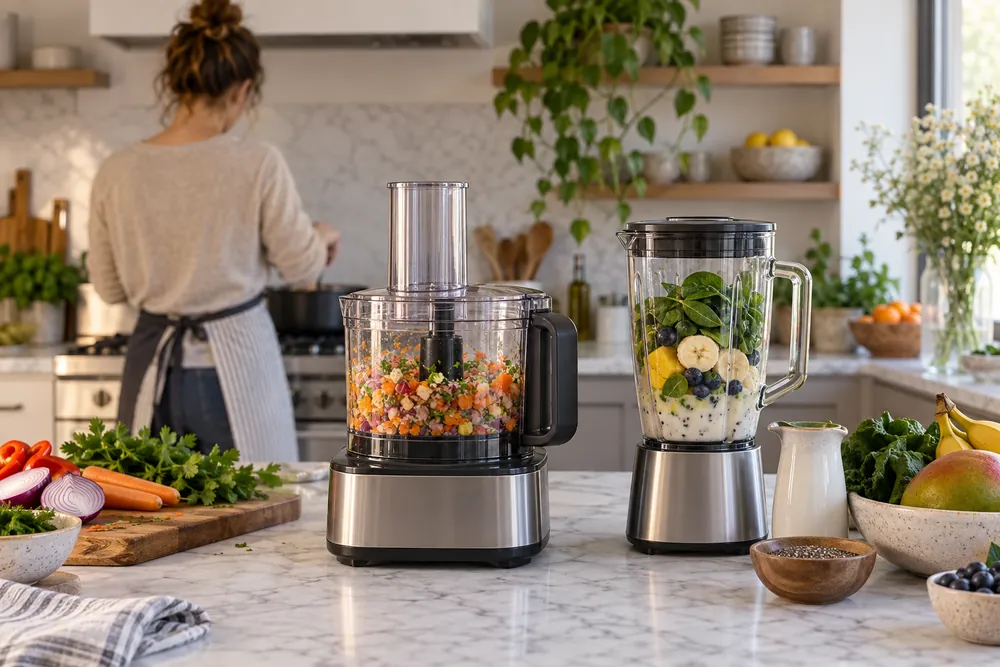
A small kitchen may favor the appliance used several times a week. For mixed cooking, many households keep both: the processor for prep work, the blender for liquids and smooth results.
Frequently Asked Questions
Food processor and blender questions usually come down to texture, container shape, and motor load.
Use the answers below to match published specifications with everyday jobs like chopping vegetables, blending smoothies, shredding cheese, and making sauces.
Is a food processor better than a blender?
A food processor is better for dry, chunky, or prep-heavy tasks. It uses a wide bowl and interchangeable blades to chop, slice, shred, knead, and pulse ingredients without needing much liquid.
A blender is better for smooth, pourable results. Its tall jar and lower blade vortex pull liquids downward, which helps with smoothies, soups, sauces, and frozen drinks.
What can a blender do that a food processor cannot?
A blender usually makes smoother textures because it is designed to circulate liquid around fast blades. That matters for drinkable smoothies, emulsified dressings, puréed soups, and nut-milk-style blends.
| Category | Common capacity range | Usual wattage band |
| Full-size blender | 48-72 oz jar | 500-1,500 watts |
| Food processor | 7-14 cup bowl | 450-1,200 watts |
| Mini chopper | 3-5 cup bowl | 200-400 watts |
Can I use a blender instead of a food processor?
Yes, but only for some jobs. A blender can handle sauces, dips, purées, and some batters, especially when there is enough liquid to keep ingredients moving.
It is weaker for even chopping, shredding, slicing, and dough mixing. You may need to stop often, scrape the jar, and work in smaller batches.
Can I use a food processor instead of a blender?
Yes, for thicker dips, pesto, salsa, hummus, pie dough, and chopped mixtures. The wide bowl makes it easier to control texture with short pulses.
It is not the best choice for very smooth drinks. Thin liquids can splash or leak near the bowl seal, depending on the design and fill line.
Which is better for smoothies, a food processor or blender?
A blender is the better pick for smoothies. Published specs usually show taller jars, tighter blade zones, and speed settings aimed at pulling fruit, ice, yogurt, and liquid into a continuous vortex.
A food processor can break down soft fruit, but the texture is often thicker and less uniform. It also handles liquid less gracefully than a blender jar.
Which is better for chopping vegetables?
A food processor is usually better for chopping vegetables because the bowl is wide and the pulse control is practical. It can process onions, carrots, celery, cabbage, and herbs without requiring much liquid.
| Task | Better choice | Why it fits |
| Chopping vegetables | Food processor | Wide bowl and pulse control |
| Crushing ice drinks | Blender | Liquid vortex and tall jar |
| Shredding cheese | Food processor | Shredding disc support |
| Smooth soup | Blender | Finer purée texture |
Do I need both a food processor and a blender?
You need both if you regularly prep vegetables and make smooth drinks or soups. They overlap, but their shapes solve different problems.
Choose one first based on your highest-volume task:
- Pick a blender for smoothies, shakes, frozen drinks, and purées.
- Pick a food processor for chopping, slicing, shredding, dough, and meal prep.
What size food processor or blender should I buy?
Buy capacity around the batches you actually make, not the largest number on the box. Small households often do well with compact jars or bowls, while batch cooking benefits from larger listed capacity.
| Appliance type | Small range | Large range |
| Blender jar | 24-40 oz | 48-72 oz |
| Food processor bowl | 3-7 cups | 9-14 cups |