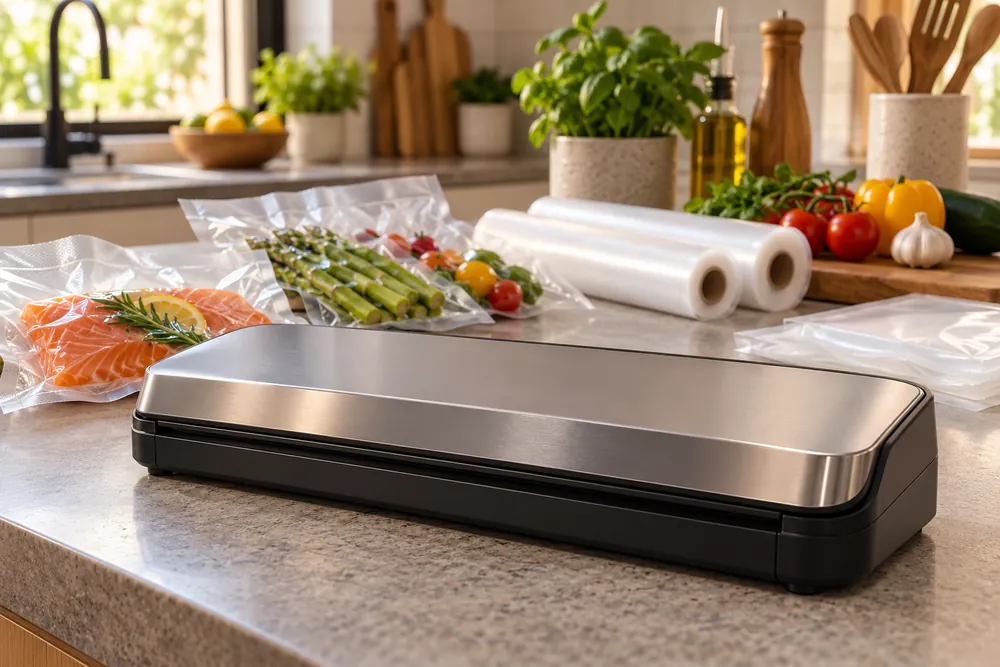
In short: A vacuum sealer removes air from specially designed bags and seals food inside them, helping reduce freezer burn and extend refrigerated or frozen storage.
The best choice depends on how often you seal food, the foods you store, available counter space, accessory compatibility, sealing controls, cleanup, and the cost and availability of replacement bags or rolls.
How Vacuum Sealers Work
Vacuum sealers remove air from a bag or container, then close the opening with a heated seal. The lower-oxygen environment slows oxidation, freezer burn, and moisture loss, but it does not replace refrigeration or safe food handling.
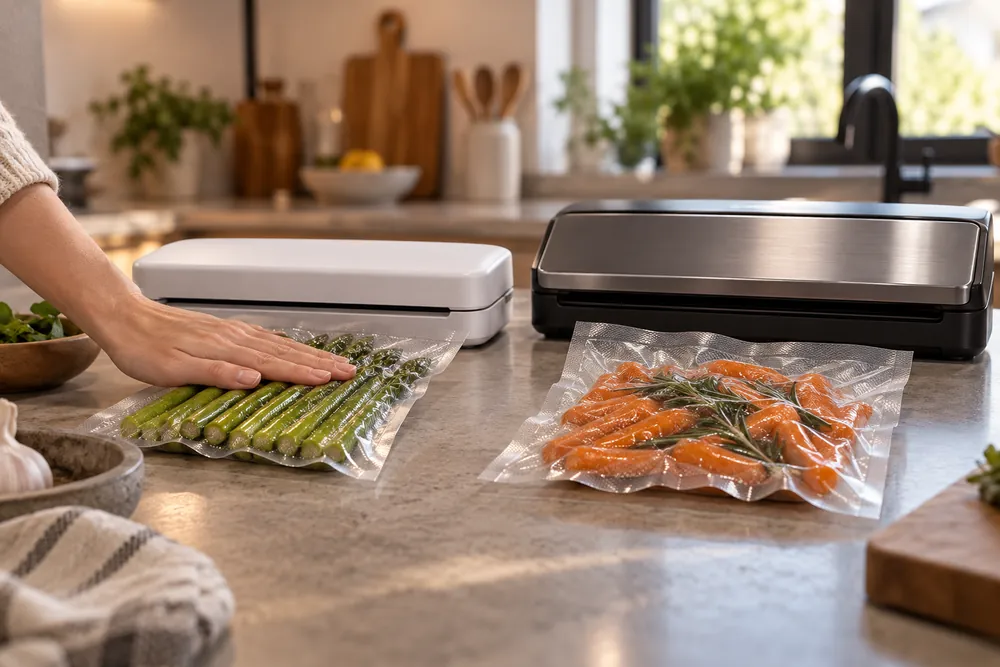
External suction models place the bag opening in a lid-mounted channel. The pump draws air through the open end, and a heat strip bonds the layers after reaching the selected vacuum level.
External Suction Versus Chamber Systems
| System | Typical operating range | Best use | Main trade-off |
| External suction | About 80–150 watts | Dry foods, portions, freezer storage | Liquid can enter the pump |
| Chamber | About 300–1,000 watts | Soups, marinades, commercial-style packing | Higher cost and larger footprint |
Chamber machines place the entire bag inside a sealed compartment. Pressure drops before sealing, reducing the chance that liquids boil out or enter the pump. Their size and cost make them less practical for occasional household use.
External models cost less and store more easily, but wet foods need preparation. Chilling sauces or briefly freezing soft foods can reduce liquid movement during suction.
What the Sealing Cycle Controls
- Vacuum strength: Stronger suction can compress bread, bruise berries, or deform delicate foods, so adjustable settings are useful.
- Seal time: Thicker, textured, or reusable bags may need a longer heat cycle than smooth standard bags.
- Pulse mode: Manual pulsing helps stop suction before fragile food is crushed or liquid reaches the channel.
- Seal width: A wider seal can provide added tolerance against small wrinkles, but it may use more bag material.
Temperature and Storage Limits
| Use | Common range | Why it matters |
| Refrigerated storage | About 34–40°F | Helps limit bacterial growth |
| Freezer storage | About 0°F to 10°F | Reduces air exposure and freezer burn |
| Sous vide cooking | About 130–185°F | Requires heat-safe, sealed bags |
Compare compatible bag materials, maximum bag width, a removable drip tray, and seal-bar cleaning access. These features often matter more for daily convenience than peak suction claims.
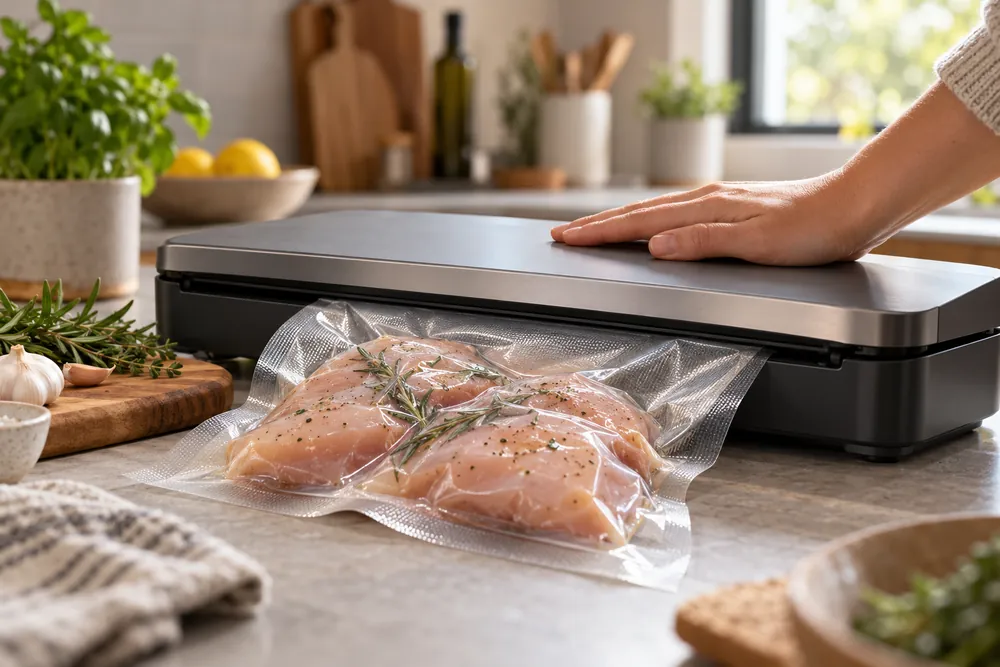
The Main Types of Vacuum Sealers
Vacuum sealers fall into three categories: external suction, handheld, and chamber machines. The right type depends on how often you seal food, your bag preferences, and whether you need to package liquids or large portions.
External suction sealers are the countertop choice. They pull air from a textured bag, then heat-seal the open edge, making them suitable for everyday freezer storage, pantry ingredients, and portioned meat.
External Suction Sealers
This format offers a useful balance of cost, storage space, and automation. Look for controls for vacuum-only, seal-only, pulse, and moist-food settings, since delicate foods can crush before the bag closes.
| Specification | Common range or feature | What it means |
| Countertop footprint | About 14–20 inches wide | Measure cabinet or drawer space before buying |
| Motor power | About 100–200 watts | Higher power may support repeated sealing, but does not guarantee a stronger seal |
| Bag format | Textured rolls or pre-cut bags | Requires bags with an air channel for suction |
Handheld Vacuum Sealers
Handheld units are compact and convenient for jars, containers, and zip-top vacuum bags designed with a valve. They remove less air than countertop machines and may require holding the unit in place.
Choose this type for occasional use, limited storage, or foods that remain in reusable containers. Check whether the package includes compatible containers or the sealer, because valve systems are not universally interchangeable.
Chamber Vacuum Sealers
Chamber machines place the bag inside a sealed compartment. The chamber and bag depressurize together, so liquids can be sealed with less risk of being pulled into the pump.
| Specification | Common range or feature | Buying implication |
| Chamber depth | About 3–6 inches | Deeper chambers handle thicker portions and larger pouches |
| Bag capacity | About 8–12 inches across | Confirm the usable seal-bar width for your meal sizes |
| Typical placement | Dedicated countertop space | Heavier construction makes frequent moving inconvenient |
Chamber models cost more and occupy more space, but they can produce consistent seals with smooth chamber bags.
They suit bulk food preparation, sous vide portions, soups, marinades, and frequent sealing better than casual household use.
How to Choose Between Them
- Pick an external suction sealer for general freezer and pantry organization.
- Choose a handheld model for occasional sealing and container storage.
- Choose a chamber model when liquids, bulk portions, or repeated daily use matter most.
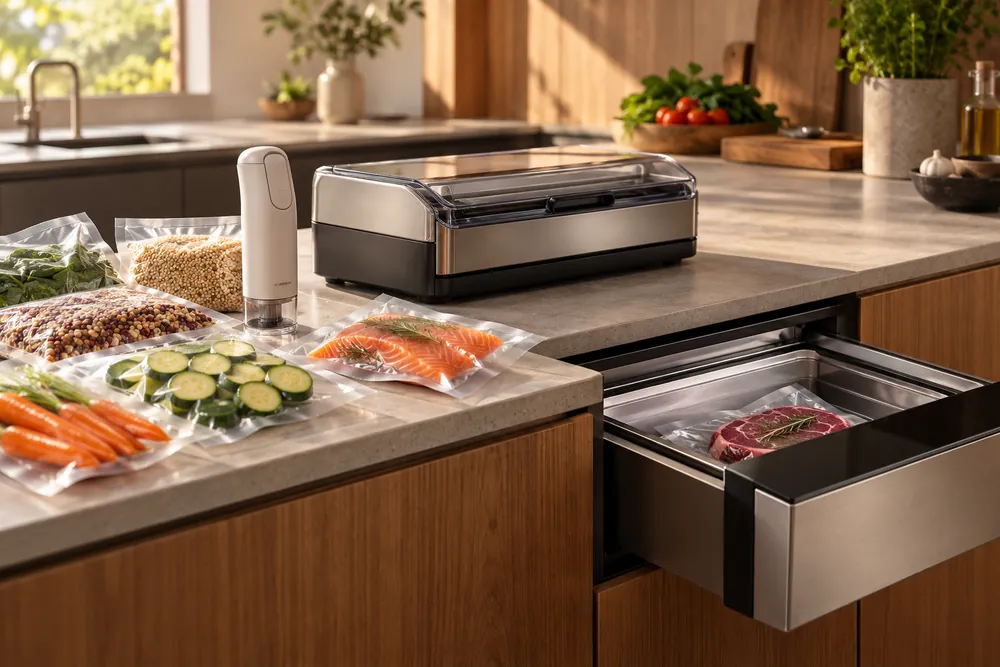
Features That Matter When Comparing Models
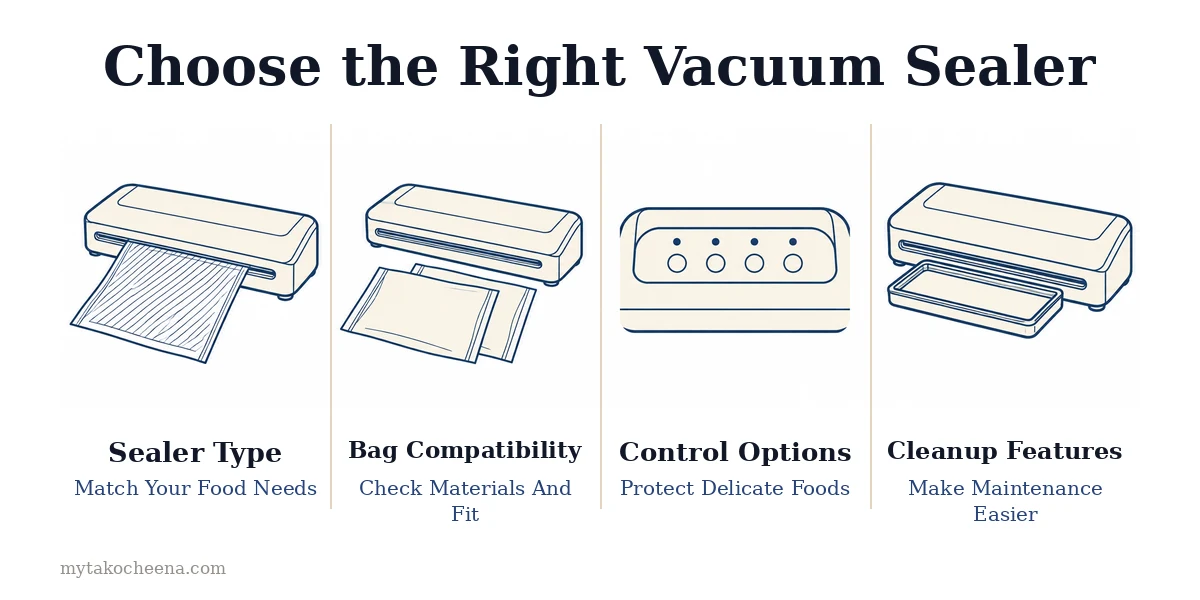
Seal quality, control options, bag compatibility, and cleanup requirements separate a convenient vacuum sealer from a frustrating one.
Compare specifications with owner reports, because more features do not always mean better everyday performance.
Pump and sealing performance: Look for adjustable vacuum strength when sealing delicate foods, liquids, or sharp-edged foods.
Pulse mode provides more control than an automatic cycle, while a removable drip tray simplifies cleanup after sealing moist ingredients.
| Feature | Common range or category | What the difference means |
| Sealing-bar width | Approximately 10–12 inches | Wider bars accommodate larger bags, but require more counter space. |
| Typical household power draw | Approximately 100–250 watts | Higher draw may support faster operation, but does not guarantee a stronger seal. |
| Vacuum-bag storage temperature | Approximately 0–220°F | Confirm whether bags suit freezer, refrigerator, boiling-water, or sous vide use. |
| Continuous sealing capacity | Approximately 5–30 bags per session | Higher capacity matters for bulk food preparation and large households. |
Check whether the sealer accepts generic textured rolls or only proprietary bags. Generic compatibility can lower costs, but bags still need the correct embossed surface and thickness for reliable air removal.
Storage design affects usage. An integrated roll holder and cutter reduce drawer clutter, while vertical storage preserves counter space in compact kitchens.
- Controls: Choose clearly labeled buttons, pulse operation, and separate seal-only control.
- Maintenance: Prefer accessible gaskets, a removable tray, and replacement parts listed by the manufacturer.
- Safety: Look for overheating protection and instructions covering liquids, sharp foods, and uninterrupted sealing.
Noise and cycle speed are practical trade-offs. Published decibel ratings help when available, but owner reports can reveal whether the pump sounds disruptive during repeated batches.
Review the warranty, return policy, included accessories, and bag availability before comparing headline features.
A simpler sealer with dependable consumables may provide better value than a feature-heavy model that is difficult to maintain.
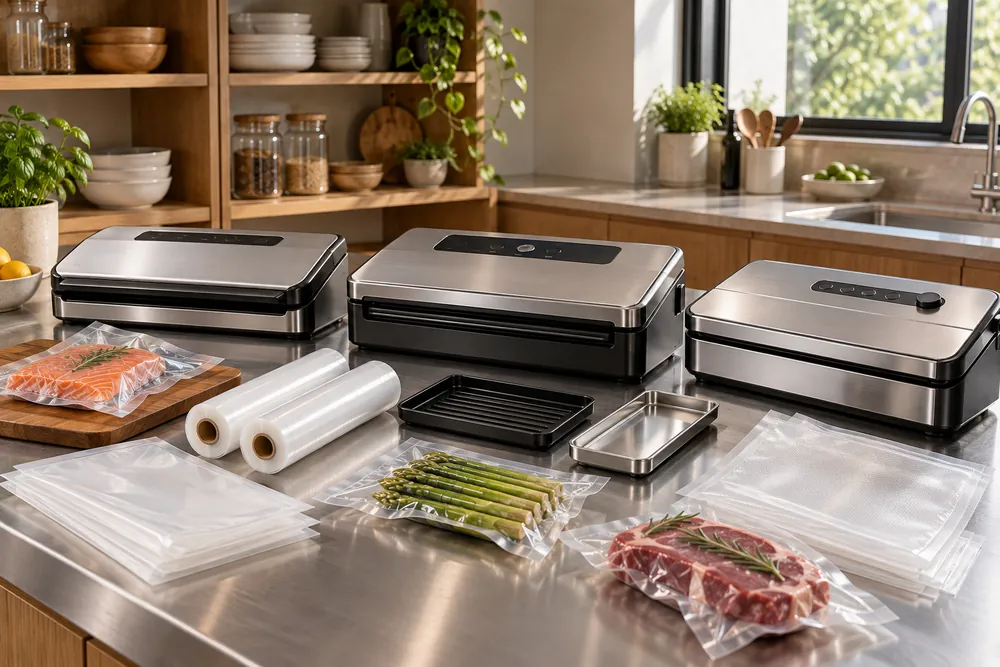
Choosing a Sealer for Different Foods and Storage Habits
Food type, freezer space, and how often you reseal packages should guide the choice more than exterior design. Compare sealing modes, bag compatibility, and storage limits before paying for extra features.
Dry pantry foods usually need a dependable heat seal and an easy way to cut custom bags. Flour, grains, coffee, and snacks benefit from adjustable bag lengths because portion sizes vary.
Moist foods require stronger control. Soup, marinades, and fresh produce can send liquid toward the seal bar, so look for a pulse setting, removable drip area, or separate container mode.
| Use case | Category-level range | Buying implication |
| Freezer storage | 0°F to -10°F | Choose thick, freezer-rated bags and durable seals |
| Refrigerated storage | 34°F to 40°F | Prioritize leak control and easy portioning |
| Low-temperature cooking | 120°F to 185°F | Verify heat-safe bags and reliable seam strength |
Frequent freezer users should favor wider sealing capacity, replaceable gaskets, and controls that tolerate repeated cycles. Occasional users may prefer compact storage and simple operation over automatic settings.
Counter space also affects the decision. Measure the intended location, including room for the bag roll and lid clearance, rather than relying on the appliance footprint alone.
| Specification | Usual category range | Why it matters |
| Sealing width | 8 to 12 inches | Determines compatible bag sizes |
| Typical appliance depth | 4 to 16 inches | Affects cabinet and counter storage |
| Typical motor draw | 80 to 200 watts | Provides a broad efficiency comparison |
Choose external-canister compatibility for jars or delicate foods, and prioritize a manual stop button for fragile items.
Before buying, confirm replacement bag availability, cleaning access, warranty coverage, and owner reports about seal consistency.
Start by measuring the usable counter width, then add clearance for opening the lid without hitting cabinets or shelves.
Check the depth from the wall to the counter edge, and leave space behind the unit if its cord or controls need access.
Measure the height of the lowest cabinet above the intended spot, especially if the sealer will stay out between uses.
A compact footprint may still be inconvenient when the lid rises, the bag roll sits nearby, or a container must be connected.
Use the tape measure again inside the freezer. A sealer that fits neatly on the counter can create oversized packages that waste shelf space.
Compare the bag widths you expect to use with the freezer’s shelves, drawers, and door openings.
Finally, mark a temporary work zone with painter’s tape. Include room for loading food, trimming bags, and setting sealed portions aside.
If that area blocks a sink, cooktop, or frequently used drawer, a simpler model that stores easily may suit the kitchen better.
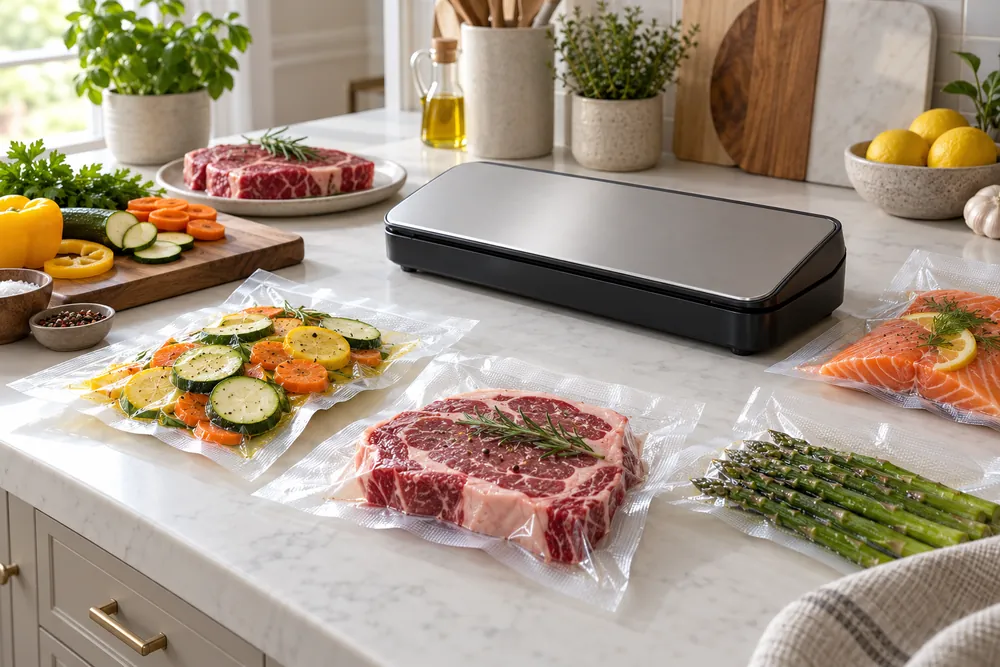
Bags, Rolls, Containers, and Ongoing Costs
Consumables often determine whether a vacuum sealer remains convenient after purchase. Compare bag formats, roll storage, container compatibility, and replacement costs alongside sealing performance.
Specifications show useful category ranges, but compatibility varies by brand. Check the opening width, accessory port, and approved bag material before assuming generic accessories will work.
Choose bags for routine portions
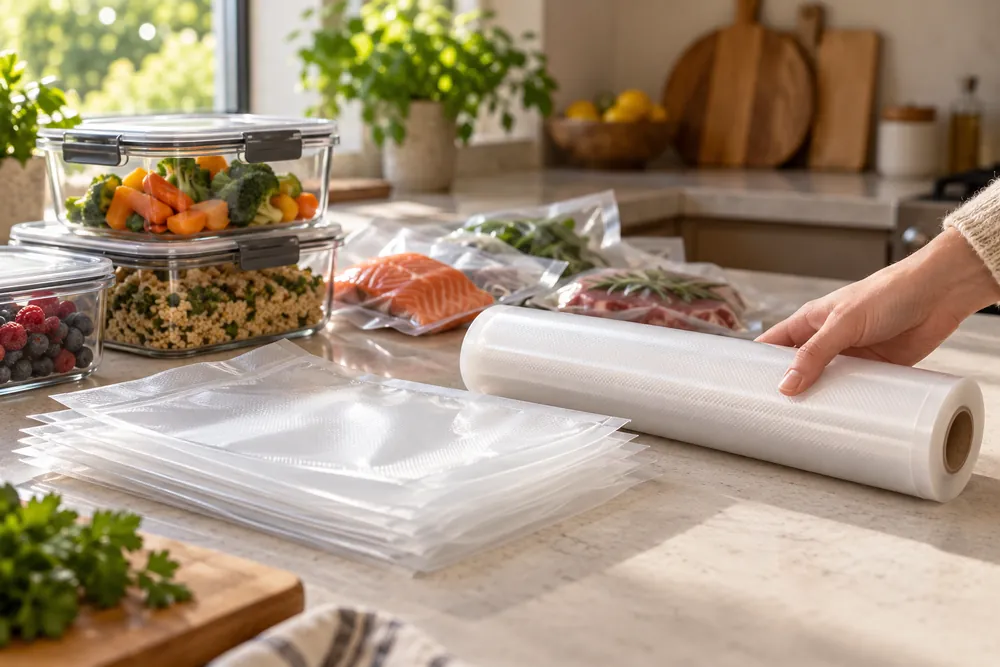
Precut bags speed meal preparation because each piece is ready to fill and seal. They suit uniform portions, but rolls reduce waste for long, irregular, or unusually shaped foods.
| Format | Typical category range | Best use |
| Precut bags | 8–12 inches wide | Consistent portions and quick packing |
| Rolls | 10–25 feet long | Custom bag lengths and varied foods |
| Canisters | 1–4 quarts | Soft foods, leftovers, and short-term storage |
Textured channel bags are generally required by external suction sealers because channels let air reach the pump. Smooth chamber-style bags may be cheaper in bulk but are not interchangeable.
Account for storage and workflow
A roll needs a cutting area and clearance near the sealer. A built-in cutter reduces handling, while a removable roll holder stores more easily in a crowded kitchen.
| Category | Common published range | Trade-off |
| Compact external sealer | 80–120 watts | Smaller footprint, narrower workflow |
| Full-size external sealer | 100–150 watts | More workspace, easier larger bags |
| Typical operating clearance | 4–8 inches above the unit | Needed for lid movement and bag handling |
Wattage is only a rough category signal, not proof of faster sealing. Pump design, seal-bar width, cooling, and duty-cycle limits can matter more during repeated batches.
Compare the continuing expense
Calculate cost per sealed bag rather than comparing package prices. Include usable roll length, discarded ends, failed seals, replacement gaskets, and container lids sold separately.
- Lowest waste: Rolls can match the food size closely, reducing unused plastic.
- Fastest preparation: Precut bags avoid measuring and cutting.
- Lowest recurring cost: Bulk-compatible bags may win, provided seals remain reliable.
- Best versatility: A container port helps protect delicate foods that would crush inside bags.
For frequent bulk cooking, select a format supporting affordable third-party bags and available rolls. For occasional use, simpler storage and dependable precut bags may outweigh small per-bag savings.
Where Buyer Reports Line Up and Where They Do Not
Owner reports and manufacturer documentation identify inconsistent sealing as the main problem, especially when users rush bag placement, leave moisture near the seal, or seal foods that are not dry solids.
Buyers generally value simple controls, available replacement bags, and dependable sealing. They differ more on noise, suction speed, and acceptable countertop space.
Where owners and documentation agree
- Moisture is the recurring trouble spot. Owner reports frequently mention liquid reaching the seal area, while manufacturer instructions recommend chilling, partially freezing, or using a moisture-friendly setting before sealing wet foods.
- Bag alignment matters. Users commonly describe weak seals after overfilling or placing the open edge unevenly. Documentation typically calls for a clean, flat section of bag inside the sealing channel.
- Consumables affect results. Buyers report better long-term consistency with bags that match the appliance’s recommended texture and thickness. Generic rolls can reduce cost, but owners often describe more adjustment and occasional seal failures.
| Specification | Typical range | Buying implication |
|---|---|---|
| Household bag widths | 8–12 inches | Check whether the sealer accepts the widths you store most often. |
| Vacuum-storage temperature guidance | About 0–40°F for frozen storage | Sealing does not replace safe refrigeration or freezing. |
| Countertop clearance depth | About 5–16 inches | Measure usable space, including room for the lid or roll holder. |
Where reports diverge
Noise is subjective: some owners accept loud, short cycles, while others prefer slower operation. Specifications rarely describe perceived sound during evacuation.
Durability reports vary. Owners cite pumps, sealing elements, latches, and controls, while others report problems caused by cleaning, overuse, unsuitable bags, or skipped cooling pauses.
Prioritize documented sealing controls, replacement parts, and moisture guidance over marketing language. Buyer reports matter most when they reveal repeated patterns rather than isolated opinions.
Frequently Asked Questions
Compare bag compatibility, controls, pump design, sealing width, storage, and cleanup before choosing a vacuum sealer.
What should I look for in a vacuum sealer?
Prioritize reliable sealing, a removable drip tray, clear controls, and standard embossed-bag compatibility. Adjustable suction and pulse control protect delicate foods and limit liquid entering the pump.
Are external suction or chamber vacuum sealers better?
External suction models suit most homes because they save space and use widely available textured bags. Chamber models handle liquids and smooth bags better but cost more and need additional space.
What foods should not be vacuum sealed?
Vacuum sealing does not replace safe refrigeration, freezing, or cooking. Avoid extended storage of raw mushrooms, soft cheeses, and garlic unless food-safety guidance supports it.
Cool cooked food promptly, never store vacuum-packed food at room temperature, and follow appliance and bag instructions.
How long does vacuum-sealed food last?
Storage life depends on freshness, temperature, packaging, and handling. Vacuum sealing reduces freezer burn and oxidation but does not make food shelf-stable.
| Storage location | Typical guidance | Important consideration |
| Refrigerator | About 1–2 weeks for some foods | Use conservative food-safety limits |
| Freezer | About 1–3 years for quality | Quality and safety depend on continuous freezing |
Can I vacuum seal liquids and wet foods?
Freeze soups, sauces, and marinades first, or choose a chamber model. Moist-food settings may not prevent liquids from reaching an external sealer’s pump.
Leave space at the bag opening and keep the sealing area dry. A removable drip tray simplifies cleanup.
What bag size and seal width should I choose?
Choose a sealing width that fits your portions without forcing bags across the appliance. Wider seals suit large packages; narrower units store more easily.
Check support for rolls, pre-cut bags, reusable containers, and third-party bags. External suction systems commonly require textured bags.
How much power does a home vacuum sealer use?
Power varies with pump design and sealing cycles. Higher wattage does not automatically mean stronger suction or better sealing.
| Specification | Typical category range | What it indicates |
| Rated power | About 100–150 watts | Electrical input during operation |
| Seal width | About 8–12 inches | Maximum bag width supported |
Is a vacuum sealer worth buying for occasional use?
It can support bulk groceries, freezer portions, sous vide cooking, and waste reduction. Occasional users should prioritize simple controls, compact storage, and affordable bags.